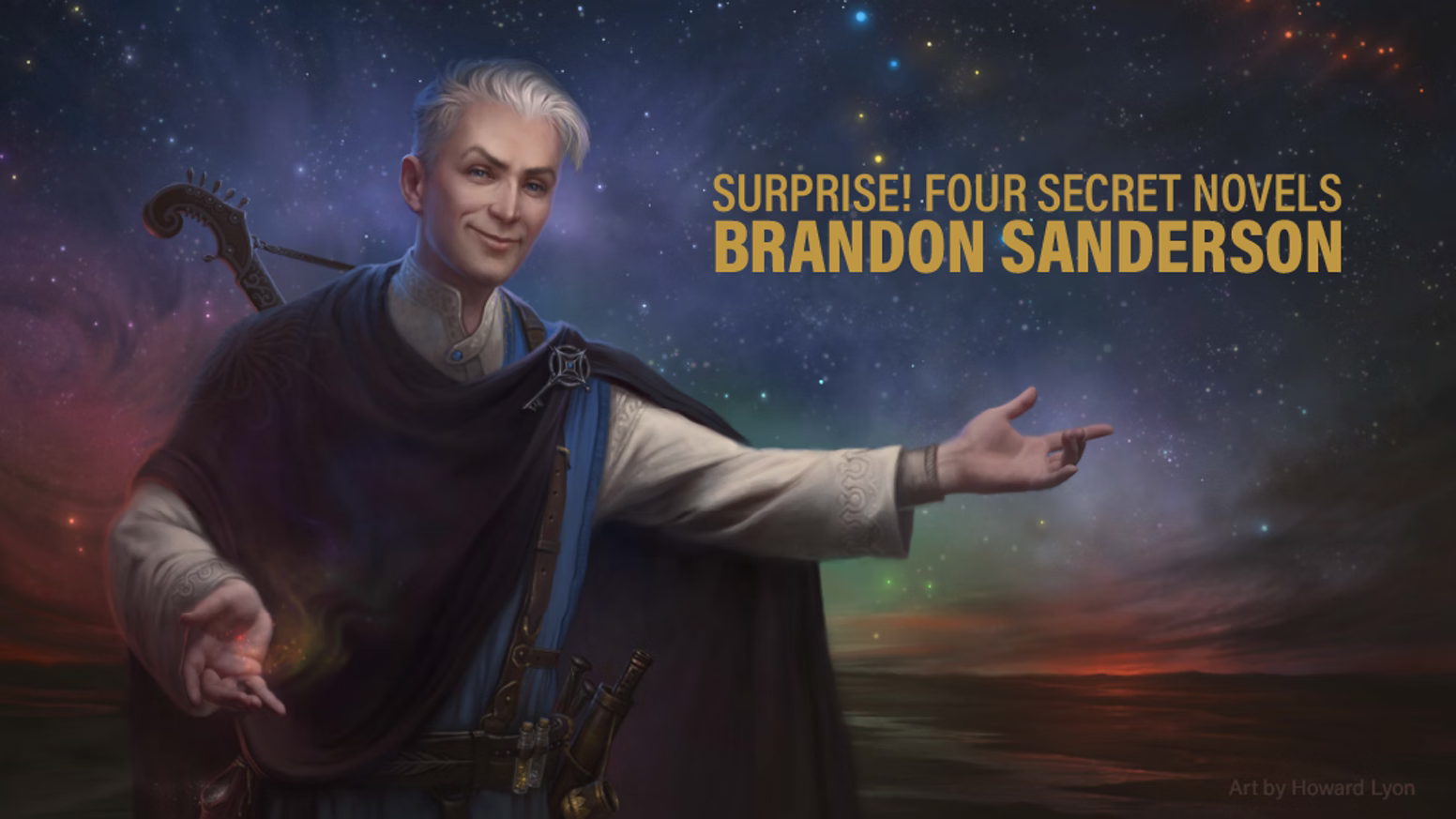
Showing posts with label the cosmere. Show all posts

Wednesday, 28 January 2026

Brandon Sanderson's COSMERE setting picked up for adaptation by Apple TV

Apple TV+ has closed an "unprecedented" deal to bring the Cosmere universe from American fantasy author Brandon Sanderson to the screen. Apple has apparently prioritised the deal and is planning to develop the Mistborn sequence for film and the Stormlight Archive series for television.


Sanderson's Cosmere setting is the home of almost all of his adult, original fantasy fiction. So far he has published seven novels in the Mistborn sequence (with at least six more planned), five in the Stormlight Archive series (with five more planned), and one each in the Elantris and Warbreaker series. He has also released the White Sand graphic novel trilogy in the setting, and the stand-alone novels The Sunlit Man, Isles of the Emberdark, Tress of the Emerald Sea and Yumi and the Nightmare Painter. A new standalone Cosmere novel, The Fires of December, will be published this year, and a further Mistborn trilogy is planned for release in 2028-30, before he resumes work on the Stormlight Archive. He also has a further trilogy, called Dragonsteel, planned, which will expand on the setting's expansive backstory. In addition to this he has a short story collection in the setting, Arcanum Unbounded, and several short stories and novellas published since. Sanderson has sold over 50 million copies of his books, and raised almost $100 million in crowdfunding projects related to the Cosmere setting, including the most successful project in Kickstarter history.

The Cosmere setting incorporates numerous planets, each with its own extensive worldbuilding, history, cast of characters and different magic system. These worlds are home to different types of magic, derived from different "shards." In the distant past, all the shards were united as one god or entity, but these were shattered by a catastrophic event. The various books explore what happens when the shards are destroyed or gain new owners, who become gods at the expense of their own souls.

The setting has been optioned for both film and television before, but budgetary concerns seem to have stymied producers on how to get them on screen. Sanderson also seemed to become wary of adaptations after working as an advisor on Amazon's Wheel of Time TV series (Sanderson co-wrote the final three novels in the Wheel of Time series after the original author Robert Jordan passed away, using Jordan's notes and outlines). Sanderson felt that the Wheel of Time TV series made too many unnecessary changes to Jordan's source material and lost a lot of the feel in the story in the process.

Sanderson's deal with Apple suggests he will be more closely involved in the process, and will have more approval over scripts and writing choices. He may also write some scripts himself, and will executive produce all the projects. This level of control is unusual, to say the least.

Apple have already put The Stormlight Archive into development, assigning production company Blue Marble (run by Theresa Kang) to make the project a priority. However, I'd be surprised to see anything on-screen this side of 2028 or, more likely, 2029.

Saturday, 4 January 2025

Wind and Truth by Brandon Sanderson

The war between the forces of Odium and those of the Knights Radiant has entered a dangerous new phase. Dalinar Kholin has negotiated a contest of champions, himself against Odium. Both sides have only ten days to seize as much territory as possible before this war will come to an end. But a devastating reversal has taken place which the Knights have no knowledge of: the shard of Odium has changed hands, and its new shardholder is a cannier, smarter foe far more willing to bend and flex than its former owner. From Shinovar in the west to the Shattered Plains in the east, the fate of Roshar, and perhaps the entire cosmere, hangs in the balance.


That sound you can hear right now is of reinforced bookshelf supports being delivered to hundreds of thousands of SFF fans across the globe. Bookshelves creak, strained by a weight they were never designed to hold. Yes, a new Stormlight Archive novel from Brandon Sanderson has arrived.

At 1,330 pages in hardcover and just a tad under half a million words by itself, Wind and Truth is the longest book in the series to date. It's also the most interesting. Whilst this is only the fifth of ten books in the series (and the seventeenth of potentially forty in the much wider Cosmere setting), it's the end of the first major story arc and has to "park" the various storylines for a planned ten-year timeskip before the sixth Stormlight book picks things back up. That book probably won't appear until the 2030s, with Sanderson committed to writing a new Mistborn trilogy and two sequels to Elantris before resuming this series.

In this sense Wind and Truth is Stormlight's equivalent to George R.R. Martin's A Storm of Swords, which also had to "park" a massive array of character and plot arcs in the Song of Ice and Fire series in preparation for a five-year timeskip which, in that case, never happened (and arguably caused problems that series is partially still confronting two and a half decades later, but that's a debate for elsewhere). It is a climax book that has to deliver massive payoffs and tee up the second half of the series but can't actually end the series.

In some senses it delivers: Wind and Truth is a massive countdown to a continent-shaking confrontation between Dalinar, the highly redoubtable, reformed war criminal turned leader of the resurrected Knights Radiant, and Odium, the principle force of evil on not just this planet, but the entire Cosmere setting. But, in arguably Sanderson's most satisfying plot twist to date, the previous incarnation of Odium was killed at the end of the prior novel, Rhythm of War, and replaced by what had appeared to have been a minor, sympathetic semi-antagonist up to that point, one with detailed knowledge of Dalinar and his allies. This creates a situation in which our heroes are fighting an enemy they literally know exists, and knows them better than they do themselves.

This results in Odium launching a complex, multi-pronged scheme to defeat and conquer as many of Dalinar's allies as possible, as fast as possible, and their increasingly desperate attempts to fend him off and survive until the deadline, with the slight problem that Dalinar still has no idea on how to actually win that confrontation when it arrives.

This structure gives us a ticking clock element, and four primary storylines that continue through the novel: Dalinar entering the Cognitive Realm to learn the deep backstory to the setting and figure out how Odium was defeated, or at least checkmated, in the past (with Shallan unwittingly tagging along); Kaladin and Szeth visiting Szeth's homeland of Shinovar to find out what's going on there; Adolin leading a desperate battle in western Roshar to fend off Odium's forces; and Sigzil and the rest of Kaladin's old Bridge Four unit leading a similar desperate battle in eastern Roshar. Characters like Lift, Wit/Hoid, Renarin and Rlain, Venli, Jasnah and Navani also have notable subplots.

This makes for a busy novel that - somewhat - justifies its yak-stunning length. This is an improvement over Oathbringer, which probably could have been reduced in length by half without losing anything too major, and Rhythm of War (aka Die Hard with a Sprengeance) which was not far off the same. Wind and Truth has a lot going on and Sanderson juggles it mostly quite well. That's not to say the novel doesn't occasionally feel indulgent: strategy meetings where characters debate the plot rather than getting on with the plot recall some of the sludgier moments of The Wheel of Time, and the elaborate Cognitive Realm TED Talks on Ancient Rosharan History start indulging in redundancy when we get to revisit the entire storyline a second time later in the novel, from a different POV.

The plots themselves also vary in quality. Kaladin and Szeth's trip around Shinovar feels like a different, almost completely self-contained novel, one that takes place in two time periods as we see both Szeth's flashback storyline and his present-day storyline, which are very similar and take place in many of the same locations (again causing a feeling of redundancy). The divorcing of their storyline from the rest of the novel makes it feel a bit disconnected, at least until the end makes its relevance clear. This storyline also drags, especially as Kaladin has been learning the art of therapy and gets to try out his various new learned techniques on Szath's numerous neuroses with all the enthusiasm (and ill-advised lack of forethought) of someone who's watched a few too many YouTube videos on mental health and not read enough deep studies or done enough actual studying. Prioritising mental health is a good thing, and that message in one of the biggest-selling modern fantasy series is laudable, but the emphasis placed on it sometimes feels incongruous, if not pace-killing.

Adolin's storyline is probably the most traditional hoo-rah epic fantasy one here, with lots of military planning, cool action sequences, epic battles and desperate fights for survival against overwhelming odds. This sequence is great (you can almost see an anime adaptation in your head as it goes on), but is potentially a bit overwrought by the time the battle has been going on for eight or nine days and eight or nine hundred pages.

Dalinar's storyline is the most important in the book, but also the vaguest. Much of his story has him viewing narrated histories about Roshar's deep past that you can almost imagine Ken Burns narrating, which is both catnip to lore...cats, but potentially boring to everyone else, so Sanderson interjects a lot of action by having Dalinar stalked by the mysterious Ghostbloods and having Shallan acting behind the scenes to stop them. A lot of this stuff is pretty good, but again you start to ponder if this could have been structured differently (especially when Dalinar gets to experience everything he's just seen again, but from a different point of view).

The final major storyline is the best-paced, with Sigzil and his team returning to visit the Shattered Plains (the evocative setting for the first book in the series, The Way of Kings) and getting embroiled in a humdinger of a complicated battle, which is further thrown for a loop by the arrival of a third side.

We flip between these storylines quite regularly, allowing all to be serviced on a frequent basis, although this can result in plot-whiplash as the reader is thrown from city to city to illusionary dream dimension to intense battle to tragic deaths to cutesy romantic exchanges and strained humour without much regard for tonal consistency.

The book is a lot even by the standards of the series so far, which can both breathlessly enjoyable but also frustrating, especially for those who find some storylines deeply engrossing and others much less so.

This is also the book which does feel like it breaks Sanderson's (already shaky) long-ago promise that readers would not have to have an in-depth knowledge of the entire Cosmere universe to enjoy any given series or even novel within it. We even spend brief parts of the book visiting Scadrial to set up the forthcoming Mistborn: Ghostbloods trilogy, and allusions to other books come thick and fast. At one point the book stops to give us a potted plot summary of Warbreaker (where the sword Nightblood first appeared), whilst one part of the ending exists to set up the events of the previously-published The Sunlit Man. This may be good from the point of view of the wider Cosmere setting, with Sanderson incorporating more elements into Stormlight that were originally planned for other books and series (thus reducing the total number of books he still has to write in the setting, which was starting to look a bit over-ambitious), but those Stormlight fans who weren't keen on Mistborn or his other works may be less happy about those wider setting elements colliding with Roshar here.

Of course, for those who love the interconnected elements of Sanderson's wider universe, this book will be outrageously enjoyable, satisfying, and prime Wiki-fodder.

Summarising a book of this breadth and heft is tricky, especially when you want to avoid "1990s flight sim expansion pack review syndrome" ("if you liked the last thing in the series, you'll like this too, I guess"). If you've read the previous books in the series, you're going to read this, and you'll have a good time; Sanderson sceptics will find little here to convince them otherwise. Wind & Truth (****) is better than the last two Stormlight books, but not as strong as The Way of Kings. Sanderson's weaknesses - a prosaic prose style, occasionally jarring use of modern language mixed in with more formal syntax, haphazard characterisation - are still present and correct, but his strengths are here as well: impressive worldbuilding, fascinating magic, explosive action sequences and satisfying moments of plot revelation and payoff. This novel also has an impressive amount of incident going on, paced surprisingly well for the book's staggering length. The book is available worldwide now.

Thank you for reading The Wertzone. To help me provide better content, please consider contributing to my Patreon page and other funding methods.

Friday, 1 April 2022

Brandon Sanderson scores the biggest Kickstarter of all time

A month after launching it, Brandon Sanderson has ended his latest Kickstarter on a stunning wave of success. The Kickstarter ended having raised $41,754,153, making it the most successful campaign of all time, bringing in more than twice the previous record: $20,338,986 for the Pebble smartwatch in 2015. The campaign brought in almost $10 million of that total in its last hour.

Sanderson launched the campaign after revealing that he had written five secret books whilst in lockdown in 2020 and 2021, taking advantage of the cancellation of his normally time-consuming touring schedule. Sanderson decided to put together an ambitious campaign consisting of limited editions of four of the books, loot bags and more bonuses to get the books out to fans (the fifth book is apparently going to be reworked into a graphic novel and will be handled later, separately).

The four books consist of three books in his Cosmere setting and a further book which is a complete stand-alone. The Cosmere books are Tress of the Emerald Sea, Yumi and the Nightmare Painter and The Sunlit Man, whilst the standalone is called The Frugal Wizard's Handbook for Surviving Medieval England.

This is in addition to Sanderson's other announced projects, such as the fifth Stormlight Archive novel which is due out in late 2023 or early 2024, and the next Mistborn novel, The Lost Metal, which is due later this year.

Sanderson's enormous Kickstarter success was made possible by a company he set up for the purposes of creating merchandise for fans. Other authors will no doubt be looking at this model to see if they can replicate its success, but I think it'll be a tall order.

Sanderson did "pay it forward" due to the overwhelming success of the Kickstarter, donating money to every currently-active literary Kickstarter to boost their profile as well.

Tuesday, 1 March 2022

Brandon Sanderson has a serious announcement to make

Brandon Sanderson has some important news. Please view the video below in full before proceeding past the break to the rest of the news. 


Sunday, 28 January 2018

Oathbringer by Brandon Sanderson

The world of Roshar stands in peril. The ancient, dark force of Odium has returned and the Voidbringer armies have come with him, subverting the parshmen, former slaves of humanity. Dalinar Kholin, the Blackthorn, one of the most feared warriors on the planet, finds himself tasked with leading the reformed Knights Radiant and uniting the world against this new threat. But to accomplish this he must overcome his own reputation as a bloodthirsty tyrant and make peace with his own, half-forgotten past.


Oathbringer, the third volume of The Stormlight Archive sequence, is a big book. At just under 500,000 words in length, it may be the second-longest epic fantasy novel ever written, behind only Tad Williams' To Green Angel Tower and significantly longer than The Lord of the Rings in its entirety. Clocking in at 1,250 pages of fairly small print, reading it is a mammoth undertaking. At regular points in the narrative the saying "journey before destination" is uttered by key characters, perhaps a message from the author to keep going and stay the course.

The Stormlight Archive is certainly Sanderson's most ambitious work to date - seven more books are planned in this series alone, and many more in the linked Cosmere universe - and also his most accomplished. Sanderson has always been a skilled worldbuilder, creator of magic systems and an eager student of epic fantasy, learning from other authors in the genre, but this series has also seen those areas where he was lacking in earlier works, such as nuanced characterisation and the depiction of a large and diverse cast of characters, step up a notch. This is a solid series, but it's also one that has often creaked under the weight of its own complexity, and Oathbringer is almost brought low by the weight of the material.

At its heart, Oathbringer is a simple story: Dalinar Kholin is, for lack of a better term, the Chosen One who must united the world against, an ancient returning evil. However, he is also tainted by his own past in which he was a warrior with a reputation for savagery and butchery. The challenge he faces in Oathbringer is dual-pronged. Externally, he must work to unify the kingdoms of Roshar against the renewed Voidbringer threat. Internally, he must overcome the demons of his past. This is complicated because he deliberately suppressed his past through magical means to remove the pain of an event involving his wife. This is - rather more literally than is normal - the traditional story of a protagonist going through self-realisation and healing a past wound in order to achieve a necessary goal in the story. Whilst traditional, it makes Dalinar a far more relatable figure (but not always a more sympathetic one: Sanderson does not absolve Dalinar of the horrible acts he committed whilst younger).

However, this simple story is almost drowned under pages and pages and chapters and chapters of "other stuff." Heralds. Knights Radiant. Voidbringers. Shadesmar. Spren. Stormsurging. Soulbinding. The Recreance (which is set up as A Major Revelation and turns out to be merely the characters of Roshar learning something that readers of the wider Cosmere series will already be aware of). The Diagram (an epic fantasy take on Isaac Asimov's Foundation). Magical talking swords that you need to have read a completely different book (Warbreaker) to fully understand. There is a lot of stuff going on in this book, often requiring pages and pages of exposition, but only some of it is really relevant to the plot at hand. By the time I finished Oathbringer I was feeling nostalgic for Steven Erikson's more opaque but far more successful approach to worldbuilding and magic systems (explain what's needed, just let other stuff that's not unfold in the background and move on).

There's also a great deal of repetition in the book. The first half of the novel, in particular, is slow-moving with constant and repetitive strategy meetings and characters meeting up to discuss the plot which they - and we - already know about. Aside from some surprising new information about the returned Voidbringers, relatively little in this section of the book justifies the immense word count it took to get there.


Fortunately, the second half moves a lot faster. We get two massive climactic battles in key locations and a trip to the Shadesmar dimension, which underpins not just Roshar in the Stormlight Archive but all the planets in the wider Cosmere, so getting to see it in more detail is interesting. This side-story is also relatively brief and constrained, feeling like a tighter self-contained novella within the larger novel. The Way of Kings and Words of Radiance both did this a lot, with what felt like short stories contained within the larger novel that were there to flesh out the world and backstory but be entertaining in their own right. Oathbringer does this comparatively rarely, and not as successfully.

The concluding battle and accompanying revelations is epic and well-handled (maybe a little too long with a few too many reversals of fortune, but still relatively brisk compared to the rest of the book). There's some firm new understandings of the world and the stakes involved in the struggle against Odium. But the overwhelming feeling is that we could have reached this conclusion far more quickly and far more concisely.

More problematic, there is a very strong echo of Sanderson's earlier Mistborn series in how this volume unfolds. That trilogy saw a group of young, inexperienced characters discovering amazing magical powers and coming to a firmer understanding of their nature and how to use them when they get involved in the ancient struggle between the godlike Shard-holders resulting from the Shattering of Adonalsium, with the mysterious Hoid popping up a couple of times to help them. This is pretty much exactly what happens in Oathbringer, with just the magic systems and the characters swapped around. This is exacerbated by the fact that at the very end of Oathbringer Sanderson has an opportunity to do a ninety-degree turn and take one character in a very different and far darker direction that would have been much more original and interesting, but ultimately chooses a more traditional resolution to that story which feels like a massive missed opportunity.

By the time I finished the book I felt conflicted. On the one hand, my admiration for Sanderson's worldbuilding, plot construction and his continuing self-analysis as a writer and his capacity for growth remained undimmed. Oathbringer explores some wider literary themes of compassion and forgiveness and does so quite well, and Sanderson is definitely getting better by book at handling character. Unfortunately, his dialogue is extremely variable sometimes far too modern and grating. The romance storyline is also massively under-developed, although given how weak it is this may be for the best. Sanderson's sense of humour is variable, with some of the supposed witty banter between characters coming off feeling forced and unconvincing. Other elements, such as the single-minded bloodthirsty nature of the sentient sword Nightblood, are more entertaining.

Ultimately, The Stormlight Archive cannot withstand comparisons with the most accomplished works in the epic fantasy genre that nod towards realism: A Song of Ice and Fire has far superior prose and characters (though, obviously, a lamentably poorer release schedule); Wheel of Time has, for all its insane length, a much clearer plot through-line that goes through the series and doesn't overburden the reader with too many magic systems and unnecessary backstory plot coupons; and The Malazan Book of the Fallen (of which Stormlight all too-often feels like a less sophisticated YA remix) deals with a lot of the same ideas and themes in a far more original, literary and interesting manner.

What Oathbringer (***½) does do really well is action, worldbuilding and magic on one of the most interesting worlds developed in epic fantasy. From that viewpoint Stormlight reads like a crazy anime series in prose form, complete with impractically massive but awesome swords, bonkers magic and a somewhat juvenile take on romance. If you can overlook the problems with the unnecessarily-padded length of the book, there's a lot of fun to be had in this world, but it's not one of the deepest fantasy series around. The novel is available now in the UK and USA.

Sunday, 6 August 2017

MISTBORN RPG video game cancelled

Video game studio Little Orbit have been working on a role-playing video game based on Brandon Sanderson's Mistborn novels for the past few years. Yesterday they confirmed that the project has been cancelled after a pair of publishing deals fell through.


Little Orbit announced the game as Mistborn: Birthright in 2012 and have spent five years developing a rule set and engine for the game. They took their time on the project, as Little Orbit is a relatively small company best-known for low-budget tie-ins with various properties but wanted to give this project more time and attention.

Unfortunately, Little Orbit appear to have been behind on the curve, preferring to work through publishers rather than releasing games directly to Steam or engaging in crowdfunding. When two publisher deals fell through in rapid succession, the company was forced to cancel the project and only barely survived folding altogether.

Although this is sad news, it does raise the intriguing possibility of a higher-profile company picking up the rights. The movie rights to the Mistborn series (as well as the rest of the Cosmere universe) were picked up a year ago and a writer was assigned to the first Mistborn movie back in January. If the film hits the big screen, expect to see renewed interest in the books and possible further spin-offs.

Wednesday, 21 December 2016

Brandon Sanderson update

Brandon Sanderson has issued his annual "State of the Sanderson", confirming what projects he will be working on in the coming year. On the Stormlight Reddit community, he has also issued a larger-scaled overview of his Cosmere mega-sequence and where he sees the series going.


For 2017, Sanderson will be releasing Oathbringer, the third Stormlight Archive novel, in November. The Lost Metal, the final Wax and Wayne novel set on the Mistborn world, will likely be released in 2018, alongside his next YA novel, The Apocalypse Guard. The second White Sand graphic novel will also likely appear in the next two years.

For the Cosmere overall, Sanderson envisages the story now encompassing the following series:

Elantris: A three-book series. Elantris itself was released in 2005 as Sanderson's first novel. Elantris II is on the horizon and getting closer, but is not imminent.

Mistborn: Originally a trilogy of trilogies, but expanded to 13 volumes with the addition of the Wax and Wayne sub-series. The first trilogy is done and Wax and Wayne will be done by the end of 2018. There will be two further trilogies. The first will be written in the gap between Stormlight Books 5 and 6, with the final set of three books acting as a capstone to the entire Cosmere mega-series.

Warbreaker: At least a duology. Warbreaker itself was released in 2009 but the sequel, Nightblood, which will bridge the first book and Stormlight Archive, is a long way off.

The Stormlight Archive: A 10-book series, unfolding in two five-volume halves. Books 1 and 2 are out and Book 3 will be out at the end of 2017.

White Sand: Originally planned as a trilogy, but now being released as a graphic novel trilogy instead, with Book 1 already out.

Dragonsteel: A planned 7-volume series which will explore the backstory of Hoid and the 17th Shard, the glue which holds the entire Cosmere together. However, Sanderson has indicated this series may be shrunk to 5 volumes and possibly just an ultra-focused trilogy. This will be the second-to-late Cosmere series, with only the last Mistborn trilogy to follow on from it.

Sanderson has also confirmed that he still plans to write and release Aether of Night and The Silence Divine (although one or both may be shrunk down to novellas), as well as a novel set on Threnody (the planet of the Shadows for Silence in the Forest of Hell novella) and possibly a novel sit in Silverlight (a city mentioned in Arcanum Unbounded, possibly a city-between-dimensions where worldhoppers can hang out, like Sigil from Planescape).

This puts the total Cosmere series at around 36 novels and three graphic novels.

Friday, 9 December 2016

Brandon Sanderson completes first draft of new STORMLIGHT ARCHIVE novel

Brandon Sanderson has completed the first draft of Oathbringer, the third novel in The Stormlight Archive sequence, following on from The Way of Kings (2010) and Words of Radiance (2014).


The novel will require extensive rewrites and editing before publication, which is currently scheduled for November 2017. The novel currently clocks in at 461,223 words, which is actually too large to be published in one volume. Sanderson anticipates the word count to come down in the edits, so the novel is reduced to something more easily publishable.

If the current word count stood, it would make Oathbringer one of the longest fantasy novels ever written, behind To Green Angel Tower by Tad Williams (520,000 words), Ash: A Secret History by Mary Gentle (493,000) and The Lord of the Rings by J.R.R. Tolkien (473,000) but ahead of A Storm of Swords by George R.R. Martin (424,000) and Sanderson's own Words of Radiance (just over 400,000).

Oathbringer is the third of ten planned novels in The Stormlight Archive sequence. Sanderson's original plan was to release the books at 18-month intervals, but the actual release dates are working out at between three and four years per book. If Sanderson is able to release each future book at precisely three-year intervals, that means that the series will not completed until 2038, or twenty-two years from now. However, it would be considerably longer than this since Sanderson plans to take a long break between Books 5 and 6 to write the Mistborn II trilogy, pushing the completion of the Stormlight series comfortably back into the 2040s.

It'll be interesting to see if Sanderson (who turns 41 next week) starts making the books shorter or reduces his other projects to get Stormlight done faster, or if he accepts that this is just how long the books are going to take.

The writing time of the Stormlight books may also become problematic if DMG Entertainment's planned film adaptation of Sanderson's Cosmere mega-series (which Stormlight is just one part of) is a big success and they want to start cranking the films out faster. But we'll see how that goes.

Thursday, 27 October 2016

Brandon Sanderson's COSMERE universe optioned for film

DMG Entertainment has optioned the film and TV rights to Brandon Sanderson's Cosmere universe, currently consisting of eleven novels, a graphic novel and six novellas and short stories. Sanderson projects that there will eventually be around forty novels set in this universe.


DMG Entertainment - more correctly, DMG Yinji - is a massive Chinese multimedia and film company, founded by Dan Mintz, Peter Xiao and Wu Bing. It has been the prime driver in localising American blockbusters for the domestic Chinese market, even co-producing special versions of films with Chinese-exclusive scenes or Chinese actors, such as Iron Man 3 and Looper. This has allowed DMG to commit $270 million to a production pot. These envisage this to cover 50% of the production costs of the first three films to be covered by the deal. Presumably they will be looking for international companies (probably American) to come on board to provide the other half of the budget.

The first two movies to go into production will be based on The Way of Kings, the first Stormlight Archive novel, and The Final Empire, the first Mistborn novel. It's unclear what the third will be, but potentially Elantris, Warbreaker, White Sand or a sequel to one of the movies. Sanderson has received a chunk of cash under the deal for the rights up-front, plus additional amounts from production and release, which will see a substantial payday for the author even if the films are not successful.

Patrick Melton and Marcus Dunstan, who have worked on Saw franchise, will be adapting The Way of Kings. The Final Empire doesn't have a screenwriter announced yet. DMG plan to fast-track both movies, suggesting we could see them in 3-4 years rather than the much larger lead time you'd expect from such a deal. However, that will likely depend on international production partners being found quickly. Given DMG's immense profile and reputation, that may not be too difficult.

Sanderson has so far sold over 10 million copies of his solo work (also including a large number of non-Cosmere novels for younger reachers, such as the Alcatraz and Rithmatist series) and reportedly more than 12 million copies of his three Wheel of Time novels (derived from Robert Jordan's notes after he passed away in 2007). The Wheel of Time is also in development as a TV series with another company, although further details have not been released as yet.

This is great news for Brandon and his fans, although the strategy will likely leave some scratching their heads. The 600-page Final Empire is far too big for a single two-hour movie, but the 1,100-page The Way of Kings is simply unfilmable as a single feature. Either DMG are envisaging a drastic cut to the storyline, multiple films to cover a single book (with 10 books planned for Stormlight alone, this is unlikely) or possibly a movie or two dovetailing into a TV series later on.

Assuming that all of Sanderson's Cosmere works are covered by the deal, here is what they have the rights to:

Published Works
The Mistborn Trilogy
The Final Empire
The Well of Ascension
The Hero of Ages
Secret History (novella)

Mistborn: Wax & Wayne
The Alloy of Law
Shadows of Self
Bands of Mourning

The Stormlight Archives
The Way of Kings
Words of Radiance
Edgedancer (short story)

Other works
Elantris
The Hope of Elantris (short story)
The Emperor's Soul (novella)
Warbreaker
Shadows for Silence in the Forest of Hell (novella)
Sixth of the Dusk (novella)
White Sand (graphic novel series)


Unpublished Works
The Mistborn II and Mistborn III trilogies
6 novels

Mistborn: Wax & Wayne
The Lost Metal

The Stormlight Achives
Oathbreaker
Seven further novels 

Dragonsteel
Seven novels

Other works
Elantris II (and possibly a third book)
Warbreaker II: Nightblood (and possibly a third book)
Hoid
The Silence Divine

Woah.

Saturday, 5 December 2015

A History of Epic Fantasy - Part 31

In 2005 Tor Books released Elantris, the debut novel by 29-year-old Brandon Sanderson. Although it had a reasonable amount of coverage for a debut novel, it wasn't heralded as the "next big thing", just a solid opening volume from a new writer. That changed the next year when Sanderson released The Final Empire, the debut volume in the Mistborn trilogy. That really changed a year later when Sanderson was announced as the author who would be completing Robert Jordan's Wheel of Time sequence after Jordan's sad death from cardiac amyloidosis.


Since 2005 Sanderson has published nineteen novels,  co-written (from Robert Jordan's notes) the final three Wheel of Time novels and also published ten novellas. He blogs and podcasts frequently, attends conventions and juggles multiple series and projects, as well as playing a lot of the Magic: The Gathering card game. His prolific output and relaxed and friendly interactions with fans have earned him a tremendous fan following. His solo novels have now sold over six million copies, with the Wheel of Time books adding another twelve million (at least) on top of that.

Sanderson core work is The Cosmere, which is the setting for almost all of his adult, original fantasy fiction. To date, this comprises the Mistborn books, Elantris, The Emperor's Soul, Warbreaker and The Stormlight Archive series, as well as the forthcoming White Sand graphic novels and Dragonsteel series (amongst others). According to Sanderson, the Cosmere is a compact dwarf galaxy which is home to a number of worlds inhabited by humans, who in this universe originated from a planet called Yolen. At some point in the past they migrated to other worlds (or were possibly recreated on other worlds) and were then cut off by the shattering of a being/entity/force called Adonalsium into sixteen "shards" of immense power. Those who came into possession of the shards each became a being of immense power, effectively gods, but they also became consumed by the nature of each shard, for good or ill. Each shard has a different form of magic or power related to it, in some cases wildly varying in capabilities.

Sanderson kept this "hidden background" was kept a mystery for his first few books. It wasn't until eagle-eyed fans spotted a mysterious character called "Hoid" appearing in apparently completely unrelated books that they began to piece together a much bigger picture. According to Sanderson, Hoid is one of a handful of individuals who can walk between the worlds using magic. He arrives on each world at a period of crisis, observes events, and then moves on. In some cases he is a background observer, almost impossible to spot. In others, such as the first two Stormlight books, he is  much bigger and more proactive character. Although this hidden background will rise to the fore and become more important in future books, it remains a relatively low-key (and, for some fans, still invisible) part of Sanderson's appeal.


Mistborn

Sanderson's most well-known set of books is the Mistborn series. This opens with an initial trilogy: The Final Empire (2006), The Well of Ascension (2007) and The Hero of Ages (2008) before jumping forward several hundred years for a quartet consisting of The Alloy of Law (2011), Shadows of Self (2015), Bands of Mourning (2016) and The Lost Metal (forthcoming). Two additional trilogies are also planned.

The Mistborn novels take place on Scadrial, a planet that is choking under cloud cover produced by incessant volcanic eruptions. The people of the Empire are kept under the tight control of the immortal Lord Ruler, who is opposed by a band of rebels. Eventually these rebels gain a major victory, but in doing so inadvertently unleash a much greater threat. The initial trilogy deals with these events and introduces the setting's magic system which is based around the ingestion of different types of metal to produce sorcerous effects. This initial trilogy is standard medieval fantasy, but in a post-apocalyptic world. The follow-up novels, which were not originally planned but organically grew out of an idle project Sanderson began to kill some time, are set 300 years later when the setting has moved on and is now more reminiscent of the American Old West. The second trilogy is planned to take place in a more contemporary-like world, with skyscrapers, TVs and electricity, whilst the final trilogy will be more futuristic and will use magic and technology to achieve FTL space travel.

The Mistborn novels have fast-moving action, some well-drawn characters and some intriguing ideas, but the core draw is the worldbuilding. This challenges the notion many fantasies have of being stuck in stasis where nothing ever changes, or change very slowly, or where magic stymies scientific progress. Sanderson, like Jordan before him, suggests otherwise and that magic itself will become part of the scientific method in such a setting, losing its supernatural overtones as it becomes understood as a natural process of the world.


The Stormlight Archive

The Stormlight Archive is Sanderson's latest major magnum opus, planned to consist of two tightly-connected five-volume series. The books published to date are The Way of Kings (2010) and Words of Radiance (2014). The third book, Oathbringer, is expected in early 2017. This series, like Mistborn, is set on a world with a specific geographical feature, in this case massive highstorms that sweep across the planet from east to west. Both the human inhabitants and the wildlife have adapted to deal with these immense storms, but their nature and origin are unclear. There is a bit more of a thematic element as well, focusing on caste systems, slavery and ethnic divisions which are forcing the peoples of Roshar to work against one another rather than the gathering true threat.

This is a much bigger series than Mistborn, with each novel expected to weight in at a massive 400,000 words or so. There are multiple magic systems drawn from multiple sources, the geographic spread of the story is much vaster (an entire supercontinent, generated from a Julia fractal set) and there are many more characters and cultures involved. The novels both have a main storyline and "interludes", self-contained short stories and vignettes establishing settings, characters and ideas that will not be further explored until much later in the series.

The Stormlight Archive has been heralded as the heir to The Wheel of Time in terms of its size, scope and epic reach, and it looks set to replicate that success with its huge sales as well.

Sanderson has written books beyond these, including a superhero trilogy, the YA Alcatraz series and more, but it's The Cosmere mega-series (already being called The Dark Tower of epic fantasy), which will eventually encapsulate more than forty novels, that will be his most famous achievement. He writes fast-paced action stories with a maturing and increasingly satisfying prose style and some vivid characters, all set against a vast, cosmic backdrop which is stunning in scope.


Sanderson is one of the best-known authors to emerge from the 2000s, but there is another author who started writing in the 1980s and publishing in the 1990s, but it was only in the 2000s that they achieved a breakthrough in the United States, won a series of awards and gained a fervent and passionate fanbase...without anyone knowing who they were.

Sunday, 19 October 2014

Sanderson's fantasy world was created through fractals

A while back, fantasy author Brandon Sanderson told his fans that there are 'hidden secrets' in the map of Roshar that accompanies his Stormlight Archive novels (so far, The Way of Kings and Words of Radiance). In April this year, fans at the Seventeenth Shard forum cracked one of the secrets.


Roshar is not an arbitrary artistic doodle, but is based on a Julia set, a Mandelbrot-related fractal shape. In fact, the shape of Roshar appears in the demonstration video on the related Wikipedia page and has been there since 2006, suggesting Sanderson may have simply borrowed it from that location.

This isn't the first time that a fantasy author has taken inspiration for their fantasy maps from real-world sources. Many authors tweak real maps of Europe or North America, whilst others take inspiration from nature. One fantasy novel from the 1990s, whose title I now mercifully forget, even used male genitalia as the inspiration for its landmass. There are also various mapping programmes which also use fractals to generate terrain (such as the Campaign Cartographer software family). This is the first time I've encountered a well-known fantasy author using them to generate his world, however.

Arthur C. Clarke also used Mandelbrot sets as a major theme of his 1990 novel The Ghost from the Grand Banks (arguably to the detriment of the core story, about the raising of the Titanic).

Sunday, 23 March 2014

Words of Radiance by Brandon Sanderson

The world of Roshar is under threat. A mysterious assassin is slaughtering the rulers of the nations. In the east, the armies of Alethkar and the Parshendi are clashing on the Shattered Plains. Signs are appearing that the evil voidbringers are returning to bring about the Desolation, the destruction of the civilised world. But there are also signs that the Knights Radiant, humans empowered with amazing abilities, are returning to stop them.


Words of Radiance is the much-delayed second volume in The Stormlight Archive series (expected to last for ten volumes) and the sequel to 2010's The Way of Kings. Brandon Sanderson's work on this novel was delayed by his commitment to completing Robert Jordan's Wheel of Time sequence. With that accomplished, Sanderson is now free to focus on his own mega-epic and bring out future novels in a more timely fashion; the third Stormlight novel (working title: Unhallowed Stones) will likely follow before the end of 2015.

Like much of Sanderson's work, the novel balances traditional epic fantasy tropes with highly original and interesting worldbuilding, logically well-thought-out magic systems and hints of a much grander plan lying behind everything. Whilst only the second book of The Stormlight Archive, this is also the eighth novel set in his Cosmere universe (following on from Elantris, Warbreaker, the four Mistborn novels and of course The Way of Kings). Whilst previously the Cosmere links were fairly subtle and mostly of interest for Easter Egg hunters, in this series they are much more overt. Hoid (aka Wit), who only appeared in minor cameos in the other books, plays a much more important role here.

Words of Radiance is also big. At over 400,000 words, it's the longest epic fantasy novel published since George R.R. Martin's A Dance with Dragons, approaching 1,100 pages in hardcover (so yes, the UK paperback will be split for publication next year). It's an immense novel, not because an enormous amount happens but because Sanderson lets events unfold at a fairly relaxed pace. We only have four major POV characters (Shallan, Kaladin, Dalinar and Adolin) and a whole host of minor ones in remote parts of the world that we flit between. The minor POV chapters are highlights, with Sanderson crafting each one almost into a separate short story set in the midst of a grander tale. The story about the trader who has to make a bargain with a bunch of people who live on the back of a vast creature dwelling in the sea is effective, as is the story of a young burglar who turns out to be more than she appears. Whilst these stories are enjoyable, they also feel a little random sprinkled throughout the longer book, especially since their consequences may not be explored in full until the second half of the series.

The main narrative, unfortunately, is much slower. After we spent most of the first, 1,000-page volume on the Shattered Plains we then proceed to spend most of the second, even longer, volume in the same place. The first book had the advantage of introducing the location and its weird alien landscape, but by at least a quarter of the way through Words of Radiance the setting has lost a lot of is lustre. Fortunately, the end of the novel suggests that we have left behind the Plains and won't see them again, which is well past time. The interludes show that Roshar is a fascinating, well-designed and evocative location and getting to see more of it in future volumes rather than just one broken landscape will be a relief.


Whilst the story is slow to unfold, it does at least move things forward significantly. More Knights Radiant appear, we learn more about the world, its history and its cultures and there are some surprising and shocking deaths (although at least one of them turns out to be a disappointing fake-out). Readers of the other Cosmere books will also have a head start in working out what's going on, which is good for them but possibly a little unfair for more casual readers. Up until now - even arguably including The Way of Kings - the Cosmere stuff has been optional background only, with it not being necessary to read every book in the setting to enjoy the next one. Words of Radiance is the first time I felt like being familiar with the Cosmere was necessary to fully appreciate what the author was doing. This is made clear in no uncertain terms when the novel ends with an event which will won't make much sense unless you've also read Warbreaker.

On the character side of things, Sanderson is definitely improving novel to novel. Shallan, the least-developed character in the previous novel, takes centre stage here and becomes a much more rounded and interesting figure. Her forced humour and defensiveness, which was previously just annoying, is fleshed out a lot here as we get to know the reasons for it. Given it's not something he's known for, Sanderson successfully turns Shallan's story into an effective and unexpected tragedy. Adolin also graduates from 'heroic buffoon' to a slightly darker, more complex character (though not until quite late in the novel). Kaladin's unrelenting emoness continues unabated (despite his transformation into a fantasy version of Neo from The Matrix), but he's a much less dominant character this time around and he does lighten up as the book goes on, which is a relief. More problematic is the dialogue, which often feels clunky and sometimes incongruous. Roshar isn't Earth or even particularly reminiscent of any of our own time periods, but the use of modern language and terms ('awesomeness', 'upgrade') may be distracting for some readers.

Sanderson's signature magic systems are present and correct, though it's possible he's gone overboard in the Stormlight books. There are something like thirty magic systems on Roshar (even if they are variants on similar themes) and the relationships between Surgebinding, Lashing, Truthspeaking, the Old Magic and so forth are not very clearly defined. It also doesn't help that some of the magic systems of the other Cosmere worlds are also alluded to (one character is even a Misting from Scadrial, the setting of the Mistborn novels, though he barely appears). Whilst previously Sanderson has outline his magic systems with clarity, here it feels like he's been taking some lessons from Steven Erikson and just decided to drop the reader into a confusing maze which they have to work their own way out of.

Words of Radiance (****) is a good book beset by minor problems: dialogue issues, a languid pace and often irrelevant-feeling (though often individually fun) side-chapters. At the same time it features much-improved characters, superior worldbuilding and some impressive action set-pieces. I don't think Stormlight is ever going to be as era-defining an epic fantasy as The Wheel of Time, A Song of Ice and Fire and The Malazan Book of the Fallen are, with Sanderson sometimes definitely 'trying too hard' to match those stories for scale and scope and missing their strengths with character and plot, but it's still a readable and fun series. One thing I think Sanderson definitely needs to do with future volumes is make them smaller, trim the fat and give a more focused story each time. The novel is available now in the UK and USA.

Wednesday, 19 March 2014

A Rough Guide to Sanderson's Cosmere

Brandon Sanderson's latest fantasy novel, Words of Radiance, is out and doing very well, topping the New York Times bestseller list and hitting #2 on the UK's Sunday Times list. The novel is the second book of ten planned in The Stormlight Archive series, but it is less well-known that it is also the eighth novel in his Cosmere setting, which will eventually total over 40 novels.


SPOILER WARNING

This article includes detailed discussions of events some readers may be unaware of in Sanderson's novels. Spoilers for Elantris, Warbreaker, the Mistborn trilogy, The Alloy of Law, The Emperor's Soul and both Stormlight Archive books (including the recently-released Words of Radiance) follow.


Overview

The Cosmere can be likened to how most (or indeed all) of Stephen King's novels and stories take place in the same universe, something that is for the most part completely irrelevant to the book at hand but occasionally becomes important when characters cross from one novel to another (like Randall Flagg appearing in both The Stand and Eyes of the Dragon). It wasn't until King wrote and completed his epic Dark Tower cycle that the connections between all of these books and characters became clear; prior to that point it was more like an assorted collection of Easter eggs for hardcore fans to puzzle over and analyse.

Sanderson's take is a little bit more involved and slightly more prevalent in each book, however. The Cosmere itself is a collection of various planets all linked by a shared extradimensional realm known as Shadesmar. Collectively these worlds are located (relatively) close to one another in a compact dwarf galaxy, and Sanderson has indicated that later books will show people crossing between worlds using starships equipped with magic-powered FTL drives. However, at this stage crossing between the worlds is only possible by magical means and limited to a very small number of people.


The following is a list of works by Sanderson set in the Cosmere, listed by publication order:
  • Elantris (2005)
  • Mistborn: The Final Empire (2006)
  • Mistborn: The Well of Ascension (2007)
  • Mistborn: The Hero of Ages (2008)
  • Warbreaker (2009)
  • The Stormlight Archive: The Way of Kings (2010)
  • Mistborn: The Alloy of Law (2011)
  • The Emperor's Soul (2012, novella)
  • Shadows for Silence in the Forests of Hell (2013, short story published in Dangerous Women)
  • The Stormlight Archive: Words of Radiance (2014)
The following is a list of works by Sanderson planned to take place in the Cosmere:
  • The Stormlight Archive: Books 3-10
  • Sixth of the Dust (short story, set on a minor Shardworld)
  • Mistborn: Shadows of Self and a sequel
  • The Mistborn II trilogy (set in a semi-modern time period)
  • The Mistborn III trilogy (set in a futuristic time period with space travel)
  • Elantris II (and possibly a third book)
  • Warbreaker II: Nightblood
  • Two stand-alone novels, The Silence Divine and Aether of Night
  • White Sand and two sequels
  • Skyward, a YA Cosmere novel
  • The Liar of Partinel, a stand-alone novel which will also apparently be a prequel to Dragonsteel
  • Dragonsteel, a seven-volume series which will apparently explain much of the Cosmere backstory
  • Hoid, either a stand-alone novel or trilogy focusing on the Cosmere's most visible character

Worlds of the Cosmere

The Cosmere appears to hold countless inhabitable (and maybe inhabited) planets. At least ten of these worlds are important in being 'core Shardworlds', where one or more Shards of Adonalsium are located.

The confirmed core Shardworlds so far are:
  • Sel: the planet on which Elantris and The Emperor's Soul are set.
  • Scadrial: the planet on which the Mistborn books are set.
  • Nalthis: the planet on which Warbreaker is set.
  • Roshar: the planet on which The Stormlight Archive is set.
  • Ashyn: the planet on which The Silence Divine will apparently be set, located in the Roshar system.
  • Braize: a planet located in the Roshar system, will apparently be glimpsed in The Stormlight Archive.
  • Taldain: the planet on which White Sand and its sequels will be set.
  • Yolen: the planet on which The Liar of Partinel and the Dragonsteel series will be set and the apparent original homeworld of humanity in the Cosmere.
A further planet named Threnody is the setting for Shadows for Silence in the Forests of Hell. Threnody is apparently a minor world of limited importance in the grand scheme of things. Sanderson is also writing a short story called Sixth of the Dust which will similarly be set on one of these 'minor Shardworlds'.

The Cosmere and its Shardworlds (core and minor) seem to mostly work as does the real universe: there are galaxies, stars, planets orbiting them, moons circling them etc. Roshar, for example, is apparently less dense planet than our Earth (and is possibly smaller) and this results in a gravity field only about 70% as strong. Earth does not exist in this universe, and Sanderson uses this to help delineate which are Cosmere novels and which are not (so his Alcatraz, Reckoners, Rithmatist and Legion series, which are all set on Earth or a parallel universe version thereof, are not part of the Cosmere). In the Cosmere universe, the original homeworld of humanity appears to be Yolen.


The Shards of Adonalsium

Adonalsium is a force named several times through the books, but its nature, origin and purpose remain totally unknown. Some have speculated Adonalsium was a supernatural entity of some kind (like a god or deity) whilst others has suggested that Adonalsium was a binding force of energy or reality. For reasons that remain unknown, Adonalsium was shattered into sixteen 'Shards'. The Shattering appears to be the most important moment in the backstory of the entire Cosmere setting, and it would appear possible that it will be explored in either The Liar of Partinel or the later-set Dragonsteel series, which are set on Yolen where the Shattering seems to have taken place.

The Shards can best be described as forces of magical power and focus. Each Shard has different capabilities, and each one of the magic systems in Sanderson's books appears to be derived from one Shard, or sometimes the interactions between several. Shards are not physical objects, as such, but seem to be conceptual ideals/ideas which can be possessed by humans. Humans who take control of Shards take on the characteristics and personalities associated with that Shard, sometimes with disastrous results. For example, the original holder of the Shard Ruin, Ati, was said to be a kind and gentle man but was corrupted by the Shard into the monstrous force of destruction mentioned in the backstory to the Mistborn novels, and eventually had to be slain. Shards can be 'splintered', which appears to dissipate their power amongst lesser forms, but it is unclear if they can be recombined later on. More intriguingly,  the effects of Shards can be combined into new forms. For example, at the end of the first Mistborn trilogy the powers of the Shards of Ruin and Preservation are combined to become Harmony. Whether it is possible for all sixteen Shards to be recombined and Adonalsium, whatever it was, to be recreated in this manner is not known.

The known Shards and their locations and holders are:
  • Ruin: originally held by Ati, apparently a kind and gentle man who was corrupted by the Shard into a merciless destroyer. Vin slew Ati at the conclusion of the first Mistborn trilogy and its power was transferred to Sazed, who then combined it with Preservation to become Harmony.
  • Preservation: originally held by Leras, who sacrificed his power to imprison Ruin at the Well of Ascension. At the conclusion of Mistborn, Sazed took possession of it and combined it with Ruin to create Harmony.
  • Endowment: a Shard located on Nalthis. Its holder is unknown. Its influence is felt in Warbreaker.
  • Devotion: a Shard located on Sel and held by Aona. Aona was slain by Rayse and the Shard was splintered. It is theorised that Devotion is linked to the AonDor and the magic of Elantris.
  • Dominion: a Shard located on Sel and held by Skai. Skai was also slain by Rayse and his Shard splintered. The Skaze magic (in Elantris) may be linked to Dominion.
  • Honor: a Shard located on Roshar and originally held by Tanavast. Honor was also known as the Almighty or, simply 'God' (to his, and others', disquiet). Odium destroyed Honor and splintered it. Apparently the highstorms of Roshar are a manifestation of Honor's power and splintering. The Stormfather appears to be a former servant of Honor, if not a splinter directly. The ten magical forces represented by the Knights Radiant may also be derived from Honor.
  • Cultivation: a Shard located on Roshar. Its Shardholder is still alive, appears to be female and may be in hiding. There are numerous fan theories on her identity.
  • Odium: the Shard of hatred, destruction and conquest. Held by a man named Rayse, who was apparently an unpleasant and violent individual even before he became a Shardholder. Unlike the other Shards, which appear content to remain on their particular worlds, Odium has moved from world to world, slaying other Shardholders. Rather than taking their Shards, which would risk altering his personality, he splinters them to prevent them being recovered and used against him. His plan is to do this to all other Shards until his is the only one left, by default giving him control of the Cosmere. He slew Devotion and Dominion on Sel, splintering them, and did the same to Honor on Roshar. However, his attempts to further his conquests on Roshar failed and he was somehow bound to the Roshar star system. According to some reports, he is imprisoned on the planet Blaize (one of Roshar's sister-worlds) and seeks to escape with the help of human servants on Roshar. The Voidbringers and Parshendi may be (willingly or not) his servants.
  • An unknown shard: held by a man named Bavadin and located on the planet Taldain. Bavadin is regarded, like Rayse, as an antagonist. White Sand will apparently explore his role further.
There are seven as-yet unidentified Shards. The so-called 'Seventeenth Shard' is not a literal further Shard, but an organisation of worldhoppers who keep track of the Shards and what is going on on the various Shardworlds.


Hoid

Hoid is notable as the only character to appear in all of Sanderson's Cosmere works to date, either directly or through writings or other evidence. According to Sanderson, Hoid is not the most knowledgeable or experienced 'worldhopper' in the Cosmere, but is notable for his independent streak (not being part of the Seventeenth Shard, at least not anymore) and also for having been present at the Shattering. Hoid appears to be quite old, intimating on occasion that he is hundreds, if not thousands, of years old. Hoid's origins are murky, but a letter suggests that Hoid is not his real name and he took the name from his slain mentor (sample chapters from The Liar of Partinel suggest that Hoid's real name is Midius, but this information is non-canon until the book itself is completed and published).

Hoid's appearances in the Cosmere books are as follows:
  • Elantris: Hoid, disguised as a beggar, helps Sarene smuggle weapons into Elantris.
  • The Emperor's Soul: Hoid, disguised as the Imperial Fool for the Rose Empire, betrays Shai to arrest and imprisonment for reasons unknown.
  • The Final Empire: Hoid acts as a street informant in Luthadel, giving intel to Kelsier.
  • The Well of Ascension: Hoid, disguised as a Terrisman, spends the book hunting for the Well in Terris before backtracking to Luthadel and briefly meeting Elend and Spook outside the city.
  • The Hero of Ages: Hoid acts a street informant again, this time in Fadrex City. Vin goes to him for information, but an overwhelming feel of dread fills her and she decides not to talk to him. It's been theorised that Vin had been touched by the power of Ruin at this point and this may have given her the feeling of antipahy towards Hoid.
  • The Alloy of Law: Disguised, again, as a beggar, Hoid attends the wedding of Lord Yomen and Lady Ostlin. He also appears to have directly written the book's appendix.
  • Warbreaker: Disguised as a storyteller, Hoid recounts tales to Lightsong and Siri.
  • The Way of Kings: Hoid takes the name 'Wit' and works behind the scenes at the Alethkar royal court. He also writes a letter to the Seventeenth Shard that is periodically referenced in the book.
  • Words of Radiance: Hoid continues in his role as Wit, taking an interest in both Kaladin and Shallan. He appears to have received a reply to his letter from the previous book, which is again quoted extensively.
 

Other worldhoppers

In the earlier books, it appeared that Hoid was the only worldhopper at large in the Cosmere. However, both The Way of Kings and Words of Radiance reveal the existence of other worldhoppers, some of whom we have met before in other books. These are as follows:
  • Galladon: a native of Sel and a former resident of the city of Elantris, Galladon later reappears on Roshar, taking the name Temoo. He appears to now be a member of the Seventeenth Shard and is looking for Hoid.
  • Demoux: a native of Scadrial. He was formerly a captain in the rebel army led by Kelsier, and later a general in Elend's forces. During the events of Mistborn he became a Seer. He later reappeared on Roshar along with Galladon, looking for Hoid. He has the nickname 'Thinker' and is likely also a member of the Seventeenth Shard.
  • Blunt: Blunt is a companion of Galladon and Demoux's and, like them, originates from another world. According to Sanderson, we will meet Blunt (presumably under his real name) at an earlier part in his life in a novel yet to be published.
  • Nazh: an artist who has worked on Scadrial (where he annotated the maps in Mistborn: The Alloy of Law) and Roshar (some of his artwork appears in The Way of Kings and Words of Radiance).
  • Vasher: also known as Warbreaker the Peaceful, Vasher was a Returned on Nalthis and played a notable role in the events of Warbreaker, most notably forging the sentient sword Nightblood. He reappears on Roshar as Master Zahel, a sword-trainer in the Alethi army. He has lost Nightblood by this point.
  • Nightblood: a sentient magical sword created by Vasher on Nalthis with the somewhat vague goal of 'destroying evil'. Nightblood is noted for its psychotic single-mindedness and quite devastating levels of power. At the end of Words of Radiance, Nightblood is given by Nalan, Herald of Justice, to Szeth (the Assassin in White) to replace his lost Honorblade. How Nalan came into possession of the blade is not known. It is assumed that the mooted Warbreaker sequel may explain more of this, entitled as it is Nightblood.
  • Khriss: an as-yet unseen character named by Sanderson as the most experienced worldhopper out there. Some fans have speculated that he/she is the leader of the Seventeenth Shard and is the person exchanging letters with Hoid in the first two Stormlight books.


So what does it all mean?

The shape of Sanderson's cosmology and setting is much clearer now and we will certainly learn more about the Cosmere through future books. However, it sounds like we might have a very long (more than a decade?) wait before we get to The Liar of Partinel and the Dragonsteel books which will fully explain what is going on. In the meantime, we can theorise and assess.

For those interested in exploring these things further, the Seventeeth Shard website features significant discussion of the topic. The accompanying wiki, Coppermind, also features a lot of more detailed information about the Cosmere and what is and is not a part of it.

Friday, 6 April 2012

New cover art: Abercrombie, Sanderson, Banks, Sapkowski

A host of cover art for forthcoming books.


First up is The Emperor's Soul by Brandon Sanderson. This 30,000-word novella is a limited edition from Tachyon Press and sees a young woman use her forbidden magical skills to save the life of a dying emperor. The book appears to be set in Sanderson's unified Cosmere super-setting, but not on one of his established worlds. The book is due in December.


Next up is the American cover art for The Hydrogen Sonata by Iain M. Banks, his ninth novel in The Culture setting. This book is due in October.


The American audience is also getting new covers for the Witcher books by Andrzej Sapkowski. The Last Wish and Blood of Elves are being rejacketed and should be available soon, and will later in 2012 be by The Time of Contempt, which is finally hitting the stands after years of delays due to rights issues.


Finally, there's the American cover art for Joe Abercrombie's Red Country (dropping the 'A', at least on this early version of the cover). Aidan has more info on the cover art here. The book is currently being revised and edited and will be out in late 2012 or early 2013.

Saturday, 18 February 2012

Brandon Sanderson plans 36-volume fantasy series

Going through some old interviews, I was surprised to read that Brandon Sanderson is planning a 36-volume fantasy series.


The good news is that, if you've read all of his adult solo fantasy novels to date, you're already six books into it. And 'series' is probably the wrong word, a more accurate term would be 'setting'.

It's been an open secret for a while that Sanderson's fantasy novels share a common background setting and mythology, the 'Cosmere'. In his first five novels - Elantris, Warbreaker and the Mistborn trilogy - this took the form of a couple of easter eggs. Most notably, a character called Hoid plays a minor, background role in all five books, apparently observing events with interest.

In The Way of Kings this background suddenly became more important to the plot: Hoid (aka 'Wit') now has a brief POV section and plays a larger role in events. We also meet three other people who can travel between the worlds, two of whom we've met before (one in Elantris and one in Mistborn), who are apparently trying to track Hoid down. Hoid sends a letter to the organisation that sent them (an organisation called the 'Seventeenth Shard') expressing irritation with this move, a letter that appears throughout the second part of the novel. Ultimately, it is clear that the ten-volume Stormlight Archive series will expand on the Cosmere and the linked setting of Sanderson's fiction.

At the moment these works exist in the Cosmere setting:
  • Elantris (2005)
  • Mistborn: The Final Empire (2006)
  • Mistborn: The Well of Ascension (2007)
  • Mistborn: The Hero of Ages (2008)
  • Warbreaker (2009)
  • The Stormlight Archive: The Way of Kings (2010)
  • Mistborn: The Alloy of Law (2011)
Note that The Alloy of Law, which was written as an unplanned side-project, is part of the Cosmere universe (Hoid has a cameo in the book as a beggar at a wedding and also apparently writes the appendix, at one stage comparing the Mistborn world's magic with that of Sel, the Elantris planet) but is not part of the planned 36 volumes in the series (nor are its planned sequels).

Sanderson plans to write the following books in the setting (and in some cases has already written very early drafts):
  • The Stormlight Archive books 2-10
  • Several further Mistborn side-novels featuring Wax and Wayne
  • The Mistborn II trilogy
  • The Mistborn III trilogy
  • Warbreaker II: Nightblood
  • Elantris II
  • The Dragonsteel series (seven volumes, first one is The Liar of Partinel)
  • White Sand and at least one sequel
  • The Silence Divine
  • Aether of Night
Sanderson plans to write Stormlight #2 (current working title: The Book of Endless Pages) this year for release in mid-to-late 2013, and then the third through fifth books of the series. He will take breaks to release additional Mistborn side-novels featuring Wax and Wayne. He also hopes to release Elantris II in 2015, on the tenth anniversary of the publication of Elantris (his first novel). Then he will release the Mistborn II trilogy (the one set in a world with modern technology). Stormlight #6-10 will follow, possibly with Warbreaker II and other books interspersed between them (presumably there will be no more Wax and Wayne books once Mistborn II has been released), then Mistborn III (the one set in space with magic-fuelled FTL travel). Only after that will we see Dragonsteel. Which assuming Brandon keeps up a book a year, means we'll hit that series somewhere around 2027!

That accounts for 28 further books in the setting. Combined with the six already published, that's 34 books with two left unaccounted so far (recalling that Alloy of Law and its forthcoming sequels are not part of the count, being new inventions). There may be a further Elantris sequel, and Brandon has also suggested that there may be a book called Hoid which tells the story of the titular character in much clearer detail (though apparently the Dragonsteel sequence will reveal a lot more about the underlying mythology and unifying points of the various books and sub-settings).

So far the Cosmere has been something that close readers have picked up on, but casual readers are probably totally ignorant of it. There are shades here of Stephen King's unified supernatural mythology: readers can read The Stand and Eyes of the Dragon with no real clue who Randall Flagg is, but then in The Dark Tower series more information is revealed about him and a grander masterplan can be discerned. This doesn't prevent the books being enjoyed individually but does reward readers who've been looking at things carefully.

Hopefully, by 2035 or thereabouts (when no doubt ebooks will be inscribed directly into our brains with lasers or something), we can look back and see how successful Sanderson was in pulling off the project. But it's certainly an ambitious - even grandiose - idea and it will be fascinating to see it develop in the years to come.