Terry Pratchett and Neil Gaiman's 1990 novel Good Omens is being adapted as a BBC mini-series, as previously revealed, and it officially entered production yesterday with the first read-through of the script. Director Douglas Mackinnon tweeted a (sadly quite small) photograph to celebrate.
Good Omens stars David Tenannt as the demon Crowley and Michael Sheen as the angel Aziraphale, former enemies-turned-friends who decide to team up to stop the Apocalypse. Jack Whitehall and Miranda Richardson have also joined the project, as witch-hunter Pulsifer and Madame Tracy respectively. Michael McKean has also been cast as Sergeant Shadwell, with Adria Arjona playing the splendidly-named Anathema Device, Nina Sosanya playing Sister Mary Loquacious of the Chattering Order of St. Beryl, Ned Dennehy playing Hastur and Ariyon Bakare playing Ligur.
Good Omens will be a six-episode mini-series produced by the BBC with Amazon as international distributors. It is expected to air in 2019.
Friday, 15 September 2017
Thursday, 14 September 2017
George R.R. Martin's NIGHTFLYERS greenlit as a TV series
George R.R. Martin's 1980 novella Nightflyers has been greenlit as a TV series by SyFy. SyFy are currently producing a pilot based on the novella and the network were impressed enough to give a full series order. Netflix is also getting involved early, negotiating both international distribution and second-run rights in the US. This may be in response to its much-derided deal for SyFy's The Expanse, which seemingly (and nonsensically) requires that several months elapse between the US release and transmission elsewhere in the world.
Martin's novella was previously adapted as a forgettable, low-budget movie in 1987. The story, set in Martin's Thousand Worlds setting, sees an advanced starship and its crew drawn into a possible conflict with both a malevolent AI and a mysterious alien creature.
Martin is not involved with this new TV project, as his contract with HBO for Game of Thrones means he can only develop new projects exclusively with them for the next few years.
Martin's novella was previously adapted as a forgettable, low-budget movie in 1987. The story, set in Martin's Thousand Worlds setting, sees an advanced starship and its crew drawn into a possible conflict with both a malevolent AI and a mysterious alien creature.
Martin is not involved with this new TV project, as his contract with HBO for Game of Thrones means he can only develop new projects exclusively with them for the next few years.
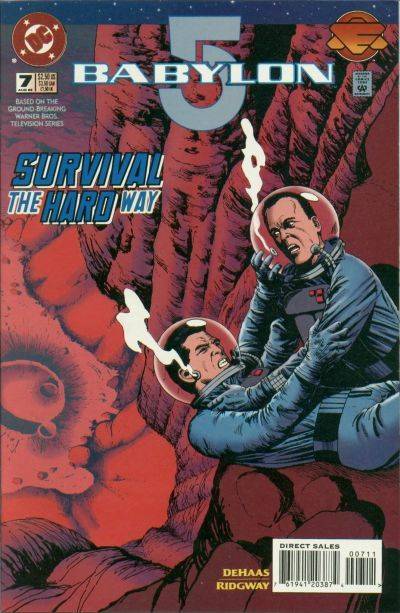
BABYLON 5 Rewatch: Comic Issues 5-8
DC2-4: Shadows Past and Present
Publication Date: March-June 1995
Written by Tim Dehaas (from an outline by J. Michael
Straczynski)
Artwork by John Ridgway (pencils and inks) & Robbie
Busch (colours)
Date: This storyline takes place prior to the
events of episode B9, setting it in early 2259. Keffer is a full
Lieutenant, placing it after the events of episode B4 (which are also
directly referenced). Episode C8 confirms the flashback storyline takes
place in 2253.
Plot: On
Babylon 5 Ambassador Mollari is toasting the recent reversal of fortunes for
the Centauri Republic. His joviality arouses the suspicions of Security Chief
Garibaldi, who decides to keep an eye on him. G’Kar is also angered by Londo’s
flippant disregard for either the ten thousand Narns killed at Quadrant 37
(episode A22) or the crew of the Narn warship dispatched to investigate
Z’ha’dum (episode B2).
Londo meets with Mr.
Morden, who asks Londo to let them know if Garibaldi continues to investigate
his activities. Shortly after this, Londo speaks to Lord Refa on Centauri
Prime, unaware that Garibaldi has hacked the transmission. Refa and Londo agree
to meet in person to discuss the latest events, including the attack on
Quadrant 37 and the Centauri Emperor’s failing health. Garibaldi “borrows” a
shuttle to investigate. Lt. Keffer sees the theft in progress but, rather than
report Garibaldi, offers to fly the shuttle for him. Morden then intercepts
Londo and tells him to cancel his meeting with Refa and undertake a diplomatic
mission elsewhere, whilst his “associates” deal with Mr. Garibaldi.
Garibaldi and Keffer’s
shuttle arrives at Londo and Refa’s meeting place, a remote outpost planet on
the fringes of Centauri space. Keffer tells Garibaldi that he can trust
Sheridan, but Garibaldi retorts that Sheridan hasn’t earned that trust like
Sinclair did. Keffer asks him how he and Sinclair built up that trust and
Garibaldi agrees to tell him the story.
Six years earlier, in
2253, Garibaldi was running a shuttle transport service on Mars Colony. He’d
been fired from his last couple of jobs and found the transport gig an easy way
to make money. He was also drinking way too much. He was hired by Lt. Commander
Jeffrey Sinclair to survey a remote area of Syria Planum where odd readings had
been detected by Earthforce.
Garibaldi’s story is
interrupted by the arrival of a Shadow fighter, which shoots down the shuttle.
Keffer manages to make an emergency landing on the planetary surface and he and
Garibaldi set out for a Centauri settlement about fifteen miles away. However,
the Shadow fighter lands at the crash site and the mysterious crew eliminate
all trace of the crash before heading off in pursuit of Garibaldi and Keffer.
To distract them from the danger, Garibaldi resumes his story.
Sinclair and two
fellow officers, Foster and Sanchez, were tasked with looking for anything “that
shouldn’t be there.” After several days of surveying remote regions of the
Martian surface, the shuttle’s guidance system failed and the ship crashed,
killing Foster instantly and injuring both Sinclair and Foster. The nearest
settlement was fifty miles away. Sinclair, whose injuries were lighter, and
Garibaldi set out on foot, leaving Foster in the (arguably) greater safety of
the shuttle wreck. The two men were trapped in a cave by a sandstorm and then a
rockslide. Garibaldi, fighting both alcoholism and post-traumatic stress
disorder after Kemmer’s death, managed to pull himself together and rescue
Sinclair from the rockslide. The two men then resumed their trek out of the
desert.
They were distracted
by a disturbance nearby and came across a startling sight: a huge, black,
spider-like ship embedded in the Martian surface. Another ship of the same
design was hovering above, using a powerful energy beam to cut it free. On the
ground were humans, people apparently helping the excavation from a mobile base.
After knocking out two of the humans when they stumbled across Sinclair and
Garibaldi, they realised they were telepaths: they had no comms gear in their
helmets. Using a stolen transport vehicle, Garibaldi and Sinclair gained entry
to the base and discovered that the telepaths were conducting experiments on other
humans using alien bio-technology, possible recovered from the alien ship.
Discovered, Garibaldi and Sinclair blasted their way out, using grenades to
almost destroy the base. The telepaths remained to save the base rather than
pursue Sinclair and Garibaldi, who recovered Sanchez and drove out of the
desert. They later flew back to the recovery site and found that the entire
site had been sterilised with no trace of the alien ships, the telepaths or their
base.
In the present, Keffer
and Garibaldi are attacked by the occupants of the Shadow ship: feral, goblin-like
creatures with telepathic powers who try to convince Keffer and Garibaldi to
kill one another. They fail and are shot dead. Their bodies are vapourised by self-destruct
devices moments later. They reach the Centauri city and are arrested. The
security chief contacts Babylon 5 to ask for Ambassador Mollari’s opinion.
Londo, after a moment’s hesitation, vouches for them and arranges for them to be
returned to Babylon 5.
Back on the station
Sheridan reads Garibaldi the riot act, but Garibaldi is certain that something
is going on. After describing the alien ships he saw on Mars, Keffer recognised
them as the same ships he saw in hyperspace during the Cortez mission (episode B4). Garibaldi also shows Sheridan
the only piece of evidence he recovered from the crash site: a tattered Psi
Corps badge.
Unbeknown to
Garibaldi, one of the telepaths being experimented on at Mars was Talia Winters…
The Arc: Garibaldi
experiences traumatic flashbacks to the death of his friend Kemmer on Europa
(as related in A13).
Garibaldi and Sinclair’s adventures on Mars are referred to
in episode C8, which picks up on
some dangling plot threads from this episode and even features flashbacks to
some of the same events. This may be the very first instance of a live-action
television series directly referring to the events of the tie-in comic in a
canonical fashion.
The suggestion that Talia was being experimented on by Psi
Corps using Shadow technology is an utterly explosive revelation to seed in
spin-off material, and is explored further in episode B19.
This issue hints at a relationship between the Shadows,
Earth and Psi Corps. Episodes C1, C5 and C14 expand on this idea significantly.
Background: The
aliens on the Shadow fighter are servants of the Shadows, rather than Shadows
themselves. They are short, humanoid, ugly and have low-level telepathic
powers. Despite their ability to run extremely fast and their evident
hostility, they are not skilled in combat and are easily dispatched.
However, a Shadow
itself – the semi-invisible insectoid aliens seen at the end of episode A22
– can be seen in the final comic on Mars. Its outline is discernible in the far
left of the big splash image of the Psi Corps base, watching over events from
afar.
Sinclair was a Lt.
Commander in 2253, having been a lieutenant during the Battle of the Line in
2247/48. He was only made a Commander later on, in 2255 or 56, prior to taking
command of Babylon 5. This is a fairly slow career progression, reflecting his
fall from grace following the Earth-Minbari War.
Londo’s role in the destruction of the base in Quadrant 39
appears to be quite well-known amongst certain Centauri politicians and
military personnel on even remote outposts.
Mistakes, Retcons and
Lamentations: Garibaldi openly admits to spying on Londo’s outgoing
transmissions. It is highly improbable that Garibaldi would do this, would be
capable of doing this (since Centauri technology is superior to Earth’s) or
would admit it so blatantly to Londo’s face.
The colony where Garibaldi was stationed and Kemmer was
killed is mistaken identified as Io; it was in fact Europa. An ice-mining
operation on Io, the most volcanically active body in the Solar system, would
be impressive.
It’s unclear why the telepaths don’t spot Garibaldi and
Keffer immediately, since they cannot communicate with anyone else. Perhaps
their guard was down or they were uncomfortable using their telepath powers so
close to a Shadow ship.
Behind the Scenes: This four-issue arc was published under the
banner title Shadows Past and Present,
divided into the individual issues With
Friends Like These…, Against the Odds,
Survival the Hard Way and Silent Enemies.
Unlike the first
story arc, J. Michael Straczynski was credited as the story writer for these
four issues.
Familiar Faces: Writer
Tim DeHaas has worked mostly in comics, but has written two episodes of Star Trek: Identity Crisis for The Next
Generation and Phage for Voyager.
Artist John Ridgway is a noted British comic book artist,
best-known for some accomplished work on various Doctor Who comic books dating back to the 1980s and also his work
on Hellblazer.
Review: A
massive step-up from the first comic arc, this four-issue arc features much
better artwork (if rather less “clean” than Ridgway’s other work) and a story
that not only reflects on and nods to the arc, but actually makes significant
additions to it: the Shadows are working with some humans, some of their ships
are buried underground on other worlds and the Shadows and Psi Corps have some
involvement in experiments involving Talia Winters. And it all stems from a
throwaway line of dialogue from one of the worst episodes of the show (Garibaldi’s
brief mention of “walking out of the desert” in A4). It’s not high art,
but it’s a serviceable and very solid addition to the Babylon 5 mythos. ***½
Thank you for reading The Wertzone. To help me provide better content, please consider contributing to my Patreon page and other funding methods, which will also get you exclusive content weeks before it goes live on my blogs. The Cities of Fantasy series is debuting on my Patreon feed and you can read it there one month before being published on the Wertzone.
Tuesday, 12 September 2017
J.J. Abrams confirmed as writer and director of STAR WARS: EPISODE IX
Lucasfilm have confirmed that J.J. Abrams will be revisiting the Star Wars universe by directing and co-writing Episode IX following Colin Trevorrow's recent departure.
The news is not really surprising: Abrams has worked on all three of the new main-sequence films as a producer and was also available. It looked like Abrams was gunning for directing a fourth Star Trek reboot movie, but with Paramount still hesitant about pulling the trigger on the film following Star Trek Beyond's disappointing box office, he had a hole in his schedule. In addition, with Episode IX due to commence filming in the next couple of months, an experienced director with some existing involvement in the film's development and conception makes a lot of sense.
Some fans will no doubt be disappointed, though. Abrams did a reasonably good job on The Force Awakens, but the movie did have some problems (such as the resurfacing of Abrams' bizarre inability to understand how big space is) and many of its strengths were down to Lawrence Kasdan's writing. Kasdan is retiring from writing Star Wars after the upcoming Han Solo spin-off movie, so will not have a hand in this movie. Instead, Chris Terrio will co-write the movie with Abrams (based on a story developed by Rian Johnson). Terrio is best-known as the co-writer of, er, Batman V Superman: Dawn of Justice but, more hopefully, he also won an Oscar for writing Argo.
Lucasfilm are also understood to have explored the possibility of Rian Johnson, who wrote and directed Episode VIII: The Last Jedi (due in cinemas in December), directing the movie. However, Johnson is still editing the movie and putting it through post-production for the next three months, whilst Episode IX needs to go into pre-production yesterday to hit its intended release date.
Star Wars: Episode IX is due for release in May 2019, although don't be surprised at all if this slips to December instead.
UPDATE: It's now been confirmed that Episode IX will debut in December 2019. This will give Abrams more time to get up to speed on the movie and will also resolve Disney's scheduling issue of launching two massive movies (Episode IX and Avengers: Infinity War Part II) within a couple of weeks of one another.
The news is not really surprising: Abrams has worked on all three of the new main-sequence films as a producer and was also available. It looked like Abrams was gunning for directing a fourth Star Trek reboot movie, but with Paramount still hesitant about pulling the trigger on the film following Star Trek Beyond's disappointing box office, he had a hole in his schedule. In addition, with Episode IX due to commence filming in the next couple of months, an experienced director with some existing involvement in the film's development and conception makes a lot of sense.
Some fans will no doubt be disappointed, though. Abrams did a reasonably good job on The Force Awakens, but the movie did have some problems (such as the resurfacing of Abrams' bizarre inability to understand how big space is) and many of its strengths were down to Lawrence Kasdan's writing. Kasdan is retiring from writing Star Wars after the upcoming Han Solo spin-off movie, so will not have a hand in this movie. Instead, Chris Terrio will co-write the movie with Abrams (based on a story developed by Rian Johnson). Terrio is best-known as the co-writer of, er, Batman V Superman: Dawn of Justice but, more hopefully, he also won an Oscar for writing Argo.
Lucasfilm are also understood to have explored the possibility of Rian Johnson, who wrote and directed Episode VIII: The Last Jedi (due in cinemas in December), directing the movie. However, Johnson is still editing the movie and putting it through post-production for the next three months, whilst Episode IX needs to go into pre-production yesterday to hit its intended release date.
Star Wars: Episode IX is due for release in May 2019, although don't be surprised at all if this slips to December instead.
UPDATE: It's now been confirmed that Episode IX will debut in December 2019. This will give Abrams more time to get up to speed on the movie and will also resolve Disney's scheduling issue of launching two massive movies (Episode IX and Avengers: Infinity War Part II) within a couple of weeks of one another.
The GAME OF THRONES tapestry is absolutely amazing
When it comes to boosting tourism, hosting a major and popular TV show or movie series seems to be a reliable way of getting visitors to show up. New Zealand is still enjoying a tourism boost from the Lord of the Rings and Hobbit movies. Northern Ireland has been getting in on the act for a few years now, promoting locations from Game of Thrones as destinations for visitors.
Tourism Ireland has now got a step further and commissioned an enormous tapestry which tells the complete story of Game of Thrones (so far). The tapestry is currently 77 metres (just over 250 feet, or over a third the height of the Wall!) in length and takes the story right up to the end of Season 7. It's on display in the Ulster Museum in Belfast, Northern Ireland, and I visited it this past weekend as part of the annual TitanCon convention for SFF fans in and around Northern Ireland.
I took almost seventy photos of the tapestry in-situ, which you can follow on my Twitter feed here.
Handily, you can also view every part of the tapestry in detail here.
The tapestry will be displayed at the Ulster Museum until next spring, when it will be moved to another location. It will also be updated and completed when Season 8 of the show airs. Photos and the website guide are helpful, but if at all practical I would recommend trying to see it in person. It's absolutely worth it.
Tourism Ireland has now got a step further and commissioned an enormous tapestry which tells the complete story of Game of Thrones (so far). The tapestry is currently 77 metres (just over 250 feet, or over a third the height of the Wall!) in length and takes the story right up to the end of Season 7. It's on display in the Ulster Museum in Belfast, Northern Ireland, and I visited it this past weekend as part of the annual TitanCon convention for SFF fans in and around Northern Ireland.
I took almost seventy photos of the tapestry in-situ, which you can follow on my Twitter feed here.
Handily, you can also view every part of the tapestry in detail here.
The tapestry will be displayed at the Ulster Museum until next spring, when it will be moved to another location. It will also be updated and completed when Season 8 of the show airs. Photos and the website guide are helpful, but if at all practical I would recommend trying to see it in person. It's absolutely worth it.
The Expanse: Season 2
An uncontrollable force has been unleashed on the Eros asteroid settlement, killing over a hundred thousand people. Eros has been quarantined whilst Earth, Mars and the Belt each blame one another for starting the crisis. But Jim Holden and the crew of the Rocinante know the truth, that what they are dealing with is far more powerful and far stranger than anything humanity has encountered so far. When Eros moves out of orbit and a recurrence of the crisis takes place on Ganymede, the Solar system moves to the brink of war.
Season 1 of The Expanse was the most satisfying slice of overtly science fiction drama seen on TV in many years. It was superbly-written and well-crafted, with fantastic production values and an absolutely stellar cast doing great work. Season 1 was undercut by pacing problems - a very slow first few episodes and then a mad rush at the end - and also a curious structural decision not to cover the entire first novel in the first season, but hold off on the book's ending until the start of Season 2, which both finishes Leviathan Wakes and covers part (but again, not all) of the second book, Caliban's War.
Season 2 of The Expanse shows that this decision had some merit: unlike the more relaxed first season, Season 2 starts with a bang and never lets up. For thirteen episodes on the trot, the story moves quite fast but also knows when to take the foot off the pedal for an important moment of characterisation or worldbuilding or simple beauty. The Expanse's CGI budget is clearly enormous and the show deserves credit for taking moments out of the action to show the haunting, empty beauty of space, the mind-boggling view of Jupiter from one of its moons or show sweeping shots of New York City two centuries from now.
Like the first season, the actors continue to knock it out of the park, particularly Thomas Jane as Miller and Wes Chatham as Amos, the letter coming into his own as he sells Amos's very complex motivations and personality issues with a minimum of fuss. Shohreh Aghdashloo continues to steal every scene she's in as Avasarala, especially now she moves into the Caliban's War story arc and actually has an active storyline to pursue. SyFy also clearly lifted the restriction on swearing between seasons, as she now employs the kind of invective she does in the books (if not quite as frequently). New addition Frankie Adams (as Martian marine Bobbie Draper) also does great work, although the split of the storyline means she spends a bit too much time as "blind patriot grunt" Bobbie rather than the more nuanced character she becomes later on. But Draper has presence and charm in the role. Terry Chen is also good as Prax, a POV character from the books who has a somewhat smaller (but still important) role on the show.
The season continues to explore the aesthetics of the first season, depicting space as dangerous and simply flying from point A to point B can be long, hard and extremely hazardous. Space battles have bits of metal flying through hulls with ease (meaning that it's rarely necessary to completely destroy enemy ships, just fillet them with gunfire so the crew can't breathe any more). The space battle between the Rocinante and the enemy stealth ship in close quarters around a space station is particularly gripping, with the CGI being utterly outstanding. The marine training exercise on Mars is also exceptional, although it's a shame we don't see the iconic battle on Ganymede in as much detail. In other areas the effects are a bit more limited, particularly the ocean view scenes in New York which look pretty fake.
What the second season does do very well is depict the politics of two great superpowers on the brink of war and the constant politicking and brinkmanship required to maintain the peace, and the impact of those decisions on the little people, with the fates of millions depending on the whims and horse-trading of people tens or hundreds of millions of miles away. Apart from Avasarala (who often isn't in as much control of circumstances as she'd like to think), our heroes are mostly at the short end of events, having to scramble to put out fires caused by others elsewhere, but in certain moments (usually involving Holden making an Important Announcement on the radio) they fight back.
It's a rich show that packs a lot into its episodes and its second season has almost no major problems at all, except maybe that the finale, which takes place about two-thirds of the way through Caliban's War, doesn't really have a big season-ending event (it's actually the fourth episode of the season which is the most epic). But then overcoming that cliche is quite enjoyable in itself.
The second season of The Expanse (*****) is the most satisfying space-set SF drama since arguably the second season of Battlestar Galactica over a decade ago, mixing politics, ethics, fine characterisation and nodding at the real science of space travel in a very satisfying manner. It is available on DVD and Blu-Ray in the United States, and is on Netflix in the UK and Ireland (and many other territories). Season 3 has been commissioned and will air on SyFy in the United States in 2018.
Season 1 of The Expanse was the most satisfying slice of overtly science fiction drama seen on TV in many years. It was superbly-written and well-crafted, with fantastic production values and an absolutely stellar cast doing great work. Season 1 was undercut by pacing problems - a very slow first few episodes and then a mad rush at the end - and also a curious structural decision not to cover the entire first novel in the first season, but hold off on the book's ending until the start of Season 2, which both finishes Leviathan Wakes and covers part (but again, not all) of the second book, Caliban's War.
Season 2 of The Expanse shows that this decision had some merit: unlike the more relaxed first season, Season 2 starts with a bang and never lets up. For thirteen episodes on the trot, the story moves quite fast but also knows when to take the foot off the pedal for an important moment of characterisation or worldbuilding or simple beauty. The Expanse's CGI budget is clearly enormous and the show deserves credit for taking moments out of the action to show the haunting, empty beauty of space, the mind-boggling view of Jupiter from one of its moons or show sweeping shots of New York City two centuries from now.
Like the first season, the actors continue to knock it out of the park, particularly Thomas Jane as Miller and Wes Chatham as Amos, the letter coming into his own as he sells Amos's very complex motivations and personality issues with a minimum of fuss. Shohreh Aghdashloo continues to steal every scene she's in as Avasarala, especially now she moves into the Caliban's War story arc and actually has an active storyline to pursue. SyFy also clearly lifted the restriction on swearing between seasons, as she now employs the kind of invective she does in the books (if not quite as frequently). New addition Frankie Adams (as Martian marine Bobbie Draper) also does great work, although the split of the storyline means she spends a bit too much time as "blind patriot grunt" Bobbie rather than the more nuanced character she becomes later on. But Draper has presence and charm in the role. Terry Chen is also good as Prax, a POV character from the books who has a somewhat smaller (but still important) role on the show.
The season continues to explore the aesthetics of the first season, depicting space as dangerous and simply flying from point A to point B can be long, hard and extremely hazardous. Space battles have bits of metal flying through hulls with ease (meaning that it's rarely necessary to completely destroy enemy ships, just fillet them with gunfire so the crew can't breathe any more). The space battle between the Rocinante and the enemy stealth ship in close quarters around a space station is particularly gripping, with the CGI being utterly outstanding. The marine training exercise on Mars is also exceptional, although it's a shame we don't see the iconic battle on Ganymede in as much detail. In other areas the effects are a bit more limited, particularly the ocean view scenes in New York which look pretty fake.
What the second season does do very well is depict the politics of two great superpowers on the brink of war and the constant politicking and brinkmanship required to maintain the peace, and the impact of those decisions on the little people, with the fates of millions depending on the whims and horse-trading of people tens or hundreds of millions of miles away. Apart from Avasarala (who often isn't in as much control of circumstances as she'd like to think), our heroes are mostly at the short end of events, having to scramble to put out fires caused by others elsewhere, but in certain moments (usually involving Holden making an Important Announcement on the radio) they fight back.
It's a rich show that packs a lot into its episodes and its second season has almost no major problems at all, except maybe that the finale, which takes place about two-thirds of the way through Caliban's War, doesn't really have a big season-ending event (it's actually the fourth episode of the season which is the most epic). But then overcoming that cliche is quite enjoyable in itself.
The second season of The Expanse (*****) is the most satisfying space-set SF drama since arguably the second season of Battlestar Galactica over a decade ago, mixing politics, ethics, fine characterisation and nodding at the real science of space travel in a very satisfying manner. It is available on DVD and Blu-Ray in the United States, and is on Netflix in the UK and Ireland (and many other territories). Season 3 has been commissioned and will air on SyFy in the United States in 2018.
A History of Middle-earth Part 8: Arnor and Gondor - Realms in Peril
In the aftermath of the Downfall of Númenor, the survivors founded two realms-in-exile in Middle-earth: mighty Arnor in the north and Gondor, the great southern kingdom that lay about the White Mountains. Both endured for centuries into the Third Age, but both also faced mounting threats from the servants of evil.
The Trials of the South-kingdom
Whilst Arnor endured hardship in the North, Gondor rose to greatness. It was much more heavily populated than Arnor, with the lands south of the White Mountains teeming with game and life. Gondor not only maintained the populous capital city of Osgiliath, but also the large cities of Pelargir, Dol Amroth and Edhellond. The fortresses of Minas Anor and Minas Ithil were also well-populated and Minas Anor in fact became a city as well as fortress, taverns and shops sprouting up within its seven encircling walls. By 420 TA Minas Anor had been refortified and enlarged to cope for the burgeoning populace.
It was not long before war threatened. The Easterlings – the peoples who lived east of the Sea of Rhûn – long hated Gondor’s wealth and power. In 490 they attacked Gondor in strength. They established settlements south of Greenwood and for ten long years troubled Gondor until King Romendacil I led a great army in destroying the Easterling settlements. Gondor was free again of trouble for come centuries. In 830 King Falastur set about establishing Gondor as a mighty sea power and his descendent King Eärnil I proved the worth of this by taking the city of Umbar by force in 933, making it into a fortress and city of Gondor. However, the cruel Haradrim of the south became enraged by the Gondorian presence and mad war upon Umbar in the hopes of recapturing it. In 1015 they laid siege to the city and killed King Ciryandil when he came south with a relief force. However, they failed to take the city and fell back. Divided by internal strife, they were easy pickings when King Hyarmendacil led a mighty invasion of the Near Harad starting in 1050. This war smashed the Haradim armies and pushed Gondor’s armies far to the south of Umbar.
Gondor’s time of greatness came to an abrupt end in 1432 when King Valacar died. Valacar’s father, Romendacil II, had won a great war against the Easterlings with the aid of Rhovanion, a kingdom south-east of Mirkwood (the name ‘Rhovanion’ has become synonymous with “Wilderland”, the lands east of the Misty Mountains, but it was originally used to identify this one specific kingdom). Valacar married a princess of this kingdom and their son Eldacar became heir to the throne. However, many in Gondor questioned this as, for the first time since Elendil founded their kingdom, a Dúnedain had married one of ‘inferior’ race. When Eldacar made to take the throne, King Valacar’s cousin Castamir, Captain of the Fleets, declared Eldacar unworthy to take the throne. Castamir was supported by the people and nobles of Pelargir and the coastal provinces, who overran the rest of Gondor, taking the twin fortresses of Minas Anor and Ithil and laying siege to Osgiliath. This process took seven years, the bloodiest stage of the Civil War of the Kin-strife. Eldacar fled to Rhovanion, but his son Ornendil was murdered in the process.
Eldacar dwelt in exile for ten long years, but word came to him that Castamir’s rule was arbitrary and cruel. Winning the allegiance of his mother’s people, he led an army from Rhovanion south into Gondor at the start of 1447. Minas Ithil and Osgiliath both declared for Eldacar whilst Castamir was in the south and Eldacar took both without battle. Negotiations saw Minas Anor declare for Eldacar as well. Castamir rushed north with his armies from Pelargir, but Eldacar took the city behind him by landing troops from the river. Castamir’s army, trapped between two hosts, was forced to meet Eldacar’s on ill-chosen ground near the Crossings of Erui. In that battle Castamir died and Eldacar took the throne of Gondor. However, Castamir’s sons survived to take ship for Umbar. There they declared themselves Kings of Umbar, forever at strife with Gondor. Their descendants killed King Aldamir, Eldacar’s second son, in 1540 when he tried to take Umbar and complete the victory started by his father. Eleven years later Hyarmendacil II came south and tried to attack Umbar by land, but a large force of Haradrim met him in combat before he could reach the city. He defeated the Haradrim, but his exhausted forces were unable to besiege Umbar and withdrew back to the north. In 1634 the Umbarians launched a risky attack on Gondor which succeeded in sacking Pelargir and killing King Minardil, but failed to topple Gondor altogether.
Two years later the Great Plague swept through Gondor, severely depopulating the nation and killing the White Tree of Minas Anor. The plague was bad everywhere it struck, but it struck hardest in Osgiliath, killing 90% of the population. King Tarondor was forced to abandon Osgiliath altogether and declared Minas Anor the new capital of Gondor.
Gondor’s perceived weakness lasted for less than two centuries. The Umbarians had grown fat and indolent and were taken by surprise when King Telumhetar Umbardacil took the city by land and sea in a massive assault in 1810. However, this victory was only possible by stripping the eastern garrisons in Ithilien. The need for a large occupation force in unquiet Umbar meant that this became a permanent state of affairs. When a new threat, the Wainriders, an Easterling people, arose, Gondor was unable to meet them in battle. King Narmacil was slain in 1856 and Gondor’s territories north and south of Mordor were lost. In 1899 King Calimhetar was able to trick the Wainriders into bringing the bulk of their army north of Mordor to meet an imagined attack from that direction, but instead he hit them from the south on Dagorlad, destroying them and forcing them to rereat. In celebration of his victory, he commissioned the White Tower, a new seat for the Kings of Gondor, in Minas Anor.
In 1944 Gondor was suddenly best by enemies on two sides. The Wainriders struck again in the north whilst the Haradrim advanced from the south, crossing into South Ithilian. King Ondoher was slain and his son Eärnil II achieved a mighty victory by attacking the Haradrim and shattering them in the shadow of Emyn Arnen before marching north and taking the Wainriders by night as they slept in the legendary Battle of the Camps, driving the survivors into the Dead Marshes. Eärnil was acclaimed King of Gondor, although Arvedui of Arnor had a claim on the throne as well. When Arnor was destroyed, King Eärnur son of Eärnil took a gamble and rushed reinforcements to Arnor to aid the elves in destroying Angmar. They succeeded, but Gondor lacked the men to repopulate Arnor, which ceased to exist.
The Witch-King, having destroyed Arnor, returned to Mordor and raised a new host, eager to now strike against Gondor as well. In 2000 TA the Nazgûl led an army through the Cirith Ungol pass and attacked Minas Ithil, taking it after a two-year siege. They renamed the city-fortress as Minas Morgul, the Tower of Sorcery, and the Nazgûl made it their lair.
In 2043 TA Eärnur became King of Gondor and the Witch-King challenged him to single combat. Eärnur wisely ignored the sally, but some called him craven behind his back. Eventually, in 2050, he was forced to accept. Unsurprisingly, he was slain. Childless, the line of kings came to an end and it fell to Mardil, his steward, to assume the rule of Gondor. Mardil announced the founding of the Line of the Ruling Stewards who would hold the throne of Gondor in trust until Isildur’s Heir emerged, namely one of the Dúnedain Chieftains of the North. However, their oath not to rule again until the Witch-King lay dead also prevented them from taking the throne of Gondor. Thus Gondor endured without a king. Minas Anor, Tower of the Sun, became Minas Tirith, Tower of the Guard, and Gondor prepared for a long struggle against the Shadow as it raided against them out of Minas Morgul.
However, in 2063 the wizard Gandalf entered the fortress of Dol Guldur, a dark tower that had appeared in Mirkwood. The Nazgûl, who were believed to be based there as well as in Mordor, apparently fled (though it seems that Sauron himself was now present, at least in a spiritual form). Gandalf forged an alliance with the Ruling Stewards of Gondor and with other notables to form the Watchful Peace, which kept a careful eye on enemy movements along the borders of Mordor. The Peace meant that the enemy could not gather in strength outside of Mordor’s walls and was successful in keeping the enemy bottled up in Mordor for some 400 years. In 2460 the Peace ended when suddenly evil creatures started issuing forth from Dol Guldur in some strength. In 2463 Gandalf and Saruman convened the White Council, consisting of the Istari, the elven high lords and representatives from Gondor. The White Council was designed to stand against the threat of Mordor, but after some decades the rulers of Gondor disregarded it as being little more than a talking shop whilst Gondorian troops died defending all the free lands of Middle-earth. This was made clear in 2475 when a large orc force attacked Gondor, making it as far as Osgiliath before being checked. In a mighty battle Osgiliath’s bridges were destroyed and the last habitable part of the city was sacked.
In 2510 the Gondorians received word of an enormous army of a barbarous people known as the Balchoth was advancing from the north. So huge was this army that Gondor seemed to have no chance of victory. Nevertheless, Ruling Steward Cirion led his army forth to do battle.
The Battle of Carn Dûm, from The Battle for Middle-earth II: Rise of the Witch-King.
The Fall of the North-kingdom
After the Battle of the Gladden Fields and the death of Isildur, the rule of the North-kingdom fell to his only surviving son, Valandil, who had been left behind in Rivendell when the Army of the Last Alliance had set out to war. Valandil inherited the throne upon coming of age in 10 TA and his line ruled the North-kingdom of Arnor for a further 850 years. Arnor was never as populous as Gondor and only possessed one large city, the capital of Annúminas on Lake Evendim. A smaller fortress-city was established not far to the east at Fornost on the North Downs and a mighty fortress built on Amon Sûl, the hill also called Weathertop, to house one of the palantíri. These devices, the seeing-stones of Númenor, had been forged by Fëanor himself in the depths of time, according to some, and passed down through the various bloodlines to Eärendil, and from him to his son Elros, who was first king of Númenor. Elendil had taken the stones ere the Downfall and used them to facilitate communications between Arnor and Gondor.
In 861 TA King Eärendur died and his three sons disputed the succession between them. Eventually they divided the realm in three: Arthedain in the west, Cardolan in the south and Rhudaur in the east. Arthedain and Cardolan worked alongside one another, but Rhudaur was more estranged and its people less civilised, as they lived on the harsh Ettenmoors and the lands north to the northern-most part of the Misty Mountains. By 1356 TA Rhudaur was regularly feuding and raiding with the other kingdoms. Unbeknown to the western kingdoms, the leader of the Nazgûl, claiming the title Witch-King, had come north circa 1300 and seized control of the land of Angmar, which lay at the northern end of the mountains. He rapidly subverted and made alliance with Rhudaur, promising the king of that land the throne of all Arnor in return for his allegiance.
In 1409 TA the Witch-King tired of the deception. He amassed great strength of arms and assaulted Arthedain and Cardolan directly. The two realms’ capitals, Fornost and Tyrn Gorthad (the latter located on what are now the Barrow-downs), were defended against the attack and full-scale war erupted. The elves of Rivendell and Lindon lent what aid they could, although for some time both Círdan and Elrond believed the war was merely an internal human matter.
In 1636 the Great Plague swept across Gondor and then north through Eriador to Arnor. However, the Witch-King’s own forces were decimated by the plague and his attempts to use the situation to attack Arnor were foiled. Arthedain and Cardolan became much more closely allied as the threat of Rhudaur and Angmar remained, but over the next three centuries the lack of overt military action caused their guard to falter.
By 1940 Arnor had been reunified under the rule of King Arvedui, who in turn married Princess Firielm, daughter of King Ondoher of Gondor. When Ondoher was killed in the mighty two-front war against both the Wainriders of Khand and the Haradim, Arvedui claimed the throne of Gondor also. However, it fell to Prince Eärnil to save Gondor by crushing the Haradim and then defeating the Wainriders at the Battle of the Camps. In recognition of this, the Lords of Gondor gave Eärnil II the throne, enraging Arvedui to saw himself as the legal heir to the throne.
Arvedui had little time to ponder his rage, however, as Angmar became resurgent, launching a mighty assault against Arnor in 1974 TA that carried their armies all the way to Fornost, which they brutally sacked. Arvedui led a fighting retreat to the ruins of Annúminas, but the enemy hounded him remorselessly. He fled to the ice-shores along the great Bay of Forochel and there waited for rescue in the form of a ship sent from Lindon. However, the ship foundered in bad weather and Arvedui was slain.
Arvedui’s son, Aranarth, continued a guerrila war against the Witch-King of Angmar, but now nothing stood between the Witch-King and the total conquest of Eriador. With little choice, Círdan sent practically the entire armed might of Lindon to stand against the Witch-King in the Hills of Evendim. The ferocity of the elven attack drove the armies of Angmar back to Fornost, but the elves lacked the numbers for siege. What the Witch-King had not counted on, however, was Elrond leading an army north from Rivendell to attack his own capital city of Carn Dûm, which was easily destroyed, and then advancing on Fornost from the east. King Eärnur of Gondor landed troops both on the Gulf of Lhûn to reinforce Círdan and also on the Icebay of Forochel, so that Fornost was now assailed from all sides. In the mighty Battle of Fornost the armies of Angmar were destroyed utterly, although the Witch-King fled back to Mordor.
Aranarth might have taken the throne of Arnor, but he now saw that Arnor could not be held. It was too large, its population too small and scattered across a vast stretch of territory. He refused the throne, stating that the Kingdom of Arnor would live again only when the one who had destroyed it, the Witch-King, lay dead and all of Middle-earth was freed from the threat of the Shadow of Mordor. Instead, Aranarth created the Rangers of the North, consisting of himself and his kin and remaining followers, the Dúnedain of the North. In alliance with the elves, they would ensure that the Shadow would not fall again on the north.
After the Battle of the Gladden Fields and the death of Isildur, the rule of the North-kingdom fell to his only surviving son, Valandil, who had been left behind in Rivendell when the Army of the Last Alliance had set out to war. Valandil inherited the throne upon coming of age in 10 TA and his line ruled the North-kingdom of Arnor for a further 850 years. Arnor was never as populous as Gondor and only possessed one large city, the capital of Annúminas on Lake Evendim. A smaller fortress-city was established not far to the east at Fornost on the North Downs and a mighty fortress built on Amon Sûl, the hill also called Weathertop, to house one of the palantíri. These devices, the seeing-stones of Númenor, had been forged by Fëanor himself in the depths of time, according to some, and passed down through the various bloodlines to Eärendil, and from him to his son Elros, who was first king of Númenor. Elendil had taken the stones ere the Downfall and used them to facilitate communications between Arnor and Gondor.
In 861 TA King Eärendur died and his three sons disputed the succession between them. Eventually they divided the realm in three: Arthedain in the west, Cardolan in the south and Rhudaur in the east. Arthedain and Cardolan worked alongside one another, but Rhudaur was more estranged and its people less civilised, as they lived on the harsh Ettenmoors and the lands north to the northern-most part of the Misty Mountains. By 1356 TA Rhudaur was regularly feuding and raiding with the other kingdoms. Unbeknown to the western kingdoms, the leader of the Nazgûl, claiming the title Witch-King, had come north circa 1300 and seized control of the land of Angmar, which lay at the northern end of the mountains. He rapidly subverted and made alliance with Rhudaur, promising the king of that land the throne of all Arnor in return for his allegiance.
In 1409 TA the Witch-King tired of the deception. He amassed great strength of arms and assaulted Arthedain and Cardolan directly. The two realms’ capitals, Fornost and Tyrn Gorthad (the latter located on what are now the Barrow-downs), were defended against the attack and full-scale war erupted. The elves of Rivendell and Lindon lent what aid they could, although for some time both Círdan and Elrond believed the war was merely an internal human matter.
In 1636 the Great Plague swept across Gondor and then north through Eriador to Arnor. However, the Witch-King’s own forces were decimated by the plague and his attempts to use the situation to attack Arnor were foiled. Arthedain and Cardolan became much more closely allied as the threat of Rhudaur and Angmar remained, but over the next three centuries the lack of overt military action caused their guard to falter.
By 1940 Arnor had been reunified under the rule of King Arvedui, who in turn married Princess Firielm, daughter of King Ondoher of Gondor. When Ondoher was killed in the mighty two-front war against both the Wainriders of Khand and the Haradim, Arvedui claimed the throne of Gondor also. However, it fell to Prince Eärnil to save Gondor by crushing the Haradim and then defeating the Wainriders at the Battle of the Camps. In recognition of this, the Lords of Gondor gave Eärnil II the throne, enraging Arvedui to saw himself as the legal heir to the throne.
Arvedui had little time to ponder his rage, however, as Angmar became resurgent, launching a mighty assault against Arnor in 1974 TA that carried their armies all the way to Fornost, which they brutally sacked. Arvedui led a fighting retreat to the ruins of Annúminas, but the enemy hounded him remorselessly. He fled to the ice-shores along the great Bay of Forochel and there waited for rescue in the form of a ship sent from Lindon. However, the ship foundered in bad weather and Arvedui was slain.
Arvedui’s son, Aranarth, continued a guerrila war against the Witch-King of Angmar, but now nothing stood between the Witch-King and the total conquest of Eriador. With little choice, Círdan sent practically the entire armed might of Lindon to stand against the Witch-King in the Hills of Evendim. The ferocity of the elven attack drove the armies of Angmar back to Fornost, but the elves lacked the numbers for siege. What the Witch-King had not counted on, however, was Elrond leading an army north from Rivendell to attack his own capital city of Carn Dûm, which was easily destroyed, and then advancing on Fornost from the east. King Eärnur of Gondor landed troops both on the Gulf of Lhûn to reinforce Círdan and also on the Icebay of Forochel, so that Fornost was now assailed from all sides. In the mighty Battle of Fornost the armies of Angmar were destroyed utterly, although the Witch-King fled back to Mordor.
Aranarth might have taken the throne of Arnor, but he now saw that Arnor could not be held. It was too large, its population too small and scattered across a vast stretch of territory. He refused the throne, stating that the Kingdom of Arnor would live again only when the one who had destroyed it, the Witch-King, lay dead and all of Middle-earth was freed from the threat of the Shadow of Mordor. Instead, Aranarth created the Rangers of the North, consisting of himself and his kin and remaining followers, the Dúnedain of the North. In alliance with the elves, they would ensure that the Shadow would not fall again on the north.
The Realm of Gondor, map by Zikuul at Caramail.com
Whilst Arnor endured hardship in the North, Gondor rose to greatness. It was much more heavily populated than Arnor, with the lands south of the White Mountains teeming with game and life. Gondor not only maintained the populous capital city of Osgiliath, but also the large cities of Pelargir, Dol Amroth and Edhellond. The fortresses of Minas Anor and Minas Ithil were also well-populated and Minas Anor in fact became a city as well as fortress, taverns and shops sprouting up within its seven encircling walls. By 420 TA Minas Anor had been refortified and enlarged to cope for the burgeoning populace.
It was not long before war threatened. The Easterlings – the peoples who lived east of the Sea of Rhûn – long hated Gondor’s wealth and power. In 490 they attacked Gondor in strength. They established settlements south of Greenwood and for ten long years troubled Gondor until King Romendacil I led a great army in destroying the Easterling settlements. Gondor was free again of trouble for come centuries. In 830 King Falastur set about establishing Gondor as a mighty sea power and his descendent King Eärnil I proved the worth of this by taking the city of Umbar by force in 933, making it into a fortress and city of Gondor. However, the cruel Haradrim of the south became enraged by the Gondorian presence and mad war upon Umbar in the hopes of recapturing it. In 1015 they laid siege to the city and killed King Ciryandil when he came south with a relief force. However, they failed to take the city and fell back. Divided by internal strife, they were easy pickings when King Hyarmendacil led a mighty invasion of the Near Harad starting in 1050. This war smashed the Haradim armies and pushed Gondor’s armies far to the south of Umbar.
Gondor’s time of greatness came to an abrupt end in 1432 when King Valacar died. Valacar’s father, Romendacil II, had won a great war against the Easterlings with the aid of Rhovanion, a kingdom south-east of Mirkwood (the name ‘Rhovanion’ has become synonymous with “Wilderland”, the lands east of the Misty Mountains, but it was originally used to identify this one specific kingdom). Valacar married a princess of this kingdom and their son Eldacar became heir to the throne. However, many in Gondor questioned this as, for the first time since Elendil founded their kingdom, a Dúnedain had married one of ‘inferior’ race. When Eldacar made to take the throne, King Valacar’s cousin Castamir, Captain of the Fleets, declared Eldacar unworthy to take the throne. Castamir was supported by the people and nobles of Pelargir and the coastal provinces, who overran the rest of Gondor, taking the twin fortresses of Minas Anor and Ithil and laying siege to Osgiliath. This process took seven years, the bloodiest stage of the Civil War of the Kin-strife. Eldacar fled to Rhovanion, but his son Ornendil was murdered in the process.
Eldacar dwelt in exile for ten long years, but word came to him that Castamir’s rule was arbitrary and cruel. Winning the allegiance of his mother’s people, he led an army from Rhovanion south into Gondor at the start of 1447. Minas Ithil and Osgiliath both declared for Eldacar whilst Castamir was in the south and Eldacar took both without battle. Negotiations saw Minas Anor declare for Eldacar as well. Castamir rushed north with his armies from Pelargir, but Eldacar took the city behind him by landing troops from the river. Castamir’s army, trapped between two hosts, was forced to meet Eldacar’s on ill-chosen ground near the Crossings of Erui. In that battle Castamir died and Eldacar took the throne of Gondor. However, Castamir’s sons survived to take ship for Umbar. There they declared themselves Kings of Umbar, forever at strife with Gondor. Their descendants killed King Aldamir, Eldacar’s second son, in 1540 when he tried to take Umbar and complete the victory started by his father. Eleven years later Hyarmendacil II came south and tried to attack Umbar by land, but a large force of Haradrim met him in combat before he could reach the city. He defeated the Haradrim, but his exhausted forces were unable to besiege Umbar and withdrew back to the north. In 1634 the Umbarians launched a risky attack on Gondor which succeeded in sacking Pelargir and killing King Minardil, but failed to topple Gondor altogether.
Two years later the Great Plague swept through Gondor, severely depopulating the nation and killing the White Tree of Minas Anor. The plague was bad everywhere it struck, but it struck hardest in Osgiliath, killing 90% of the population. King Tarondor was forced to abandon Osgiliath altogether and declared Minas Anor the new capital of Gondor.
Gondor’s perceived weakness lasted for less than two centuries. The Umbarians had grown fat and indolent and were taken by surprise when King Telumhetar Umbardacil took the city by land and sea in a massive assault in 1810. However, this victory was only possible by stripping the eastern garrisons in Ithilien. The need for a large occupation force in unquiet Umbar meant that this became a permanent state of affairs. When a new threat, the Wainriders, an Easterling people, arose, Gondor was unable to meet them in battle. King Narmacil was slain in 1856 and Gondor’s territories north and south of Mordor were lost. In 1899 King Calimhetar was able to trick the Wainriders into bringing the bulk of their army north of Mordor to meet an imagined attack from that direction, but instead he hit them from the south on Dagorlad, destroying them and forcing them to rereat. In celebration of his victory, he commissioned the White Tower, a new seat for the Kings of Gondor, in Minas Anor.
In 1944 Gondor was suddenly best by enemies on two sides. The Wainriders struck again in the north whilst the Haradrim advanced from the south, crossing into South Ithilian. King Ondoher was slain and his son Eärnil II achieved a mighty victory by attacking the Haradrim and shattering them in the shadow of Emyn Arnen before marching north and taking the Wainriders by night as they slept in the legendary Battle of the Camps, driving the survivors into the Dead Marshes. Eärnil was acclaimed King of Gondor, although Arvedui of Arnor had a claim on the throne as well. When Arnor was destroyed, King Eärnur son of Eärnil took a gamble and rushed reinforcements to Arnor to aid the elves in destroying Angmar. They succeeded, but Gondor lacked the men to repopulate Arnor, which ceased to exist.
The Witch-King, having destroyed Arnor, returned to Mordor and raised a new host, eager to now strike against Gondor as well. In 2000 TA the Nazgûl led an army through the Cirith Ungol pass and attacked Minas Ithil, taking it after a two-year siege. They renamed the city-fortress as Minas Morgul, the Tower of Sorcery, and the Nazgûl made it their lair.
In 2043 TA Eärnur became King of Gondor and the Witch-King challenged him to single combat. Eärnur wisely ignored the sally, but some called him craven behind his back. Eventually, in 2050, he was forced to accept. Unsurprisingly, he was slain. Childless, the line of kings came to an end and it fell to Mardil, his steward, to assume the rule of Gondor. Mardil announced the founding of the Line of the Ruling Stewards who would hold the throne of Gondor in trust until Isildur’s Heir emerged, namely one of the Dúnedain Chieftains of the North. However, their oath not to rule again until the Witch-King lay dead also prevented them from taking the throne of Gondor. Thus Gondor endured without a king. Minas Anor, Tower of the Sun, became Minas Tirith, Tower of the Guard, and Gondor prepared for a long struggle against the Shadow as it raided against them out of Minas Morgul.
However, in 2063 the wizard Gandalf entered the fortress of Dol Guldur, a dark tower that had appeared in Mirkwood. The Nazgûl, who were believed to be based there as well as in Mordor, apparently fled (though it seems that Sauron himself was now present, at least in a spiritual form). Gandalf forged an alliance with the Ruling Stewards of Gondor and with other notables to form the Watchful Peace, which kept a careful eye on enemy movements along the borders of Mordor. The Peace meant that the enemy could not gather in strength outside of Mordor’s walls and was successful in keeping the enemy bottled up in Mordor for some 400 years. In 2460 the Peace ended when suddenly evil creatures started issuing forth from Dol Guldur in some strength. In 2463 Gandalf and Saruman convened the White Council, consisting of the Istari, the elven high lords and representatives from Gondor. The White Council was designed to stand against the threat of Mordor, but after some decades the rulers of Gondor disregarded it as being little more than a talking shop whilst Gondorian troops died defending all the free lands of Middle-earth. This was made clear in 2475 when a large orc force attacked Gondor, making it as far as Osgiliath before being checked. In a mighty battle Osgiliath’s bridges were destroyed and the last habitable part of the city was sacked.
In 2510 the Gondorians received word of an enormous army of a barbarous people known as the Balchoth was advancing from the north. So huge was this army that Gondor seemed to have no chance of victory. Nevertheless, Ruling Steward Cirion led his army forth to do battle.
Parts 9-10 of the History of Middle-earth Series are available to read now on my Patreon feed as follows:
Thank you for reading The Wertzone. To help me provide better content, please consider contributing to my Patreon page and other funding methods, which will also get you exclusive content weeks before it goes live on my blogs. The Cities of Fantasy and History of Middle-earth series are debuting on my Patreon feed and you can read them there one month before being published on the Wertzone.
Thursday, 7 September 2017
Cities of Fantasy: Midgar
Gaia is a vast and exotic world, ranging from the freezing arctic north to the lush forests and burning deserts of the Western Continent. Many interesting races and people inhabit this world, and the greatest and most famous of its cities can be found on the Eastern Continent: Midgar, capital of the lands dominated by the Shinra Corporation.
Origins and Influences
The city of Midgar first appeared in the iconic, classic video game Final Fantasy VII (1997). During the writing and planning of the game, the team at Squaresoft briefly considered setting the game in the real world, with New York City being the main city. This was a significant shift from the previous six games, which were each set in a new, original fantasy world. Ultimately, the team decided to continue in this vein and created a new planet, Gaia, for the game, although some of the original ideas for a New York game did resurface in Parasite Eve.
However, the team did like the idea of starting the game in a large metropolis, not dissimilar to modern-day cities. This would continue upping the technological level of the series (which had previously moved from a traditional, medieval setting to steampunk) and give fans something new to experience. As the first game designed for the original PlayStation, it had a much more ambitious design than the previous games, with lots of complex, dazzling CGI cut scenes.
Art director Yuusuke Naora was given the task of design Midgar and early on moved it away from the New York concept. He hit on the idea of making the city look like a “pizza” early on and this went down well with the rest of the creative team. Nods to this inspiration can be found throughout the game, with Mayor “Domino” and his deputy Hart (Hut) being named after pizza chains.
Final Fantasy VII was an enormous success on its first release, selling millions of copies. Midgar was the main setting for the entire first quarter or so of the game, with several return visits later on. This made Midgar a highly iconic location. Originally, Midgar was destroyed at the end of the game and this is seemingly confirmed by a cut scene showing the city completely in ruins and given back over to nature. The prequel games Before Crisis: Final Fantasy VII (2004) and Crisis Core: Final Fantasy VII (2007) are both partially set in Midgar before the events of FF7 itself, whilst the sequel film Final Fantasy VII: Advent Children (2005) and action game Dirge of Cerberus: Final Fantasy VII (2006) both show the city recovering from the events of FF7 and inhabited once more.
Some fans interpret this to mean that Advent Children and Dirge of Cerberus take place before the final abandonment of Midgar (hence the last FF7 cut scene); others suggest that the ending of FF7 itself has simply been retconned out of existence.
Although these are the only canonical appearances of Midgar, various other games feature “cameos” from the city, such as the FF7-themed battle arenas in the various Super Smash Bros. games.
In 2018 or (more likely) 2019, Midgar will return in Final Fantasy VII Remake, an ambitious, modern remake of the original game with all-new graphics, gameplay and technology.
Midgar is important as a fantasy city that eschews many traditional fantasy elements altogether, instead appearing primarily as a modern city of skyscrapers and towers (albeit suspended in the air above more traditional, medieval fantasy structures), with characters driving cars, taking trains and riding bikes into battle. This moves on even from “steampunk” into a more contemporary form of fantasy, little-explored by fantasy novelists. Square would go on to explore this theme of “contemporary fantasy” even further in Final Fantasy XIII and XV.
In terms of cities most directly influenced by Midgar, the most obvious is Hengsha in Deus Ex: Human Revolution. In this game – created by Western studio Eidos Montreal but published by Squaresoft’s successor company, Square Enix – the Chinese have built an entire utopian sky city above Hengsha Island (just off the coast around Shanghai), suspended over the city below by immense towers. The undercity has become a place of crime, squalor and corruption, whilst the city above is far more beautiful and seemingly perfect.
Midgar is an idea ahead of its time, a city of literal and geographic divisions and levels which reflect the ideological and political divisions riven through its society and through the story. It remains, twenty years on, one of the most iconic video game fantasy cities ever created.
Midgar as it will appear in the upcoming Final Fantasy VII Remake.
Location
Midgar is located near the north-western coast of the Eastern Continent, north of Junon and south-west of Kalm. It is located close to the Western Ocean, which is dominated by Shinra’s warships and cargo vessels, which constantly keep Midgar supplied from the mines on the Western Continent. Cost del Sol, a beautiful port city due west of Midgar across the ocean, is a popular getaway and retreat for senior Shinra officials.
Midgar as depicted in the original 1997 release of Final Fantasy VII.
Physical Description
Midgar was originally a network of villages and towns of wooden and stone buildings, linked together by roads and surrounding relatively fertile farmland. After Shinra ascended to power and rapidly developed high technology, by pursuing a mix of scientific research and magical exploitation of materia (magical crystals), they constructed a new city directly over the old towns. The “new” Midgar consists of a massive circular dish with many buildings built on top, suspected directly above the “old” city below (which is now left in perpetual gloom). The surface-dwelling inhabitants of Midgar disparagingly refer to the new city above them as a “pizza”.
The new city of Midgar is suspended by a single, massive pillar and other supports located around the edge of the dish. The dish is divided into nine sectors, with massive Mako Reactors located between each sector. The Reactors fuel the enormous, power-hungry city, but the area around Midgar has gradually become more barren and lifeless as a result. According to the freedom fighters known as AVALANCHE (dismissed as terrorists by Shinra), the Reactors are draining the life force of the very planet itself and will eventually turn all of Gaia into a desert, but Shinra dismisses this claim.
Sectors 1-8 run around the dish, whilst Sector 0 is located at the very centre. Shinra Headquarters, a massive skyscraper and Mako Reactor, is located in the middle of the dish.
The slums below the “pizza” are where poorer residents of the city live. Climbing from the slums to the main city is possible via the central pillar or the city’s train system, which carries workers from below the city to their work places on top. There is an elevated freeway which runs around the city and then descends to ground level outside.
A subterranean city, Deepground, is located in the bedrock below even the slums. Its existence is relatively little-known.
The total size of Midgar is unclear, but it appears to be several miles across.
Population
The population of Midgar, at least prior to the Meteor/Jenova incident and the downfall of the Shinra Corporation, appears to be comfortably in the tens of thousands and possibly hundreds of thousands. Midgar is the largest and most technologically-advanced city on the planet.
Midgar as depicted in Final Fantasy VII: Advent Children.
History
The Shinra Corporation evolved out of Shinra Manufacturing Works, a company specialising in weapons manufacturing. When Shinra discovered how to convent the planet’s Lifestream into Mako energy, they began building Mako Reactors all over the globe. This further propelled both their scientific research and technological advancement, resulting in the development of many powerful weapons, advanced vehicles and other wonders…and terrors.
The town of Wutai rejected Shinra’s proposal to build a Mako Reactor near their settlement, resulting in a nine-year war. During this time Midgar was constructed by Shinra over several pre-existing towns in a relatively defensible part of the eastern continent, becoming both Shinra’s capital and also its greatest achievement. The Wutai War ended in a Shinra victory, but survivors of the Wutai forces and other groups opposed to Shinra’s ultra-capitalist ideology – and horrified by the growing evidence that the Mako Reactors were sapping the Lifestream of the planet – joined forces to form AVALANCHE, a rebel organisation dedicated to destroying the Mako Reactors.
The first incarnation of AVALANCHE operated out in the countryside, hitting isolated reactors (such as the one at Corel). This group become more hardline and ruthless until one member, a scientist named Fuhito, considered the sacrifice of humanity itself to be a worthwhile consequence of destroying the Mako Reactors and saving the Planet. He tried to summon a powerful magical force named Zirconiade to wipe out Shinra forever, but was stopped and killed by the Turks, Shinra’s special operations combat team.
Barret Wallace, a native of Corel, worked with the Turks to defeat AVALANCHE, but was horrified when Shinra laid waste to Corel in retaliation, killing his wife and (apparently) his best friend. Swearing vengeance, Barret moved to Midgar and restarted AVALANCHE as a freedom-fighting organisation. This second version of the rebel group avoided civilian casualties where possible, but sometimes they were incurred. During this period Barret allied with a young, canny fighter named Tifa and her childhood friend, a former Shinra soldier named Cloud Strife.
The conflict between Shinra and AVALANCHE became quite intense, to the point where Shinra destroyed the Sector 7 pillar and dropped the entire sector onto the slums below, including the districts where AVALANCHE’s headquarters were located. Most of AVALANCHE was wiped out in this attack and AVALANCHE were blamed for the cataclysm, which caused thousands of casualties. Barret, Cloud and others launched a retaliatory strike on Shinra Headquarters. During these events AVALANCHE learned of a much more sinister series of experiments going on behind the scenes, involving the Ancients, the mysterious progenitor race who nearly destroyed the world two thousand years earlier. Sephiroth, the former Shinra military commander (and Cloud’s mentor), liberates the team after they are captured and kills President Shinra before escaping with the remnants of one of the Ancients, Jenova.
Eventually it was revealed that Sephiroth (sometimes possessed by Jenova, sometimes acting on his own) planned to use the fabled Black Materia to summon a massive Meteor to devastate Gaia. The planet’s Lifestream would respond to heal the wound and Sephiroth would seize the resulting flow of power for himself. Working together, the former members of AVALANCHE (helped, if unwittingly by Shinra) defeated Sephiroth and destroyed the Meteor; unfortunately, in the final battle Midgar was partially destroyed.
After the final battle, Midgar was repopulated. The overhanging main plate had mostly been obliterated, opening the city up to the sky once again. The governance of the city was disputed between the surviving remnants of Shinra and other factions, but eventually the World Regenesis Organisation was formed by several groups to take over governance (in a fairer, more democratic form and help the planet heal from the immense damage wreaked upon it).
Hengsha in Deus Ex: Human Revolution
Origins and Influences
The city of Midgar first appeared in the iconic, classic video game Final Fantasy VII (1997). During the writing and planning of the game, the team at Squaresoft briefly considered setting the game in the real world, with New York City being the main city. This was a significant shift from the previous six games, which were each set in a new, original fantasy world. Ultimately, the team decided to continue in this vein and created a new planet, Gaia, for the game, although some of the original ideas for a New York game did resurface in Parasite Eve.
However, the team did like the idea of starting the game in a large metropolis, not dissimilar to modern-day cities. This would continue upping the technological level of the series (which had previously moved from a traditional, medieval setting to steampunk) and give fans something new to experience. As the first game designed for the original PlayStation, it had a much more ambitious design than the previous games, with lots of complex, dazzling CGI cut scenes.
Art director Yuusuke Naora was given the task of design Midgar and early on moved it away from the New York concept. He hit on the idea of making the city look like a “pizza” early on and this went down well with the rest of the creative team. Nods to this inspiration can be found throughout the game, with Mayor “Domino” and his deputy Hart (Hut) being named after pizza chains.
Final Fantasy VII was an enormous success on its first release, selling millions of copies. Midgar was the main setting for the entire first quarter or so of the game, with several return visits later on. This made Midgar a highly iconic location. Originally, Midgar was destroyed at the end of the game and this is seemingly confirmed by a cut scene showing the city completely in ruins and given back over to nature. The prequel games Before Crisis: Final Fantasy VII (2004) and Crisis Core: Final Fantasy VII (2007) are both partially set in Midgar before the events of FF7 itself, whilst the sequel film Final Fantasy VII: Advent Children (2005) and action game Dirge of Cerberus: Final Fantasy VII (2006) both show the city recovering from the events of FF7 and inhabited once more.
Some fans interpret this to mean that Advent Children and Dirge of Cerberus take place before the final abandonment of Midgar (hence the last FF7 cut scene); others suggest that the ending of FF7 itself has simply been retconned out of existence.
Although these are the only canonical appearances of Midgar, various other games feature “cameos” from the city, such as the FF7-themed battle arenas in the various Super Smash Bros. games.
In 2018 or (more likely) 2019, Midgar will return in Final Fantasy VII Remake, an ambitious, modern remake of the original game with all-new graphics, gameplay and technology.
Midgar is important as a fantasy city that eschews many traditional fantasy elements altogether, instead appearing primarily as a modern city of skyscrapers and towers (albeit suspended in the air above more traditional, medieval fantasy structures), with characters driving cars, taking trains and riding bikes into battle. This moves on even from “steampunk” into a more contemporary form of fantasy, little-explored by fantasy novelists. Square would go on to explore this theme of “contemporary fantasy” even further in Final Fantasy XIII and XV.
In terms of cities most directly influenced by Midgar, the most obvious is Hengsha in Deus Ex: Human Revolution. In this game – created by Western studio Eidos Montreal but published by Squaresoft’s successor company, Square Enix – the Chinese have built an entire utopian sky city above Hengsha Island (just off the coast around Shanghai), suspended over the city below by immense towers. The undercity has become a place of crime, squalor and corruption, whilst the city above is far more beautiful and seemingly perfect.
Midgar is an idea ahead of its time, a city of literal and geographic divisions and levels which reflect the ideological and political divisions riven through its society and through the story. It remains, twenty years on, one of the most iconic video game fantasy cities ever created.
Thank you for reading The Wertzone. To help me provide better content, please consider contributing to my Patreon page and other funding methods, which will also get you exclusive content weeks before it goes live on my blogs. The Cities of Fantasy series is debuting on my Patreon feed and you can read it there one month before being published on the Wertzone.
Wednesday, 6 September 2017
Scott Lynch on THE THORN OF EMBERLAIN
The Helsinki Times caught up with fantasy author Scott Lynch whilst he was at WorldCon in Finland last month. They chatted about his fantasy series, The Gentleman Bastard, and Scott's inspirations and future plans.
Scott confirmed that the fourth book in the series, The Thorn of Emberlain, should be finished before the end of the year and then published next year. He is very happy with how the book has turned out, and notes that it marks a major shift in the series. Originally Thorn of Emberlain was supposed to be where the series starts, but he couldn't make the characters work without more backstory, so The Lies of Locke Lamora, Red Seas Under Red Skies and The Republic of Thieves were essentially written as prequels.
The Thorn of Emberlain introduces two new factors to the series: Emberlain itself as a sort-of permanent new base for our characters, instead of each subsequent book featuring a new city, and Anton Strata as a new major character, a teenage claimant to the throne of the Kingdom of the Seven Marrows whose ascent is tested by Locke and Jean's latest scam.
Lynch also expands further on his love of Japanese RPGs and his appreciation for the mighty Matt Stover.
Scott confirmed that the fourth book in the series, The Thorn of Emberlain, should be finished before the end of the year and then published next year. He is very happy with how the book has turned out, and notes that it marks a major shift in the series. Originally Thorn of Emberlain was supposed to be where the series starts, but he couldn't make the characters work without more backstory, so The Lies of Locke Lamora, Red Seas Under Red Skies and The Republic of Thieves were essentially written as prequels.
The Thorn of Emberlain introduces two new factors to the series: Emberlain itself as a sort-of permanent new base for our characters, instead of each subsequent book featuring a new city, and Anton Strata as a new major character, a teenage claimant to the throne of the Kingdom of the Seven Marrows whose ascent is tested by Locke and Jean's latest scam.
Lynch also expands further on his love of Japanese RPGs and his appreciation for the mighty Matt Stover.
Tuesday, 5 September 2017
STAR WARS EPISODE IX loses its director
In what seems to be becoming a trend, the Star Wars franchise steamroller has lost another director. Colin Trevorrow has stepped down as director of Star Wars: Episode IX, the concluding chapter in the trilogy that began with The Force Awakens (2015) and continues with this year's The Last Jedi (due out in December).
Trevorrow had previously directed the surprise mega-hit Jurassic World (2015), which unexpectedly became the fourth-highest grossing movie of all time. For his accomplished use of visual effects, comedy and action, Trevorrow seemed a reasonable choice for the third new main-sequence Star Wars movie, but the choice was criticised since Jurassic World was not exactly the smartest movie ever made, and lacked a lot of heart. Trevorrow certainly didn't have the indie cred of Rian Johnson (who's directed The Last Jedi) or the proven track record of J.J. Abrams (who directed The Force Awakens).
Trevorrow stepping down isn't quite as disastrous as the situation with the Han Solo spin-off movie, which lost its directors halfway through filming, with Ron Howard stepping in to finish the movie off. However, Episode IX is already in pre-production, with shooting have been expected to start at the end of this year or the start of the next in order to hit its (already ambitious) May 2019 release date, so a new director will need to be found quickly.
One possibility is that J.J. Abrams might be willing to step in. He's produced several movies but has not got a directing gig lined up at present. Apparently he was interested in helming a fourth Star Trek movie, but Paramount seem to have put the franchise on hold whilst they debate what happened with the disappointing performance of Star Trek Beyond. Rian Johnson is also going to be wrapped up in post on The Last Jedi up until release day, so might not be willing to take on this project.
It'll be interesting to see who picks up the baton. Episode IX will conclude the trilogy that started with The Force Awakens and will resolve - if only for a time - the stories of Rey, Poe Dameron, Finn, Kylo Ren, the First Order and the Resistance (not to mention Luke Skywalker, Chewbacca and others). Taking on that story and making it would could be a tall order.
Trevorrow had previously directed the surprise mega-hit Jurassic World (2015), which unexpectedly became the fourth-highest grossing movie of all time. For his accomplished use of visual effects, comedy and action, Trevorrow seemed a reasonable choice for the third new main-sequence Star Wars movie, but the choice was criticised since Jurassic World was not exactly the smartest movie ever made, and lacked a lot of heart. Trevorrow certainly didn't have the indie cred of Rian Johnson (who's directed The Last Jedi) or the proven track record of J.J. Abrams (who directed The Force Awakens).
Trevorrow stepping down isn't quite as disastrous as the situation with the Han Solo spin-off movie, which lost its directors halfway through filming, with Ron Howard stepping in to finish the movie off. However, Episode IX is already in pre-production, with shooting have been expected to start at the end of this year or the start of the next in order to hit its (already ambitious) May 2019 release date, so a new director will need to be found quickly.
One possibility is that J.J. Abrams might be willing to step in. He's produced several movies but has not got a directing gig lined up at present. Apparently he was interested in helming a fourth Star Trek movie, but Paramount seem to have put the franchise on hold whilst they debate what happened with the disappointing performance of Star Trek Beyond. Rian Johnson is also going to be wrapped up in post on The Last Jedi up until release day, so might not be willing to take on this project.
It'll be interesting to see who picks up the baton. Episode IX will conclude the trilogy that started with The Force Awakens and will resolve - if only for a time - the stories of Rey, Poe Dameron, Finn, Kylo Ren, the First Order and the Resistance (not to mention Luke Skywalker, Chewbacca and others). Taking on that story and making it would could be a tall order.
Subscribe to:
Posts (Atom)