It is always interesting to see various websites produce "Books for Gamers" articles, where writers suggest novels and series for the hardcore Skyrim fan to enjoy when they're tired of knocking undead monsters into chasms. More interesting, however, would be to do the reverse. So here's a few games that SFF readers might do well to check out:
Anachronox
Ion Storm - 2001 - Available from gog.com
Humour in video games can be a hard thing to get right, with many more failures than successes. One of the more interesting successes is Anachronox, a 2001 roleplaying game set in the distant future. Humanity has colonised (alongside various alien races) Anachronox, a floating city made up of rotating sections inside a huge sphere of alien origin. The sphere enables FTL transit across many worlds. Your character, down-on-his-luck private investigator Sly Boots, is drawn into a mystery that starts off small in scale but eventually becomes huge in scope, taking in the fate of the galaxy, alternate realities and a mind-bending number of plot twists.
The humour is absurdly brilliant, taking in everything from satire on detective and SF cliches to riffing off superhero stories and governmental philosophies. It also has some of the craziest ideas to appear in an SF video game, taking in a miniaturised planet that joins your team as a party-member (to the disquiet of everyone you later meet - "Is that a planet floating behind you?") and a fantastically-developed sequence which pays tribute to silent movies by not involving any dialogue at all.
The game has not aged well graphically, but if you can look beyond the surface, one of the richest and most imaginative games in the roleplaying pantheon awaits.
See also: Star Wars: Knights of the Old Republic and the Mass Effect trilogy draw more than a little inspiration from this game, but are much more po-faced; Gearbox's Borderlands series also employs a nice line in humour (but not as good as this).
Play if you like: Douglas Adams, Harry Harrison, Terry Pratchett.
Planescape: Torment
Black Isle Studios - 1999 - Available from gog.com
Most fantasy games stick fairly close to the Tolkien-derived norm (although they can often be great fun to play), but Planescape: Torment is wildly different. It is set on alternate planes of reality where thoughts and deeds can shape the landscape and where battles are more often won with philosophy and oratory skills than with swords. The game features vast reams of text and is built with subtlety and intelligence. Bursting into rooms and killing everything in sight is not the right way to go here (although the game gives you the freedom to do that, as long as you are prepared for the consequences). The game is also darkly funny and beautifully characterised with some of the most memorable characters in CRPG history, and its tone is grimly tragic.
See also: Fallout: New Vegas (see below), made by some of the same team; Neverwinter Nights 2: Mask of the Betrayer, also made by some of the same team; and the forthcoming Torment: Tides of Numenera, a deliberate spiritual successor, made by some of the same etc.
Play if you like: Gene Wolfe, Steven Erikson, China Mieville.
Elite: Dangerous
Frontier Developments - 2014 - Available from Steam
You can't fault Elite: Dangerous for ambition. It seeks to recreate nothing less than the entire Milky Way Galaxy inside your computer, all 400 billion stars of it. Every known expolanet is in its right place, you can fly through the Orion Nebula and visit the black hole at the centre of our galaxy (if you don't mind spending weeks flying there). The scale and scope of the game is vast, allowing you to make a living as a bounty hunter, mercenary, trader or miner, or mixing them up as you like.
The game can be a little bit daunting to approach, although it's fairly easy to get the basics down (and there's plenty of help online). More interesting is that the game is expanding and improving constantly, with the ability to land on planets about to be added. The game is light on story and narrative-based missions, so those who want more direction and structure may find the game too open-ended. But for those who relish exploration, this can be a deeply rewarding and time-consuming game.
See also: Freespace 2 (below) for more focus, story and combat; X3: Reunion for the ability to build your own space stations and own your own corporations; EVE Online for a much bigger, multiplayer take on the same ideas. Star Citizen (expected in 2016/17) will be a similar game with a much smaller scope but more side-ideas (such as a first-person, on-foot combat mode).
Play if you like: Arthur C. Clarke, Alastair Reynolds, Peter F. Hamilton.
Fallout: New Vegas
Obsidian Entertainment/Bethesda - 2010 - Available from Steam
The post-apocalyptic Fallout series has been going strong since the seminal, original 1996 RPG. It received a lease of new life when Elder Scrolls developers Bethesda bought the rights to the franchise and released Fallout 3 in 2008. However, it's the 2010 entry to the series, New Vegas, that remains the strongest game in the series to date. Developed by much the same team as the first two games, it's a post-apocalyptic Western taking in themes of revenge, redemption and war.
Like Skyrim (developed on the same engine), New Vegas allows you to create your own character and set foot in a vast, open-world landscape (in this case, the Mojave Desert and the area around Las Vegas), free to pursue a large number of missions and quests for different factions. However, New Vegas has a much tighter focus on narrative and character than other games of its ilk, with a particular emphasis on the moral consequences of your decisions. The game gives you enormous freedom to decide how to proceed, who can live or die and which faction will rule Nevada...or if you tell them all to take a running jump and conquer the wastelands yourself with your own army of laser death robots. The game's expansions (included in most editions of the game) are by turns inventive, epic, hilarious and darkly metafictional.
See also: Fallout 3 is less sophisticated than New Vegas in terms of character and narrative, but it is more approachable, easier and perhaps a little more rewarding for those who prepare straight-up action to dialogue; Wasteland 2 is a top-down, party-based take on the same post-apocalyptic genre and is more reminiscent of the original two Fallout games. Of course, the most natural alternative is the brand-new game in the series, Fallout 4, which will be released in November and will be set in and around Boston.
Play if you like: Hugh Howey, Walter M. Miller Jnr., S.M. Stirling, the Mad Max movies.
Deus Ex: Human Revolution
Eidos Montreal - 2011 - Available from Steam
The original Deus Ex (2000) may be one of the greatest games ever made, but it's also borderline unplayable today due to clunky controls and aged graphics. The 2011 series prequel/reboot is much less hardcore and flexible, but also a lot more approachable whilst still being true to the series' roots.
This is a cyberpunk epic, set in a future dominated by massive mega-corporations, growing AI and the increasing augmentation of humans with cybernetic technology. Hard questions about morality, medical ethics and corporate responsibility are asked and engaged with intelligently. The game also allows you to choose how to play it, whether you burst into every situation with all guns blazing (note: I would not recommend this), stealthily knock out all of your enemies with EMPs and tranquilisers, or instead "ghosting" your way through situations with no-one being aware of your presence at all. Some irritating boss fights aside (made much better in the Director's Cut of the game), this is a smart and smoothly-executed SF game.
See also: The direct sequel, Deus Ex: Mankind Divided, is due out in 2016. In the meantime, you can try Satellite Reign, a top-down, squad-based cyberpunk game from the team that brought us the classic Syndicate games of the 1990s, due out on 28 August. There's also Shadowrun Returns and its sequels Dragonfall and Hong Kong, which fuse cyberpunk with epic fantasy. Those who enjoy the stealth aspects of the game may want to check out Invisible Inc, or the similar steampunk take on the same idea, Dishonored (see below). If you have a high forgiveness for its aged graphics and idiosyncratic gameplay, you can also check out the original Deus Ex.
Play if you like: Richard Morgan, William Gibson, K.W. Jeter.
StarCraft
Blizzard - 1998 - Available from Blizzard
Real-time strategy had been around for a few years (not least in Blizzard's own WarCraft franchise) when Blizzard released StarCraft in 1998. However, this was the first game to really successfully marry some intelligent, solid strategy gameplay with memorable characters and a well-told story. There's nothing hugely original here, but the story of three races caught in a desperate struggle for survival on the far side of the galaxy is well-told and colourfully depicted. The game also has a wonderful line in self-deprecating humour.
See also: StarCraft II and its two expansions are more recent, better-looking and more lavish. However, they are also more po-faced, way too overlong and more clumsily written. They're still entertaining, but lack the original game's tightness. Relic's Dawn of War and Company of Heroes series are much more satisfying real-time strategy games from a gameplay perspective, but lack Blizzard's narrative drive. For different types of strategy game, Hostile Waters and Homeworld (see below) are worthy alternatives.
Play if you like: Dan Abnett, Aaron Dembski-Bowden, Jack McKinney.
Crusader Kings II
Paradox Entertainment - 2012 - Available from Steam
Strategy games usually de-emphasise the human element in favour of managing economics, fighting massive battles and researching tech trees. Crusader Kings II still has those things, but uses a complex dynasty simulator to add a tremendous amount of humanity to the game. Your heir is no longer just a collection of stats, but an overreaching religious fanatic with poor diplomatic skills but makes for a serviceable general. Unfortunately, it later turns out he has a perchance for incest that puts your entire dynasty's future in jeopardy when you offend a prickly vassal and he declares a rebellion against you.
The result is a tense, unpredictable and original strategy game (which can also be inadvertently hilarious) where each playthrough can be completely different. There are also excellent mods available, including a fantastic one that turns the game into an unofficial Game of Thrones title, complete with maps of Westeros and Essos and all of the factions from the books available.
See also: Crusader Kings II can be a little complicated and daunting to get into. Firaxis's Civilization V is likewise huge in scope but much more approachable (but less hardcore); the Creative Assembly's Total War series (see below) dial back the sophistication of the grand strategy element but are far more compelling simulators of historical warfare. Paradox's own Europa Universalis and Hearts of Iron series take the gameplay ideas of Crusader Kings forwards into the Renaissance and World War II eras respectively.
Play if you like: George R.R. Martin, Bernard Cornwell.
Freespace 2
Volition/Interplay - 1999 - Available from GoG.com
The space combat genre was huge in the 1990s, with games like the Wing Commander and X-Wing series providing the thrills of jumping into a trusty space fighter and blowing the hell out of everything in sight. However, it was the one-two punch of Volition's Conflict Freespace: The Great War (1998) and its sequel (1999) that dropped the mic on the genre. Freespace 2 was a stunning achievement, beautiful to look at, massive in scope and constantly engaging with a twisting, turning storyline and, in the implacable Shivans, one of the most terrifying alien enemies to ever appear in a game. The inscrutably bizarre ending, unsullied by sequels that could only have cheapened it, is also highly unusual and thoughtful for the genre.
It's not often to see a game basically perfect its genre to the point where further games of its type are pointless, but Freespace 2 did just that. You can also visit the Freespace 2 Source Code Project to get some excellent mods that upgrade the graphics to modern standards and add new campaigns.
See also: GoG recently reissued the entire X-Wing series of space combat games, which are well worth taking a look at for Star Wars fans. Elite: Dangerous (see above) has brilliant combat, but is much less narrative-focused. The forthcoming Squadron 42 (a spin-off from the in-development Star Citizen) will be the first major, single-player, narrative-driven space combat game in many years.
Play if you like: Timothy Zahn, David Weber, David Drake, anything with spaceships going boom.
The Banner Saga
Stoic - 2013 - Available on Steam
The Banner Saga is a remarkable game. It mixes the harshness and brutality of a Viking-riffing epic fantasy with the beauty of a classic Disney cartoon and richly compelling gameplay influenced by sources ranging from Battlestar Galactica to The Oregon Trail. This is a story about choice and consequence, with an invading army of mechanical robots reducing entire civilisations to ash and causing thousands of refugees to try to escape to other lands. Unusually, you take command of two of these refugee trains on opposite sides of the continent, trying to reach one redoubt of safety halfway inbetween where a final stand can be mounted. Your leadership skills are put to the test as you deal with attacking enemy skirmishers, low supplies and how to handle disputes between different factions. It's a delicious mix of gameplay types set against a vivid world where the Sun is dimming and massive artifacts from a long-obliterated age sit on the horizon. Well worth a look.
See also: The Banner Saga II, due in a couple of months, continues the story. The ancient Oregon Trail (and its amusing zombie remake, The Organ Trail) feature a similar focus on survival in a harsh wilderness. Some of the same team are also making a thieves' guild management simulator, Killers and Thieves, with a similarly interesting art style. Skyshine's Bedlam is a forthcoming, post-apocalyptic steampunk take on the same ideas as The Banner Saga, using the same engine.
Play if you like: Steven Erikson, R. Scott Bakker, anything Viking-flavoured.
Dishonored
Arkane/Bethesda - 2012 - Available on Steam
Dishonored is a game which mashes up multiple genres together to memorable effect. It's set in a steampunk world of weird creatures and has a strange, haunting atmosphere, more than slightly reminiscent of China Mieville's Bas-Lag books. It allows you to proceed through stealth or all-out violence but gifts you with an array of abilities which, by the end of the game, allow you to teleport and stop time like a superhero. It's a freeform adventure with an intriguing narrative which adjusts flexibly to different playing styles. More impressively, in the game's expansions the POV reverses and you can now play from the perspective of the villain as well as the "hero".
See also: Deus Ex: Human Revolution for a cyberpunk game in a similar vein; Thief: The Dark Project and its sequels and remake for the direct inspiration to this game; Half-Life 2 for similarly memorable graphic and architectural design. Dishonored II is in development for a 2016 release.
Play if you like: China Mieville, Fritze Lieber.
Homeworld Remastered
Relic/Blackbird/Gearbox - 1999/2003/2015 - Available on Steam
Few games wear their classic SF influences as openly as Homeworld. Using a similar basic premise to Battlestar Galactica, this tale of a group of survivors from a destroyed colony planet to find their true homeworld is haunting, atmospheric and strategically compelling. The game is worth playing alone for its fantastic graphic design, influenced by classic 1970s SF cover artists Peter Elson and Chris Foss, and its beautiful soundtrack (although sadly the recent Remastered Edition does away with the closing credits song by 1970s prog-masters Yes).
See also: Ground Control and its sequel are probably the closest we have to a ground-based version of Homeworld. Sins of a Solar Empire and Haegemonia: Legions of Iron are other space-based strategy games, but play very differently. The creators of Homeworld are currently working on a planet-based prequel, Homeworld: Shipbreakers.
Play if you like: the Terran Trade Authority universe books, Battlestar Galactica, military SF, anything with a Chris Foss or Peter Elson cover.
FTL
Subset - 2012 - Available on Steam
A lot of space games take either the perspective of you directly controlling the ship through a 3D universe (like Elite: Dangerous) or massing a huge fleet and taking on enemy forces (like Homeworld). FTL is a little different. You only have one ship but the game is more interested in how you manage the crew and resources than directly controlling its course. You have a fleet of hostile ships on your tail and you have to make it to a rendezvous point with vital intel on the enemy flagship. Along the way you can be ambushed by roving enemies, answer distress calls, salvage valuable tech and recruit new crewmembers. It's a tough, unforgiving game where death is frequent and failure almost inevitable. But you also learn from each failure and every play-through gets you a little closer to the end. It's a compelling experience that results in a user-created narrative that changes with each play-through.
See also: Nexus: The Jupiter Incident for a more combat-based, 3D experience; Star Trek: Bridge Commander, which does exactly what it says in the title.
Play if you like: Firefly, James S.A. Corey, Peter F. Hamilton.
Medieval II: Total War
Creative Assembly - 2006 - Available on Steam
A lot of strategy games, from Civilization through to Crusader Kings, allow you to take command of a nation-state and take it from minor player to world-bestriding colossus through a mix of diplomacy, technological research and, occasionally and carefully-considered, restrained warfare.
The Total War series has little truck with this. You still control an empire and build up cities, but the game's focus is firmly on war, war and more war. The turn-based strategy mode is pretty much just there to provide a context for the gorgeous, well-realised 3D battles featuring real-world tactics and armies of thousands raining arrows on one another and hitting each other in the face with swords. There have been numerous games in the series, but 2006's Medieval II probably remains the high point due to its sheer scope (all of Europe from the end of the Viking age to the dawn of the Renaissance) and also its moddability: you can download mods for the game that turn it into anything from Middle-earth to Westeros to Hyrule. Later games in the series are far less customisable.
See also: more recent games in the series like Total War: Rome II and its stand-alone expansion Hannibal are graphically far superior, but tend to lack the deeper gameplay of older titles in the series. The next game in the series will be a major departure, taking place as it does in the Warhammer fantasy universe. Games like Crusader Kings II go into the strategic layer a lot more, but lack the amazing 3D real-time battles.
Play if you like: J.R.R. Tolkien (the Third Age: Total War mod for Medieval II is the best Lord of the Rings video game ever made), George R.R. Martin, David Gemmell, Paul Kearney, Stephen Pressfield, anything with large armies of dudes whacking other dudes with bits of metal.
The Witcher 2: Assassin of Kings
CD Projekt - 2011 - Available on Steam
This may be cheating a little, as The Witcher 2 is based on the bestelling fantasy novels by Polish superstar Andrzej Sapkowski. However, it's also interesting for a game based on a series of novels to first massively outsell those novels and then raise interest in them. It's happened before with TV and film of course, but I haven't seen it before with video games.
On its own merits, The Witcher 2 is worth playing. It has a morally murky plot with real consequences (the entire middle third of the game is completely different based on choices made near the start), a refreshingly mature attitude to sex and nudity (unlike the first game, which was much more juvenile) and the successful evocation of a traditional fantasy world but imbuing it with an alien and bizarre atmosphere.
See also: The Witcher 3, once you've finished the second game. The third is a much, much bigger and more freeform title, so you may benefit from playing the second (and more focused) first. I'd avoid the first game as it's combat and sluggish pace is painful to behold, although it does have some great moments in it. BioWare's Dragon Age series can be seen as The Witcher's more PG-rated, duller and less ambitious cousin. Obsidian's recent Pillars of Eternity is a similar brilliant, fantasy roleplaying game that does things a bit differently to the norm.
Play if you like: Andrzej Sapkowski, natch.
Brothers: A Tale of Two Sons
Starbreeze - 2013 - Available on Steam
Platform games in which you don't have to kill people in the face are few and far between, and this is the best of them. You control two boys whose father is sick and they have to travel to a mountain to find the cure. There are some fun puzzles based around the boys' personalities and ages (the older son is stronger but also clumsier, whilst the younger son can charm other characters with his goofy antics) but the game's strength lies in its atmosphere. There's also no dialogue, with the characters speaking a completely fictional language which is not translated. You have to work out what they are saying or meaning through context.
It's a short game, taking just 3-4 hours or so to put away, but in the process the game ranges through multiple, beautiful environments and runs the full gamut of emotions from comedy to terror to tragedy.
See also: Journey on the PS3 for a similar combat-less, dialogue-less experience.
Play if you like: crying, Studio Ghibli, feels. Actually, I cheated on this one because it's a good example of a game where its effect and mood would be near-impossible to replicate in a novel or short story. It gives a hint of what the medium can do when it really tries to be its own thing, rather than a Hollywood movie or blockbuster novel in another form.
Showing posts with label elite: dangerous. Show all posts
Sunday, 16 August 2015
Sunday, 9 August 2015
ELITE: DANGEROUS gets first major expansion, HORIZONS
Frontier Developments have announced Horizons, the first major expansion to Elite: Dangerous. Horizons adds the ability to land on planets (airless moons and rocks in the first place, planets with atmospheres later on) and conduct mining, trading and combat over and on the planetary surfaces.
The expansion will also add the ability to deploy Surface Recon Vehicles (SRVs) and will add several new ships, the first of which is the Cobra Mk. IV.
Horizons will be a paid-for expansion and is expected to be released in December for PC and in early 2016 for the X-Box One version of the game.
The expansion will also add the ability to deploy Surface Recon Vehicles (SRVs) and will add several new ships, the first of which is the Cobra Mk. IV.
Horizons will be a paid-for expansion and is expected to be released in December for PC and in early 2016 for the X-Box One version of the game.
Sunday, 8 February 2015
Elite: Wanted by Stephen Deas and Gavin Smith
The 34th Century. A routine bit of piracy goes badly wrong, leaving the crew of the Song of Stone wanted by both the authorities and the most lethal criminal gang in inhabited space. When a bounty hunter famed for being relentless and efficient gets on their tail, events rapidly spiral out of control.
The Elite video game series has always had a good relationship with its tie-in fiction. The original game, released in 1984, had very simple graphics so relied on the manual and flavour text to fit in a lot of the background. Key to this was The Dark Wheel, a novella written by Robert Holdstock (who won the World Fantasy Award the same year for his seminal Mythago Wood) which brought the setting to life with memorable characters and a focused storyline about revenge and family.
For the release of Elite: Dangerous, the fourth game in the series, a whole line of new books are being released from several different publishers. First out of the gate is Wanted, a collaboration between Stephen Deas (best-known for the Memory of Flames fantasy sequence) and Gavin Smith (Veteran, War in Heaven, Age of Scorpio). This novel focuses on pirates, bounty-hunters and the dividing line between the law and lawlessness, key features of the Elite games which can also be used to generate good stories.
Wanted has a simple but extremely effective structure: chapters alternate between Captain Ravindra of the Song of Stone and Ziva, pilot of the Dragon Queen and one of the most renowned bounty hunters around. The characterisation of these two leading figures is strong, with the authors setting up each captain's motivations (Ravindra's wayward son and Ziva's relationship problems) and using them to drive the story forward. For a tie-in novel the risk is always that the iconic setting will overwhelm the story and characters, but there Deas and Smith avoid that, putting the central characters front-and-centre.
That said, they do handle the setting pretty well. There's always been a conflict between the Elite universe being set so far in the future and the relative low technology of it all, with no artificial gravity and ship-to-ship combat being carried out at close range rather than with drones from thousands of miles away. The two authors do a good job of staying true to the game setting whilst throwing their own innovations and extrapolations of technology into the mix.
On the weaker side of things, some of the secondary cast could do with being fleshed out more. The motivations of the villains is also under-developed, especially as the maguffin the plot revolves around is never really explained. On one meta-level it's irrelevant, as it's simply the excuse for the story to happen, but on another it means that the stakes are never properly defined.
Still, Smith and Deas deliver more than what was expected here: a punchy, rip-roaring space opera with some clever bits of science, some nicely-handled character relationships and a book that leaves the reader intrigued to try both the game and the other books in the setting. Elite: Wanted (****) is out now in the UK and USA.
The Elite video game series has always had a good relationship with its tie-in fiction. The original game, released in 1984, had very simple graphics so relied on the manual and flavour text to fit in a lot of the background. Key to this was The Dark Wheel, a novella written by Robert Holdstock (who won the World Fantasy Award the same year for his seminal Mythago Wood) which brought the setting to life with memorable characters and a focused storyline about revenge and family.
For the release of Elite: Dangerous, the fourth game in the series, a whole line of new books are being released from several different publishers. First out of the gate is Wanted, a collaboration between Stephen Deas (best-known for the Memory of Flames fantasy sequence) and Gavin Smith (Veteran, War in Heaven, Age of Scorpio). This novel focuses on pirates, bounty-hunters and the dividing line between the law and lawlessness, key features of the Elite games which can also be used to generate good stories.
Wanted has a simple but extremely effective structure: chapters alternate between Captain Ravindra of the Song of Stone and Ziva, pilot of the Dragon Queen and one of the most renowned bounty hunters around. The characterisation of these two leading figures is strong, with the authors setting up each captain's motivations (Ravindra's wayward son and Ziva's relationship problems) and using them to drive the story forward. For a tie-in novel the risk is always that the iconic setting will overwhelm the story and characters, but there Deas and Smith avoid that, putting the central characters front-and-centre.
That said, they do handle the setting pretty well. There's always been a conflict between the Elite universe being set so far in the future and the relative low technology of it all, with no artificial gravity and ship-to-ship combat being carried out at close range rather than with drones from thousands of miles away. The two authors do a good job of staying true to the game setting whilst throwing their own innovations and extrapolations of technology into the mix.
On the weaker side of things, some of the secondary cast could do with being fleshed out more. The motivations of the villains is also under-developed, especially as the maguffin the plot revolves around is never really explained. On one meta-level it's irrelevant, as it's simply the excuse for the story to happen, but on another it means that the stakes are never properly defined.
Still, Smith and Deas deliver more than what was expected here: a punchy, rip-roaring space opera with some clever bits of science, some nicely-handled character relationships and a book that leaves the reader intrigued to try both the game and the other books in the setting. Elite: Wanted (****) is out now in the UK and USA.
Friday, 26 December 2014
ELITE: DANGEROUS - Early thoughts
Nineteen years ago, David Braben released the third game in his Elite series of space trading games. First Encounters was released ahead of schedule by the publishers, still unfinished and riddled with bugs. Braben and his team at the then-just-formed Frontier Developments sued the publisher, eventually winning an out of court settlement. But the damage had been done. Despite some patches to help fix the game post-release, it had gotten a bad reputation and sales were disappointing.
Braben decided not to repeat the mistake and would only release a fourth Elite game if publishers could be found willing to give him the freedom and time needed to make the game right. Despite several meetings and some interest, none were willing to do so. The fourth Elite game languished on the back-burner whilst Frontier Developments worked on numerous other games.
That changed in 2012 when the company took advantage of Kickstarter to fund a new Elite game. They raised over a million dollars and, combined with their own resources, they were able to create and develop the game independently, with no outside assistance. They threw open the doors of development, posting frequent updates and releasing an early access version of the game to backers. Through multiple development periods, hundreds of players were able to see the game in action and report back on it to others. Whilst other space combat games promised everything including the kitchen sink, Frontier kept a laser-like focus on the basics: space travel, exploration, combat, mining and dynamically-generated missions. Other things, like landing on planets and walking around inside ships, was left for another day. In a remarkably short period of time - just over two years - the game's initial version was completed and released.
A conventional review of Elite: Dangerous is not really possible, at least not yet. In just ten days since release, Frontier have already released three major patches for the game and more are promised in the coming weeks, adding new control schemes, features and options. The game's storyline is rapidly evolving, changing and expanding. A new expansion next year will add the promised ability to land on planets, and it is whispered that the alien Thargoids are due to show up in force in the coming months. A review of the game will only be a snapshot of what it's like at the moment, not what it might be a few months down the line.
Still, there's enough meat on the initial release of the game to come to an early conclusion: this is easily the best space simulator game to be released since Freespace 2 way back in 1999. Given both Frontier and Braben's haphazard reputation for the quality of their previous games - even the previous Elite games were blighted by one serious design flaw or another - some cynicism was understandable, but Frontier have surpassed almost every expectation of them here. Having experimented with a fully Newtonian flight model in Frontier and First Encounters and discovering it wasn't very much fun to fly (especially not at interplanetary velocities), they have created an interesting fight model for Dangerous that mixes Newtonian physics with more fly-by-wire, jet fighter-like controls from space combat games. You can still enact a full Newtonian model at sublight speeds (by turning off flight assist), although this is still limited in speed to prevent the confusing morass of thrusting and counter-thrusting that the earlier games suffered from. Hardcore space sim gamers may be disappointed by this, but for many players it hits just the right spot between realism and fun. It's a particularly good fit for combat, allowing for some satisfying tactics as you spin and fire at enemy ships whilst continuing to fly in a different direction, use afterburners to enact a sudden change of direction and side-thrusters to avoid collisions at the last possible moment. Sublight flight and combat is rock solid, which is essential as they are the foundations of the game.
Slightly more awkward is the supercruise mode. This is the FTL drive that allows you to fly across systems in minutes rather than weeks, and is a compromise between the in-system microjumps of the original Elite and the time-acceleration of the second and third games. It's a cool feature to start with, allowing you to fly across systems quite fast, but soon the lack of an autopilot begins to get a little annoying. I get why they did this, as the autopilot in Frontier and First Encounters meant that the player pretty much had nothing to do unless combat erupted, reducing the player to a mere spectator for 90% of the game. However, constantly adjusting velocities (even within clear guidelines) and having to switch course to investigate nearby signal sources gets old after the first hundred or so trips. It's certainly not a dealbreaker, but it's an area Frontier probably should look at developing more to make less of a chore.
In terms of content, well, the entire Milky Way galaxy is in the same, with the 150,000-odd visible stars from Earth all in their correct positions. Stars with known planets have these in the correct orbits and enterprising players can even find the Voyager space probes on the edge of the Solar system in the position they really would be in 1,286 years time. The vastness of the game is both compelling and daunting. Using the galactic map is terrific fun, as you plot distances and courses, working out what route you should take to get to systems dozens of light-years away, and what trading runs and missions you can do along the route. There's a nice variety of missions and things to do in the game at the moment, from mining and courier work to mercenary contracts to the old favourite standby of trading. Unlike some of the previous Elite games Frontier have worked hard to make sure that whilst trading and mining are rewarding, you can do without them by simply doing the oddjob missions and still allowing you to get a lot of money relatively quickly. As you get richer you can upgrade to better and bigger ships (the most iconic ship in the series, the Cobra Mk. III, awaits you when you clear 300K) and take on more dangerous and challenging missions.
In terms of storylines, the game is pretty bare bones at the moment. There's a slave uprising going on in the Empire which players can support, and there's lots of dynamic storytelling possibilities in systems where the balance of power between factions is poised on a knife's edge. By doing jobs for one faction over another, you can even trigger wars and wide-ranging shifts in political power. A lot of this is more theoretical than actual at the moment, but if Frontier can deliver on the dynamic storytelling front the game will become a lot more compelling, not to mention justifying the last-minute removal of the offline mode.
In its current release, version 1.03, Elite: Dangerous (easily **** right now, if you need that score) is a highly compelling, gripping space sim game with a lot of content. I can see it getting a little repetitive after a few months if Frontier aren't able to deliver more new content on a regular basis, but if they can do that, then this could easily become the best space game of its generation.
Braben decided not to repeat the mistake and would only release a fourth Elite game if publishers could be found willing to give him the freedom and time needed to make the game right. Despite several meetings and some interest, none were willing to do so. The fourth Elite game languished on the back-burner whilst Frontier Developments worked on numerous other games.
That changed in 2012 when the company took advantage of Kickstarter to fund a new Elite game. They raised over a million dollars and, combined with their own resources, they were able to create and develop the game independently, with no outside assistance. They threw open the doors of development, posting frequent updates and releasing an early access version of the game to backers. Through multiple development periods, hundreds of players were able to see the game in action and report back on it to others. Whilst other space combat games promised everything including the kitchen sink, Frontier kept a laser-like focus on the basics: space travel, exploration, combat, mining and dynamically-generated missions. Other things, like landing on planets and walking around inside ships, was left for another day. In a remarkably short period of time - just over two years - the game's initial version was completed and released.
A conventional review of Elite: Dangerous is not really possible, at least not yet. In just ten days since release, Frontier have already released three major patches for the game and more are promised in the coming weeks, adding new control schemes, features and options. The game's storyline is rapidly evolving, changing and expanding. A new expansion next year will add the promised ability to land on planets, and it is whispered that the alien Thargoids are due to show up in force in the coming months. A review of the game will only be a snapshot of what it's like at the moment, not what it might be a few months down the line.
Still, there's enough meat on the initial release of the game to come to an early conclusion: this is easily the best space simulator game to be released since Freespace 2 way back in 1999. Given both Frontier and Braben's haphazard reputation for the quality of their previous games - even the previous Elite games were blighted by one serious design flaw or another - some cynicism was understandable, but Frontier have surpassed almost every expectation of them here. Having experimented with a fully Newtonian flight model in Frontier and First Encounters and discovering it wasn't very much fun to fly (especially not at interplanetary velocities), they have created an interesting fight model for Dangerous that mixes Newtonian physics with more fly-by-wire, jet fighter-like controls from space combat games. You can still enact a full Newtonian model at sublight speeds (by turning off flight assist), although this is still limited in speed to prevent the confusing morass of thrusting and counter-thrusting that the earlier games suffered from. Hardcore space sim gamers may be disappointed by this, but for many players it hits just the right spot between realism and fun. It's a particularly good fit for combat, allowing for some satisfying tactics as you spin and fire at enemy ships whilst continuing to fly in a different direction, use afterburners to enact a sudden change of direction and side-thrusters to avoid collisions at the last possible moment. Sublight flight and combat is rock solid, which is essential as they are the foundations of the game.
Slightly more awkward is the supercruise mode. This is the FTL drive that allows you to fly across systems in minutes rather than weeks, and is a compromise between the in-system microjumps of the original Elite and the time-acceleration of the second and third games. It's a cool feature to start with, allowing you to fly across systems quite fast, but soon the lack of an autopilot begins to get a little annoying. I get why they did this, as the autopilot in Frontier and First Encounters meant that the player pretty much had nothing to do unless combat erupted, reducing the player to a mere spectator for 90% of the game. However, constantly adjusting velocities (even within clear guidelines) and having to switch course to investigate nearby signal sources gets old after the first hundred or so trips. It's certainly not a dealbreaker, but it's an area Frontier probably should look at developing more to make less of a chore.
In terms of content, well, the entire Milky Way galaxy is in the same, with the 150,000-odd visible stars from Earth all in their correct positions. Stars with known planets have these in the correct orbits and enterprising players can even find the Voyager space probes on the edge of the Solar system in the position they really would be in 1,286 years time. The vastness of the game is both compelling and daunting. Using the galactic map is terrific fun, as you plot distances and courses, working out what route you should take to get to systems dozens of light-years away, and what trading runs and missions you can do along the route. There's a nice variety of missions and things to do in the game at the moment, from mining and courier work to mercenary contracts to the old favourite standby of trading. Unlike some of the previous Elite games Frontier have worked hard to make sure that whilst trading and mining are rewarding, you can do without them by simply doing the oddjob missions and still allowing you to get a lot of money relatively quickly. As you get richer you can upgrade to better and bigger ships (the most iconic ship in the series, the Cobra Mk. III, awaits you when you clear 300K) and take on more dangerous and challenging missions.
In terms of storylines, the game is pretty bare bones at the moment. There's a slave uprising going on in the Empire which players can support, and there's lots of dynamic storytelling possibilities in systems where the balance of power between factions is poised on a knife's edge. By doing jobs for one faction over another, you can even trigger wars and wide-ranging shifts in political power. A lot of this is more theoretical than actual at the moment, but if Frontier can deliver on the dynamic storytelling front the game will become a lot more compelling, not to mention justifying the last-minute removal of the offline mode.
In its current release, version 1.03, Elite: Dangerous (easily **** right now, if you need that score) is a highly compelling, gripping space sim game with a lot of content. I can see it getting a little repetitive after a few months if Frontier aren't able to deliver more new content on a regular basis, but if they can do that, then this could easily become the best space game of its generation.
Saturday, 8 November 2014
ELITE: DANGEROUS will be released on 16 December
Frontier Developments' space sim Elite: Dangerous will be released on 16 December this year.
Set in the 34th Century, Elite: Dangerous casts the player as a lowly space trader who can work his or her way up the mercenary and trading ranks, buy more ships and explore deep space. The setting is a simulated Milky Way galaxy, complete with 400 billion stars (made possible by procedural generation). The game can be played solo, in co-op with friends or as part of an enormous virtual community encompassing thousands of players.
The game was funded two years ago through Kickstarter and much of the development has been in the public eye, thanks to a hugely popular beta testing period with hundreds of people testing the game and passing on feedback to the developers. Whilst many games have now been funded through Kickstarter, few have been quite so open in their development process.
The game's launch on 16 December will also not be the end of the road. Over the next several years the game will be expanded with the addition of modes allowing ships to enter planetary atmospheres and land, and the possible addition of modes allowing you to walk around your ship or in space stations. However, the game's primary focus will remain on space trading, exploration and combat.
The game is the fourth in the Elite series, following on from Elite (1984), Frontier (1993) and First Encounters (1995). Familiarity with the previous games in the series is not required.
Set in the 34th Century, Elite: Dangerous casts the player as a lowly space trader who can work his or her way up the mercenary and trading ranks, buy more ships and explore deep space. The setting is a simulated Milky Way galaxy, complete with 400 billion stars (made possible by procedural generation). The game can be played solo, in co-op with friends or as part of an enormous virtual community encompassing thousands of players.
The game was funded two years ago through Kickstarter and much of the development has been in the public eye, thanks to a hugely popular beta testing period with hundreds of people testing the game and passing on feedback to the developers. Whilst many games have now been funded through Kickstarter, few have been quite so open in their development process.
The game's launch on 16 December will also not be the end of the road. Over the next several years the game will be expanded with the addition of modes allowing ships to enter planetary atmospheres and land, and the possible addition of modes allowing you to walk around your ship or in space stations. However, the game's primary focus will remain on space trading, exploration and combat.
The game is the fourth in the Elite series, following on from Elite (1984), Frontier (1993) and First Encounters (1995). Familiarity with the previous games in the series is not required.
Monday, 27 October 2014
PILLARS OF ETERNITY delayed, ELITE: DANGEROUS on track
2014 will go down as the year of the big Kickstarter games starting to be released and turning out to be pretty good: The Banner Saga, Shadowrun: Dragonfall, Divinity: Original Sin and Wasteland 2 (amongst others) have all shown that this is a viable route for creating compelling video games on a smaller budget.
There are two more big crowdfunded games due for fairly imminent release: old-school RPG Pillars of Eternity from Obsidian and massive space sim Elite: Dangerous from Frontier Developments.
Pillars of Eternity has, regrettably, been delayed. Obsidian are keen to make sure they have time to integrate all of the suggestions from the beta phase the game is currently in and to work on bug-fixing (something they don't have the best reputation for, sometimes fairly and more often not). Currently 'early 2015' is the target date, although it's unclear if they are thinking a modest delay to January or February or a more substantial one to say April or May.
Elite: Dangerous, on the other hand, is much closer to release. A third stage of the game's beta has just been released, adding yet more star systems and game mechanics (such as mining), and Frontier Developments have announced a launch party for 22 November, at which time the game's release date will be confirmed. They are still saying that the game will launch before the end of 2014, making a December release likely.
Bad news for Pillars of Eternity, although hopefully this does mean that when it comes out I should have enough time to actually play it. I'm currently about halfway through Wasteland 2, which is quite unfeasibly massive (and pretty good) RPG.
There are two more big crowdfunded games due for fairly imminent release: old-school RPG Pillars of Eternity from Obsidian and massive space sim Elite: Dangerous from Frontier Developments.
Pillars of Eternity has, regrettably, been delayed. Obsidian are keen to make sure they have time to integrate all of the suggestions from the beta phase the game is currently in and to work on bug-fixing (something they don't have the best reputation for, sometimes fairly and more often not). Currently 'early 2015' is the target date, although it's unclear if they are thinking a modest delay to January or February or a more substantial one to say April or May.
Elite: Dangerous, on the other hand, is much closer to release. A third stage of the game's beta has just been released, adding yet more star systems and game mechanics (such as mining), and Frontier Developments have announced a launch party for 22 November, at which time the game's release date will be confirmed. They are still saying that the game will launch before the end of 2014, making a December release likely.
Bad news for Pillars of Eternity, although hopefully this does mean that when it comes out I should have enough time to actually play it. I'm currently about halfway through Wasteland 2, which is quite unfeasibly massive (and pretty good) RPG.
Tuesday, 24 June 2014
Yet another ELITE: DANGEROUS trailer
Elite: Dangerous celebrates the arrival of the next stage of its beta test with a new video. This shows off the Orbis-class space station (a redesign of a station from Frontier: Elite II) which will appear in the game alongside the more familiar Coriolis-class. This video is best play at 1080p in fullscreen.
The Orbis is a nod to Space Station One from Arthur C. Clarke and Stanley Kubrick's 2001: A Space Odyssey, hence the appropriate music (which was also the docking music for the original Elite).
Elite: Dangerous is expected for release at the end of the year, I suspect in October.
The Orbis is a nod to Space Station One from Arthur C. Clarke and Stanley Kubrick's 2001: A Space Odyssey, hence the appropriate music (which was also the docking music for the original Elite).
Elite: Dangerous is expected for release at the end of the year, I suspect in October.
Tuesday, 10 June 2014
New ELITE: DANGEROUS trailer
Frontier Developments have released a new trailer for Elite: Dangerous.
The game has entered its premium beta phase and will be followed by a standard beta phase before release. Currently the smart money is on a release in October or November (unfortunately probably missing the 30th anniversary of the original Elite in September).
Sunday, 18 May 2014
New ELITE: DANGEROUS video shows galactic map and hyperspace
The fourth alpha build of Elite: Dangerous has launched, giving backers a chance to experience the game's navigation and starflight capabilities for themselves. The new version includes the galactic map, which players will use to jump from system to system, and an early version of the hyperspace animation that will accompany these jumps.
Apparently, the fourth alpha of Elite: Dangerous will be the final one. A beta test, which will likely try to combine the different game systems (combat, trading, navigation) together, will begin in a few weeks. The full game should be out towards the end of the year.
Gollancz published three Elite: Dangerous e-book novels last week. They will be released in hardcover on 16 October this year.
Apparently, the fourth alpha of Elite: Dangerous will be the final one. A beta test, which will likely try to combine the different game systems (combat, trading, navigation) together, will begin in a few weeks. The full game should be out towards the end of the year.
Gollancz published three Elite: Dangerous e-book novels last week. They will be released in hardcover on 16 October this year.
Sunday, 4 May 2014
ELITE: DANGEROUS reaches important milestone
Elite: Dangerous, the ambitious space trading game from Frontier Developments, hits an important milestone on 15 May. The game's fourth and final alpha build will be released, which will add the entire Milky Way galaxy to the game.
At the moment the game, which is playable by those who backed the title's Kickstarter campaign, consists of a series of linked missions spanning around a single light-year, allowing fighting and docking but not much more. The new alpha release will add 400 billion star systems and the simulated space will increase to 100,000 light-years, effectively containing our entire galaxy. The game will accurately simulate the position of the stars relative to one another, including some nebulae and dust clouds. The game will remain limited in what can be done within this space - at the moment you can't visit Earth, for example, and the actual flyable space will be limited to a 200 light-year-wide stretch of the Bootes constellation - but it goes some way to showing the full potential of the game.
Several weeks after the release the fourth alpha build, the game will enter beta status as the last game systems (likely to involve missions, the economy and more varied AI enemies) are slotted into place. The game appears to be on track for a final release before the end of the year. Releasing the game in September would be appropriate, as that would mark the 30th anniversary of the release of the original Elite.
Meanwhile, on 15 May Gollancz will release three tie-in novels for the game in the UK.
Part of the starmap in the original Elite, from 1984. Only go to Riedquat if you fancy dying, a lot.
At the moment the game, which is playable by those who backed the title's Kickstarter campaign, consists of a series of linked missions spanning around a single light-year, allowing fighting and docking but not much more. The new alpha release will add 400 billion star systems and the simulated space will increase to 100,000 light-years, effectively containing our entire galaxy. The game will accurately simulate the position of the stars relative to one another, including some nebulae and dust clouds. The game will remain limited in what can be done within this space - at the moment you can't visit Earth, for example, and the actual flyable space will be limited to a 200 light-year-wide stretch of the Bootes constellation - but it goes some way to showing the full potential of the game.
The starmap from Elite: Dangerous (concept art pictured) is a bit more impressive.
Several weeks after the release the fourth alpha build, the game will enter beta status as the last game systems (likely to involve missions, the economy and more varied AI enemies) are slotted into place. The game appears to be on track for a final release before the end of the year. Releasing the game in September would be appropriate, as that would mark the 30th anniversary of the release of the original Elite.
Meanwhile, on 15 May Gollancz will release three tie-in novels for the game in the UK.
Tuesday, 1 April 2014
Gollancz confirm details of three ELITE novels
Gollancz have confirmed the details of the three novels they are publishing to tie-in with the launch of the new space trading/combat game Elite: Dangerous.
Elite: Dangerous is the fourth game in the Elite series, which launched in September 1984 with the eponymous original game. The original Elite was accompanied by The Dark Wheel, a novella written by fantasy author Robert Holdstock (author of the mighty Mythago Wood sequence). Gollancz, Holdstock's publisher when he sadly (and prematurely) passed away in 2009, snapped up the rights to three Elite novels by contributing more than £13,000 to the game's funding campaign on Kickstarter.
The game - and the novels - are set at the dawn of the 34th Century. Humanity has expanded across dozens of worlds and star systems in a radius of several hundred light-years from Earth. There are three primary power groups in explored space: the Federation, centred on Earth; the Empire, centred on Achernar; and the Independent Alliance, a banding-together of small powers to resist the strength of the greater ones. Alien life is almost completely unknown, save for a mysterious insectoid species known as the Thargoids. Brutal enemies in Elite, completely missing in Frontier and pacified in First Encounters, it is rumoured that the Thargoids will return in force during the events of Elite: Dangerous.
Elite: Wanted is a collaboration between Gavin Smith (author of the splendid Veteran and War in Heaven) and Stephen Deas (author of the Memory of Flames fantasy sequence) featuring a duel between two starship crews. The Song of Stone has a bounty-hunter vessel on their trail, the feared Dragon Queen. The story flips between the two crews as they fight a battle of wits to keep ahead of the enemy.
Elite: Nemorensis, by Simon Spurrier (a writer for X-Men comics and the Warhammer franchise), is Bonny and Clyde in space, featuring two lovers who steal a spaceship, go on the run and end up becoming celebrities through the chaos they cause across known space.
Elite: Docking is Difficult by Gideon Defoe (the writer of the Oscar-nominated film The Pirates! in an Adventure with Scientists) is a humorous take on life in the 34th Century, in particular the dream of a young man to become 'Elite', the best of the best. Unfortunately, he has to cope with being broke and young first.
All three books will be available a e-editions on 15 May. Hardcover editions will be accompany the release of the game later this year.
No release date for Elite: Dangerous itself has been set. However, the game is currently being tested online by hundreds of players and it seems well on course for release before the end of this year.
Elite: Dangerous is the fourth game in the Elite series, which launched in September 1984 with the eponymous original game. The original Elite was accompanied by The Dark Wheel, a novella written by fantasy author Robert Holdstock (author of the mighty Mythago Wood sequence). Gollancz, Holdstock's publisher when he sadly (and prematurely) passed away in 2009, snapped up the rights to three Elite novels by contributing more than £13,000 to the game's funding campaign on Kickstarter.
The game - and the novels - are set at the dawn of the 34th Century. Humanity has expanded across dozens of worlds and star systems in a radius of several hundred light-years from Earth. There are three primary power groups in explored space: the Federation, centred on Earth; the Empire, centred on Achernar; and the Independent Alliance, a banding-together of small powers to resist the strength of the greater ones. Alien life is almost completely unknown, save for a mysterious insectoid species known as the Thargoids. Brutal enemies in Elite, completely missing in Frontier and pacified in First Encounters, it is rumoured that the Thargoids will return in force during the events of Elite: Dangerous.
Elite: Wanted is a collaboration between Gavin Smith (author of the splendid Veteran and War in Heaven) and Stephen Deas (author of the Memory of Flames fantasy sequence) featuring a duel between two starship crews. The Song of Stone has a bounty-hunter vessel on their trail, the feared Dragon Queen. The story flips between the two crews as they fight a battle of wits to keep ahead of the enemy.
Elite: Nemorensis, by Simon Spurrier (a writer for X-Men comics and the Warhammer franchise), is Bonny and Clyde in space, featuring two lovers who steal a spaceship, go on the run and end up becoming celebrities through the chaos they cause across known space.
Elite: Docking is Difficult by Gideon Defoe (the writer of the Oscar-nominated film The Pirates! in an Adventure with Scientists) is a humorous take on life in the 34th Century, in particular the dream of a young man to become 'Elite', the best of the best. Unfortunately, he has to cope with being broke and young first.
All three books will be available a e-editions on 15 May. Hardcover editions will be accompany the release of the game later this year.
No release date for Elite: Dangerous itself has been set. However, the game is currently being tested online by hundreds of players and it seems well on course for release before the end of this year.
Friday, 14 March 2014
ELITE: DANGEROUS shows off docking tutorial
Frontier Developments, the makers of Elite: Dangerous, have released a gameplay video showing how docking with space stations will work in the new game.
Veterans of the 30-year-old space trading series will know that docking has always been a tricky proposition in the series. The original Elite required careful lining up of the spacecraft with the docking port, matching rotation and slowly moving towards the station until the ship either successfully docked (about 20% of the time) or smashed into the docking bay walls at the last moment and exploded (the other 80%). It's rather notable that the sequels, Frontier and First Encounters, both made docking an automated affair to avoid the problem.
Elite: Dangerous returns to a manual docking approach and is easier, but requires the pilot to steer the ship to the correct docking bay inside the space station. You'll be able to buy docking computers later on to speed the process up, but they seem to have hit the right balance between making the game fun to play but not giving you everything on a plate.
Elite: Dangerous is tentatively scheduled for release later in the year, although don't be too surprised if there is a delay into 2015. The game's coming together impressively with each alpha iteration and trailer, but they've still got a little way to go.
Veterans of the 30-year-old space trading series will know that docking has always been a tricky proposition in the series. The original Elite required careful lining up of the spacecraft with the docking port, matching rotation and slowly moving towards the station until the ship either successfully docked (about 20% of the time) or smashed into the docking bay walls at the last moment and exploded (the other 80%). It's rather notable that the sequels, Frontier and First Encounters, both made docking an automated affair to avoid the problem.
Elite: Dangerous returns to a manual docking approach and is easier, but requires the pilot to steer the ship to the correct docking bay inside the space station. You'll be able to buy docking computers later on to speed the process up, but they seem to have hit the right balance between making the game fun to play but not giving you everything on a plate.
Elite: Dangerous is tentatively scheduled for release later in the year, although don't be too surprised if there is a delay into 2015. The game's coming together impressively with each alpha iteration and trailer, but they've still got a little way to go.
Saturday, 14 December 2013
ELITE: DANGEROUS combat alpha begins
Elite: Dangerous, the forthcoming, Kickstarted fourth game in the highly influential Elite franchise, has launched its combat alpha for backers of the project. This will allow backers to play a series of combat missions to get a feel for the game's user-interface, combat mechancis and spaceflight model.
The second and third games in the series, Frontier (1993) and First Encounters (1995), were lauded for their use of Newtonian physics and vast universes, but criticised for their combat which was confusing, messy and unenjoyable. The new game will employ a system more akin to that of the original Elite (1984) and games like the Wing Commander and Freespace series, allowing players to pull dynamic maneoeuvers and shunt energy from one subsystem to another for a quick boost to speed, shields or weapons. However, this system will be more complex in Elite: Dangerous and allow players to mask their energy signatures altogether to go into stealth mode (at the risk of overheating).
In the linked interview, David Braben also talks about the modelling of star systems within the game, with the 150,000 star systems closest to Earth modelled accurately (even down to their exoplanets, if known).
Elite: Dangerous will enter its beta stage in the New Year, with a full release hoped for by the middle of 2014. UK SF publishers Gollancz will be published a range of novels to tie in with the release of the game as well.
The second and third games in the series, Frontier (1993) and First Encounters (1995), were lauded for their use of Newtonian physics and vast universes, but criticised for their combat which was confusing, messy and unenjoyable. The new game will employ a system more akin to that of the original Elite (1984) and games like the Wing Commander and Freespace series, allowing players to pull dynamic maneoeuvers and shunt energy from one subsystem to another for a quick boost to speed, shields or weapons. However, this system will be more complex in Elite: Dangerous and allow players to mask their energy signatures altogether to go into stealth mode (at the risk of overheating).
In the linked interview, David Braben also talks about the modelling of star systems within the game, with the 150,000 star systems closest to Earth modelled accurately (even down to their exoplanets, if known).
Elite: Dangerous will enter its beta stage in the New Year, with a full release hoped for by the middle of 2014. UK SF publishers Gollancz will be published a range of novels to tie in with the release of the game as well.
Friday, 13 September 2013
New ELITE: DANGEROUS trailer
Frontier Developments have unveiled a new trailer for Elite: Dangerous, the fourth game in the series. Made with money from Kickstarter, the game will be released in 2014, which is also the thirtieth anniversary of the release of the original Elite.
They've come a surprising way quite quickly and this is starting to look very promising indeed.
Tuesday, 9 July 2013
ELITE: DANGEROUS starmap is a thing of beauty
Frontier Developments have posted a new screenshot from their Kickstarter-funded space trading/combat game Elite: Dangerous. This screenshot shows their starmap, which the player will use to travel from system to system and within systems as well.
The starmap used in Frontier: Elite 2 was a phenomenal piece of work (considering it was an addendum to the main game) and it looks like the map in the fourth game is shaping up to be far more impressive.
As a bonus, see if you can catch all the SF references on the image.
The starmap used in Frontier: Elite 2 was a phenomenal piece of work (considering it was an addendum to the main game) and it looks like the map in the fourth game is shaping up to be far more impressive.
As a bonus, see if you can catch all the SF references on the image.
Sunday, 7 July 2013
The SF of Gaming
Where would computer games be without science fiction? Alien bad guys, stonking great railguns, cyborg protagonists and post-apocalyptic landscapes are ten-a-penny in games. The number of games out there without any SF or fantasy elements is tiny; even the historical simulation Civilization games allows Gandhi to build an army of death-dealing laser tanks and then fly to Alpha Centauri, whilst the Crusader Kings series postulates fantastical alternate timelines where Wales is a European superpower.
That said, SF in games is usually scenery rather than the focus of the setting. The socio-economic basis of why the alien Lord Mental, with access to vast resources and commanding a star-spanning empire, needs to invade Earth in the Serious Sam series remains resolutely unexplored. And how do those suicide bomber guys scream when they don't have a head anyway? The science in science fiction is often questionable in books (and almost non-existent on TV and in film), and even moreso in games.
Still, exceptions exist. Here's a look at some games which attempt to use real science as more than just wallpaper.
Released in 1993, Frontier was David Braben's ambitious follow-up to the classic, medium-defining 1984 space sim Elite. Frontier allows you to take on the role of the captain of a spacecraft. You can indulge in trading goods between star systems, fighting pirates (or turning pirate yourself) or undertaking missions for one of several interstellar powers (the Federation, the Empire or numerous independent worlds, as well as various corporations). You can switch between spacecraft and upgrade them.
Where the game was truly stunning was that it simulated the entire Milky Way Galaxy on just a single floppy disk. 100 billion stars were located in the galaxy, and the several hundred closest to Earth were placed in their (more or less) correct astronomical positions, along with a few hundred other major stars. You could fly to the Pleiades (though it'd take a while), check out Polaris or skim the surface of Arcturus. The game also used real Newtonian physics, complete with effectively infinite inertia once you had fired your engines in a particular direction, and space stations simulating gravity through centrifugal force. You could even fly over planetary surfaces and land at starports.
Of course, the game looks pretty primitive by modern standards, 99% of the stars in the game are randomly placed and named and the Newtonian physics make space combat unintuitive and almost ridiculously difficult to pull off (and the fact that few later space games - I-War and Tachyon's nods to it side - use real physics may be down to Frontier's problems). But the ambition and scope are there. It will be interesting to see if Elite: Dangerous, due in 2014, manages to solve the issues whilst retaining the immense scale, scope and ambition of its forebear.
Predating Frontier by a few years, Damocles similarly depicts an impressive 3D universe which allows you to land and take off from planets. The setting is much more limited, with just a single solar system on offer. The spacecraft is also merely a way of getting from planet to planet, with the focus being on your character wandering around (in first-person 3D; a stunning achievement in 1990). The premise is that the comet Damocles is about to crash into and destroy the planet Eris and your character has to find a way of stopping it. The game presents several possibilities, from the direct (finding and blowing up the comet with a mega-powerful antimatter bomb) to the sensible (redirecting the comet away from Eris onto a safer orbit by blowing up another, uninhabited body nearby).
One of the more interesting things about the game is that your spacecraft can accelerate to near-lightspeed to get around the system, but this results in time dilation. You can travel right across the system in minutes, but the doomsday clock will tick down at a ridiculous rate. This forces the player to find alternate ways of travelling around (teleporters being the favourite alternative, but their locations are unknown at the start of the game) to avoid the problem.
Also released in 1993, Syndicate was an action-strategy game set in a dystopian cyberpunk future, where the world is controlled by corporations who influence and pacify citizens via chips in their brains. These chips can be subverted by the player, allowing them to take control of huge crowds of people during missions to be used as cannon fodder or a distraction. This notion of human/computer interfaces is only lightly touched upon in the game due to control limitations, although it does bring in other SF ideas such as robot policemen and massive corporate advertising boards (influenced by Blade Runner). Most sinister is the way the game postulates a future where governments are rump states at best, with the real power held by corporations and their private armies.
A sequel, Syndicate Wars, moved the game into 3D in 1996. Recently, several of the design team for Syndicate and its sequel announced a Kickstarter campaign for a 'spiritual sequel', Satellite Reign, that will expand upon many of the ideas in the original game and allow for things like hacking and more freeform approaches to missions.
One of the greatest (though also underplayed) strategy games of all time, Hostile Waters (aka Antaeus Rising in the USA) places you in command of an immense aircraft carrier with orders to liberate a chain of newly-risen islands from the control of a hostile power. What at first appears to be a remake of the classic 1987 strategy title Carrier Command (itself given a lacklustre, official remake in 2012) quickly turns into a different beast. Part of this is down to the compelling fiction, created by writer Warren Ellis.
The game postulates a technological singularity (in 2012) which comes to pass due to the invention of Creation Engines, devices which use nanotechnology to break items apart and reassemble them at a molecular level. Anything can be turned into anything else. Rubbish can be transformed into food, sand into diamonds. This immediately removes scarcity - famine, lack of resources - as an issue for everyone on the planet and would seem to herald a golden age. The owners of the means of production, who are effectively out of a job, resist by trying to regulate the introduction of Creation Engines, resulting in a messy, bloody global civil war. At the end of the war the 'old guard' are defeated and everyone lives in a world of plenty. Needless to say, some of these old guard launch a new assault using weaponised Creation Engine technology...technology which gets out of hand very rapidly.
Dealing with SF hot topics like nanotechnology, the Singularity (not exactly in a robust way, though, as the post-2012 society is still pretty comprehensible to us), life-extension via 'saving' consciousness on AI systems, the conflicts of closed systems versus open ones and ideology versus religion, the game's storyline is surprisingly deep though arguably flawed: the world also being a secularist paradise with billions of people abandoning religion seems a bit far-fetched, though there are hints that the new society has a sinister side as well. All the more remarkable is that this background is there purely to explain the game's use of standard strategy tropes, like being able to build vehicles instantly on the battlefield. The fiction is impressive and well-thought-out, complementing the amazing gameplay very well.
Released in 2007, Portal was a small game but a hugely influential one. The game is based around the idea that you can create two linked dimensional portals on certain surfaces, allowing for intelligent ways to solve apparently insurmountable puzzles. Jumping across a vast chasm is possible by creating a portal on the wall behind you and another at the bottom of the chasm: falling into the chasm builds up enough momentum to shoot through the portal, over the top of the chasm and landing safely on the other side.
The portal technology is of course highly speculative, but it's a rare example of a gaming taking its central scientific/technological premise (no matter how ludicrous) and exploring it intelligently. The 'science!' theme, the impressive AI antagonist, the game's remarkable sense of humour and it's bigger, better sequel all help cement the game's reputation as one of the finest first-person action games in existence.
This prequel to 2000's classic Deus Ex deals with a number of important near-future issues. As well as the standard cyberpunk government/corporation tension, the game explores the theme of augmentation and using technology to enhance human abilities in depth and with intelligence. The notion of how much of our bodies we can replace and remain human is also a key theme: does the corporation 'own' protagonist Adam Jensen because they paid for the augmentations that allow him to live? A rich and involving game (let down a little by silly boss fights).
This recent game is set in an alternate timeline in which a huge flying city called Columbia was built in the early 20th Century thanks to the invention of quantum engines, technology that never existed in our world. As the game progresses, the protagonist and the girl he was sent to save find themselves passing through tears in the fabric of reality into other universes, including some similar to our own and others completely different.
The 'many worlds' theory of quantum reality is a common theme in modern SF, but this is the first time a game successfully explores the same theme with some intelligence and uses it to tie together the disjointed narrative in a manner which makes sense.
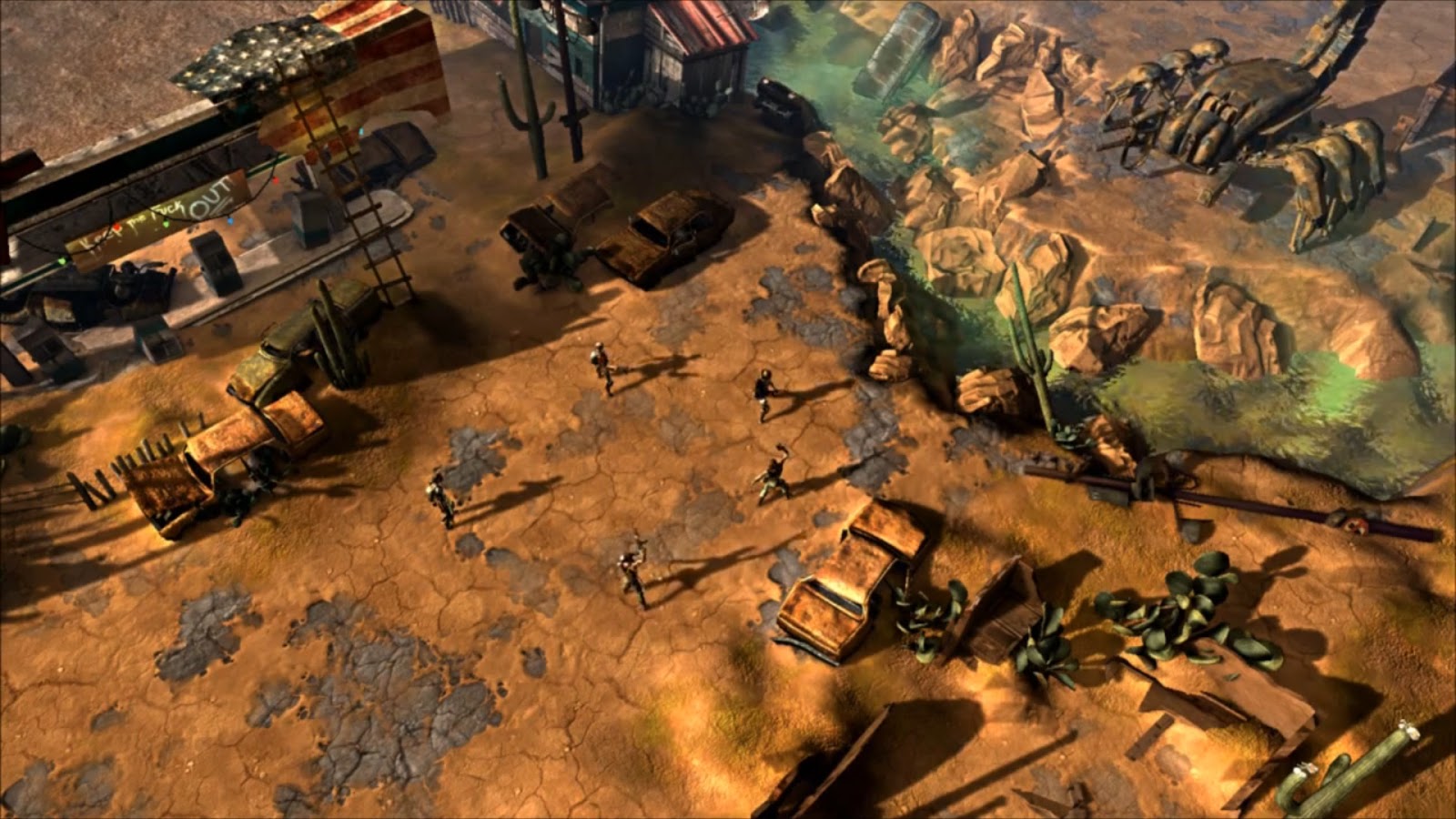
The upcoming Wasteland 2, from some of the same team that gave us the Fallout games, is a post-apocalyptic romp which makes few pretences towards scientific realism in its backstory or how anyone survived the nuclear apocalypse. However, the developers have called upon the services of real scientists to help portray environments and creatures, leading to the creation of the fearful giant hermit crab, which hides within the shells of abandoned and burned-out cars and gives the players a nasty surprise when they wander by.
As we can see, there are a few games around which do make more use of science and real SF ideas than as just a cheesy explanation for insane ultraviolence. Hopefully this is something we will see more of in the future.
See also: Polygon has interviews with the scientists who have consulted and advised on games such as Wasteland 2, BioShock Infinite, Deus Ex: Human Revolution and the upcoming Outlast.
Scientifically inexplicable.
That said, SF in games is usually scenery rather than the focus of the setting. The socio-economic basis of why the alien Lord Mental, with access to vast resources and commanding a star-spanning empire, needs to invade Earth in the Serious Sam series remains resolutely unexplored. And how do those suicide bomber guys scream when they don't have a head anyway? The science in science fiction is often questionable in books (and almost non-existent on TV and in film), and even moreso in games.
Still, exceptions exist. Here's a look at some games which attempt to use real science as more than just wallpaper.
Frontier: Elite 2 - Real Astronomy & Newtonian Physics
Released in 1993, Frontier was David Braben's ambitious follow-up to the classic, medium-defining 1984 space sim Elite. Frontier allows you to take on the role of the captain of a spacecraft. You can indulge in trading goods between star systems, fighting pirates (or turning pirate yourself) or undertaking missions for one of several interstellar powers (the Federation, the Empire or numerous independent worlds, as well as various corporations). You can switch between spacecraft and upgrade them.
Where the game was truly stunning was that it simulated the entire Milky Way Galaxy on just a single floppy disk. 100 billion stars were located in the galaxy, and the several hundred closest to Earth were placed in their (more or less) correct astronomical positions, along with a few hundred other major stars. You could fly to the Pleiades (though it'd take a while), check out Polaris or skim the surface of Arcturus. The game also used real Newtonian physics, complete with effectively infinite inertia once you had fired your engines in a particular direction, and space stations simulating gravity through centrifugal force. You could even fly over planetary surfaces and land at starports.
Of course, the game looks pretty primitive by modern standards, 99% of the stars in the game are randomly placed and named and the Newtonian physics make space combat unintuitive and almost ridiculously difficult to pull off (and the fact that few later space games - I-War and Tachyon's nods to it side - use real physics may be down to Frontier's problems). But the ambition and scope are there. It will be interesting to see if Elite: Dangerous, due in 2014, manages to solve the issues whilst retaining the immense scale, scope and ambition of its forebear.
Damocles: Mercenary II - Comets and Time Dilation
Predating Frontier by a few years, Damocles similarly depicts an impressive 3D universe which allows you to land and take off from planets. The setting is much more limited, with just a single solar system on offer. The spacecraft is also merely a way of getting from planet to planet, with the focus being on your character wandering around (in first-person 3D; a stunning achievement in 1990). The premise is that the comet Damocles is about to crash into and destroy the planet Eris and your character has to find a way of stopping it. The game presents several possibilities, from the direct (finding and blowing up the comet with a mega-powerful antimatter bomb) to the sensible (redirecting the comet away from Eris onto a safer orbit by blowing up another, uninhabited body nearby).
One of the more interesting things about the game is that your spacecraft can accelerate to near-lightspeed to get around the system, but this results in time dilation. You can travel right across the system in minutes, but the doomsday clock will tick down at a ridiculous rate. This forces the player to find alternate ways of travelling around (teleporters being the favourite alternative, but their locations are unknown at the start of the game) to avoid the problem.
Syndicate - Cyberpunk Dystopia
Also released in 1993, Syndicate was an action-strategy game set in a dystopian cyberpunk future, where the world is controlled by corporations who influence and pacify citizens via chips in their brains. These chips can be subverted by the player, allowing them to take control of huge crowds of people during missions to be used as cannon fodder or a distraction. This notion of human/computer interfaces is only lightly touched upon in the game due to control limitations, although it does bring in other SF ideas such as robot policemen and massive corporate advertising boards (influenced by Blade Runner). Most sinister is the way the game postulates a future where governments are rump states at best, with the real power held by corporations and their private armies.
A sequel, Syndicate Wars, moved the game into 3D in 1996. Recently, several of the design team for Syndicate and its sequel announced a Kickstarter campaign for a 'spiritual sequel', Satellite Reign, that will expand upon many of the ideas in the original game and allow for things like hacking and more freeform approaches to missions.
Hostile Waters - Nanotech Singularity and Social Revolution
One of the greatest (though also underplayed) strategy games of all time, Hostile Waters (aka Antaeus Rising in the USA) places you in command of an immense aircraft carrier with orders to liberate a chain of newly-risen islands from the control of a hostile power. What at first appears to be a remake of the classic 1987 strategy title Carrier Command (itself given a lacklustre, official remake in 2012) quickly turns into a different beast. Part of this is down to the compelling fiction, created by writer Warren Ellis.
The game postulates a technological singularity (in 2012) which comes to pass due to the invention of Creation Engines, devices which use nanotechnology to break items apart and reassemble them at a molecular level. Anything can be turned into anything else. Rubbish can be transformed into food, sand into diamonds. This immediately removes scarcity - famine, lack of resources - as an issue for everyone on the planet and would seem to herald a golden age. The owners of the means of production, who are effectively out of a job, resist by trying to regulate the introduction of Creation Engines, resulting in a messy, bloody global civil war. At the end of the war the 'old guard' are defeated and everyone lives in a world of plenty. Needless to say, some of these old guard launch a new assault using weaponised Creation Engine technology...technology which gets out of hand very rapidly.
Dealing with SF hot topics like nanotechnology, the Singularity (not exactly in a robust way, though, as the post-2012 society is still pretty comprehensible to us), life-extension via 'saving' consciousness on AI systems, the conflicts of closed systems versus open ones and ideology versus religion, the game's storyline is surprisingly deep though arguably flawed: the world also being a secularist paradise with billions of people abandoning religion seems a bit far-fetched, though there are hints that the new society has a sinister side as well. All the more remarkable is that this background is there purely to explain the game's use of standard strategy tropes, like being able to build vehicles instantly on the battlefield. The fiction is impressive and well-thought-out, complementing the amazing gameplay very well.
Portal - Science as Fun
Released in 2007, Portal was a small game but a hugely influential one. The game is based around the idea that you can create two linked dimensional portals on certain surfaces, allowing for intelligent ways to solve apparently insurmountable puzzles. Jumping across a vast chasm is possible by creating a portal on the wall behind you and another at the bottom of the chasm: falling into the chasm builds up enough momentum to shoot through the portal, over the top of the chasm and landing safely on the other side.
The portal technology is of course highly speculative, but it's a rare example of a gaming taking its central scientific/technological premise (no matter how ludicrous) and exploring it intelligently. The 'science!' theme, the impressive AI antagonist, the game's remarkable sense of humour and it's bigger, better sequel all help cement the game's reputation as one of the finest first-person action games in existence.
Deus Ex: Human Revolution - Augmentation and Cyborgs
This prequel to 2000's classic Deus Ex deals with a number of important near-future issues. As well as the standard cyberpunk government/corporation tension, the game explores the theme of augmentation and using technology to enhance human abilities in depth and with intelligence. The notion of how much of our bodies we can replace and remain human is also a key theme: does the corporation 'own' protagonist Adam Jensen because they paid for the augmentations that allow him to live? A rich and involving game (let down a little by silly boss fights).
BioShock Infinite - An Infinity of Possibilities
This recent game is set in an alternate timeline in which a huge flying city called Columbia was built in the early 20th Century thanks to the invention of quantum engines, technology that never existed in our world. As the game progresses, the protagonist and the girl he was sent to save find themselves passing through tears in the fabric of reality into other universes, including some similar to our own and others completely different.
The 'many worlds' theory of quantum reality is a common theme in modern SF, but this is the first time a game successfully explores the same theme with some intelligence and uses it to tie together the disjointed narrative in a manner which makes sense.
Wasteland 2 - Post-Apocalyptic Wildlife
The upcoming Wasteland 2, from some of the same team that gave us the Fallout games, is a post-apocalyptic romp which makes few pretences towards scientific realism in its backstory or how anyone survived the nuclear apocalypse. However, the developers have called upon the services of real scientists to help portray environments and creatures, leading to the creation of the fearful giant hermit crab, which hides within the shells of abandoned and burned-out cars and gives the players a nasty surprise when they wander by.
As we can see, there are a few games around which do make more use of science and real SF ideas than as just a cheesy explanation for insane ultraviolence. Hopefully this is something we will see more of in the future.
See also: Polygon has interviews with the scientists who have consulted and advised on games such as Wasteland 2, BioShock Infinite, Deus Ex: Human Revolution and the upcoming Outlast.
Sunday, 6 January 2013
Gollancz to publish three ELITE novels
Gollancz have announced that they will be publishing three novels based on the Elite series of computer games in 2014.
The new Elite game, Elite: Dangerous (the fourth in the thirty-year-old series), recently passed its funding goal on Kickstarter, ending with more than £1.5 million raised for game development. The title is expected to be released by mid-2014. To help the game reach its goal Gollancz pledged a significant sum on Kickstarter to buy the rights to publish three novels based on the Elite universe.
Gollancz had already been in discussions with David Braben and Frontier Studios about adding the original Elite tie-in novella, The Dark Wheel, to its SF Gateway online store. The Dark Wheel is notable as it was written by the late Robert Holdstock, best-known for his Mythago Wood series of novels. The Dark Wheel was packaged with the original BBC Micro release of Elite in 1984 (I still have a copy in a box somewhere). Frontier: Elite II, released in 1992, was also accompanied by a book of short stories entitled Tales of Life on the Frontier. Whether this will be reprinted at some point is unknown (but unlikely; it was not as good as Holdstock's novella).
The three novels will be published in 2014. The identities of the potential writers have not yet been revealed.
The new Elite game, Elite: Dangerous (the fourth in the thirty-year-old series), recently passed its funding goal on Kickstarter, ending with more than £1.5 million raised for game development. The title is expected to be released by mid-2014. To help the game reach its goal Gollancz pledged a significant sum on Kickstarter to buy the rights to publish three novels based on the Elite universe.
Gollancz had already been in discussions with David Braben and Frontier Studios about adding the original Elite tie-in novella, The Dark Wheel, to its SF Gateway online store. The Dark Wheel is notable as it was written by the late Robert Holdstock, best-known for his Mythago Wood series of novels. The Dark Wheel was packaged with the original BBC Micro release of Elite in 1984 (I still have a copy in a box somewhere). Frontier: Elite II, released in 1992, was also accompanied by a book of short stories entitled Tales of Life on the Frontier. Whether this will be reprinted at some point is unknown (but unlikely; it was not as good as Holdstock's novella).
The three novels will be published in 2014. The identities of the potential writers have not yet been revealed.
Tuesday, 6 November 2012
ELITE 4 Kickstarter announced
David Braben and Frontier Developments have put up a Kickstarter page for Elite: Dangerous, the long-awaited fourth game in the Elite series.
The original Elite was released in 1984 on the BBC Micro and is one of the most famous, seminal and game-changing titles of all time. It was an open-universe game in which you took a spaceship and could trade and fight your way across eight galaxies and some 2,000 star systems, all in (wireframe) 3D. It was the first major 3D game and one of the first games to give you total freedom in how you approached playing it. The sequel, Frontier: Elite II was released in 1993 and featured filled-in 3D graphics, multiple controllable spacecraft, an even vaster universe (hundreds of millions of procedurally-generated star systems in a - somewhat - accurate recreation of the Milky Way) and the ability to land on planets. The third game, First Encounters: Frontier II was released in 1995 and was notable for the number of bugs present in the game, resulting in a lawsuit between the developers and the publisher.
Braben has been teasing fans with the possibility of an Elite IV for many years before announcing this Kickstarter project. Braben indicates that raising funds the traditional way has been difficult, and he's only been able to spare a few developers to work on the project in moments of spare time, hence the decision to go down the Kickstarter route.
So far, mixed feelings. On the one hand, Elite was a seminal, brilliant game, a total gamechanger and one of the biggest steps forward in the history of the form. Frontier was also a very solid game, even if its ambition exceeded its grasp. However, the Kickstarter page is scant on details about the proposed title: no graphics or videos have been posted, which is odd for a game that's been in development (even if at a low ebb) for several years already. So far the only hard info that's been released is that the game will have modern graphics (as you'd expect) and some form of multiplayer component (as you'd expect). Otherwise there seems little to distinguish it from the X series of space sims or Chris Roberts's recently-announced Star Citizen (or even EVE Online, though presumably Elite IV will have direct 'twitch' controls rather than the mouse-driven interface of that title).
Still, with 10% of the funding already raised within hours of the announcement and even the BBC running a news story on it, it looks likely that this will be funded. Certainly a project worth keeping an eye on.
In visual terms, this was 1984's answer to Crysis II.
The original Elite was released in 1984 on the BBC Micro and is one of the most famous, seminal and game-changing titles of all time. It was an open-universe game in which you took a spaceship and could trade and fight your way across eight galaxies and some 2,000 star systems, all in (wireframe) 3D. It was the first major 3D game and one of the first games to give you total freedom in how you approached playing it. The sequel, Frontier: Elite II was released in 1993 and featured filled-in 3D graphics, multiple controllable spacecraft, an even vaster universe (hundreds of millions of procedurally-generated star systems in a - somewhat - accurate recreation of the Milky Way) and the ability to land on planets. The third game, First Encounters: Frontier II was released in 1995 and was notable for the number of bugs present in the game, resulting in a lawsuit between the developers and the publisher.
Braben has been teasing fans with the possibility of an Elite IV for many years before announcing this Kickstarter project. Braben indicates that raising funds the traditional way has been difficult, and he's only been able to spare a few developers to work on the project in moments of spare time, hence the decision to go down the Kickstarter route.
So far, mixed feelings. On the one hand, Elite was a seminal, brilliant game, a total gamechanger and one of the biggest steps forward in the history of the form. Frontier was also a very solid game, even if its ambition exceeded its grasp. However, the Kickstarter page is scant on details about the proposed title: no graphics or videos have been posted, which is odd for a game that's been in development (even if at a low ebb) for several years already. So far the only hard info that's been released is that the game will have modern graphics (as you'd expect) and some form of multiplayer component (as you'd expect). Otherwise there seems little to distinguish it from the X series of space sims or Chris Roberts's recently-announced Star Citizen (or even EVE Online, though presumably Elite IV will have direct 'twitch' controls rather than the mouse-driven interface of that title).
Still, with 10% of the funding already raised within hours of the announcement and even the BBC running a news story on it, it looks likely that this will be funded. Certainly a project worth keeping an eye on.
Subscribe to:
Posts (Atom)