Showing posts with label star trek: voyager. Show all posts

Wednesday, 24 September 2025

New STAR TREK video game will let you decide to murder Tuvix or let him live

Finally, you can make the decision yourself. Star Trek: Voyager - Across the Unknown is an ambitious video game which recreates the USS Voyager's entire seven-year journey across the Delta Quadrant, putting you in the command chair and making decisions very similar to the problems that Captain Janeway had to deal with.

Do you ally with the Borg to defeat Species 8472 or take a different path? Do you fight the Kazon or avoid them? And, most critically, will you brutally murder Tuvix or not? Will you promote Ensign Kim? Ever? And what will the long-term fallout from that be?

With some similarities to The Alters and XCOM's base-building, combined with some fine starship adventuring, the game looks like an intriguing spin on the franchise. Developed by Gamexcite and published by Daedalic, it doesn't have a release date yet but smart money is on 2026, for PC and console.

Friday, 25 October 2024

RIP Jeri Taylor

News has sadly broken that television producer and writer Jeri Taylor has passed away at the age of 86. She is best-known for her contributions to the Star Trek franchise, including co-creating Star Trek: Voyager.

Jeri Taylor on the set of Star Trek: The Next Generation. She was a writer and producer on the show from its fourth season, and executive producer during the final season.

Born in Bloomington, Indiana in 1938, Taylor received her BA degree in English from Indiana University in 1959. She later gained a master's degree in English from California State University in Northridge.

Taylor began working in television in 1976, producing and writing for shows including Quincy, M.E., Magnum, P.I., In the Heat of the NightJake and the Fatman and Blue Thunder. On Jake and the Fatman she met J. Michael Straczynski, giving him one of his first writing credits on a live-action show.

She joined Star Trek: The Next Generation in 1990 as a supervising producer, starting with the episode Brothers in Season 4. Her first writing credit was the episode Suddenly Human. She would go on to write or co-write episodes including The Wounded, Night Terrors, The Drumhead, Unification, Aquiel and Descent.

For Season 6 of TNG she was promoted to Co-executive Producer and for Season 7 became Executive Producer and effective showrunner (though the term was not used at the time) whilst Rick Berman and Michael Piller were focusing on Deep Space Nine. During Season 6 and 7 she was also involved in the development of Star Trek: Voyager, contributing enough that she was named co-creator of the show alongside Berman and Piller. She was made Executive Producer and effective showrunner of Voyager for its first four seasons. Taylor was closely identified with the writing and character development of Captain Janeway.

She also found time to work on Deep Space Nine, contributing story material for three episodes in its second season.

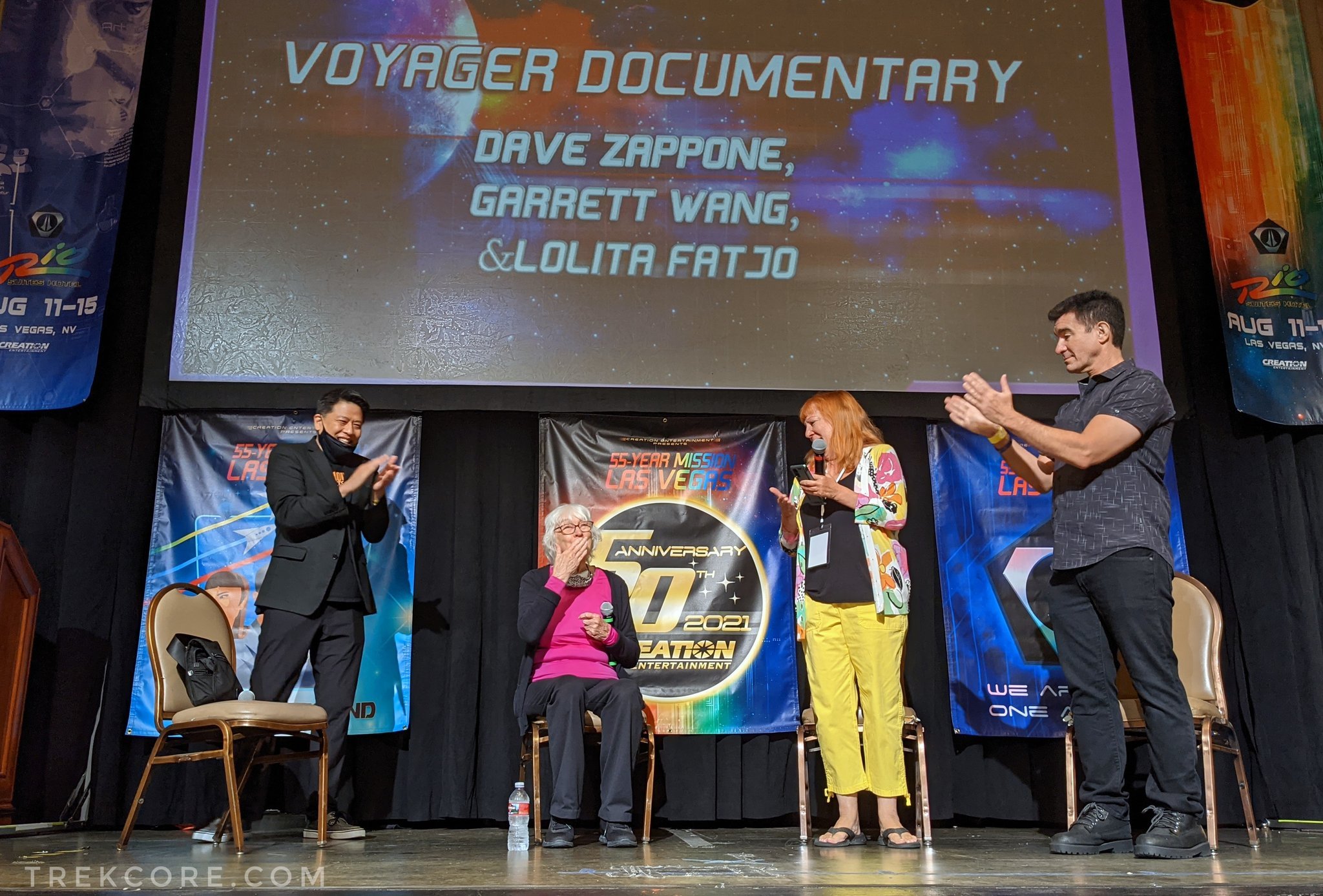
Taylor's appearance at STLV in Las Vegas, 2021, alongside Voyager actor Garrett Wang, TNG/DS9/VOY script supervisor Lolita Fatjo (for whom Leeta is named) and Voyager documentary director Dave Zappone. Source: TrekCore

Taylor was a rare TV writer who made the transition to novels, penning the novelisation of Unification before writing the novel Mosaic, which explores the backstory of Janeway in considerable detail, and its later sequel Pathways. Unlike most Star Trek novels, Taylor's books were considered of a higher level of canonicity and reliability.

Taylor chose to leave the Star Trek franchise after the fourth season of Voyager, but accepted the position of creative consultant for the remainder of Voyager's run, offering feedback on scripts.

After Voyager wrapped Taylor decided to retire from television altogether, and mostly shunned the limelight. However, in 2021 she attended her first Star Trek convention in Las Vegas and was warmly greeted by fans and fellow castmembers.

One of the more significant figures in the writing and development of Star Trek, Jeri Taylor was a skilled writer and producer. She will very much be missed.

Thursday, 8 October 2020

Kate Mulgrew to reprise role of Captain Janeway on STAR TREK: PRODIGY

Kate Mulgrew is reprising her most famous role, as Captain Kathryn Janeway from Star Trek: Voyager, for upcoming animated series Star Trek: Prodigy.

The new animated series - the second from the new Trek franchise, after Lower Decks - is aimed at a younger audience and will premiere on Nickelodeon, with a possible later appearance on CBS All Access. The series will be unusual in that it does not focus on a Starfleet crew, but instead a group of youngsters from various races who find themselves in control of a derelict Starfleet vessel. It's unclear how Janeway will interact with the new characters, or, indeed, what the timeframe for the series will be.

Star Trek: Prodigy is in production at the moment and expected to debut in 2021.

Friday, 10 April 2020

Where to Start with Star Trek?

The recent arrival of Star Trek: Picard on CBS All Access and Amazon Prime has spurred a renewed interest in the venerable SF franchise. New viewers want to check out the older material, but the sheer amount of it is daunting. By the summer of 2020, no less than 34 seasons of television will have aired in the franchise, totalling 777 episodes spread across eight separate series airing over fifty-four years (and counting). It would take you more than 570 hours (or almost 24 days, non-stop) to watch all of that material. In addition, there are 13 feature films in the mix, as well as a plethora of video games and hundreds of novels, audio dramas and fan films. If you want to check out this mass of material where do you start?

There are several different approaches you can take and I’ll run through a few of them below. The one thing I would say first is that, with a few notable exceptions, Star Trek is mostly an episodic franchise, where each episode stands alone with its own beginning, middle and end. That starts to shift in Deep Space Nine, which introduces more serialised elements, and by the time of Discovery and Picard the series has become fully serialised, but for the most part the different series are episodic and in fact designed for each episode to be enjoyed by themselves.

Before we get into the lists, it might be worthwhile briefly brushing up on what each series is about.


Star Trek: The Original Series
Live-action: 1966-69 • 79 episodes • 3 seasons • 6 films (1979-91)
Animated: 1973-74 • 22 episodes • 2 seasons


Also called the original series, the classic series or just Star Trek, this series follows the adventures of Starfleet Captain James T. Kirk and the crew of the Constitution-class starship USS Enterprise. They explore strange new worlds, encounter new alien life and seek to uphold the utopian values of the United Federation of Planets in the mid-23rd Century whilst dealing with recurring enemies, including the Klingons and Romulans. The story of this series continues in Star Trek: The Animated Series (which is the same, but as a cartoon) and then in the first six Star Trek feature films.

The first episode of the series, The Cage, was filmed two years before the rest of the series and features a significantly different cast of characters (who do go on to play major roles in some of the films and in Star Trek: Discovery, which revisits the same time period).


Star Trek: The Next Generation
1987-94 • 178 episodes • 7 seasons • 4 films (1994-2002)

Set in the mid-24th Century, roughly 100 years after the events of the original series, The Next Generation focuses on a brand-new, much larger and vastly more sophisticated Galaxy-class USS Enterprise under the command of Captain Jean-Luc Picard. The emphasis remains on exploring new worlds and meeting new races. Although the series mostly remains episodic, recurring and more serialised elements creep in towards its end. Most notable is the introduction of the Borg, an overwhelmingly powerful cybernetic threat which remains a key enemy through the next several series, and the Cardassians, a mid-ranking antagonistic enemy. The story of this series continues in the seventh through tenth Star Trek feature films and the sequel-series Star Trek: Picard, set thirty years later.


Star Trek: Deep Space Nine
1993-99 • 176 episodes • 7 seasons

To date, the only Star Trek series not set on a starship. Instead, the focus is on Deep Space Nine, a Federation outpost established on an abandoned Cardassian space station orbiting the planet Bajor. The Cardassians conquered and ruled Bajor with an iron fist for forty years before withdrawing, leaving the planet in ruins. The Federation are helping them rebuild, their efforts spearheaded by Commander Benjamin Sisko. Unlike most Star Trek series, which focuses on the Federation and Starfleet crewmembers, this series has a large number of civilian and alien recurring characters. Bajor becomes unexpectedly important when a stable wormhole leading to the remote Gamma Quadrant of the galaxy is discovered, allowing the planet to benefit from increased trade (to the fury of the Cardassians). Early seasons revolve around renewed Cardassian/Bajoran tensions before the introduction of the Dominion, the alien alliance which rules the Gamma Quadrant and is unhappy with the Federation poking around its back yard. Later seasons are more heavily serialised and see the outbreak of full-scale war between the Federation and the Dominion.

Deep Space Nine was controversial during its first airing for being perceived as a lot darker than prior Star Trek shows, but in recent years it has undergone a critical reassessment and is now often cited as the best (or at least the most critically consistent) of the Star Trek series.


Star Trek: Voyager
1995-2001 • 172 episodes • 7 seasons

This series opens when the USS Voyager is flung 75,000 light-years across the galaxy to the Delta Quadrant and has to return home, which is estimated will take over seventy years at maximum warp. Captain Kathryn Janeway and her crew seek to find faster ways home with any means at their disposal, whilst upholding Federation values in a desperate corner of space where no one even knows who the Federation are.


Star Trek: Enterprise
2001-05 • 98 episodes • 4 seasons

A prequel series taking place about a century before the events of The Original Series, this show takes place before the Federation or Starfleet even exist. Instead, it follows the adventures of the NX-01 Enterprise, Earth’s first experimental spacecraft with a Warp 5 drive. The series sees the crew trying to engage in interstellar diplomacy, exploration and commerce with much more primitive technology than even in Kirk’s time, whilst also trying to deal with problems such as a brewing conflict between the Andorians and Vulcans, and Earth’s first fumbling dealings with the Klingons and Romulans. The series is almost completely episodic for its first two years, but in its third season explores a series-long arc where Enterprise has to search for aliens who carried out a devastating sneak attack on Earth. The final season is divided into shorter arcs revolving around the formation of the Federation.


Star Trek: The Kelvin Timeline Films
2009-16 • 3 films

A series of three films (Star Trek, Into Darkness, Beyond) produced by J.J. Abrams, these films are set in an alternate timeline created by time travel. Spock (from the original series) is blasted back in time by his failure to stop the destruction of the Romulan homeworld, pursued by a vengeful Romulan crew. This results in alterations to the timeline, such as a younger James T. Kirk and his fellow crewmembers joining forces and taking command of the Enterprise years earlier than in the original timeline and getting into fresh, new adventures in the mid-23rd Century.


Star Trek: Discovery
2017 onwards • 42 episodes • 3 seasons (to date, as of the end of 2020)

Another prequel series, this time taking place ten years before the events of The Original Series. The focus is on Michael Burnham, the first officer of the USS Shenzhou who badly fumbles a confrontation with the Klingons, inadvertently leading to a massive war. A disgraced Burnham is assigned to the USS Discovery, a highly experimental starship with unusual technology and an oddball, maverick captain, where she is offered the chance to atone for her mistakes.


Star Trek: Picard
2020 onwards • 10 episodes • 1 season (to date)

A sequel series set at the end of the 24th Century, Star Trek: Picard picks up story elements left dangling from the end of The Next Generation, Deep Space Nine and Voyager, as well as exploring events in the original timeline after the destruction of Romulus (in the original timeline).


The Curated Sample

This order is not exhaustive but what it does is provide a snapshot of the different series and some of the strongest stand-alone episodes which hold up well today. These episodes are stand-alones (not part of multi-episodic arcs) and are designed to showcase some of the different types of storytelling the series indulges in. A viewer can jump from these episodes into the rest of that series if they like what they see.

The Animated Series is effectively a continuation of The Original Series and it would be hard to recommend individual episodes from Enterprise, Discovery or Picard due to their heavy serialisation (Picard is also best-watched having seen some or all of The Next Generation first).
  • Star Trek: The Original Series, The City on the Edge of Forever
  • Star Trek: The Original Series, The Trouble with Tribbles
  • Star Trek: The Original Series, Space Seed
  • Star Trek II: The Wrath of Khan
  • Star Trek: The Next Generation, The Measure of a Man
  • Star Trek: The Next Generation, Q Who?
  • Star Trek: The Next Generation, The Inner Light
  • Star Trek: Deep Space Nine, The Visitor
  • Star Trek: Deep Space Nine, Far Beyond the Stars
  • Star Trek: Deep Space Nine, In the Pale Moonlight*
  • Star Trek: Voyager, Eye of the Needle
  • Star Trek: Voyager, Message in a Bottle
* This may seem to be an exception to the multi-episode arc rule, as In the Pale Moonlight has references to and a big impact on the Dominion War storyline which dominates much of Deep Space Nine’s latter seasons. However, the episode itself is more about Sisko’s journey and how he and Garak bring about a major shift in political events whilst never leaving the station (the Dominion itself does not appear), which can be understood well enough without additional context.


The Pilot Sample

This approach simply has the viewer sampling the first episode of each version of the series to see what grabs their attention straight away, and from there they can choose which series to watch first:
  • Star Trek: The Original Series, The Cage (1964)
  • Star Trek: The Original Series, Where No Man Has Gone Before (1966)
  • Star Trek: The Next Generation, Encounter at Farpoint (1987)
  • Star Trek: Deep Space Nine, The Emissary (1993)
  • Star Trek: Voyager, Caretaker (1995)
  • Star Trek: Enterprise, Broken Bow (2001)
  • Star Trek: Discovery, The Vulcan Hello (2017)

Release Order

AKA the “completionist” approach. This may be the approach everyone ends up taking once they’ve been sucked into the material, but I wouldn’t recommend it for a first run-through. This approach basically means watching the series in order of release and is the best for enjoying the series as it originally aired and was intended (just somewhat compressed).

The primary weakness of this approach is having to watch The Original Series in full before the more recent shows. The original show is certainly great from the perspective of a 1960s TV series and also has many outstanding episodes that have withstood the test of time, but it also has a lot of episodes that…have not. The series underwent an in-depth HD remastering process in 2006 which saw the film quality improved and revamped CG effects added to make the visual quality of the episodes more acceptable to modern audiences, although obviously the writing and performances were not affected.

You can tweak this order for simplicity: there’s nothing stopping you from watching all six films featuring the original cast before watching The Next Generation, and Deep Space Nine and Voyager are divorced from one another almost completely, so you could watch DS9 in full before switching to Voyager. TNG and DS9 do have a few more notable crossovers in terms of characters and storylines, but it also wouldn’t be the end of the world if you finished watching TNG in full before watching DS9.
  • Star Trek: The Original Series Pilot, The Cage (made in 1964, but didn’t air until later as part of the original series)
  • Star Trek: The Original Series Season 1-3 (1966-69)
  • Star Trek: The Animated Series Season 1-2 (1973-74)
  • Star Trek: The Motion Picture (1979)
  • Star Trek II: The Wrath of Khan (1982)
  • Star Trek III: The Search for Spock (1984)
  • Star Trek IV: The Voyage Home (1986)
  • Star Trek: The Next Generation Season 1-2 (1987-89)
  • Star Trek V: The Final Frontier (1989)
  • Star Trek: The Next Generation Season 3-4 (1989-91)
  • Star Trek VI: The Undiscovered Country (1991)
  • Star Trek: The Next Generation Season 5 (1991-92)
  • Star Trek: Deep Space Nine Season 1 / Star Trek: The Next Generation Season 6 (1992-93)
  • Star Trek: Deep Space Nine Season 2 / Star Trek: The Next Generation Season 7 (1993-94)
  • Star Trek: Generations (1994)
  • Star Trek: Deep Space Nine Season 3 (1994-95) / Star Trek: Voyager Season 1 (1995)
  • Star Trek: Deep Space Nine Season 4 / Star Trek: Voyager Season 2 (1995-96)
  • Star Trek: First Contact (1996)
  • Star Trek: Deep Space Nine Season 5 / Star Trek: Voyager Season 3 (1996-97)
  • Star Trek: Deep Space Nine Season 6 / Star Trek: Voyager Season 4 (1997-98)
  • Star Trek: Insurrection (1998)
  • Star Trek: Deep Space Nine Season 7 / Star Trek: Voyager Season 5 (1998-99)
  • Star Trek: Voyager Season 6-7 (1999-2001)
  • Star Trek: Enterprise Season 1 (2001-02)
  • Star Trek: Nemesis (2002)
  • Star Trek: Enterprise Season 2-4 (2002-05)
  • Star Trek (2009)
  • Star Trek Into Darkness (2013)
  • Star Trek Beyond (2016)
  • Star Trek: Discovery Season 1-2 (2017-19)
  • Star Trek: Picard Season 1 (2020)
  • Star Trek: Discovery Season 3 (2020)

Chronological Order
This order lists the series in the order of when the episodes take place in the order of events within the Star Trek universe.

This order has some strengths, as it roughly matches the historical order of events, but it also has some major weaknesses. It puts Enterprise, arguably the weakest Trek series overall, up first and also features a number of spoilers for later series (since the Enterprise writers couldn’t resist pulling in familiar creatures and aliens to the show from later periods, no matter how incongruous). You’re also talking about waiting a long time to get to the good stuff.
  • Star Trek: Enterprise Seasons 1-4 (2151-55, 2161)
  • Star Trek: The Original Series Pilot, The Cage (2254)
  • Star Trek: Discovery Seasons 1-2 (2256-57)
  • Star Trek: The Original Series Seasons 1-3 (2266-68)
  • Star Trek: The Animated Series Seasons 1-2 (2269-70)
  • Star Trek: The Motion Picture (2271)
  • Star Trek II: The Wrath of Khan (2285)
  • Star Trek III: The Search for Spock (2285)
  • Star Trek IV: The Voyage Home (2286)
  • Star Trek V: The Final Frontier (2287)
  • Star Trek VI: The Undiscovered Country (2293)
  • Star Trek: The Next Generation Seasons 1-5 (2364-68)
  • Star Trek: The Next Generation Season 6 / Star Trek: Deep Space Nine Season 1 (2369)
  • Star Trek: The Next Generation Season 7 / Star Trek: Deep Space Nine Season 2 (2370)
  • Star Trek: Deep Space Nine Season 3 / Star Trek: Voyager Season 1 (2371)
  • Star Trek: Generations (2371)
  • Star Trek: Deep Space Nine Season 4 / Star Trek: Voyager Season 2 (2372)
  • Star Trek: First Contact (2373)
  • Star Trek: Deep Space Nine Season 5 / Star Trek: Voyager Season 3 (2373)
  • Star Trek: Deep Space Nine Season 6 / Star Trek: Voyager Season 4 (2374)
  • Star Trek: Insurrection (2375)
  • Star Trek: Deep Space Nine Season 7 / Star Trek: Voyager Season 5 (2375)
  • Star Trek: Voyager Season 6-7 (2376-77)
  • Star Trek: Nemesis (2379)
  • Star Trek (2385, alternate 2258), Star Trek Into Darkness (2259), Star Trek Beyond (2263)*
  • Star Trek: Picard (2399)
  • Star Trek: Discovery Season 3 (c. 3160)
* The chronological order of events also makes placing the Kelvin timeline movies awkward, as they rely heavily on knowledge of events after the original show and The Next Generation but are set much earlier, albeit in a parallel universe. Sticking them here is probably the best approach.

What's the best order then? I'd say order of release for those who want to experience the franchise as it was released and understand it could be a bit of a bumpy ride, otherwise one of the curated approaches might be best.

Thank you for reading The Wertzone. To help me provide better content, please consider contributing to my Patreon page and other funding methods.

Saturday, 20 July 2019

Familiar faces join the crew in first STAR TREK: PICARD trailer

CBS All Access has released the first trailer for Star Trek: Picard, their new TV series which picks up with the adventures of the retired Admiral Picard twenty years after his previous appearance in the film Star Trek: Nemesis (2002).


The trailer explains the storyline. Picard is in retirement at his family vineyard in France (previously visited in the Star Trek: The Next Generation Season 4 episode Family) when he is visited by a young woman named Dahj (Isa Briones), who is in danger. She is attacked by unknown assailants whom she fends off. Picard requests Starfleet's aid in protecting her and ends up assembling a crew consisting of Cristobel Rios (Santiago Cabrera), Raffi Musiker (Michelle Hurd), Dr. Agnes Jurati (Alison Pill), Narek (Harry Treadway) and Elnor (Evan Evagora).


More surprising is that Picard is also joined by some familiar faces on his travels, including former Borg agents Seven of Nine (Jeri Ryan, from Star Trek: Voyager) and Hugh (Jonathan Del Arco, from three episodes of The Next Generation), and an android played by the redoubtable Brent Spiner. It appears that this android is B-4, the prototype android for Lt. Commander Data. Data's destruction in Nemesis is mentioned as another motivating factor for Picard's mission and the presumed decision to resurrect B-4 for this mission.


It has also been confirmed that Jonathan Frakes and Marina Sirtis will also be reprising their roles as Riker and Troi from Star Trek: The Next Generation for the series, although it is unclear how extensive their roles will be.


Near the end of the episode it is also confirmed who the real big bad of the series will be: the Borg! A Borg cube is shown either being constructed or rebuilt, and the Borg threat is presumably what calls Picard (who has a long-standing grudge against them), Hugh and Seven into the fight.

Star Trek: Picard will debut on CBS All Access in the United States and Amazon Prime in the rest of the world in early 2020.

Saturday, 10 September 2016

Gratuitous Lists: The Star Trek TV Series Ranked

The philosophy of the Gratuitous Lists feature was to have lists of stuff that are unranked, because frankly if you're talking about the 12th best thing of all time or the 9th best thing of all time, the differences are going to be pretty minor. In the case of the Star Trek lists, however, that's kind of pointless because there's way too few things to put on the list. So for these ones I'm ranking them and people can argue away to their heart's content. So let us proceed:

The cast of Voyager: Lt. Harry Kim (Garrett Wang), Seven-of-Nine (Jeri Ryan), the Doctor (Robert Picardo), Neelix (Ethan Phillips), Captain Katherine Janeway (Kate Mulgrew), Commander Chakotay (Robert Beltran), Lt. B'Elanna Torres (Roxann Dawson), Lt. Tom Paris (Robert Duncan McNeill) and Lt. Commander Tuvok (Tim Russ)


6. Star Trek: Voyager
Created by Rick Berman, Michael Piller and Jeri Taylor Produced by Rick Berman, Jeri Taylor, Michael Piller and Brannon Braga • Aired 16 January 1995-23 May 2001 • 7 seasons 172 episodes

Timeframe: AD 2371-2377

Premise: The Intrepid-class USS Voyager is dispatched on a mission to apprehend a vessel belonging to the Maquis, a terrorist group. Both ships are inadvertently transported 70,000 light-years to the remote Delta Quadrant of the galaxy. Captain Janeway is forced into an uneasy alliance with the Maquis commander, Chakotay, so that both crews can return home to Federation space.

Assessment: When Voyager started in 1995, it had a lot of promise to it. Fans had been criticising The Next Generation (and, to a lesser extent, the original series) because it spent an awful lot of time flying between starbases rather than genuinely going "where no one had gone before". By dumping a Federation starship on the far side of the galaxy with no Federation, no Starfleet, no Klingons and no Romulans, the hope was to create a completely new set of heroes and villains, with the incredibly isolated ship in genuine danger.

None of that really happened. Voyager remained in pristine condition despite not being able to resupply or get repaired. Continuity was minimal, with the reset button being hit at the end of every episode. Its new, original races were cheesy stock races which didn't vary from the Star Trek standard, and it wasn't long before the show was (rather desperately) trying to shoehorn in Klingons, Romulans and the Ferengi. The most prevalent new enemy race, the Kazon, were soon thrown out for being dire and the show settled on The Next Generation's most memorable foe, the Borg, as their main enemy, as well as reintroducing staple TNG villain Q.

The show moderately improved in the fourth season, with the introduction of Jeri Ryan as "saved" Borg drone Seven of Nine. Seven provided an able foil for Captain Janeway, with their on-screen antagonism giving way to mutual respect fuelled by the actresses' off-screen antipathy to one another. Rapidly improving CG effects technology also resulted in some visually impressive episodes late in the show's run. However, a largely indifferent and unchallenged cast, some awful writing and a lot of pulled punches made Star Trek: Voyager excruciating most of the time and just plain dull the rest.

The show wasn't a complete wash, however, with Robert Picardo's excellent performance as the ship's holographic doctor gradually attaining sentience providing a lot of humour and, surprisingly, pathos as the show continued. However, the show's greatest success may have been annoying long-term Trek writer Ronald D. Moore so much with its unfulfilled promise that he later went off and put most of his ideas into practice on the far superior Battlestar Galactica (2003-09) reboot instead.

Check Out: Scorpion (Parts 1 & 2), Year of Hell, Message in a Bottle.

Avoid at All Costs: Threshold, Fair Haven, Endgame and, to be frank, any episode that doesn't revolve around the Doctor or Seven-of-Nine.

The cast of Enterprise: Dr. Phlox (John Billingsley), Chief Engineer Charles "Trip" Tucker (Connor Trinneer), Ensign Travis Mayweather (Anthony Montgomery), Captain Jonathan Archer (Scott Bakula), T'Pol (Jolene Blalock), Ensign Hoshi Sato (Linda Park) and Lt. Malcolm Reed (Dominic Keating.

5. Star Trek: Enterprise

Created by Rick Berman and Brannon Braga Produced by Rick Berman, Brannon Braga and Manny Coto • Aired 26 September 2001-13 May 2005 • 4 seasons 98 episodes

Timeframe: 16 April 2151-55 (the final episode takes place in 2161)

Premise: In 2151 Earth launches its first Warp 5-capable ship, the NX-01 Enterprise, under the command of Jonathan Archer and the watchful eye of the Vulcan "advisor" T'Pol. Earth faces rising tensions between neighbouring worlds like Tellar, Vulcan and Andora, not to mention navigating the dangerous first contact with the Klingon Empire. But the Enterprise's adventures will eventually set the scene for the birth of the United Federation of Planets itself.

Assessment: When Paramount demanded that Star Trek uber-producer Rick Berman create a new series to follow up Voyager, he was dubious. He felt that the series was suffering from "franchise fatigue" after shooting twenty-one seasons in fourteen years and recommended resting the show for a while. But Paramount wanted the new series to start immediately. Reluctantly, Berman and co-writer Brannon Braga complied.

And they did try to be original. They decided to make the new show a prequel, set a century before the original series. Their aim was to gradually build to the founding of the Federation. The decision to have a ship called Enterprise which had never been mentioned before was cheesy, but they did at least attempt to justify it. They also made clever use of ever-more-impressive effects technology and the casting was much better than Voyager's, with the actors feeling more engaged and excited by the project. But too often in the first two seasons the writers fell back on stock Star Trek ideas and situations rather than doing the premise justice.

In Season 3 they abruptly course-corrected. They brought in a talented and imaginative new writer, Manny Coto, and began engaging in more serialisation. They also dropped the ill-advised "temporal cold war" story of the first two seasons (a pointless attempt to keep touching base with the post-Voyager timeline) and focused more on interstellar politics and tensions, laying the seeds for the foundation of the Federation. This culminated in the Coto-helmed fourth season which saw a dramatic upswing in quality. Unfortunately, when the series was cancelled they decided to go out on a truly diabolical note. These Are the Voyages... is the worst Star Trek finale and one of the worst episodes in the franchise's history, and soured both fans and cast on the show. Still, there are some great episodes to be found and if Enterprise was one series too far, at least it tried to be original and ambitious.

Check Out: Demons, Terra Prime, The Forge, Babel One, The Andorian Incident.

Avoid at All Costs: These Are the Voyages..., A Night in Sickbay, Two Days and Two Nights.

The cast of The Animated Series: Lt. Nyota Uhuru (Nichelle Nichols), Commander Spock (Leonard Nimoy), Commander Montgomery Scott (James Doohan), Lt. Arex (James Doohan), Captain James T. Kirk (William Shatner), Lt. M'Ress (Majel Barrett), Lt. Hikaru Sulu (George Takei), Dr. Leonard McCoy (DeForest Kelley) and Nurse Christine Chapel (Majel Barrett)

4. Star Trek: The Animated Series
Created by Gene Roddenberry Produced by Gene Roddenberry and D.C. Fontana • Aired 8 September 1973-12 October 1974 • 2 seasons 22 episodes

Timeframe: approx. 2269-70

Premise: Continuing the five-year mission of the USS Enterprise under Captain James T. Kirk. Only in two dimensions.

Assessment: Given The Animated Series's relative obscurity (until its recent re-release) and the fact it's animated on a low budget, it's actually surprisingly decent. The writers (many returning from the live-action series) clearly revel in the fact that they can depict truly alien beings and planets and the TV show actors all return to voice their characters, which adds a lot of credibility to the show. The show has also been surprisingly well-suited to modern social media, with both Swear Trek and Starcher Trek generating a lot of laughs based on it.

Check Out: Yesteryear, The Time Trap, More Tribbles, More Troubles, The Lorelei Signal.

Avoid at All Costs: Mudd's Passion

The cast of the original series: Chief Engineer Montgomery Scott (James Doohan), Ensign Pavel Chekov (Walter Koenig), Dr. Leonard McCoy (DeForest Kelley), Nurse Christine Chapel (Majel Barrett), Captain James T. Kirk (William Shatner), Lt. Nyota Uhuru (Nichelle Nichols), Commander Spock (Leonard Nimoy) and Lt. Hikaru Sulu (George Takei)

3. Star Trek: The Original Series
Created by Gene Roddenberry Produced by Gene Roddenberry, Gene L. Coon and Fred Freiberger • Aired 8 September 1966-3 June 1969 • 3 seasons 79 episodes

Timeframe: approx. 2265-68 (the pilot episode takes place circa 2255)

Premise: In the mid-23rd Century, Captain James T. Kirk commands the Constitution-class USS Enterprise (NCC-1701) on a five-year mission to explore strange new worlds, seek out new life and new civilisations and to boldly go where no one has gone before.

Assessment: For a show made in the 1960s, the original Star Trek has withstood the test of time far better than you'd expect. The regular actors are on top form throughout and some of the episodes remain genuinely inventive, powerful and surprisingly topical. Other episodes are poor, particularly most of the third season when the network replaced Gene Roddenberry with hack writer Fred Freiberger, but the seeds of Star Trek and the reason the franchise has lasted fifty years are clearly in place.

The original show probably has the strongest set of characters in terms of archetypes, but it's actually startling how little most of the characters bar Spock, McCoy and Kirk get to do. Given there's 79 episodes, you'd expect Chekov, Sulu, Uhura and Scotty to have at least a few dedicated episodes apiece but nope. They'd have to wait until the films and the reboot movies to get a bigger slice of the action.

Still, the original series still packs an impressive emotional wallop in episodes like The City on the Edge of Forever and Amok Time, whilst episodes like Space Seed and Balance of Terror are effective, tense action stories and The Trouble with Tribbles is a splendid comedy piece. This is where it all started, and it (mostly) still holds up well.

Check Out: The City on the Edge of Forever, Space Seed, Amok Time, Balance of Terror, Mirror, Mirror, The Trouble with Tribbles.

Avoid at All Costs: Spock's Brain, The Way to Eden, Turnabout Intruder.

The cast of The Next Generation: Commander William Riker (Jonathan Frakes), Counsellor Deanna Troi (Marina Sirtis), Lt. Commander Data (Brent Spiner), Captain Jean-Luc Picard (Patrick Stewart), Guinan (Whoopi Goldberg), Lt. Commander Geordi LaForge (LeVar Burton), Dr. Beverly Crusher (Gates McFadden) and Lt. Worf (Michael Dorn)

2. Star Trek: The Next Generation
Created by Gene Roddenberry Produced by Gene Roddenberry, Rick Berman, Michael Piller and Jeri Taylor • Aired 28 September 1987-23 May 1994 • 7 seasons 178 episodes

Timeframe: AD 2364-71


Premise: Almost a century after Kirk's time, Captain Jean-Luc Picard commands the Galaxy-class USS Enterprise (NCC-1701-D) as it defends the Federation, explores new planets and undertakes cutting-edge scientific research.

Assessment: Bringing back Star Trek was an obvious move, but employing a whole new cast and set of characters and putting them on a new (and, at the time, rather weird-looking) Enterprise a hundred years further in the future? Paramount made a massive gamble with Star Trek: The Next Generation and one that at first didn't look like it had paid off. Although ratings were strong, most of the show's first two seasons were torn apart by critics. It wasn't until deep in the second season that classic episodes started appearing.

It took Gene Roddenberry's retirement and the bringing-in of hungry new writer-producer Michael Piller to really let things take off. In particular, the writers Piller brought in like Ronald D. Moore and Naren Shanker soon really began making the show work by writing to the strengths of the characters. New enemies like the Borg were introduced, old races like the Klingons and Romulans were explored in greater depth and, most importantly of all, the show employed the formidable skills of some extremely talented actors like Patrick Stewart and Brent Spiner.

The Next Generation is easily the most popular incarnation of Star Trek, its ratings dwarfing that of the rest, but it's also the most important. It showed that Star Trek can still work when you move away from the Kirk-Spock dynamic and that the universe can have numerous different kinds of story in it.

However, it's not the best. TNG is somewhat inconsistent in tone, with almost half the run of the show being blighted by weak episodes. At its best with episodes like The Best of Both Worlds, TNG is absolutely untouchable, but its worst episodes are horribly-written, badly-conceived and even outright racist (Code of Honour put off future Trek writer Brannon Braga from even watching the show). In addition, although TNG does pay more attention to continuity than the original show (or even Voyager), it still hits the reset button and avoids exploring the consequences of major character moments too easily.

Check Out: The Measure of a Man, Q Who?, Sins of the Father, Yesterday's Enterprise, Deja Q, The Best of Both Worlds (Parts 1 and 2), Family, The Inner Light, Tapestry, All Good Things, most of Seasons 3-6.
 
Avoid at All Costs: Code of Honour, Justice, Up the Long Ladder, Genesis, Sub Rosa, most of Seasons 1, 2 and 7.

The cast of Deep Space Nine: Lt. Commander Worf (Michael Dorn), Lt. Jadzia Dax (Terry Farrell), Chief Engineer Miles O'Brien (Colm Meaney), Dr. Julian Bashir (Alexander Siddig), Quark (Armin Shimmerman), Captain Benjamin Sisko (Avery Brooks), Security Chief Odo (Rene Auberjonois), Major Kira Nerys (Nana Visitor) and Jake Sisko (Cirroc Lofton).

1. Star Trek: Deep Space Nine
Created by Rick Berman and Michael Piller Produced by Rick Berman, Michael Piller and Ira Steven Behr • Aired 3 January 1993-2 June 1999 • 7 seasons 176 episodes

Timeframe: AD 2369-75

Premise: After forty years of brutal occupation, the Cardassian Union has withdrawn from the planet Bajor, leaving it exhausted and devastated. The Federation agrees to provide assistance, directing relief efforts from an abandoned Cardassian space station, Terok Nor, which they rename Deep Space Nine. When a stable wormhole linking Bajor to the remote Gamma Quadrant of the galaxy is discovered, Bajor and Deep Space Nine become the most important locations in Federation space. When a hostile alien government in the Gamma Quadrant, the Dominion, stages an invasion of Federation space, it also becomes the flashpoint for the most devastating war in the Federation's history.

Assessment: When Deep Space Nine started in 1993 it was seen as The Next Generation's slightly crazy spin-off. That hasn't entirely changed in the quarter-century since then. It's the only Star Trek series not predominantly set on a starship, it doesn't feature too much boldly going where no-one has gone before and the cast is the most eclectic, oddball collection of characters ever assembled for a Trek series. It also had a perceived rivalry with another space station-set SF show, the conceptually bolder Babylon 5, which at the time it was felt that DS9 had lost.

History, on the other hand, has been much kinder to Deep Space Nine. The fact it's set on a space station is something it turns to its advantage, gradually accumulating a very large cast of secondary and recurring characters that really makes its corner of the Federation feel like a real, lived-in place. It explores the themes and ideas of the Star Trek universe in exacting - even uncomfortable - depth. It even has a cast of recurring, brilliantly-realised villains in the last couple of seasons. It takes a long look at the ideals of Star Trek, tests them, but often finds that they are still valid. Deep Space Nine is, indeed, the "darkest" incarnation of Star Trek but it is still full of hope and optimism, even at the bloodiest heights of the Dominion War in Seasons 6 and 7.

This is also the most mature and progressive installment of Star Trek. Gene Roddenberry liked to talk up a good fight, how he was going to be more inclusive and show gay people and stronger female characters in the Star Trek universe, but he always retreated from doing it. Deep Space Nine faced an uphill battle to even include two women kissing briefly, but at least it made the attempt. It also tackled issues like racism and social inequality head-on, never more powerfully in stories like Far Beyond the Stars.

No other Star Trek series matches DS9 for its organic, beautifully-played character growth across the series. There was also the attitude it took to entire races. It explored the spirituality and religion of Bajor, it made the Klingons a little scarier and more alien again and it rehabilitiated the Ferengi, whose sexism and misogyny had been played a little too much for laughs on TNG even when it got uncomfortable.

But for a show that could be the most serious Trek series it is also the most hilarious. Trials and Tribbleations (in which Forrest Gump-style technology is used to integrate the DS9 crew into footage from the original series) is hands-down the funniest episode of the entire franchise, with scenes including Worf's deadpan description of the genocidal war launched by the Klingon Empire against the tribbles, Bashir urgently trying to convince O'Brien he should sleep with a woman in case she's his own great-grandmother and he needs to ensure his own existence, and Dax throwing tribbles out of a storage compartment to hit Captain Kirk on the head. In the Cards is a more subtle episode which gently takes the mickey out of the Federation's hippy ideology ("We work to better ourselves, and all of humanity," "What does that mean, exactly?" "It means we haven't got any money!"). Little Green Men posits Quark as being the Roswell alien and somehow makes it work. Our Man Bashir has Dr. Bashir posing as a James Bond-style spy in a holosuite adventure that goes badly wrong.

Finally, Deep Space Nine has the finest space battles, some of the finest lines and some of the greatest moments in the history of Star Trek. It needed The Original Series and The Next Generation to lead the way and blaze the trail, of course, but for now Deep Space Nine remains the crowning achievement of the Star Trek franchise on screen.

Check Out: Duet, The Jem'Hadar, The Way of the Warrior, The Visitor, Little Green Men, Our Man Bashir, Trials and Tribbleations, In Purgatory's Shadow, By Inferno's Light, In the Cards, Call to Arms, Sacrifice of Angels, Far Beyond the Stars, In the Pale Moonlight, The Siege of AR-558, What You Leave Behind and most of the entire show (but especially Seasons 3-7).

Avoid at All Costs: Profit and Lace, Let He Who Is Without Sin.


The question now, of course, is where the new TV series, Star Trek: Discovery, will fit into the list.

Tuesday, 5 July 2016

All of STAR TREK now available on Netflix UK

The Star Trek franchise recently disappeared from the US version of Amazon Prime, along with many of the movies from Netflix, as it is all moving over to CBS's inhouse on-demand service, CBS All Access. It is likely that the remaining TV series and movies will follow suit from other streaming services as their contracts expire. CBS All Access will also be the home of the new, still-unnamed Star Trek series which will debut at the end of January. However, the UK (and Irish) version of Netflix has picked up the slack.


As of yesterday, all 30 seasons and 725 episodes of Star Trek across all of its different incarnations are available. For the count, that's:
  • All 79 episodes of the original series.
  • All 22 episodes of Star Trek: The Animated Series.
  • All 178 episodes of Star Trek: The Next Generation.
  • All 176 episodes of Star Trek: Deep Space Nine.
  • All 172 episodes of Star Trek: Voyager.
  • All 98 episodes of Star Trek: Enterprise.
In addition, all of the original series, The Next Generation and Enterprise are available in HD as well as standard definition. I strongly recommend watching the HD version of ST:TNG, as they job they've done on it is absolutely phenomenal. DS9 and Voyager have not had the remastering treatment (yet, and possibly ever), but The Animated Series has also been transferred to HD. It's unclear if that version will also be available after it's released on Blu-Ray in the next few weeks.

In addition, Netflix UK is negotiating with CBS to bring the new Star Trek series to the on-demand service at the same time it launches (or, at most, a day later) in the US.

Saturday, 11 June 2016

Star Trek at 50: Exploring the Final Frontier

In 1993, shortly after the launch of Star Trek: Deep Space Nine, Paramount Studios held a discussion with Rick Berman. Having two Star Trek TV shows on the air at the same time had proved to be unexpectedly successful, so they requested that Berman and his team produce a new series to directly replace Star Trek: The Next Generation when it concluded in the spring of 1994. Despite the prospective rigours of running two productions simultaneously for many years to come, Berman agreed to sit down with his writers and consult on ideas.

The cast of Star Trek: Voyager during its first season, which aired in 1995.


As with Deep Space Nine, Berman brought Michael Piller in on the discussions. Both were keen that the new series should have a female protagonist and involved TNG writer and producer Jeri Taylor in their meetings. Taylor's influence and suggestions became key, and she was officially credited as the co-creator and executive producer of the new series. They also decided that the new show should involve a starship, as a contrast to the station-bound DS9, but wanted something different to TNG. In particular, they were aware of the occasionally-voiced complaint that TNG spent very little time in all-new or unexplored space, "boldly going where no-one had gone before." They hit on the idea of stranding a Federation starship thousands of light-years from Federation territory and having to spend years getting home through uncharted space, with no starbases, friendly ships or allies to call upon.

The producers were concerned, as they had been on DS9, by Gene Roddenberry's maxim that there should be no interpersonal conflict between the Starfleet crewmembers. To overcome the hurdle, they decided that the crew of the new ship would be partly made up of members of the Maquis, a freedom-fighting organisation that had been resisting a peace treaty calling for several Federation colonies to be turned over to the Cardassians. The Maquis were set up during the closing episodes of TNG and throughout DS9's second and third seasons. This sense of conflict was enhanced by the addition of natives from the Delta Quadrant to the crew and the reintroduction of the Vulcans as a regular race, through crewman Tuvok. The producers were also keen to explore the notion of holograms and Starfleet computers being able to create true AI, so added the character of the Doctor, an emergency medical hologram who develops intelligence and apparent sentience as the series progresses.

The new ship was dubbed the USS Voyager and was described as a lot smaller than the Enterprise-D of TNG and less combat-focused than DS9's Defiant, but also a lot faster and more manoeuvrable than either. It was also focused more on exploration and science, a return to Star Trek's core principles.

The USS Voyager was a smaller ship than the Enterprise-D but was also more flexible and a faster design. The ship soon drew derision for its apparently infinite supply of shuttlecraft and for its pristine appearance even after seven years in deep space with no servicing or refitting.

Shooting of the pilot episode began over the summer of 1994, with Genevieve Bujold cast in the role of Captain Nicole Janeway. However, Bujold was unprepared for the intense time schedule of making a weekly television series and dropped out on the second day of shooting. Production moved to other characters whilst the producers scrambled to find another actress. Kate Mulgrew, who had been on their shortlist for the role, was fortunately still available and came on board. She suggested changing the character's name to "Kathryn", to which the producers readily agreed. Most of the rest of the cast were relative newcomers, aside from Robert Picardo, an experienced supporting actor in film, who was cast as the Doctor. Robert Duncan McNeill was initially cast as Nicolas Locarno, who had appeared in the ST:TNG episode The First Duty as a disgraced Starfleet cadet. When it was realised that using Locarno would have meant paying royalties to The First Duty's writer on every episode, he was changed to the near-identical character of Tom Paris, to the initial confusion of many Star Trek fans.

The first two seasons of Voyager dealt with the ship being hurled into the Delta Quadrant, 70,000 light-years from Federation space, and having to negotiate its way through various hostile species, most notably the Kazon. However, fan reaction to the Kazon was negative and it was decided that, as an enemy species, they had not done enough to distinguish themselves from the standard, generic hostile Star Trek alien race. In the third season the Voyager left behind Kazon space and instead approached Borg territory. Although canon had previously established that the Borg were based in the Delta Quadrant, the producers had initially been reluctant to use them for fear of diluting their aura of indestructibility (the same rationale that saw them used only sparingly on TNG and not at all on DS9). With the Kazon a bust and Voyager's critical reception being lukewarm, it was decided that they would be brought on board in force at the end of the third season. The writers were helped by the movie First Contact, which refreshed the Borg with new ideas and concepts (such as the Borg Queen and nano-assimilation) they felt they could explore in greater depth.

Michael Piller departed Star Trek altogether at the end of Voyager's second season, with Jeri Taylor promoted to replace him. The third and fourth seasons, which reintroduced the Borg and a new, even greater threat called Species 8472, were judged successful. The transition from model-based effects to CGI (courtesy of Digital Muse and the ex-Babylon 5 Foundation Imaging team) also allowed for much more ambitious stories and non-humanoid aliens to be realised. Particularly successful, especially from a marketing perspective, was the introduction of a new, recurring Borg character, Seven of Nine, played by Jeri Ryan.

The premature cancellation of the excellent Dark Skies in 1997 allowed Jeri Ryan to join Star Trek: Voyager as rescued Borg drone Seven of Nine. Her arrival sparked a brief creative resurgence in the series, as well as Paramount using her for a renewed marketing drive. Ryan's performance was excellent but the studio's focus on her appearance and sexy outfits was regarded as a lowpoint for the franchise.

However,  the introduction of Seven saw the departure of regular character Kes (Jennifer Lien) and a gradual shift in the writing focus of the series, as more and more episodes switched their attention to Janeway, the Doctor and Seven. The rest of the crew had fewer and fewer storylines. This particularly offended Robert Beltran, playing the role of Commander Chakotay, the nominal first officer and second-in-command of the vessel.
"I just felt let down, ignored and insulted. I think they did a grave disservice to what I thought could have been an interesting character."
Famously, Beltran soon became outspoken about what he felt was being done to the other castmembers at conventions. This was also joined by rumours of a reported on-set coolness between Mulgrew and Ryan, and growing disputes amongst the writers about the future direction of the series. When Deep Space Nine ended in the spring of 1999, Ronald D. Moore joined the writing team of Voyager. He was extremely keen on messing up the dynamics of the show and depicting the Voyager getting more damaged the longer it went without servicing and the crew being forced to make harder moral decisions to keep the ship flying. However, his suggestions were shot down by Brannon Braga, who had taken over as showrunner (under Rick Berman's overall direction) in Season 5. Moore wrote two episodes for Voyager but ultimately only lasted a few weeks before quitting. He later took many of the ideas and plans he had for the show and instead applied them to the superficially similar but ultimately vastly superior Battlestar Galactica reboot which ran from 2003 to 2009.

The cast of Voyager during the seventh and final season, which aired in 2000-01.

A key debate within the fan community was whether Voyager should return to the Alpha Quadrant before the end of the show, with the fate of the Maquis characters and the ramifications of Voyager's actions (particularly its inflicting of several defeats on the Borg) providing a rich seam of new stories to tell. However, Braga and Berman ultimately chose to keep the show in the Delta Quadrant right up to the series finale in 2001, when it abruptly returned home thanks to some time travelling shenanigans. Unlike the triumphant, well-received ends to both TNG and DS9, Voyager ended on something of a damp squib of disappointment and cliche.

As Voyager began drawing to a close, Rick Berman proposed that Star Trek be rested for several years to recover from what he called "franchise fatigue" and for it to return with a radical new concept and idea. Paramount, however, wanted to maintain the momentum of the franchise. They asked Berman and Braga to submit ideas for a new series to pick up immediately after Voyager and, despite fearing the well had run dry, they began drawing up ideas.

Tuesday, 23 February 2016

Tony Todd up for a role on the new STAR TREK series

Veteran science fiction and horror actor Tony Todd is apparently being considered for a role on the new Star Trek TV series from CBS.

Tony Todd as the adult Jake Sisko in the Deep Space Nine episode The Visitor, which aired in 1995.

Tony Todd rose to fame playing the title character in the Candyman movies, but in the 1990s got involved in the Star Trek franchise. He is most famous in that franchise for playing the role of Commander Kurn of the Klingon Defence Forces, Lt. Worf's younger brother. He appeared in that role in four episodes: Sins of the Father (Season 3), Redemption (Season 4) and Redemption, Part II (Season 5) for The Next Generation and Sons of Mogh (Season 4) for Deep Space Nine. He also played two other characters: a far-future, adult version of Jake Sisko in DS9's The Visitor (Season 4) and the Alpha Hirogen in Star Trek: Voyager's Prey (Season 4).

Having played three different roles on three Trek series set in the same universe, Todd's possible return does not mean that the new series will definitely take place in the original continuity rather than the revamped canon of the J.J. Abrams movies. It's also unclear if Todd is being considered for a recurring role or a series regular.

The new Star Trek series will debut on CBS with following episodes to be released CBS's on-demand digital service. Bryan Fuller and Alex Kurtzman will be producing the new series, expected to debut in January 2017.

Tuesday, 9 February 2016

Bryan Fuller to produce new STAR TREK TV series

The new Star Trek series has found its showrunner: Bryan Fuller, the man behind Pushing Daisies, Hannibal and the best episodes of Heroes, will produce the new series for CBS.

After writing two episodes of Star Trek: Deep Space Nine in 1997, Fuller transferred to Voyager and had writer and producer credits on eighty-one of the show's 172 episodes.

It marks a return to his roots for Fuller, who started his writing career with two scripts (The Darkness and the Light and Empok Nor) for Star Trek: Deep Space Nine's fifth season in 1997 before joining the writing staff on Star Trek: Voyager. After Voyager ended in 2001 he created and wrote the short-lived but critically-acclaimed series Dead Like Me and Wonderfalls before joining the writing team on Heroes. He was credited for several of the best episodes of the series' first season (most notably Company Man). He left after the first season to produce the well-received Pushing Daisies, but returned for several episodes of the third. His most recent project was the critically acclaimed Hannibal.

Fuller will be mixing his duties on Star Trek with producing and showrunning American Gods for Starz. Fuller has several times mused on how to revive Star Trek, discussing both a Next Generation set in the Abramsverse (from the new movies) and a series set on the USS Reliant, the ill-fated Miranda-class starship from Star trek II: The Wrath of Khan. Fuller has been dismissive of the direction the franchise took in its later days on television, indicating that a return to the "Prime Universe" of the original TV series is less likely under his stewardship. However, as the "Abramsverse" is legally owned by Paramount, it is unclear if CBS would be able to use it at all for their new project.

The new Star Trek project is expected to air a pilot episode on CBS in early 2017, with subsequent episodes to bizarrely air exclusively on CBS's digital platform.

Saturday, 3 August 2013

RIP Michael Ansara

Genre actor and legend Michael Ansara sadly passed away on Wednesday 31 July at the age of 91.

As Elric in Babylon 5.

Ansara will be best-known to SFF fans for his role as Commander Kang in Star Trek. One of the original Klingons, he played the role in the original series episode Day of the Dove. Thirty years later he reprised the same character for the excellent Deep Space Nine episode Blood Oath, and then again in the Voyager episode Flashback, when Kang faced off against Captain Sulu of the USS Excelsior in a special episode made to commemorate the 30th anniversary of the franchise. He also played an unrelated character, Jeyal (husband of Lwaxana Troi!) in another episode of DS9. Towards the end of his career, he voiced the character of Mr. Freeze in Batman: The Animated Series and several of its spin-offs.

Born in Syria, Ansara's family moved to the USA when he was two years old. As a child he was chronically shy and took acting lessons to overcome the problem. He began appearing in minor roles in American film in the late 1940s but achieved a breakthrough when he was cast in the role of Native American chief Cochise in Broken Arrow (1956-58). He went on to play the role of Native American US Marshal Sam Buckhart in two episodes of The Rifleman (ironically, one of the main inspirations for Star Trek: Deep Space Nine) and then spun off in his own series, Law of the Plainsman. Later, he played a recurring role on I Dream of Jeannie (he was married to the star of the show, Barbara Eden, for a time).

As Commander Kang in the original Star Trek.

Ansara's height, presence, looks and commanding voice won him numerous roles in film and television from the 1950s right through the 1990s. He played three different roles on Irwin Allen's series Voyage to the Bottom of the Sea, another on The Fugitive and two on The Time Tunnel. He played the title character in Soldier, an acclaimed episode of The Outer Limits written by Harlan Ellison. In 1979 he had a recurring role as Killer Kane during the first season of Buck Rogers in the 25th Century.

Ansara also had a memorable appearance on Babylon 5, playing Elric, the leader of the techno-mages in the third episode of the second season, The Geometry of Shadows. The character was a simultaneous homage by writer J. Michael Straczynski to Michael Moorcock's albino hero and also J.R.R. Tolkien (Elric quotes Gandalf at one memorable moment). The character was popular but did not make a return appearance on-screen, instead playing a major role in the spin-off Passing of the Techno-Mages Trilogy of novels.

A great actor who lived a full life and brought to life many memorable roles, both in SFF and outside of it. He will be missed.