Wednesday, 20 January 2021

Metro: Redux

In 2013, a nuclear war devastated the Earth. The city of Moscow was destroyed by several direct nuclear hits, the few thousand survivors being driven literally underground to seek refuge in the Moscow Metro. Twenty years later several competing factions have arisen, with the Spartan Rangers, the Fourth Reich and the Red Line fighting whilst several independent city-states try to survive in the crossfire. And above their heads, strange creatures have arisen to take control of the surface world.

Originally released in 2010 and 2013, the first two instalments in Ukrainian 4A Studios' Metro series of first-person shooters were accomplished games. Metro 2033 and Metro: Last Light told an intriguing story of survival, horror, war, love and loss against a superbly-realised background, provided by Dmitry Glukhovsky's trilogy of source novels (Metro 2033, Metro 2034 and Metro 2035). The developers have form from working on the earlier S.T.A.L.K.E.R. series of games, although the Metro series eschews those games open-world settings for a much more linear and focused experience.

In 2014 both games were reworked and re-released in "Redux" editions. These editions of the games rework graphics, AI, controls and difficulty to provide a more consistent and linear experience across both games. Minor differences in controls, interfaces and enemies are smoothed out to form what is effectively one large game.

Being the older game, Metro 2033 benefits much more from the upgrade. Graphics, physics and lighting are much-improved and things like the games' stealth system is now more reliable and works better. Best of all is the evening out of the first game's infamously punishing difficulty. The original game's "normal" is now "hard" and a newer, normal difficulty level has been imported from Last Light, which makes ammo easier to find. In contrast, Last Light has inherited 2033's more punishing optional difficulty levels to turn it more into a survival game. The disparity between the two titles is gone and you can now play both as either a hardcore survival shooter or a more relaxed and forgiving action title.

Both games have aged well, and their at-the-time impressive focus on stealth has become all the more impressive. The games don't do a great job of telling you about the stealth system though. Basically, enemies, no matter how tough, can be killed with a single thrown knife as long as you take them unawares. You can also sneak up behind them and knock them out or kill them in close proximity without alerting their friends. If one enemy does spot you, instead of magically letting everyone else know your precise location via telepathy, you do have a narrow window of opportunity to disable them before they can alert other guards, allowing you to recover from serious errors. You can also use muffled weapons to take down enemies, extinguish lights, although causing too much mischief from the shadows can lead to the enemy getting suspicious and switching to a higher alert state.

Both games retain impressive action set pieces and the storytelling remains intriguing. The environmental storytelling, reliance on NPC companions and your status as a silent protagonist all make for positive comparisons with the Half-Life series. However, the games suffer a little from their morality system, which they don't tell you about. Basically, the less mayhem you cause, the more guards you knock out rather than kill, the more you go out of your way to avoid killing (even mutants), the higher your morality score. This unlocks secret endings for both games. For Metro 2033, to be honest, this is a bit pointless as the secret ending is not canon (Last Light starts the "negative" ending from the first game, which is off-putting if you're playing both games together), but for Last Light it's more important because the "secret" ending in Last Light is the canon one and sets up the third game in the series, Metro: Exodus. Unfortunately, some of the high-moral outcomes in Last Light are a bit obtuse, requiring you to uncover secret caches and avoid killing even when it appears fully justified to do so.

These vagaries are minor annoyances, and made up for by the package's impressive amount of side-content. All of Last Light's generous DLC is included, including more missions expanding on background events in Last Light (focusing on various side-characters and their own storylines), a solid single-player survival mode set on an open world map with you scavenging for supplies at a huge library, and a specialist (and punishingly hard) sniper map.

Metro: Redux (****) takes two strong, older games and makes them sharper, better and more enjoyable for modern gamers. The morality and stealth systems feel a bit under-explained, but once you get to grips with them, they enhance an atmospheric and accomplished pair of shooters. The package is available now on PC, PlayStation 4 and X-Box One.

Transformers: War for Cybertron - Earthrise

The battle for Cybertron has ended with Optimus Prime hurling the Allspark, the key to his dying world's salvation, through a space bridge portal and into deep space. He pursues in the Autobot starship, the Ark. Back on Cybertron the last remnants of the Autobot Resistance mount what seem like increasingly futile attacks on Deception bases, with Megatron finally victorious in his goal to conquer the planet, only to find it on the brink of destruction.


War for Cybertron is a new, cross-media instalment of the venerable Transformers franchise, consisting of a toyline and a three-part Netflix TV show, consisting of the sub-series Siege, Earthrise and Kingdom. One of the goals of this series has been to create a "greatest hits" of the Transformers franchise, packaged into an easy-to-digest single storyline spanning a modest eighteen episodes in total. Given the sheer expanse of the Transformers universe - more than 300 individual characters appeared over seven years in the first generation period alone with numerous takes on the basic premise stretching back almost forty years - this is theoretically a good way of making the property approachable for newcomers.

That said, I'm not sure War for Cybertron entirely works as a stepping-on point for newcomers in practice. This second season in particular seems obsessed with fanservice, so we get nods to the Creation Matrix, the Quintessons, Galvatron, Unicron and other elements that aren't actually the focus of the series, so probably shouldn't have been brought in at all. As a result, a streamlined and focused narrative, one of the key benefits of the first season, gets bogged down in mostly irrelevant trivia.

There's also the fact that not very much happens in the second season. Prime and his Autobots pursue the Allspark through space and find a space bridge portal that might help speed them to their destination. However, the portal is jammed by a space station that's gotten stuck in it. This leads to some very cool imagery but also fairly interminable scenes as the Autobots get bogged down fighting Scorponok (whose presence in the story is fairly random). A subplot revolving around mercenaries led by Doubledealer but in the employ of a deranged five-times-schizophrenic Quintesson is also potentially entertaining but under-serviced.

Instead we get more of what Siege handled awkwardly: lots of introspection. Optimus Prime second-guessing his decisions is a common trait of the character, but appearing indecisive and audibly doubting himself is not. The Prime of Siege is less of a confident military commander and more of an awkward politician who can't seem to make a single decision without having an existential crisis. This is a mistake writers have made before with the character, but never in such a high-profile instalment of the franchise. It's hard to see why anyone would follow this guy into battle when he can't seem to get up in the morning without pangs of self-doubt.

Much better-handled is War for Cybertron's best idea (so far), namely that Megatron began the war because of class struggle. The Decepticons arose from Cybertron's downtrodden worker underclass, who were tired of being exploited, under-paid and under-appreciated. Megatron, himself a low-class bruiser with unusual intelligence who came to fame and fortune in the fighting arena, helped lead them in a revolution against the Autobot intelligentsia and nobility. This idea - on the surface somewhat barmy (Megatron as a version of Lenin) - is actually rather interesting and explains some of the oddities of the Transformers backstory, like how the majority of the population rallied to his banner and why the Autobots are such a tiny minority. Earthrise expands on this in a sequence where Megatron visits a district due to be shut down so its power can be diverted elsewhere and encounters a band of true believers in the Decepticon cause as a just one against elitist tyranny. This leads to some brief character introspection for Megatron as he has to consider whether he has been corrupted by power. This story works well, especially as it is handled relatively concisely and Megatron emerges from it more confident and surer of his motivations (unlike Prime).

In six relatively short episodes the show covers a lot of ground but not much of it seems to propel the story forward in any meaningful way. In fact, a lot of it feels like filler designed to keep things in a holding pattern until we finally get to Earth, where the third and concluding season (due later in 2021) will take place.

Earthrise (***½) eschews the first season's focus and better (though imperfect) pacing to deliver a lot of side-quests and filler, but for the most part it is entertaining. A more thoughtful and meaningfully-motivated Megatron is the show's greatest success in characterisation, but a much more hesitant and tremulous Optimus Prime is its biggest weakness. Overall, the show is watchable, if a bit too obviously treading water. It is available to watch on Netflix now. The final season should follow later in 2021.

Tuesday, 19 January 2021

Guy Gavriel Kay completes latest novel

Guy Gavriel Kay has completed his latest novel. The book doesn't yet have a title or plot summary.

Guy Gavriel Kay being inducted into the Order of Canada in 2015, for his services to Canadian literature.

Kay notes that this is the first draft and much more editorial work remains before the book will be published, which he currently estimates will happen in 2022. This will maintain the book-every-three-years pace he has maintained since The Last Light of the Sun in 2004; his books since then have been Ysabel (2007), Under Heaven (2010), River of Stars (2013), Children of Earth and Sky (2016) and A Brightness Long Ago (2019). 

Rhythm of War by Brandon Sanderson

The war between the forces of Odium, a dark god who desires ultimate power over the Cosmere, and the Knights Radiant is continuing to escalate. The Knights Radiant have conquered the ancient tower-city of Urithiru and are using it as an impregnable stronghold to wage war on Odium's forces. Dalinar Kholin forms an alliance with a skilled general and decides to mount an attack on Odium's armies to the south, whilst his son Adolin embarks on a dangerous mission into the other-dimensional realm of Shadesmar to seek an alliance with the honorspren, a task complicated by ancient crimes committed by humanity against them. Kaladin Stormblessed, the greatest soldier in Dalinar's armies, finds himself granted a leave of absence to deal with his own battle stress and self-doubt. But Odium is not beaten yet and takes advantage of Dalinar's absence from Urithiru to put a bold plan into motion.

Rhythm of War is a lot. It's the latest in a lot of books: this is the fourth of ten planned books in the Stormlight Archive series and the twelfth of a planned thirty-odd books in the wider Cosmere universe. It's a lot of pages: at more than 1,200 pages this is the longest epic fantasy novel published since the previous volume in the series, Oathbringer, which in turn was possibly the longest fantasy novel published in over a decade. It's a lot of characters, with dozens of major and minor characters playing important roles in the story. It's also a lot of worldbuilding, with fabrials and Shardplate and voidlight and stormlight and half a dozen different magic system employing different principles being discussed at chapter-stretching length (not helped by the three-year gap since the last book in the series; keeping the Stormlight wiki on standby during reading may be advisable). This is not a series for the faint-hearted or the short of time.

Rhythm of War is also, it is pleasing to report, a stronger novel than its forebear, arresting a slight decline in quality that the series had been suffering since the start. The Way of Kings was a strong novel which set up an unusual, alien setting with an interesting story and worldbuilding and characters who were among Sanderson's best. Words of Radiance was almost as good, but suffered some pacing issues. These pacing issues became overwhelming in Oathbringer, a relatively simple and focused novel that was diffused and made more complicated than it needed to be by immense amounts of worldbuilding and backstory discussions that, strictly speaking, didn't really need to be in the book. 

Rhythm of War shores up a building that was, if not in danger of collapse, starting to list under its own weight. The novel is helped by dropping the completely self-contained side-stories that appeared in previous novels and by setting up very clear stories around its four main characters: Venli, Shallan, Kaladin and Navani (with Dalinar, Wit, Adolin and Lift having reasonably important secondary roles). Each story is told clearly and intersects with the others in a well-laid out manner, with Sanderson expending a lot of energy on making these characters jump off the page more than previously.

It's also a heavy novel, in the sense that both Shallan and Kaladin's stories revolve around mental health, stress, PTSD and other issues revolving around personality disorders and the need for good mental health practice. It's a strong theme that was touched on in the previous books but becomes a major plot point in this novel. It's welcome to see a contemporary issue being fleshed out in a fantasy novel in a respectful and mostly well-handled way. However, given the novel has come out in the middle of a global pandemic and many readers will be suffering stress and pressure as a result, readers should be forewarned going into the book that it is tackling weightier-than-normal themes for the author.

The clear demarcation and semi-equal screen time between the four leads helps tremendously in overcoming the pacing issues from the previous novel (thinking of this more as four much more reasonably-sized 300-page novels, each focused on a strong lead character, helps).

That said, problems remain. There are immense stretches of time, especially in the Navani storyline, where characters sit around and discuss worldbuilding issues between them. The idea of characters in a epic fantasy novel acting like scientists and trying to work out how the magic of the world works in an experimental manner is really interesting, but the novel does feel it goes a bit overboard as we see people using magnets and beakers to try to catch stormlight and voidlight in bulbs and do weird things with them. It's a cool idea that is overindulged in.

In addition, the splitting of time between the characters feels a bit uneven at times, with the Shallan/Adolin/Shadesmar plot benched for the entire central third or so of the novel because the author ran out of things for them to do. That's a reasonable solution and better than giving them filler, but it's a bit odd that Shallan is a such a hugely important character at the start and end of the novel but then completely vanishes between.

There's also a perennial Sanderson problem that he's improved on a lot book-by-book but still pops up at odd moments, namely that Sanderson is traditionally a writer who works from the head rather than the heart. There are sections in this book that do feel more like they've come from the heart, excellent action sequences as characters confront old enemies or moments of major character revelation, but some of the book feels studied, analysed and written with something of an absence of passion. This is particularly notable whenever Odium appears live on-page. The Dark Lord showing up to confront the characters (even in a vision where they can't touch or fight one another) should be a major event, but pretty much every time this happens some kind of odd debate on rules of conduct unfolds; the last such major confrontation has all the tension of Odium and Dalinar debating the small print of a text like two opponents who've paused a board game to check the rules online to see if an odd move is allowed. There is a last-minute, genuinely impressive plot twist that might change this for future books, but that remains unproven for now.

Rhythm of War (****) is a stronger novel than the one that came before it and continues to display Sanderson's strengths to full effect: immensely detailed, convincing worldbuilding, solid action and a logical, considered development of the plot, as well as interesting characters. Some of his weaknesses remain, such as a tendency to overwrite, occasionally getting bogged down in the minutiae of the setting and a lack of writing flair in some scenes which doesn't sell big events as much as they should be sold. But it's hard not to remain impressed by the sheer size and scope of the story he is telling here.

The novel is available now in the UK and USA.

Wertzone Classics: Star Trek: Deep Space Nine - Season 6

2374. The United Federation of Planets is, for the first time in a century, fighting a full-blown war. The Dominion, augmented by the addition of the Cardassian Union to their ranks, is pushing the Federation and their Klingon allies back on every front. When news arrives that the Dominion is preparing to bring down the minefield defending the wormhole and bringing in reinforcements from the Gamma Quadrant, Captain Sisko takes command of the largest fleet in Federation history to mount a daring mission to recapture Deep Space Nine. But this war is only just beginning.
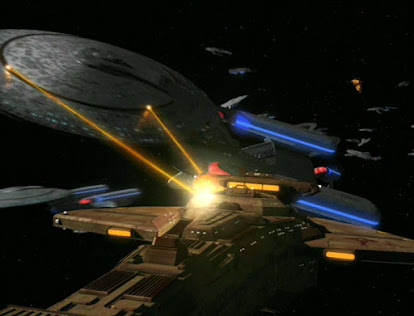
With the fourth season of Deep Space Nine having taken the show off-track, the fifth season had gotten the show back to where the writers had wanted to go: pitching the Federation into conflict with the Dominion. By the end of the season that conflict had exploded into all-out war, leaving Star Trek with arguably its biggest cliffhanger since Jean-Luc Picard was turned into a Borg: the Dominion capture Deep Space Nine and drive most of the crew off the station.

The aftermath of that event drives the largest-to-date storyline ever attempted in the entire Star Trek franchise: a continuously building narrative that spans the first six episodes of the season. This mini-series-within-a-series was a bold move for Star Trek at the time, although some sceptics sourly noted possible inspiration from DS9's sometimes-rival show, Babylon 5, which had become more significantly serialised some time earlier. Despite the franchise not being really geared to it, the writers do an excellent job of making it work, giving us stories of life on the station under Dominion occupation and on the Defiant and on the Klingon Bird-of-Prey Rotarran as the war escalates. There's some excellent storytelling and character-building in these episodes, particularly the introduction of regular "inside the enemy camp" asides as Dukat, his aide Damar, Weyoun and the Female Changeling plot the downfall of the Federation. For the first time, ever, we have a regular cast of bad guys to balance the regular cast of good guys and it's great fun to see the story being explored from two different angles.

This arc culminates in Sacrifice of Angels, which gives us the biggest battle in Star Trek history (matched only by the battles at the end of Season 7, but those battles are too reliant on stock footage to be as impressive) thanks to Babylon 5's recently-ejected CGI team, Foundation Imaging. The result is a dramatic improvement in vfx quality. For the first time in Star Trek's history, we get immense, convincing fleet battles which remain superb more than twenty years later. The battle is balanced out by tremendous character work, such as Dukat lamenting the fact that the Bajorans (a people he brutally oppressed for years, killing more than five million of them) never erected a statue of them whilst Weyoun looks at him with the slowly dawning realisation that he's allied himself to an increasingly deluded lunatic.

After the initial arc we get an entertaining episode where Worf and Jadzia finally get married (prompting the bachelor party from hell) and then things calm down a bit, with a string of "standard Star Trek" episodes. This string of episodes remains entertaining though: Resurrection brings characters from the Mirror Universe to DS9 for a change (rather than vice versa), whilst Statistical Probabilities is highly influenced by Isaac Asimov's Foundation series, and asks what happens when a statistical science for analysing future trends reveals that the Federation's defeat in the war is inevitable. The Magnificent Ferengi is a mighty all-Ferengi show as Quark recruits a team of the brightest and best of his race to mount a commando raid to rescue his mother from the Dominion. The barminess of the premise is only enhanced by Iggy Pop guest starring as a Vorta.

Waltz is an angry episode, inspired by Ira Steven Behr visiting a DS9 message board and becoming annoyed by the number of Dukat apologists he saw trying to justify his evil. Waltz makes Dukat's self-delusion absolutely crystal clear and sets up his story arc for the rest of the series. Who Mourns for Morn? and One Little Ship are fun comedy episodes, the former focusing on DS9's resident enigmatic barfly but without revealing too much about him and the latter being an excuse to do a Fantastic Voyage homage (although they don't quite go that far).

Honor Among Thieves is a great character piece that has O'Brien become an undercover intelligence agent for Starfleet Intelligence, much to his own chagrin, whilst Change of Heart reveals one of the problems with the Dominion War putting Starfleet officers who are also family in combat situations alongside one another. Wrongs Darker Than Death or Night is another episode about the Cardassian occupation of the DS9 station and is based on a couple of shaky premises (that Dukat spent nine years in a relationship with Kira's mother, which you feel should have come up before, and that Kira would really risk time travel just to find out the truth) but is well-acted. Inquisition is an intriguing episode which sees Bashir apparently outed as a spy, only to discover the existence of Section 31, the Federation's clandestine black ops intelligence agency. Section 31 has gone on to be grossly overused in later Trek shows, but at this point is an intriguing addition to the Trek mythos.

His Way is a controversial episode, first for finally hooking up Odo and Kira (not a popular relationship among DS9 fans, although the actors do a reasonable job with it) and also introducing the holographic character of Vic Fontaine and his Las Vegas holosuite program. Fans were not enamoured of this at the time, but it's reasonably harmless and it's hard not to be charmed by Jimmy Darren's excellent performance. The Reckoning is a hugely significant episode for the Prophet/Pah-Wraith story arc, where the station becomes the battleground for an epic fantasy style duel to the death between two superpowered entities. The more overt fantasy elements border on the silly, but the episode is in reality more about faith, and there's a crushing moment of horror for Kai Winn (superbly played by Louise Fletcher) where she realises that Sisko - an alien - has greater faith than she does.

Valiant is an effective war story, although let down by poor CGI (Foundation Imaging having moved on to Voyager and Paramount bringing a less capable company to work on DS9, which in retrospect was a mistake), whilst Time's Orphan is an effective story about fatherhood and loss. The Sound of Her Voice features one of the best vocal performances in all of Trek, as the crew make contact with a crashed Starfleet officer they can only speak to via subspace. Tears of the Prophets ends the season with a surprisingly brutal cliffhanger as the Federation and their allies go on the offensive against the Dominion and suffer an unexpected loss.

In the middle of this last run of episodes we have Profit and Lace, an episode which started from the idea of making it the "Some Like It Hot" of DS9 with Quark having to pose as a woman. This escalated to Quark having to be surgically altered to become female, with hilarity resulting from his hormonal and personality changes. To say this episode is terrible is a massive understatement: it is simply the worst-ever episode of Deep Space Nine, bar none, and probably one of the twenty worst Star Trek episodes ever made. It's wince-inducing, bordering on the unwatchable.

Profit and Lace is remarkable though, in that it is the sole weak link of the entire season. It is so bad that it was in danger of bringing down the score of the entire season by itself, but fortunately the season more than counterbalances this by deploying arguably the two single finest episodes of Deep Space Nine, and easily two of the best episodes of the entire Star Trek franchise since its inception. If you even had a list of the best episodes of Star Trek and put these two at the very top, I don't think people would argue with you too hard.

The ever-so-slightly lesser of the two episodes is In the Pale Moonlight, an episode of wartime paranoia and deception as Sisko finds himself reluctantly working with Garak on a scheme to convince a high-ranking Romulan senator that the Romulans should enter the war against the Dominion. At every step of the way, Sisko makes what seems like reasonable, logical choices even as they corrupt him further and draw him deeper into the mire, with Garak acting as a siren, luring him on to more dubious decisions. The ending of the episode, with a horrified Sisko trying to morally justify the murder and mayhem he's inadvertently sanctioned and the millions of deaths that will now stem from his actions, ranks as one of the most powerful in all of Star Trek.

The other powerhouse is Far Among the Stars, where Sisko finds himself as a struggling novelist and short story writer in 1950s New York City, with his friends recast in new roles. This episode repeats the trick from (the homeless-centric episode) Past Tense in Season 3, of taking a social issue and directly tackling it head head-on rather than through traditional Star Trek allegories and metaphors. In this case the subject is racism and how arbitrary prejudice (subconscious or outright) limits ideas and progress. The episode is centred on Avery Brooks' stunning performance and also on his outstanding direction, but all of the actors put in tremendous work in what is one of Star Trek's most powerful hours.

The sixth season of Deep Space Nine (*****) is its strongest year, narrowly beating out the almost-as-accomplished fourth season. Thanks to Far Among the Stars and In the Pale Moonlight, not to mention the outstanding opening six-part arc, it shows the series and the franchise at its very best. The season is available on DVD in the USA and UK, as well as on CBS All Access in the States and Netflix in the UK.

Note: I previously reviewed DS9's sixth season as part of a wider review of the final two seasons twelve years ago. That review can be read here.

Sunday, 17 January 2021

Sam Esmail adds to BATTLESTAR GALACTICA 3.0 confusion

Producer Sam Esmail has taken part in a video interview with Collider about the upcoming new Battlestar Galactica TV show, on which he is working as an executive producer.

This new project has been described by Esmail as a continuation, or at least set in the same universe, as Ronald D. Moore's Battlestar Galactica, the second version of the franchise which ran from 2003-09 and spawned two spin-off projects (prequel series Caprica and prequel TV movie Blood & Chrome). He reiterates in the new interview that he spoke to Moore (currently helming both Starz's Outlander and Apple+'s For All Mankind) and got his blessing for the project.

However, the new show's actual head writer and showrunner Michael Lesslie, has previously indicated that the new show will be a fresh reboot/remake of the original premise, something which NBC's publicity seems to have agreed with.

Although there is scope for further exploration of Moore's BSG iteration, it would probably not involve the titular Galactica starship herself and might involve a fairly deep dive of the mythology behind the show. It is unclear if NBC would be interested in a reboot of the show which did not involve the "classic" elements of the series, such as Viper fighters, Cylons and characters such as Adama, Apollo, Starbuck and Baltar.

NBC's parent company, Universal, are also simultaneously developing a totally fresh, ground-up movie version of Battlestar Galactica with X-Men movie ruiner Simon Kinberg and Planet of the Apes reboot mastermind Dylan Clark and it's unclear if they would want two versions of the same story airing simultaneously. It's also unclear if they'd want two different universes/takes on the same story going on at the same time, maybe feeling that might get confusing. However, it's not unprecedented, with both Netflix and Constantin Films developing two different takes on the Resident Evil franchise in different continuities, with both projects now greenlit and in pre-production.

The third TV iteration of Battlestar Galactica is currently in the planning stages and is due to debut on Peacock, NBC's new streaming service, in 2022 or 2023. Esmail hopes to start shooting the series this year, but notes that may not be possible due to various delays stemming from the global pandemic.

JOHN WICK writer tapped to develop DUNGEONS AND DRAGONS TV series

Hasbro and their inhouse studio, eOne, have tapped John Wick writer Derek Kolstad to develop a Dungeons and Dragons TV series proposal for them.


Hasbro are eyeing transferring the popular Dungeons and Dragons fantasy multiverse to the screen in the form of a mixed media approach consisting of video games, films and TV shows. A number of video games are on the way, including Dark Alliance and Baldur's Gate III (both tapped for a late 2021 release), whilst Paramount and eOne are in negotiations with Chris Pine for him to star in a feature film slated to begin shooting later this year in the Titanic Studios in Belfast (where Game of Thrones was previously based).

Hasbro began developing a TV series a couple of months ago and are apparently looking for multiple pitches, with a view to putting several projects in development simultaneously.

Kolstad is best known for his work on all three John Wick movies. He has also written several episodes of the imminent MCU TV show, The Falcon and the Winter Soldier, and is working on the script for the long-gestating Just Cause movie.

The multimedia approach for Dungeons and Dragons is a lot more appropriate than for most properties. D&D, despite its reputation for standard fantasy tropes, actually spans a multitude of very different worlds, including the more traditional Forgotten Realms and Dragonlance settings, the post-apocalyptic Dark Sun world, the dark horror of Ravenloft, the surreal multidimensional Planescape universe and the steampunk setting of Eberron.

Friday, 15 January 2021

RIP Storm Constantine

Word has sadly broken that British fantasy author Storm Constantine has died at the age of 64, after a long illness.


Born in 1956 in Salford, England, Constantine attended art college and was the manager of several bands. She began writing stories as a child, developing a strong interest in Egyptian, Greek and Roman mythology, as well as the Tarot. In the late 1970s she began developing a fantasy series revolving around a new, hermaphrodite post-human species that would arise to replace humanity. This idea evolved into the Wraeththu Chronicles, a trilogy starting with The Enchantments of Flesh and Spirit (1987).

The series was highly successful, sparking a prolific period lasting into the late 1990s and consisting of the Artemis and Grigori series. However, although she maintained strong sales in the USA, Constantine found sales in the UK dipping and publishers losing interest in her work. In 2003 she founded Immanion Press as a way of keeping her work in print and publishing new work, such as a Wraeththu sequel trilogy. She also published work by other authors, including numerous works related to paganism, myth and mythology. An immense fan of fellow fantasy/horror author Tanith Lee, she republished some of Lee's back catalogue as well. She also founded and edited the Visionary Tongue magazine in the 1990s.

During her career, she published one novella, nine short story collections and twenty-five novels (one in collaboration with Michael Moorcock), as well as collaborating on the Wraeththu roleplaying game.

Her work was notable for breaking new ground in the treatment of gender and sexuality in fantasy fiction, as well as being an author unafraid to embrace fanfiction. Many fans who wrote fiction set in her worlds were encouraged to submit to official anthologies she published, and she encouraged them to seek professional careers in the field. She will be missed.

Amazon Prime releases concept art for the WHEEL OF TIME TV series

To celebrate today's 31st birthday of the Wheel of Time fantasy series, Amazon have shared some concept art for the upcoming TV series.


Showrunner Rafe Judkins introduced a slew of artwork showing how the TV show will be bringing the late Robert Jordan's vision to life.

In the first image (above), two characters - possibly Rand and Mat - are in a narrow valley staring down at a settlement below. This doesn't seem immediately like anything from the books but could be during their long journey overland from Shadar Logoth to Caemlyn..


The second image is more readily identifiable as the village of Emond's Field, possibly during the Winternight celebrations. In the first Wheel of Time novel, The Eye of the World, the actual Winternight celebration takes place off-page. Actually seeing it, and the tumultuous events that follow, is a reasonable change from the page.


The third image is likely of the Tinker caravan, where Perrin and Egwene seek refuge after the events at Shadar Logoth.


This image seems to feature our main group of characters travelling through a forest towards a distant tower. This is most likely just before the group arrive in the ruined city of Shadar Logoth.


The final image is likely of the ruined, eerie city itself just before trouble erupts.

The first season of Wheel of Time has concluded shooting, although there has been some confusion over whether the season wrapped on schedule or was forced to wrap early due to greater COVID restrictions in the Czech Republic, with a few scenes left to shoot. This has an impact on the show's airdate. Assuming they have everything they need, Season 1 of The Wheel of Time could potentially air in the next few months, otherwise they'll have to wait until they can pick up those last shots (which possibly won't happen until they shoot a second season).

More news, of course, as we get it.

Thursday, 14 January 2021

Brian McClellan's POWDER MAGE TRILOGY optioned for television by STARGATE producer

Joseph Mallozzi, the former producer of the StarGate TV franchise and more recently Dark Matter and Utopia Falls, has optioned Brian McClellan's well-received Power Mage epic fantasy series for TV.


Mallozzi is teaming with Canadian company No Equal Entertainment and Frantic Films. No broadcaster or streamer is yet attached.

The Powder Mage Trilogy consists of the novels Promise of Blood (2013), The Crimson Campaign (2014) and The Autumn Republic (2015) and revolves around a world where the gods have returned after a long absence to find time and technology has moved on without them and the people have developed 18th Century levels of technology, including gunpowder and campaign. The story revolves around "powder mages" who can combined the powers of gunpowder and sorcery in an unusual way. The series has gained some positive critical notices and sold almost a million copies since it was published. A sequel trilogy followed in 2017-19.

As usual, this is a speculative option by a producer company, not a greenlight by a big streamer or network, so it's a long way from going on-screen, but it's another sign that the fantasy genre remains hot and many TV and film studios are interested in developing new properties.