The fifth volume in the Chung Kuo series, The Art of War, is out on 1 March. Unlike the previous volumes, I haven't received an ARC so I'll have to pick it up the old-fashioned way at some point. Here is the Larry Rostant cover art for the sixth volume in the series, An Inch of Ashes:
Corvus's new catalogue confirms that there will only be three Chung Kuo novels published this year rather than the previously-suggested four. An Inch of Ashes will be out on 4 July, followed by The Broken Wheel on 7 November. The good news is that apparently Corvus has reached a deal with Barnes and Nobel in the United States, with the UK versions of the novels being released in the USA via their shops. With no news on a US-specific publisher picking up the series, this should be of interest to American readers. The books are also available via Amazon, with the e-editions also accessible from the USA (though not always on release).
Thursday, 14 February 2013
Wednesday, 13 February 2013
Solaris to publish Paul Kearney omnibus in early 2014
Though not the one you're likely thinking of.
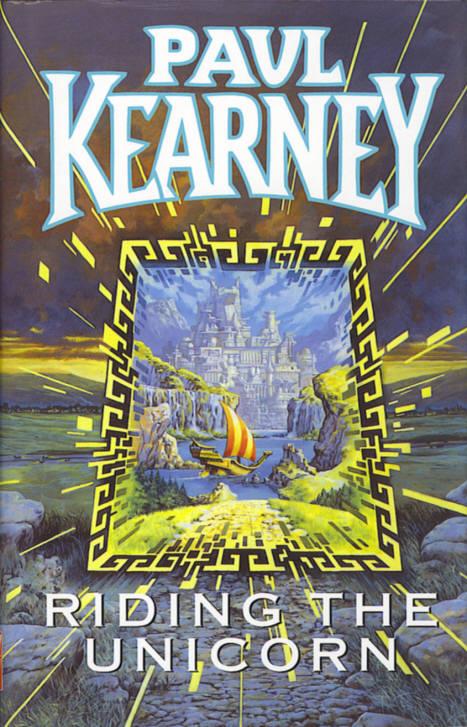
Solaris has purchased the reprint rights to Paul Kearney's first three novels: The Way to Babylon, Riding the Unicorn and A Different Kingdom, and will be publishing these as an omnibus in early 2014.
The status of Kearney's omnibus of The Sea-Beggars, which will include the brand-new third and concluding volume of the trilogy, Storm of the Dead, remains unclear.
These early novels of Kearney were different from his later work, which was historically-influenced epic fantasy. They featured people from the real world crossing into a fantastical one, with A Different Kingdom being more of an Irish take on Robert Holdstock's Mythago Wood (without being derivative of it). The three books are also independent of one another and are not part of the same series.
Solaris has purchased the reprint rights to Paul Kearney's first three novels: The Way to Babylon, Riding the Unicorn and A Different Kingdom, and will be publishing these as an omnibus in early 2014.
The status of Kearney's omnibus of The Sea-Beggars, which will include the brand-new third and concluding volume of the trilogy, Storm of the Dead, remains unclear.
These early novels of Kearney were different from his later work, which was historically-influenced epic fantasy. They featured people from the real world crossing into a fantastical one, with A Different Kingdom being more of an Irish take on Robert Holdstock's Mythago Wood (without being derivative of it). The three books are also independent of one another and are not part of the same series.
Update on STORMLIGHT ARCHIVE #2
Brandon Sanderson has confirmed that the second Stormlight Archive novel now has a target release date of 12 November this year, as revealed on Amazon. However, it is not a confirmed date and is dependent on when Sanderson finishes the book. Via a Facebook update, Sanderson has said that he will know for sure in April.
Sunday, 10 February 2013
George R.R. Martin expands on HBO deal
Not very far, but Martin confirms that, in the wake of the new deal, he is actively discussing Dunk and Egg with HBO and will be pitching a Tuf Voyaging TV series to them as well (note he doesn't say to HBO, but the recent deal means it really has to be to HBO). He also suggests Conleth Hill (Varys in GoT) could make an excellent Haviland Tuf, and rules himself out from having any role on the new I, Claudius TV series.
No word on a possibly Ron Donachie-starring version of Fevre Dream, unfortunately. Martin's comments do confirm earlier supposition that the deal will be used - at least in part - to explore his existing, non-optioned franchises.
Update: Martin has confirmed that a movie version of Fevre Dream is in the works, with a 'name' director interested in the project. However, nothing has been signed yet. The Wild Cards franchise is currently being worked on as a movie collaboration between SyFy and Universal, with Melinda Snodgrass having just delivered her first draft of the script.
No word on a possibly Ron Donachie-starring version of Fevre Dream, unfortunately. Martin's comments do confirm earlier supposition that the deal will be used - at least in part - to explore his existing, non-optioned franchises.
Update: Martin has confirmed that a movie version of Fevre Dream is in the works, with a 'name' director interested in the project. However, nothing has been signed yet. The Wild Cards franchise is currently being worked on as a movie collaboration between SyFy and Universal, with Melinda Snodgrass having just delivered her first draft of the script.
The Making of XCOM
Polygon.com have an excellent article here on the making of the recent strategy game (and my top game of 2012) XCOM. Lead designer Jake Solomon and head of Firaxis Sid Meier talk extensively about the game's nine-year development process, the multiple false starts on the project and how it only came together when they brainstormed ideas for a week whilst playing a board game version of the title.
Lots of great stuff there and confirmation at the end that an XCOM sequel is being looked at.
First WASTELAND 2 gameplay video
inXile have released the first gameplay video for their upcoming, Kickstarter-funded, retro-RPG, Wasteland 2.
Wasteland 2 is a stand-alone sequel to the original, released, way back in 1988. The new game features similar turn-based combat and text-based descriptions of events, but also a vastly more advanced graphics engine based on 3D models. It'll be interesting to see how this old-school style of gaming resonates with modern audiences, but there's a lot here that looks promising (particularly the fully-customisable UI). The game is due for release at the end of the year.
A Man Betrayed by J.V. Jones
Jack and Melliandra continue their flight through the lands of Halcus, seeking refuge in the distant city of Bren. Meanwhile, the mad Prince Kylock has seized his father's throne and embarked on a bloody invasion of Halcus, committing atrocity after atrocity. In Bren, Chancellor Baralis and Lord Maybor have arrived to arrange the marriage between Kylock and the Duke's daughter, to the Duke's disquiet, as well as continuing their own bitter feud. And in the fighting pits of the city, a disgraced knight struggles to find his redemption.
A Man Betrayed is the middle volume of the Book of Words trilogy and is a prime example of a novel that falls foul of 'middle book syndrome'. The book has no real opening and no real end (though there's a hell of a cliffhanger) and the plot is a mixture of dynamic forward movement in some storylines and some slightly tedious wheel-spinning in others.
In one of the more successful storylines, Melliandra is kidnapped (again), but this time around is able to turn her circumstances to her favour. She goes from victim to political player over the course of the novel in a transition that is convincingly-handled by the author. On the other hand, Jack's storyline becomes seriously bogged down. Jones clearly had to find something to do to prevent him from travelling straight to Bren and getting involved in events there, and somewhat unconvincingly lands him with a screwed-up family unit living in the backwoods and getting involved in a murder plot. There's some attempts to turn it into important character-building material for Jack but, aside from the titular betrayal at the subplot's climax, it fails to resonate.
More successful is Tawl's storyline, which is a more traditional arc of seeking redemption following the heinous crime he commits (though unwillingly) at the end of the first volume. Though there is little surprising in this storyline, it's handled well by the author, particularly in the use of the previously tedious 'lovable rogue' Nabber to help Tawl along his path. Elsewhere, Baralis is as fiendishly (if occasionally cartoonishly) evil and Machivellian as ever, Maybor becomes a more interesting character and Tavalisk's observations-from-afar of the main plot remain amusing. Bodger and Grift (the trilogy's answer to Rosencrantz and Guildenstern) also get a bit more involved in the plot as well as providing the book's more comical moments.
Overall, A Man Betrayed (***½) is not without its shortcomings but is a stronger book than The Baker's Boy. Jones's writing has improved, and she juggles the multiple character arcs with confidence. Aside from Jack's repetitive storyline, this is an entertaining fantasy novel, though one that does not stray far from familiar ground. The book is available now in the UK and USA.
A Man Betrayed is the middle volume of the Book of Words trilogy and is a prime example of a novel that falls foul of 'middle book syndrome'. The book has no real opening and no real end (though there's a hell of a cliffhanger) and the plot is a mixture of dynamic forward movement in some storylines and some slightly tedious wheel-spinning in others.
In one of the more successful storylines, Melliandra is kidnapped (again), but this time around is able to turn her circumstances to her favour. She goes from victim to political player over the course of the novel in a transition that is convincingly-handled by the author. On the other hand, Jack's storyline becomes seriously bogged down. Jones clearly had to find something to do to prevent him from travelling straight to Bren and getting involved in events there, and somewhat unconvincingly lands him with a screwed-up family unit living in the backwoods and getting involved in a murder plot. There's some attempts to turn it into important character-building material for Jack but, aside from the titular betrayal at the subplot's climax, it fails to resonate.
More successful is Tawl's storyline, which is a more traditional arc of seeking redemption following the heinous crime he commits (though unwillingly) at the end of the first volume. Though there is little surprising in this storyline, it's handled well by the author, particularly in the use of the previously tedious 'lovable rogue' Nabber to help Tawl along his path. Elsewhere, Baralis is as fiendishly (if occasionally cartoonishly) evil and Machivellian as ever, Maybor becomes a more interesting character and Tavalisk's observations-from-afar of the main plot remain amusing. Bodger and Grift (the trilogy's answer to Rosencrantz and Guildenstern) also get a bit more involved in the plot as well as providing the book's more comical moments.
Overall, A Man Betrayed (***½) is not without its shortcomings but is a stronger book than The Baker's Boy. Jones's writing has improved, and she juggles the multiple character arcs with confidence. Aside from Jack's repetitive storyline, this is an entertaining fantasy novel, though one that does not stray far from familiar ground. The book is available now in the UK and USA.
Friday, 8 February 2013
Star Trek: The Next Generation - Season 2 (remastered)
Originally airing from 1988 to 1989, the second season of Star Trek: The Next Generation was beset by challenges. A writer's strike crippled Hollywood between seasons and the show was almost cancelled as a result. The producers were able to get around the problem by re-tasking scripts from the aborted Star Trek: Phase II TV show from the 1970s, reducing the season order by four episodes and - in a fit of true desperation - dropping a clip show (the terrifyingly awful Shades of Grey, widely-acknowledged as the worst episode of the entire franchise) into the mix. They scraped through to produce a season that is a notable improvement over the first year, and definitely better than it has any right to be given the situation it was produced under.
As with the first season, things get off to a bumpy start but improve later on. Fortunately, they improve a lot faster. The first two episodes, The Child (Troi gets pregnant with a rapidly-evolving alien thingamajig) and Where Silence Has Lease (the Enterprise gets stuck in a void in space where an alien superintelligence messes around with them just because that's how it rolls), are pretty bad but there is a quantum leap in improvement when Elementary, Dear Data comes on. Excellent performances and a strong script alleviate the somewhat ropey rules the show is establishing regarding the holodeck. Weaker episodes continue to roll in - The Outrageous Okona (slightly tepid conman comes on board), The Dauphin (Wesley Crusher romance episode...NO!), The Royale (crew encounter weird hotel IN SPACE) and Up the Long Ladder (outrageous Irish stereotyping) should all be burned - but there's also a better sense of the characters getting their own voices and characterisation becoming more consistent.
More to the point, the season gives us a larger number of very good episodes compared to the first. A Matter of Honour is terrific fun, establishing Riker as the first officer of a Kling Bird of Prey during an officer exchange programme. Jonathan Frakes - whose acting powers have now been radically enhanced by The Beard - steps up his game a lot. Contagion is a very dumb episode about computer viruses, but as an action romp it's very entertaining (similar to The Arsenal of Freedom in Season 1, but better). Peak Performance from later in the season is in a similar vein. Time Squared is a creepy episode about time loops and features some disturbing ideas and a doom-laden atmosphere, though some questionable writing for Picard prevents it from fulfilling its full promise. The Emissary is an important episode for Worf and the progression of his character arc and is very solid.
More impressively, this season gives us the first two hands-down, no-questions, absolute 'classic' episodes of Star Trek: The Next Generation. First up is The Measure of a Man, written by Melinda Snodgrass (best-known as the co-editor of the Wild Cards superhero books series). The episode is an examination of whether Data is a sentient being or not, and features some terrific acting from Patrick Stewart, Brent Spiner and Jonathan Frakes. It's a morality play, the sort of thing that Trek can make tedious if it mishandles it, but here the team do an exemplary job of exploring the issues and turning them into a riveting hour of television (and it is an hour, as the Blu-Ray set features the hitherto-unseen 60-minute cut of the episode before it was trimmed down to the normal 44 minutes).
Even more impressive is Q Who? This episode is notable for introducing the Borg, but it's also a masterclass in pacing, music (the score is incredibly ominous), exposition without getting leaden (the hints to the past antagonism between Guinan and Q are played just right), tension, action and a genuinely surprising ending: arguably the only time on ST:TNG that the crew 'lose' the struggle of the episode and only barely survive. It's also the one and only time that Q is effectively used as a dramatically intense character. His other appearances either misfire or are played for comedy. Here we see John De Lancie at his absolute best, particularly in the scene where he pitifully tells Picard what is happening is no illusion after eighteen Enterprise crewmembers are killed by the Borg. The climactic scene where Picard begs Q to save them before they are all slaughtered is handled pitch-perfectly by Patrick Stewart (who was genuinely troubled by the episode's message that the Enterprise crew can't win all the time) as well.
Whilst Season 2 will never be remembered as the best season of the show, it does feature two of its finest hours and a whole host of other, very solid episodes. The cast turn in excellent performances, particularly Diana Muldaur as Dr. Pulaski in her only season on the show (replacing Gates McFadden as Dr. Crusher, who was sacked for criticising the show's sexist scripts in the first season; internal and fan pressure resulted in her reinstatement for Season 3). It's a shame we didn't get to see Pulaski again, as the evolution of her character arc and the development of her relationships with Worf and Data were very well-handled over the course of the season.
As with the first season, the restoration job has done a pretty good job. However, a different team was used for the second season and there is the sense that a few corners were cut. The redone effects aren't quite as well-handled as in the first season (particularly noticeable in Q Who?, though the original version of the episode had a few iffy effects issues as well, so perhaps it was unsalvageable) and the new team have only cleaned up the planets that the Enterprise orbits, rather than replacing them with fully-convincing 3D spheres. Whilst the improvements are still light-years beyond what people might be expecting, they're not quite as jaw-dropping as the job that was done on Season 1. This is made up for a bit by the other extras, which are impressive. The highlight is a lengthy roundtable discussion between the entire cast about the show and what it meant for their careers and legacies, although the ongoing 'history of the series' documentary is also excellent. The original DVD extras are also included, though again only in standard definition.
The second season of Star Trek: The Next Generation (****) sees the show improving by leaps and bounds over the weaker first year. It is available now on Blu-Ray in the UK and USA. The third season - often regarded as the show's finest season - will be released in April.
As with the first season, things get off to a bumpy start but improve later on. Fortunately, they improve a lot faster. The first two episodes, The Child (Troi gets pregnant with a rapidly-evolving alien thingamajig) and Where Silence Has Lease (the Enterprise gets stuck in a void in space where an alien superintelligence messes around with them just because that's how it rolls), are pretty bad but there is a quantum leap in improvement when Elementary, Dear Data comes on. Excellent performances and a strong script alleviate the somewhat ropey rules the show is establishing regarding the holodeck. Weaker episodes continue to roll in - The Outrageous Okona (slightly tepid conman comes on board), The Dauphin (Wesley Crusher romance episode...NO!), The Royale (crew encounter weird hotel IN SPACE) and Up the Long Ladder (outrageous Irish stereotyping) should all be burned - but there's also a better sense of the characters getting their own voices and characterisation becoming more consistent.
More to the point, the season gives us a larger number of very good episodes compared to the first. A Matter of Honour is terrific fun, establishing Riker as the first officer of a Kling Bird of Prey during an officer exchange programme. Jonathan Frakes - whose acting powers have now been radically enhanced by The Beard - steps up his game a lot. Contagion is a very dumb episode about computer viruses, but as an action romp it's very entertaining (similar to The Arsenal of Freedom in Season 1, but better). Peak Performance from later in the season is in a similar vein. Time Squared is a creepy episode about time loops and features some disturbing ideas and a doom-laden atmosphere, though some questionable writing for Picard prevents it from fulfilling its full promise. The Emissary is an important episode for Worf and the progression of his character arc and is very solid.
More impressively, this season gives us the first two hands-down, no-questions, absolute 'classic' episodes of Star Trek: The Next Generation. First up is The Measure of a Man, written by Melinda Snodgrass (best-known as the co-editor of the Wild Cards superhero books series). The episode is an examination of whether Data is a sentient being or not, and features some terrific acting from Patrick Stewart, Brent Spiner and Jonathan Frakes. It's a morality play, the sort of thing that Trek can make tedious if it mishandles it, but here the team do an exemplary job of exploring the issues and turning them into a riveting hour of television (and it is an hour, as the Blu-Ray set features the hitherto-unseen 60-minute cut of the episode before it was trimmed down to the normal 44 minutes).
Even more impressive is Q Who? This episode is notable for introducing the Borg, but it's also a masterclass in pacing, music (the score is incredibly ominous), exposition without getting leaden (the hints to the past antagonism between Guinan and Q are played just right), tension, action and a genuinely surprising ending: arguably the only time on ST:TNG that the crew 'lose' the struggle of the episode and only barely survive. It's also the one and only time that Q is effectively used as a dramatically intense character. His other appearances either misfire or are played for comedy. Here we see John De Lancie at his absolute best, particularly in the scene where he pitifully tells Picard what is happening is no illusion after eighteen Enterprise crewmembers are killed by the Borg. The climactic scene where Picard begs Q to save them before they are all slaughtered is handled pitch-perfectly by Patrick Stewart (who was genuinely troubled by the episode's message that the Enterprise crew can't win all the time) as well.
Whilst Season 2 will never be remembered as the best season of the show, it does feature two of its finest hours and a whole host of other, very solid episodes. The cast turn in excellent performances, particularly Diana Muldaur as Dr. Pulaski in her only season on the show (replacing Gates McFadden as Dr. Crusher, who was sacked for criticising the show's sexist scripts in the first season; internal and fan pressure resulted in her reinstatement for Season 3). It's a shame we didn't get to see Pulaski again, as the evolution of her character arc and the development of her relationships with Worf and Data were very well-handled over the course of the season.
As with the first season, the restoration job has done a pretty good job. However, a different team was used for the second season and there is the sense that a few corners were cut. The redone effects aren't quite as well-handled as in the first season (particularly noticeable in Q Who?, though the original version of the episode had a few iffy effects issues as well, so perhaps it was unsalvageable) and the new team have only cleaned up the planets that the Enterprise orbits, rather than replacing them with fully-convincing 3D spheres. Whilst the improvements are still light-years beyond what people might be expecting, they're not quite as jaw-dropping as the job that was done on Season 1. This is made up for a bit by the other extras, which are impressive. The highlight is a lengthy roundtable discussion between the entire cast about the show and what it meant for their careers and legacies, although the ongoing 'history of the series' documentary is also excellent. The original DVD extras are also included, though again only in standard definition.
The second season of Star Trek: The Next Generation (****) sees the show improving by leaps and bounds over the weaker first year. It is available now on Blu-Ray in the UK and USA. The third season - often regarded as the show's finest season - will be released in April.
The Baker's Boy by J.V. Jones
Conspiracies and treachery run deep at Castle Harvell. King Lesketh is dying of an illness, the Four Kingdoms are at war with the neighbouring land of Halcus and Chancellor Baralis is intriguing with the Knights of Valdis and the Duke of Bren. The other major powers of the continent, sensing a coming clash of nations, are arming for war. But such things are flying high over the head of Jack, a simple baker's apprentice who just wants to get on with his life. When Jack manifests powers that mark him as a sorcerer, he earns the enmity of Baralis. Fleeing into the wilderness along with Lady Melliandra, who is trying to escape a marriage to the sinister Prince Kylock, Jack has to come to grips with his powers and discover his role in the unfolding events.
The Baker's Boy, originally published in 1995, is the debut novel by British fantasy author J.V. Jones and the opening volume of the Book of Words trilogy (itself the opening three volumes of a longer fantasy epic continued in her current Sword of Shadows sequence). As a glance at the plot summary will reveal, we are deep in the heart of Traditional Fantasy Territory here. There's a young boy destined for great things. There's evil sorcerers conniving to bring about dark ends. There's cruel and unworthy heirs to thrones, and beautiful ladies trying to escape from pre-arranged fates. It's all very traditional.
Traditional does not necessarily mean bad, and Jones laces her story with some darker and more interesting elements. The book is fairly 'low fantasy' in nature, dwelling on conspiracies, murders and assassinations. Characters such as Baralis are ruthless and merciless, but do not see themselves that way and are presented as the hero of their own story. Blurring the moral boundaries nicely, Jones sets up the greatest threats to Baralis as coming from Tavalisk, Archbishop of the distant city of Rorn, who himself is a venal, vain, arrogant and cruel man, little better than Baralis; and Maybor, Baralis's rival at court and the father of Melliandra, who is also presented as a violent and unpleasant man. The fact that these three characters are as bad as one another makes it hard to root for any side, although Jones gives a more sympathetic portrait of the three characters caught up in the three connivers' webs: Jack, Melliandra and Tawl, a knight who is searching for a young boy whose coming is foretold in prophecy (yes, one of those). There is also a tremendously satisfying vein of black humour running through the book, such as Tavalisk's wry observations of events being accompanied by a battle of wits with his much put-upon manservant.
Whilst Jones mixes the traditional fantasy ingredients up a little, and the book is always readable, regular genre readers will find little here that has not been done before, and better. As a first novel, The Baker's Boy is certainly very rough in places. Where the book gains some additional value is that Jones later went on to write The Sword of Shadows, a fantasy epic that is categorically superior to almost everything else in the genre (certainly it's batting at the same level as A Song of Ice and Fire, the Malazan series and the works of Guy Gavriel Kay). Whilst The Book of Words is nowhere near as good, though there is an escalation in quality from book to book that is impressive to watch, it's certainly worth a look as some characters that re-occur in the later Sword of Shadows do first appear here, and knowing their backstory has some worth for the later books.
The Baker's Boy (***) is as traditional a start to a fantasy series as there has ever been, though it remains resolutely entertaining. There are some rough spots as Jones comes up to speed but there's a rich vein of dark humour, some solid characterisation and an ending that was rather startling and refreshingly bleak in those altogether more cliched times when the book first came out. The novel is available now in the UK and USA.
The Baker's Boy, originally published in 1995, is the debut novel by British fantasy author J.V. Jones and the opening volume of the Book of Words trilogy (itself the opening three volumes of a longer fantasy epic continued in her current Sword of Shadows sequence). As a glance at the plot summary will reveal, we are deep in the heart of Traditional Fantasy Territory here. There's a young boy destined for great things. There's evil sorcerers conniving to bring about dark ends. There's cruel and unworthy heirs to thrones, and beautiful ladies trying to escape from pre-arranged fates. It's all very traditional.
Traditional does not necessarily mean bad, and Jones laces her story with some darker and more interesting elements. The book is fairly 'low fantasy' in nature, dwelling on conspiracies, murders and assassinations. Characters such as Baralis are ruthless and merciless, but do not see themselves that way and are presented as the hero of their own story. Blurring the moral boundaries nicely, Jones sets up the greatest threats to Baralis as coming from Tavalisk, Archbishop of the distant city of Rorn, who himself is a venal, vain, arrogant and cruel man, little better than Baralis; and Maybor, Baralis's rival at court and the father of Melliandra, who is also presented as a violent and unpleasant man. The fact that these three characters are as bad as one another makes it hard to root for any side, although Jones gives a more sympathetic portrait of the three characters caught up in the three connivers' webs: Jack, Melliandra and Tawl, a knight who is searching for a young boy whose coming is foretold in prophecy (yes, one of those). There is also a tremendously satisfying vein of black humour running through the book, such as Tavalisk's wry observations of events being accompanied by a battle of wits with his much put-upon manservant.
Whilst Jones mixes the traditional fantasy ingredients up a little, and the book is always readable, regular genre readers will find little here that has not been done before, and better. As a first novel, The Baker's Boy is certainly very rough in places. Where the book gains some additional value is that Jones later went on to write The Sword of Shadows, a fantasy epic that is categorically superior to almost everything else in the genre (certainly it's batting at the same level as A Song of Ice and Fire, the Malazan series and the works of Guy Gavriel Kay). Whilst The Book of Words is nowhere near as good, though there is an escalation in quality from book to book that is impressive to watch, it's certainly worth a look as some characters that re-occur in the later Sword of Shadows do first appear here, and knowing their backstory has some worth for the later books.
The Baker's Boy (***) is as traditional a start to a fantasy series as there has ever been, though it remains resolutely entertaining. There are some rough spots as Jones comes up to speed but there's a rich vein of dark humour, some solid characterisation and an ending that was rather startling and refreshingly bleak in those altogether more cliched times when the book first came out. The novel is available now in the UK and USA.
Mass Effect 4 - Knights of the Old Republic 3
Following up their comments a few weeks ago, Obsidian have confirmed that they have pitched a new Star Wars roleplaying game to LucasArts. The new game won't actually be Knights of the Old Republic III, as it will be set between Revenge of the Sith and A New Hope. Obsidian's top writer, Chris Avellone, has developed and written the story. Obsidian are waiting to hear back from LucasArts and their new owner, Disney (who have made discouraging noises about not wanting to focus on big gaming projects any more) about their pitch.
Meanwhile, BioWare have made a lot of confusing comments about Mass Effect 4. The only thing they have seemingly confirmed is that it will not be called Mass Effect 4. In a bizarre twist one of the developers has said that "the game does not have to come after. Or before. Or off to the side. Or with characters you know." Actually, logically it kind of does, unless it's set in a completely different universe (and hence wouldn't be a Mass Effect title). Good to see that BioWare still can't make a single announcement about the Mass Effect franchise without turning into a confusing mess. However, it does confirm that Mass Effect 4: Whatever is now in active development.
Meanwhile, Ubisoft have confirmed that Far Cry 3 has sold 4 million copies since its release, far outstripping their projections. As a result, they have confirmed that a Far Cry 4 will be released within the next three to four years. Surprising no-one, they have also confirmed that a new Assassin's Creed game is in the offering for 2014. Assassin's Creed III has sold a staggering 12 million copies since its release just three months ago.
Don't expect to be seeing many - or any - of these guys in the new Mass Effect.
Meanwhile, BioWare have made a lot of confusing comments about Mass Effect 4. The only thing they have seemingly confirmed is that it will not be called Mass Effect 4. In a bizarre twist one of the developers has said that "the game does not have to come after. Or before. Or off to the side. Or with characters you know." Actually, logically it kind of does, unless it's set in a completely different universe (and hence wouldn't be a Mass Effect title). Good to see that BioWare still can't make a single announcement about the Mass Effect franchise without turning into a confusing mess. However, it does confirm that Mass Effect 4: Whatever is now in active development.
Meanwhile, Ubisoft have confirmed that Far Cry 3 has sold 4 million copies since its release, far outstripping their projections. As a result, they have confirmed that a Far Cry 4 will be released within the next three to four years. Surprising no-one, they have also confirmed that a new Assassin's Creed game is in the offering for 2014. Assassin's Creed III has sold a staggering 12 million copies since its release just three months ago.
Subscribe to:
Posts (Atom)


.jpg)
.jpg)