Thursday, 22 September 2022

New Vince Gilligan show lands on Apple TV+ with two-season order

Apple TV+ has given a two-season order to Vince Gilligan's new TV show. The Breaking Bad and Better Call Saul creator is working on the show with Sony Television and will re-team with actress Rhea Seehorn.

Presumably, this is the science fiction idea Gilligan was recently discussing. The show will have a somewhat contemporary setting, but with an SF "twist."

Seehorn played the character of Kim Wexler across all six seasons of Better Call Saul, attracting significant critical acclaim for her performance and an Emmy nomination (although, remarkably, not a win).

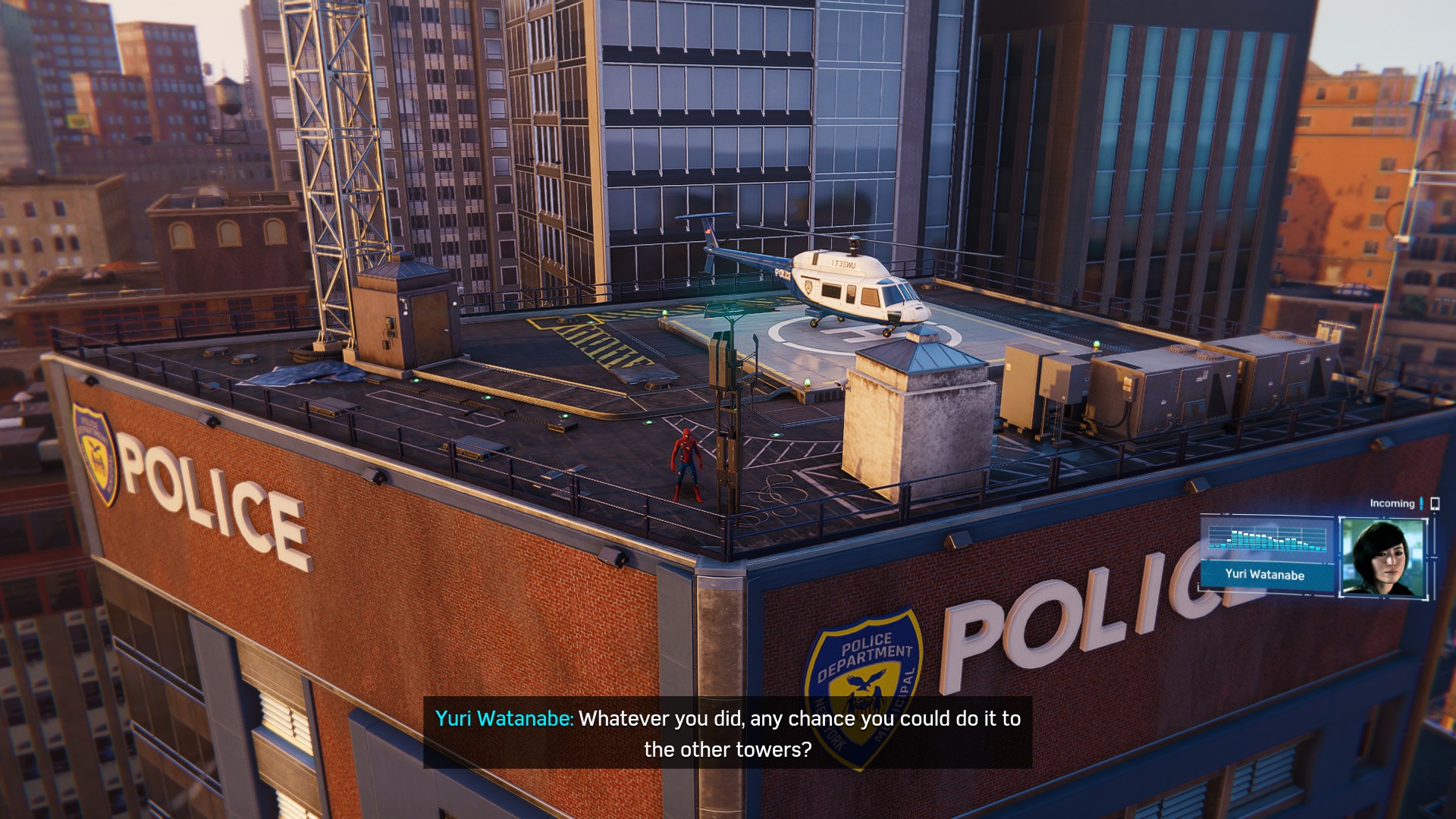
Marvel's Spider-Man Remastered

Eight years into his superhero career, Peter Parker (aka Spider-Man) is a lab assistant working for Dr. Octavius on the next generation of prosthetic limbs. Parker finds juggling his job, personal life and his secret identity as Spider-Man challenging, resulting in his breakup with his girlfriend Mary Jane. Parker finally succeeds in helping the NYPD (via his contact, Yuri Watanabe) take down the dreaded Kingpin, Wilson Fisk. However, the peace does not last long: Fisk's absence results in a power vacuum, which various villains and mobsters rush to fill, leading to a full workload for Parker.


Way back in 2009, Rocksteady Studios hit on the idea of making a really good Batman game, after many years of mediocre titles. They created Arkham Asylum, a superb game that featured great combat, excellent stealth, a strong storyline and outstanding use of the existing Batman canon. Insomniac Games seem to have taken a leaf out of their book in developing Marvel's Spider-Man, the first attempt in a few years to create a definitive Spider-Man video game.

The game is, as you'd expect, an open-world title set in a sort-of realistic depiction of New York City. Playing Spider-Man, you can websling between buildings, create ziplines and engage in spectacular amounts of combat against a variety of enemies, both super-powered and mundane. The storyline borrows from the entire Spider-Man canon and sees Parker teaming up with allies like Yuri, Miles Morales, MJ and Black Cat whilst fighting enemies including Mr. Negative, Kingpin, Electro, Rhino, Scorpion and Vulture. The game also mostly presents Otto Octavius as an ally, but of course even a casual Spider-Man fan will know his destiny and the game evokes some impressive tension as he drifts closer and closer to his eventual fate of becoming Doc Ock. The game even has some time for nuance, with Peter having a complex relationship with Mayor Norman Osborn and security contractor Silver Sablinova.


The game's golden feature is its depiction of webslinging. Traversing around New York City as Spider-Man is a delight and for the first time a video game evokes those dizzying memorable shots from the 2002 Spider-Man movie. The game strikes an excellent balance between making movement spectacular and giddying but also allowing you to retain control over what's going on. The PC version of the game goes further with mouse movement allowing for much greater, pinpoint accuracy in where you put your webs, when to jump and when to arrest your movement. The game features the most pointless fast travel system in existence, since just getting around New York is so much fun that you'll never want to use it (apart from the achievement it bafflingly gives you).

As well as jumping around, you'll spend an inordinate amount of time in combat. Spider-Man is not the beefiest guy in the world and can't take a lot of punishment, so combat is very movement-focused, with Spider-Man landing a few punches and then jumping away before he can be crowded. You can use your handy spider-gadgets to help in battle, and as the game continues you acquire new Spider-Suits with various abilities to help you keep up with your enemies' own escalating abilities. You can also use scenery to help in combat (flinging manhole covers into an enemy at high velocity never gets old, although curiously it never kills anyone either), and if fighting on a rooftop you can propel your opponents off the roof, to be webbed to the side for arrest later.


Combat is fun, but there's a recurring feeling that there's too much of it. Spider-Man is not Batman and although he certainly gets into fights with opponents, the massive brawls with up to several dozen enemies at a time do feel rather out of character. Whilst the game tries to keep new enemy types coming at a steady clip, it does feel like most are variations on a theme (small brawler guy, ranged attack guy, massively huge dude who needs to be weakened before being taken down, and then jetpacks!) and as you level up and get new abilities, combat becomes less challenging and more of a chore. It doesn't help that the Arkham series influence here is at its most overt: the sound effect that rings out when you knock someone one for good is identical to the one from those games. Stealth is also undercooked: although Spider-Man can use stealth in some situations to make combat easier, the game usually makes it impossible to 100% complete objectives through stealth alone, which is disappointing.

The game's central storyline is pretty good, though somewhat predictable. It makes solid use of Spider-Man's villainous roster and there's a good mix between very familiar characters and more obscure characters from the comic book. An ingame codex allows you to keep everyone straight and the game's journal system and excellent map both do a good job of keeping you up to date on what's going on. The voice acting, in particular, is superb, though Spider-Man's quips do repeat a bit more often than you'd like.


Where Spider-Man suffers a bit is how it organises its side content. To overcome the problem of a Ubisoft-style game eventually burying the map screen under quest markers, this game doles out side-activities very slowly, and seems to expect you to do all of the side-activities the second they become available. This is doable because they are relatively constrained, such as twenty new "help the police" missions popping up in one go and it being possible to polish them all off in under an hour or two. However, taking this view (and, if you don't, the map really will end up buried under icons) eventually makes you realise you're spending maybe 85% of the game on these filler tasks versus 15% on the actual story. The Arkham games had the sense to avoid this by being happy that it was possible to see off the entire game in under 20 hours by giving you much more meaningful content to enjoy. Marvel's Spider-Man lacks that confidence and keeps throwing filler content at you so it takes over 50 hours to 100% the game's story and side-missions, plus its DLC and filler. The game does risk outstaying its welcome.

But it also stays just on the right side of that gap. Swinging through New York City, stopping a jewelry shop robbery, then tracking down some rogue drones (requiring an exciting chase through midtown skyscrapers) before polishing off another story mission can be great fun. If immersion is a key goal of any game, Spider-Man certainly makes you feel like the hero in a very convincing manner.


You also can't fault this edition when it comes to content. As well as the original game, it includes the three-part City Never Sleeps DLC, which adds up to a pretty decent-sized game's worth of content (even if it does over-rely on similar enemy types to the original game). The game has spectacular graphics and the options for your suits are excellent. You can even put on the OG Spider-Man suit from the original run of the comics which also turns you into a 2D flat character (though everything else stays in 3D, which is disconcerting), or you can put on the Into the Spider-Verse suit to become a more stylised 3D animated figure. A mild disappointment might be that the Spider-Man: Miles Morales stand-alone expansion is not included (that will follow in a separate release at later date), but the package is pretty generous.

Marvel's Spider-Man (****) is a compelling, fun title that might be the definitive Spider-Man video game experience to date, with a great open world, spectacular graphics and a fun, well-acted storyline. It does have perhaps a bit too much filler side-content, resulting in issues with pacing, and some of the combat experiences go on for rather too long. It also wears its Arkham series inspiration a bit too obviously on its sleeves at times, drifting from homage to simple replication. But the game is fun and has a good heart. It is available now on PlayStation 4 and, in its remastered form, on PC and PlayStation 5.

Thank you for reading The Wertzone. To help me provide better content, please consider contributing to my Patreon page and other funding methods.

The world's most expensive video game crosses the half billion dollar barrier

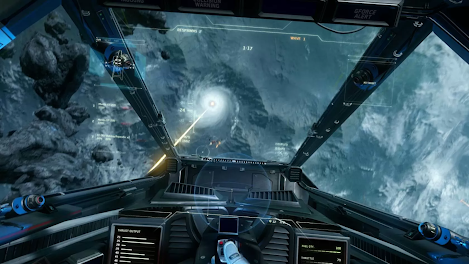
The world's most expensive video game has gotten richer. Star Citizen's funding yesterday crossed $500 million.

Star Citizen started development in 2011 and was revealed to the public in the autumn of 2012 with a Kickstarter campaign. The initial Kickstarter campaign was relatively modest, drawing in $2 million. However, Cloud Imperium Games allowed crowdfunding to continue directly between fans and the company, resulting in a continuous revenue stream. By the end of 2014 funding had reached $65 million and $127 million by September 2016.

Star Citizen is the brainchild of veteran video game designer Chris Roberts. Roberts began his career in the 1980s working on games on the BBC Micro like Stryker's Run (one of the very first video games I ever played) before moving onto much more powerful machines. In 1990 he released the game that made his name, Wing Commander, a space combat simulator with a strong storyline attached. Several sequels followed and saw the game branch into full motion video cutscenes, using actors like John Rhys Davis (Indiana Jones, The Lord of the Rings) and Mark Hamill (Star Wars) to tell increasingly elaborate stories about the war between humanity and the alien Kilrathi. After the release of Wing Commander IV and Wing Commander: Privateer 2 in 1997, Roberts moved on to working on a Wing Commander movie. The film, released in 1999 and starring Jurgen Prochnow, Freddie Prinze Jr., Saffron Burrows and David Suchet, was critically derided.

Roberts returned to gaming, producing with his brother Erin the games Starlancer (2001) and Freelancer (2003), which were set in a shared universe. Starlancer was a story-focused, single-player game with a strong narrative and linear campaign, whilst Freelancer was envisaged as a more freeform, open-world game akin to Elite or Privateer, with a bigger focus on online multiplayer. After multiple delays, budget issues and concerns over "feature creep," not to mention a buy-out by Microsoft, Freelancer was released in 2003 with a reduced focus on the multiplayer approach and a narrative storyline in place. Roberts returned to working in the feature film industry, believing it was not possible to make a game based on his vision with the resources available in the industry at the time.

Star Citizen marks Roberts' unfettered vision for a science fiction video game set in a large, open universe that the player can explore as they choose. They can own multiple spacecraft and take part in trading, mining and mercenary work. The game features a first-person mode, allowing characters to walk around their spaceship, take part in boarding actions and leave the ship to engage in combat, negotiations or discussions in person. The game will have a storyline of sorts, but will rely on online multiplayer for most of its dynamic plot generation.

The game also incorporates a whole second title using the same engine and assets, Squadron 42. Squadron 42 will be a more linear, story-focused and single-player game akin to Starlancer and the Wing Commander series, guiding the player through a lengthy story campaign featuring characters modelled on and voiced by actors including Gary Oldman and Gillian Anderson (plus a returning Mark Hamill.

Star Citizen has raised most of its money through direct player donations and contributions, including the sale of more powerful and capable spacecraft they will be able to use in the game itself. Almost 4.1 million individuals have contributed to the funding scheme. It has also raised over $60 million in external, private investment.

The game has attracted criticism for its funding methodology and its extended development time, with frequently missed deadlines and an apparent overload of feature creep, with development reportedly focusing on things like realistic sheet deformation for beds rather than optimised performance (the current build is noted as being very laggy even for top-end graphics cards). Newcomers to the early access version of the game have also criticised it for a very steep learning curve and almost non-existent tutorials. However, its fanbase has also praised the game's commitment to unparalleled levels of detail at both the macro and micro levels and its focus on immersion, as well as the potential for highly varied missions incorporating both spacecraft and ground combat, and the extended development time has been down to the game doing things that no other title has before attempted (not to mention using an engine - derived from the CryEngine mostly used for first-person shooters - that is perhaps best not-suited for these things).

Whilst scepticism over the game's progress and its funding methods is natural, there does appear to be an interesting and ambitious game design at work here, and the fact you can play it right now does show where a lot of the work and money has gone. What is astonishing is that after ten years, people are still funding the game to a very high level (in the time it's taken me to write this article, the game has raised around $4,400; the game raised $75,000 yesterday by itself), showing a remarkable degree of confidence and trust in the project.

It's hard to get precise figures, but the previous most expensive video game development budgets for titles like Red Dead Redemption 2 and the in-development Grand Theft Auto VI are thought to be more to the in the region of $200 million, with around the same for marketing. Star Citizen pulling in vastly more money, mostly for development alone, is an impressive achievement.

Star Citizen and Squadron 42 remain in development with no estimated release date at this time.

Tuesday, 20 September 2022

J. Michael Straczynski calls on BABYLON 5 fans to help boost the show's reboot chances

Babylon 5 creator and showrunner J. Michael Straczynski has called on fans to join a social media franchise to boost the show's profile and help get a planned reboot of the show off the ground.

As reported previously, Straczynski is currently developing a Babylon 5 reboot project with Warner Brothers, potentially to air on the CW. A pilot script has been written and the CW took the highly unusual step of turning down the project for the 2022-23 season but keeping it in active development for the 2023-24 season. Apparently this delay was partially down to major seismic shifts both at the CW, which has been bought by the Nexstar Media Group, and Warner Brothers, which has been bought by and merged with Discovery.

Straczynski wants a show of support to show the interest in the show, using the hashtag #B5onCWin23 across social media platforms. The campaign began yesterday and appears to have been successful, briefly trending at #1 for the day and displacing even coverage of Queen Elizabeth II's funeral in London.

The effectiveness of the campaign remains to be seen, although companies do factor in social media presence and profile in making these decisions.

Babylon 5 is a science fiction, space opera franchise created by Straczynski. It originally ran for 5 seasons and 110 episodes airing between 1993 and 1998, along with 7 TV movies and a short-lived spin-off series, Crusade. The series which was mostly written by Straczynski (who penned 91 of the episodes) and won critical acclaim during its original run, including two Hugo Awards. The show was particularly noteworthy for its dedication to telling one continuous story across five seasons - common now but unheard of at the time - and its pioneering use of CGI for its visual effects, including some of the earliest TV uses of virtual sets and 100% CG creatures. The show was also recently given a HD makeover and re-release.

Since the conclusion of the original show, the cast has unfortunately suffered a high level of attrition, effectively blocking attempts to revive the show with a "next generation" approach. Straczynski has instead planned a reboot, telling a similar story in a similar universe but with substantial differences to the original.

Sunday, 18 September 2022

Biggest video game leak for 20 years sees GRAND THEFT AUTO VI and DIABLO IV secrets unveiled

In possibly the worst day for video game developers since the infamous Half-Life 2 source code leak of 2003, two of the most eagerly-awaited video games of all time have had their secrets spilled all over the internet.


This morning, more than 90 development videos and a ton of screenshots were released from Grand Theft Auto VI. The sequel to Grand Theft Auto V (2013), one of the biggest-selling individual video games of all time, the status of GTA6 was a mystery until Rockstar Games confirmed earlier this year they were working on it, and had been for some years. The new leak confirms that the game is in a relatively advanced state of development, although the images and videos seem to run the gamut from very early development (with untextured characters running and jumping against a bare background) to high-quality, finished scenes with dialogue.

Although Rockstar and publisher Take Two Interactive had not commented on a potential launch window for the game, Take Two had allocated a large marketing spend for financial year 2023-24, later delaying that to 2024-25, suggesting they envisage a mid-to-late 2024 release for the game. Whether the leak delays that remains to be seen. Famously, when Half-Life 2 was leaked, Valve delayed the release of the game and reworked a huge amount of the source code from scratch, but that's really not viable with the scale and scope of modern games. It's also unclear if the GTA6's source code has been compromised in the same way as Half-Life 2's was.

This afternoon, an hour-long video of beta gameplay footage for Diablo IV was also leaked. Diablo III was released in 2012 and sold over 30 million copies, so anticipation for the sequel is also very high. Diablo IV is also closer to release, with the game tentatively scheduled for release before the end of 2023, with the video more likely to show things as they will be in the final release.

Leaks of this scale are almost unheard of in the video game industry, and both Rockstar and Activision-Blizzard will be looking closely to see how this happened and how to stop it happening again. Other video game companies may also be wondering nervously if any of their forthcoming high-profile releases have also been compromised.

Thursday, 15 September 2022

Amazon greenlights BLADE RUNNER 2099 TV mini-series

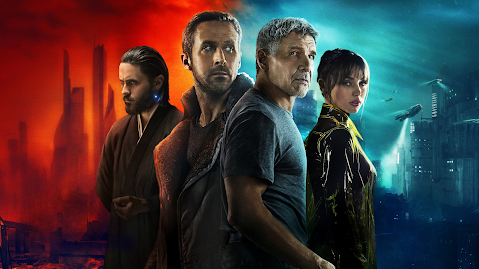
Amazon has greenlit Blade Runner 2099, a live-action TV mini-series set in the world of the 1982 movie Blade Runner and its 2017 sequel, Blade Runner 2049. They initially announced the series was on the fast track to development back in February.


Ridley Scott, who directed the first movie and produced the second, is on board as executive producer and consultant. Silka Luisa (Shining Girls) is the main writer and showrunner for the project. Tom Spezialy (Watchmen, Ash vs. Evil Dead) is also on board as a writer. Alcon Productions (The Expanse) will make the show in conjunction with Scott's own production company, Scott Free.

Both Blade Runner and Blade Runner 2049 were commercial disappointments on their original release, but have grown to be cult successes, with both movies enjoying an impressive long tail on video, DVD, Blu-Ray and now streaming. Both films have also enjoyed substantial critical acclaim.

Moving the story a full fifty years on from the events of Blade Runner 2049 suggests there will be few, if any, story or character crossovers with earlier iterations of the franchise. Amazon fast-tracking the project suggests it will film in 2023 for a likely 2024 release.

Wednesday, 14 September 2022

Tor Books publish a new, and possibly erroneous, WHEEL OF TIME world map

Tor Books have unveiled a new world map for Robert Jordan's Wheel of Time book. The map appears in Origins of the Wheel of Time, a new behind-the-scenes book about the series by Michael Livingston, due out in November.


The original world map was published in The World of Robert Jordan's Wheel of Time (published in 1997). The map was created in 1995 by John M. Ford*, between the publication of Lord of Chaos and A Crown of Swords (the sixth and seventh books in the series), based on Robert Jordan's notes and directions. Artist Tom Canty then redrew the map for the final book. After Robert Jordan's passing, those notes were among those made public, and are as follows:
The world of the books is the same size as our world. After all, it’s supposed to be our world, with all the tectonic plates shifted. Some reference points:
  • Illian is about 2,500 miles south of Chachin, and 2,700 miles south of the Mountains of Dhoom.
  • Falme to the Spine of the World is about 3,300 miles.
  • Falme to Seanchan across the Aryth Ocean is about 11,000 miles.
  • Seanchan to Shara across the Sea of Omerna is about 3,000 miles.
  • The Aiel Waste is about 1,200 miles across, while Shara is about 2,000 miles (W-E) by 5,000 miles (N-S), with the Great Blight extending further south in Shara than in the Borderlands.
  • Seanchan is about 16,000 miles from the southern tip to the Mountains of Dhoom (named by Hawkwing’s armies) in the north—yes, the same mountain range that girdles the world on land and under the ocean. The north of Seanchan is about 2,000 miles across at its widest, and there is a span of 6,000 miles at its widest in the south.
  • South of the known world is an island continent known only to the Sea Folk, but avoided by them, which they call “the Land of the Madmen.” Its dimensions are about 3,000 miles (W-E) by 2,000 miles (N-S), with its southern coast less than 500 miles from the southern ice cap in places. Some speculate on the resemblance of this continent, in all respects, to current-day Australia, but on this we have no opinion.
  • There are both northern and southern ice caps. The southern ice cap completely covers whatever land is beneath it, and is larger than Antarctica. The northern ice cap also stretches somewhat further south than in our world.
  • And to cap off this post, we note that some of the early maps were sketched out by Mike Ford, and others drawn by Thomas Canty; but the later maps throughout the series are the work of Ellisa Mitchell, a talented artist whose clarity of vision and attention to detail have been responsible for helping us imagine the major cities that have appeared in the story.

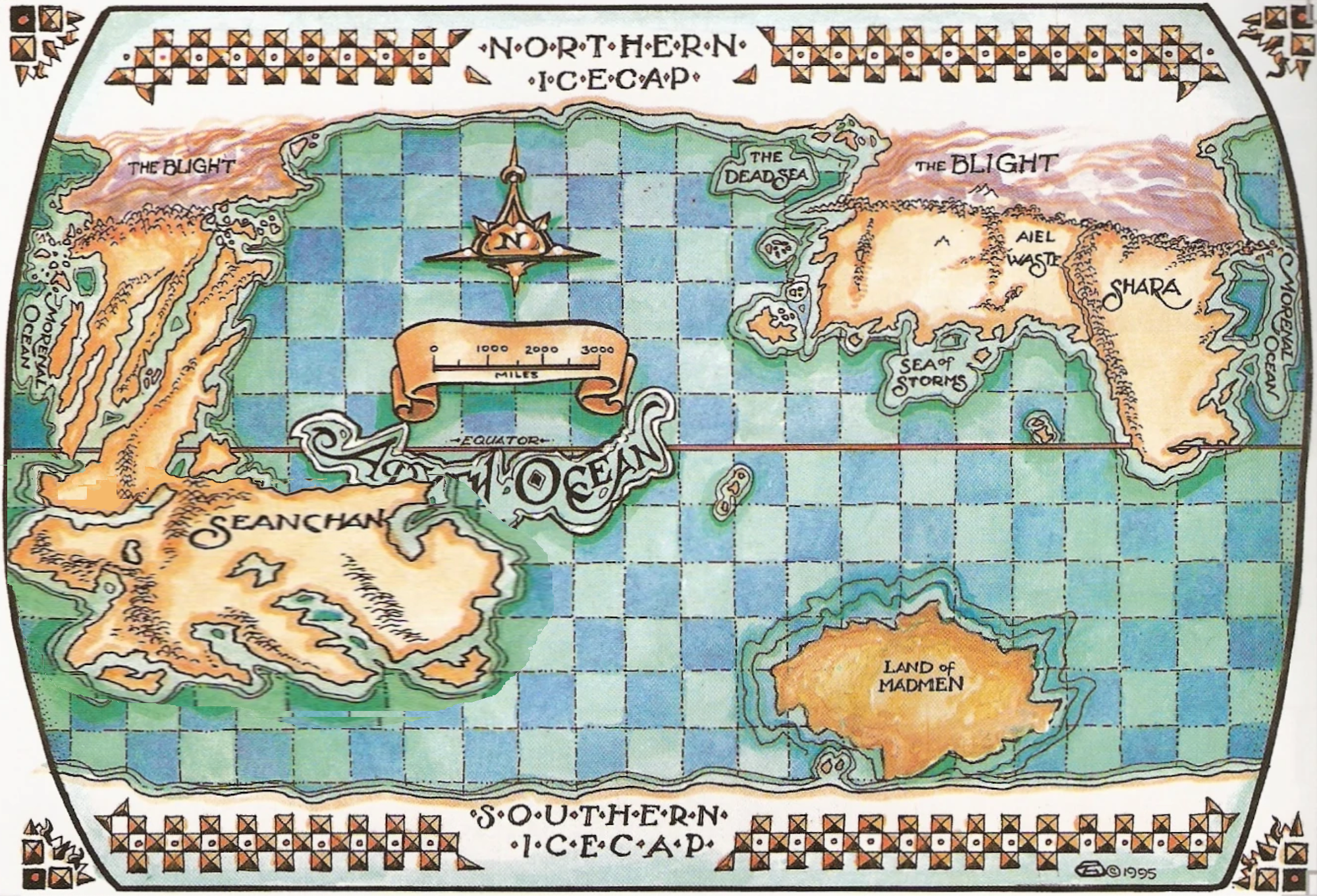
The published world map looks like this:

The world map from The World of Robert Jordan's The Wheel of Time by Teresa Patterson and Robert Jordan, map by Tom Canty, based on an initial sketch by John M. Ford (never published).

Obviously, the visual depiction of the map is at variance with Jordan's instructions. Depending on where you count it, Seanchan is between 3,000 and 5,000 miles wide south of the equator rather than 6,000 miles, and Jordan seems to have spent a fair proportion of the two years between the completion of the map and the publication of the book asking for it to be redone:
“extend Seanchan a little farther south. Make southern portion of Seanchan wider by 75%, all south of equator.”
However, the world book was infamously made on a non-existent art budget (the other art in the book is...debatable in quality) and there seems to have been no money available to have the map redrafted. As a result, the map was published as-is, to Jordan's irritation.

We can also assume that RJ wasn't using a detailed art programme to gauge sizes and was going off the scale squares to gauge Seanchan's size. He might have simply taken the 3,000-4,000 mile size and added 75% on it to make it between 5,250 and 7,000 miles, so was still trying to align with his original, 6,000-mile plan.

Twenty-seven years later, Tor have published a "fixed" world map in Origins of the Wheel of Time, and it looks like this:

The new world map from Origins of the Wheel of Time by Mike Livingston, map by Ellisa Mitchell.

Seanchan has been extended in width to some 9,000 miles across in the southern hemisphere, which is a lot (and also looks like it has a tumour sticking out of the side of it, which is less great) and seems to be a lot more than Jordan originally planned. I think simply stretching the map by 75% would have made more sense, and would have made the continent look a bit more natural:

An adjusted version of the original world map with Seanchan made 75% wider.

That's 5 minutes' work so you'd have to massage it a bit, but you get the idea. In this configuration Seanchan is a bit over 7,000 miles wide, so still wider than RJ's original notes but certainly closer to his original plan.

Michael Livingston gives some interesting reasons for the changes here, but curiously Robert Jordan's notes for the construction of the map are never mentioned, to the point where I wonder if Livingston was aware of them. Instead, he has simply followed RJ's suggestion that Seanchan be stretched by 75% (possibly more) without consideration of Jordan's earlier clear directions that Seanchan is 6,000 miles wide. Simply stretching Seanchan makes the continent some 9,000 miles wide instead (or a whole United States of America bigger!). Livingstone argues this is desirable for two reasons: to bring Seanchan closer to the Westlands, making the immense voyage of the Seanchan to the Westlands more plausible, and also because it "fits" the continental shapes of the landmasses better.

The second point I would say is not really germane: the world is the shape it is in The Wheel of Time because of the Breaking of the World, not natural geological forces. The WoT world is our world and before the Breaking likely much more closely resembled our current world map, bearing in mind Robert Jordan's original plans for a cataclysm between the First Age - our age - and the Age of Legends was for a nuclear war, which would have devastated civilisation but left the continental landmasses largely unchanged. It's possible Seanchan is a reconfigured North and South America (though much larger), and the Land of the Madmen is certainly a reconfigured Australia. The Westlands and Shara may be a reconfigured Eurasia, but the much greater size of the Westlands versus Europe suggests that a huge chunk of Africa was also smershed up into it as well. Of course, it's also likely that the Breaking was so immense that none of the reconfigured continents could really be 1:1 identified with preexisting ones at all (although Jordan did note that the Breaking was not quite so severe the greater the distance from Shayol Ghul).

Bringing Seanchan closer to the Westlands might also be desirable from a plausibility view, but it's also not really possible: Robert Jordan identifies the distance from Falme to Seanchan as being 11,000 miles, so clearly he envisaged the distance as simply being immense in any case, much more Pacific-sized or larger, than Atlantic-sized. The Seanchan could have simply used the One Power via damane to speed their passage, eliminate the risk of storms and make the crossing vastly more efficient than any mundane passage. We also see that the Seanchan invade the Westlands via Falme and Toman Head, whilst this new configuration of Seanchan would make invading via Tremalking, Tarabon and Altara from the start much more likely.

Livingston also mentions Jordan's wish to rename the southern continent, the Land of the Madmen, but that also creates another issue. It appears that after calling the continent "the Land of the Madmen" in the text of the notes, Jordan changed his mind and he wanted to call it "the Mad Lands" instead. Again, the lack of art budget seems to have made it impossible to change the name of the continent on the map so they also decided not to change it in the text. Interestingly, Robert Jordan then proceeded to call it "the Land of the Madmen" for the rest of his life. It appears in his notes under that name and whenever anyone raised the issue in interviews, Q&As, fan mail etc, he stuck to calling it "the Land of the Madmen." Basically, the published canon overrode his behind-the-scenes preference, and to save confusion he stuck with the original name.

This may also indicate that, however, unhappy he was that Seanchan's configuration could not be changed before publication, once it was published, he accepted it as canon and proceeded accordingly. So changing Seanchan's size at all, whether to the 6,000 miles of his original notes or the 9,000 miles of this new configuration, might have simple been out of keeping with the way he worked.

In my own Wheel of Time Atlas project, I found a compromise that worked surprisingly well.

The first thing I did was simply swapped out the world map version of Seanchan for the larger-scaled map of Seanchan found elsewhere in the same world book: 

The map of the Seanchan home continent from The World of Robert Jordan's The Wheel of Time by Teresa Patterson and Robert Jordan, map by Tom Canty, based on an initial sketch by John M. Ford (never published).

The "close-up" map of Seanchan is already different in shape to the world map version. It is significantly wider both to the west and east. Simply substituting this map for the other immediately made Seanchan significantly wider. Indeed, comparing the scale of simply inserting the "other Seanchan" on the map makes it line up almost immediately with being 6,000 miles wide, possibly slightly wider already. This makes me wonder if the world map was made first and the continent map later on, with Robert Jordan's notes already taken into consideration.

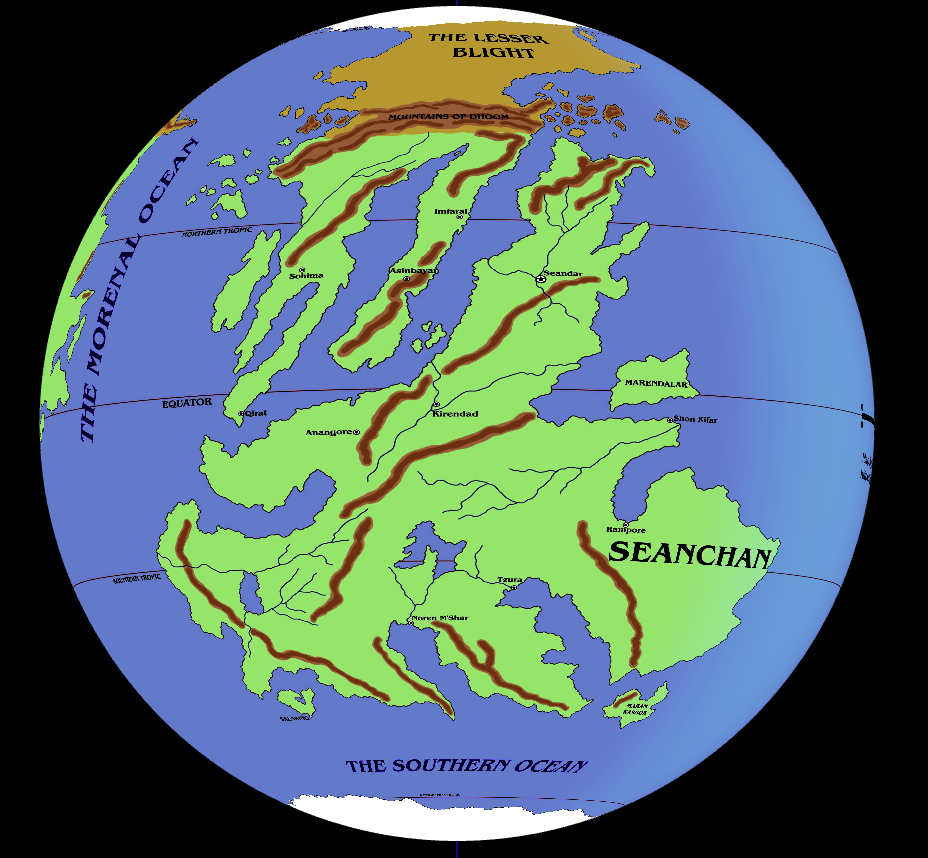
My Wheel of Time world map, which replaces the original Seanchan from the world map with the larger continent map from elsewhere in the book.

I also did the same thing with the Westlands and Shara, using the larger-scaled local maps to replace their world map versions, resulting in both greater accuracy and more detail.

More pleasingly, placing the map on a globe works extremely well, and the "bulge" effect on the maps from placing them on a sphere immediately makes Seanchan even larger without having to distort it's shape at all.


So it appears that the well-intentioned attempt to redraw the map for the new book may not have been really necessary in the first place, with a more moderate approach respecting Robert Jordan's intentions being possible.

Still, I'm looking forwards to the book to see if Livingston has unearthed any further interesting material.

* Yes, the author of the World Fantasy Award-winning The Dragon Waiting and other fantastical works (including the fan-favourite Star Trek novel How Much for Just the Planet?). It turns out that Ford was also a massive Wheel of Time fan, a fan of maps and a friend of Robert Jordan's. Sadly, John M. Ford passed away in 2006.
Thank you for reading The Wertzone. To help me provide better content, please consider contributing to my Patreon page and other funding methods.

Friday, 9 September 2022

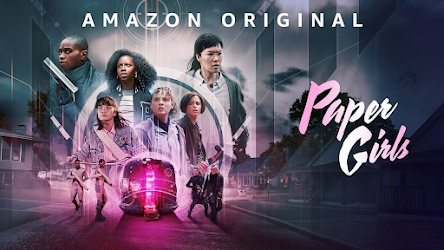
PAPER GIRLS cancelled at Amazon, despite being excellent

Sadly, but perhaps inevitably, Paper Girls has been cancelled at Amazon after a single season.

The show launched in late July to critical acclaim, but decidedly muted viewing figures. Amazon's marketing for the show was lacklustre, as Amazon shifted its marketing efforts towards the decidedly less-accomplished but staggeringly more expensive Rings of Power, which launched on 2 September, and its marketing seemed custom-designed to make the initially 1980s-set show look like a Stranger Things rip-off (despite Paper Girls' source material predating Stranger Things and the story not being anything like it).

As I said in my review, Paper Girls was the rare comic book adaptation that dramatically improved its (oft-messy and underdeveloped) source material by focusing much more on characterisation, whilst also ensuring a solid amount of plot development and action in each episode. The show also featured superb performances by seasoned hands Adina Porter, Ali Wong, Nate Corddry and Jason Mantzoukas, but outstanding turns by its four young leads: Camryn Jones, Riley Lai Nelet, Sofia Rosinsky and Fina Strazza. I suspect great things are ahead for all of them.

The show was produced by Legendary Television for Amazon but it does not appear that there's any hope of another channel or streamer taking on the project. Fortunately, the graphic novel by Brian K. Vaughan and Cliff Chiang remains available for anyone wanting closure on the story.

Eman Esfandi cast as the live-action Ezra in STAR WARS

Lucasfilm have announced that Eman Esfandi will be playing the live-action version of Star Wars character Ezra Bridger in their upcoming Ahsoka series.

The character of Ezra, voiced by Taylor Gray, was introduced in the first episode of Star Wars: Rebels in 2014. Ezra is a native of the planet Lothal, which has been occupied by the Empire. Ezra performs minor acts of rebellion and sabotage against the Empire before being recruited by Kanan Jarrus to join a rebel cell led by himself and Hera Syndulla. Kanan, an ex-Padawan, also discovers Ezra's budding Force powers and trains him in the ways of the Jedi, although Kanan's own incomplete training (and guilt for the death of his master during the Clone Wars) makes this a complicated affair. By the end of the series, Ezra has become an adept Force-user and a powerful ally of the Rebellion. In the final episode of Rebels, Ezra helps defeat the Imperial Grand Admiral Thrawn in a battle on and above Lothal, but in the process both Ezra and Thrawn disappear and have not been seen since. A post-Return of the Jedi epilogue reveals that Ahsoka and Ezra's good friend Sabine Wren are setting out to explore the galaxy to look for Thrawn and Ezra. Events in The Mandalorian suggest this search is still incomplete some five years later.

Esfani is a relative newcomer, having built up a steady stream of stage credits and appears in shorts, as well as in the film The Inspection and recent biopic King Richard. He has also directed several short films.

Esfani will join Rosario Dawson as Ahsoka Tano (reprising the role from The Mandalorian) and Natasha Liu Bordizzo as Sabine Wren for the cast of Ahsoka, with Hayden Christensen also poised to return as Anakin Skywalker/Darth Vader, presumably for flashback scenes. Ivanna Sakhno, Mary Elizabeth Winstead and Ray Stevenson have also been cast in undisclosed roles. Rebels characters Hera Syndulla and psychotic droid Chopper are also due to appear, but their casting has not been announced so far (it is possible that Ahsoka writer-producer and Rebels creator Dave Filoni will return to "voice" Chopper, as he did throughout Rebels).

Star Wars: Ahsoka is due to air on Disney+ in 2023.

WARLORD CHRONICLES TV series greenlit by Bad Wolf and ITVX

Bad Wolf Productions have finally pulled the trigger on their long, long-gestating Warlord Chronicles TV series.

Based on the historical-with-a-hint-of-fantasy trilogy by Bernard Cornwell, the series is a "realistic" take on the legend of Arthur, recasting Arthur as a post-Roman mercenary commander or warlord who has to rule as regent of the kingdom of Dumnonia for the young Prince Mordred, and how he deals in a politically complex world divided between the remnants of the Romans (particularly the cult of Mithras), the native Britons and the invading Saxons. The series is notable for its attempts to be historically accurate to 5th and 6th Century Britain, particular when it comes to military, religious and political concerns.

The trilogy consists of the novels The Winter King (1995), Enemy of God (1996) and Excalibur (1997), and is consistently Cornwell's most acclaimed series, helped by its conciseness (his Sharpe and Last Kingdom series, both previously adapted to television, are better-known but considerably longer) and its revisionist take on familiar characters, with Guinevere as a fierce warrior-queen of another tribe and Merlin as a priest whose magical powers are more claimed than demonstrable.

The 10-part first season, which will adapt The Winter King, will debut on the streaming platform ITVX in the UK. Bad Wolf Productions are currently looking for an international streaming/distribution partner. They have good relations with HBO and the BBC, with whom they produced His Dark Materials (which returns for a third and final season this year). Kate Brooke and Ed Whitmore are writing, whilst Otto Bathurst will direct.

Bad Wolf originally optioned the series in 2015, at the same time as His Dark Materials, but wanted to complete work on that show before moving to a new project.

Bad Wolf are also producing Doctor Who for the BBC, with Russell T. Davies in charge. Production appears to be complete or almost so on a series of three specials due to air in 2023 for the show's 60th anniversary, which will see David Tennant reprise his role as the Doctor, and they are about to start production on the fourteenth series, which will see Ncuti Gatwa take on the role.