Wednesday, 12 December 2018

Revisiting the Wasteland: Modding FALLOUT 3

Since 2002 Bethesda Softworks have been making 3D roleplaying games set in large, open worlds which encourage exploration. Despite vast improvements in graphics technology, these games are notable for using the same basic game engine, GameBryo, throughout. In 2011 Bethesda renamed this engine "Creation" in an attempt to make it appear they were using newer technology, but it was in fact the same engine with different rendering and lighting modules. In one form or another, this engine has now powered seven games: Morrowind (2002), Oblivion (2006), Fallout 3 (2008), Fallout: New Vegas (2010), Skyrim (2011), Fallout 4 (2015) and Fallout 76 (2018), and will apparently still be powering their next two games, Starfield and The Elder Scrolls VI.


Despite the weaknesses of using the same basic codebase for twenty years (to the point where code referencing Morrowind can still be found in the files for Fallout 4 and 76), it does provide a very stable platform for modders, fans who use the engine's open nature to tinker with the makeup of the game. By adjusting files, modders can add new quests, weapons and locations, adjust the world map, fix bugs (especially useful for Bethesda games, where Bethesda are notorious for fixing just a few game-breaking bugs in an early patch and then leaving myriad minor problems unfixed, sometimes ones that recur from game to game) and - most importantly - improve the graphics of the games to keep them relevant later on.

My recent and ongoing playthrough of Fallout 3 - a game more than a decade old which frankly already looked a bit dated on release - would not have been as pleasant an experience without the presence of mods to help fix up the game. These mods do everything from dramatically improving the game's textures to reworking blades of grass so they feel more realistic and making the characters look more like people and less disconcertingly like drunk mannequins. There are limits on what can be done - no amount of modding can totally remove the slightly stodgy movement, clumsy jumping or imprecise shooting outside of VATS mode, or alleviate the vast number of identikit ruined buildings in DC - but it is the difference between the game being a cluster of microfrustrations and something that is much more enjoyable to play by 2018 standards.

Modding Fallout 3 is, fortunately, not a ruinously complicated procedure. Most of the modding process is automated these days and it's relatively simple to do or abandon and revert to the base game if you feel like playing the game in its old-skool incarnation.


In order to mod Fallout 3 you need to do the following:

1. Have a PC (modding to this scale is not available for the PS3 or X-Box 360 versions of the game).

2. Secure a copy of Fallout 3 Game of the Year edition from GoG.com. You can mod an original 2008 boxed version of the game or a Steam version of the game, but it's far, far more work and it will be constantly challenged by the original version of the game's use of Games for Windows Live and the Steam version's flakiness when played on Windows 8 or 10, and will probably crash a lot more. The GoG version of the game also comes pre-modded to remove the GFWL launcher and also adds the LAA (Large Address Aware) Patch, which allows the game to make use of more of your PC's RAM (the 2008 version was hardcoded to use 2GB of RAM only for the game, which was ridiculous). Fortunately Fallout 3 is ten years old and quite cheap (especially if you wait for the next GoG sale around Christmas). It's probably a good idea to grab a copy of New Vegas as well from them for the same reason.

3. Bookmark the Fallout 3 page on the Nexus Mods web page. You're going to be spending a lot of time here.

4. Download the Nexus Mod Manager. This will make the process of downloading and installing mods far easier than it will be otherwise.

5. Watch this video (the same as embedded above). There are many, many videos on modding Fallout 3 out there, but this one is notable for being concise and focused solely on stabilising and improving Fallout 3, not adding loads of fan content or doing whacky stuff with the graphics that move the game away from Bethesda's original intentions.


Once you've done that your're set to go. The video (by "Some Kind of Elephant") is pretty good and will take you through the basis of modding the game. The Nexus Mod page contains most of the mods you need to use. It should be noted that some of the links in the YouTube video have expired, so to find the mods just type the name into the search function on the Nexus Mod page. I'd also advise not using the DLC retexture pack addresses in the main description, as they lead to sites which triggered my antivirus software. Instead get those files from here:

http://www.mediafire.com/file/d1c1vp8g1jbgb8y/Operation+Anchorage.7z http://www.mediafire.com/file/boi3u7tgqan5htt/ThePitt.7z http://www.mediafire.com/file/fwksyu0v6auw32u/BrokenSteel.7z http://www.mediafire.com/file/ql238cvbl494re3/PointLookout.7z

One mod not mentioned in the video but which - frankly - is essential is SpeedMod v2. This mod can be used to improve your character's base walking and running speed by one of several presets, which is essential because the base speed in Fallout 3 is insanely slow. Adding this mod will prevent you from hurling something through the screen in horror at how slowly you (and everyone else) moves. The game does increase everyone's movement speed, so monsters and other characters in the game will also get a speed boost (so it won't let you "cheat" by running much faster than anyone else).

It's worth noting that the UI mod (which makes the on-screen information like health and ammunition) is only desirable if you are playing the game on a monitor which you're sitting right next to. If you're outputting the game to a TV and you're playing from the couch, you may want to leave the UI as it is for clarity.

Once that's all done, launch the game via the Nexus Mod Manager programme using the "Launch FOSE" option and you should be all set to go.


Thank you for reading The Wertzone. To help me provide better content, please consider contributing to my Patreon page and other funding methods, which will also get you exclusive content weeks before it goes live on my blogs. A History of the Wheel of Time, SF&F Questions and The Cities of Fantasy series are debuting on my Patreon feed and you can read them there one month before being published on the Wertzone.
Sunday, 9 December 2018

Happy 15th Anniversary to BATTLESTAR GALACTICA (2.0)

On 8 December 2003, the Sci-Fi Channel aired a two-part TV movie based on Glen A. Larson's 1978 space opera, Battlestar Galactica. This new show had been preceded by very low expectations: none of the cast or crew of the original show was involved, and two previous reboot pitches which had been direct sequels to the original show had been cancelled in favour of a total remake. Redesigns of iconic ships and vehicles had annoyed the original fanbase, as had the "gender-swapping" of established characters like Starbuck and Boomer. However, early critical reviews were positive and some of the casting for the show, such as Edward James Olmos as the new version of Commander Adama (in the role played by Lorne Green in the original) and Mary McDonnell as the new President of the Colonies, seemed promising.

A promotional image for Battlestar Galactica's third season (2006-07).

The road to relaunching Battlestar Galactica had been a long one. ABC had commissioned Glen A. Larson to create the original show back in 1977, keen to launch on the bandwagon of space opera and impressive visual effects generated by the release of the original Star Wars movie. They even brought in John Dykstra, who had created Star Wars's special effects, to work on the show. Borrowing heavily from Egyptian mythology and Mormon theology, the show told the story of the annihilation of the Twelve Colonies of Man at the hands of a hostile alien race, the Cylons, consisting of cyborg leaders and fully-robotic soldiers. The last surviving human warship, the battlestar Galactica, leads a "ragtag fugitive fleet" in search of the mythical Thirteenth Colony, also known as Earth. Despite schmaltzy acting, the presence of cute kid and animal actors (including the still-bizarre decision to have a chimp playing a robot dog) and whiplash-inducing shifts in tone, the show built up a strong following for its impressive effects and its emphasis on family.

The show launched to enormous ratings, but these fell drastically over the course of the first season. Combined with the show's eye-watering cost, ABC decided to cancel it and resurrect it two years later as Galactica 1980, a much lower-budged show meant more to appeal to kids. Galactica 1980 holds a strong claim to be the worst TV show ever made (with the solitary exception of a flashback episode set during the original series) and was quickly put out of its misery.

The original Battlestar Galactica had spectacular visual effects for 1978 but less impressive scripts.

Larson moved on to other projects, but always felt there was more mileage in the Battlestar concept. Richard Hatch, who'd played Captain Apollo on the original series, agreed, and with Larson's blessing undertook various attempts to relaunch the show. Successful novel and comic series followed through the 1980s and 1990s and in 1998 Hatch produced a proof-of-concept video dubbed Battlestar Galactica: The Second Coming. Ignoring Galactica 1980, this would have been a "next generation" concept picking up on the story twenty years later with the Galactica crew still searching for Earth with a whole new generation growing up in the fleet. Despite being popular at fan conventions, the idea did not find fertile ground with a studio. A year later Glen A. Larson started developing a movie concept which would have followed up on the fate of the battlestar Pegasus from the original series, but again this didn't get very far.

A much more serious attempt followed in 2000. Producers Bryan Singer and Tom DeSanto were the hot flavour of the month in Hollywood for the success of their movie X-Men and Singer, a huge fan of the original Battlestar Galactica, was determined to get the show launched again. His concept was similar to Hatch's and would have been a next generation reboot. Fox TV signed on, but were somewhat sceptical that BSG's relatively small fanbase could help propel the show to a larger audience, especially as it was a continuation. Nevertheless, the project moved to within a few weeks production starting (including some early set construction and lots of concept art being produced) when Fox put all new projects on hold in the wake of the 9/11 terrorist attacks. Fox were slow to get the show moving again, so when Singer and DeSanto left the project to focus on the next X-Men movie, Fox let the idea lapse.

Promotional artwork for Bryan Singer and Tom DeSanto's planned Battlestar reboot (2001).

Universal Pictures, who held the rights to the original BSG, decided to push forwards with a new version of the show themselves. Whilst 9/11 had disrupted Fox's plans, Universal saw it as an opportunity to tell a very different kind of story. Critics of the original BSG - and even some fans - had felt that the original series had massively undersold the darkness and trauma that would have resulted from the destruction of twelve planets and billions of human beings on the survivors. Universal asked producer David Eick to work on ideas for the new series, but the first directive was that this was going to be a page one rewrite and remake set in a new continuity. Eick decided he needed to bring on board someone who really understood science fiction and in particular space opera and brought on board a writer named Ronald D. Moore.

Moore had cut his teeth as a very young writer on Star Trek: The Next Generation, which he'd joined in 1989 in its third season. He was just about the only staff writer to survive the chaotic third season into the fourth, and became a key creative lead on the show in its latter five seasons. When the show wrapped, he co-wrote the movies Generations and First Contact as well as moving over to Deep Space Nine for its third season, again playing a key creative role on that show. When Deep Space Nine wrapped in 1999, he moved over to Star Trek: Voyager but immediately found a much more restrictive creative environment. Moore was in particular frustrated by the fact that the starship Voyager was still clean and pristine despite being trapped on the other side of the galaxy with very limited chances for resupply. His feeling was that the show should have been darker, more challenging and engaged in more morally murky discussions about the morality of the Federation when a ship was put in a difficult position. The producers disagreed, feeling that cookie-cutter philosophising and constantly hitting a big red reset button at the end of every episode was the way forwards instead. Moore duly quit, going to work first on Roswell at the WB and then Carnivale at HBO.

Executive producer and showrunner Ronald D. Moore on the hanger set of Battlestar Galactica.

He was still working on Carnivale when Eick called. Moore had watched Battlestar when it first aired and seen great promise in it, but had also disliked the campy and sillier elements of the show (such as the cute kids, robots and the "casino planet" in the pilot). He rewatched the pilot movie and realised there was a lot of strength in the basic premise and agreed that it could be reworked in a post-9/11 environment for greater emotional impact. He agreed to write a new pilot for Universal's subsidiary, the Sci-Fi Channel (now SyFy). This ballooned into a (relatively) high-budget three-hour mini-series which could also work as a backdoor pilot for a full series.

Moore penned the pilot and oversaw some elements of production, including exercising his desire for a slightly darker aesthetic than Star Trek and to have a completely new (for SF) way of shooting the action with handheld cameras, even the space scenes. Director Michael Rymer immediately locked into what Moore was thinking of and his directorial style immediately became a hallmark of the show. Moore also wanted a more understated and less symphonic way of doing music for a space series and lucked out when Richard Gibbs also picked up that idea and ran with it. A young composer named Bear McCreary also assisted Gibbs on the pilot.

Edward James Olmos as Commander William Adama and Mary McDonnell as President Laura Roslin.

Casting proved interesting but controversial. Moore wanted distinct actors with gravitas and experience, but was aware that it was very unusual for producers to get their first choices. In this case, he wanted Edward James Olmos for Adama and Mary McDonnell for Roslin and was flabbergasted when both said yes, sold on the quality of the scripts. The casting department also scored a steady series of successes when they found a lot of fresh young talent for the series, from Jamie Bamber for Apollo to James Callis for Baltar and, most iconically, Katee Sackhoff as Starbuck and former model Tricia Helfer as Caprica Six. Established fans of the show were furious to learn that both Starbuck and Boomer (to be played by Grace Park) had been changed from male characters to a female one for the show and some of the original castmembers agreed with them: Dirk Benedict (who played Starbuck in the original show) scathingly referred to the new character as "Stardoe".

For visual effects, the team at Zoic were called in to produce the huge amount of CGI needed for the mini-series. Zoic had just come off the back of Joss Whedon's newly-cancelled Firefly so the commission was good news for them. The CG team included many veterans of both Babylon 5 and Deep Space Nine, who relished on rendering effects on a new, more powerful hardware and having the ability to design lots of new ships, although honouring the designs laid down in the original show.


The Battlestar Galactica mini-series was critically acclaimed on its release. The reviews were excellent across the board, with a lot praise for the actors, direction and acting, and the ratings were very high, setting new records for SyFy. It was an easy choice to commission a full first season, especially once Ron Moore confirmed he would drop Carnivale (which was being torn apart by corporate politics and would be cancelled after its second season) to move over as full-time showrunner. When the first season proper debuted a year later, with 33 (the episode that won the show a Hugo Award), it was even better.

Of course, the show could not quite sustain that early acclaim and eventually went off the rails, but that's another story. Battlestar Galactica did for space-set science fiction what Game of Thrones later did for epic fantasy, making it grittier, more real and more resonant with a wider audience previously dismissive of the art form. It's a shame we haven't seen more shows come along in its wake, but finally, with shows like The Expanse, it seems that promise has come good. Battlestar Galactica remains, despite its declining quality later on, one of the strongest SF TV shows ever made, and essential viewing for any fan of the genre.

Get COMPANY OF HEROES 2 free until tomorrow

Relic are giving away their 2013 real-time strategy game Company of Heroes 2 free for the rest of the weekend.


Set in World War II, Company of Heroes 2 focuses on the confrontation between Germany and the Soviet Union on the Eastern Front. Although not quite as accomplished as the original Company of Heroes (2006), Company of Heroes 2 features superior graphics and new gameplay features such as simulating freezing cold weather and the impact of that on troops and vehicles.

Relic have also bundled Company of Heroes 2's numerous expansions and DLC into a single bundle for less than £5, including the very large, game-sized Ardennes Assault expanson which adds a persistent campaign map mode.

You can get Company of Heroes 2 here and the DLC here.

Saturday, 8 December 2018

Art & Arcana: A Visual History of Dungeons and Dragons by Michael Witwer

In 1974 Gary Gygax and Dave Arneson created a different type of tabletop game. Dungeons and Dragons became the world's first and most popular roleplaying game. For thirty-four years it ruled supreme and unchallenged, until a problematic fourth edition and the rise of the rival Pathfinder game knocked it off its perch. However, with its fifth edition the game has regained its crown. A key ingredient to the game's success has been the phenomenal roster of artists who have worked on the game for almost forty-five years.


Art & Arcana is a visual history of the Dungeons and Dragons game, taking in every edition and campaign setting the game has produced, as well as many of its novels, calendars and video games. Artwork from the very first prototypes right through the latest 5th Edition expansions and modules is featured, along with lengthy histories and interviews with key personnel.

Arts & Arcana is massive: more than 440 pages in length, it features over 700 separate pieces of artwork along with a significant amount of text detailing the history of the game in some depth. It starts with Gygax and Arneson playing miniatures wargames in Wisconsin in the late 1960s and rapidly hitting on the idea of moving from large armies of lots of figures to small parties of just a few figures exploring dungeons, and later wilderness and towns. Dungeons and Dragons was born, with Gygax and Arneson founding the company TSR to sell it all over the world.

This is where the fun began.

From there the game exploded, selling millions of copies and inspiring spin-off novels, board games and a TV show. Several times the management of the game became fraught and complicated, with Gygax forced out in a corporate takeover and TSR later collapsing before being rescued by Wizards of the Coast. The game's struggles in the face of competition from video games and card games such as Magic: The Gathering are also documented, not to mention the attacks on the game in the press by fundamentalist Christians in the 1980s. The book brushes over arguably the game's nadir, the problematic 4th Edition (2008-13) and the rise of rival products to challenge the game's supremacy, but it does end strongly with the game's return to recent prominence in a new era of podcasts, YouTube videos and Twitch streams.

The one constant throughout the book is artwork. The initial artwork for the game was simplistic, sourced for very little money from whatever artists were on hand. As the game boomed in sales, so the quality of the artwork increased dramatically, with iconic artists like Larry Elmore, Clyde Caldwell and Keith Parkinson joining the company. Later on younger artists arrived with radically different styles, ready to reassess the game for its later editions. As well as artwork for the core game, they also produced art for tie-in novels and video games.

The githyanki, created by future-bestselling SF author Charles Stross, using a name he borrowed from future fantasy megastar George R.R. Martin.

The result is a splendid coffee table book and the perfect gift for a fan of Dungeons and Dragons specifically or fantasy artwork in general. In fact, it's a tribute to the artistic strength of Dungeons and Dragons that so many brilliant pieces of artwork aren't even in the book, as there wasn't enough room.

In fact, that's probably the book's biggest weakness (along with the somewhat dry and mostly controversy-ducking text): the sheer amount of material produced for D&D over the past forty-five years means that some elements get fairly short shrift in this book. Ravenloft feels a bit hard-done by in particular. There's also, somewhat bemusingly given their prevalence in and for the game, very little material on maps, although perhaps there's enough material there for a completely separate book later on.

If you can accept the fact that the book isn't exhaustively complete (and isn't meant to be, and would be far too unwieldy even if it was), there's still a huge amount to enjoy here, and the book forms probably the best and most concise history of the D&D game to date for the beginner. Art & Arcana (****½) is available now in the UK and USA.

A History of the Wheel of Time Part 10: The Conquest of Seanchan and the War of the Hundred Years


The Conquest of Seanchan
Early in FY 993, fishermen who worked the Aryth Ocean off the eastern coast of Northern Seanchan were stunned to see a group of huge white-sailed ships appear out of the rising sun. These ships bore two banners. One was of three golden hawks in flight, formerly the Royal Flag of Shandalle and now the Imperial Flag of the Hawkwing Empire. The second was of a golden hawk clutching three lightning bolts in its talons, the personal sigil of Luthair Paendrag Mondair, eldest son and heir apparent to Artur Hawkwing, the High King of the Westlands.

Hundreds of ships arrived. Warships, cargo carriers and troop transports, more than two thousand vessels bearing over three hundred thousand settlers and soldiers to a new world. This vast fleet made landfall off the coast hundreds of men waded ashore to secure the boats and begin the weeks-long task of establishing a foothold on the continent.

Luthair sent out scouts to examine this new land in more detail. Mountains rose to the south and west, but this coastal area was relatively flat and sparsely populated. Only when the scouts ranged further afield did they run into trouble.

This continent was known as Seanchan to its inhabitants. Two and a half thousand years earlier, at the end of the Breaking, Seanchan had been overrun by Shadowspawn. The Aes Sedai who found themselves trapped here after the Breaking did battle with them, founding kingdoms and training thousands of troops to fight them. Even then they might have been defeated had not the Aes Sedai discovered several Portal Stones in this land. Travelling to the other dimensions beyond, weavings of the Wheel that had been abandoned, they found numerous exotic and savage beasts which they could tame and train. These creatures proved the equal of Shadowspawn in battle and with their aid the Aes Sedai annihilated them almost entirely, rendering Trollocs and Myrddraal extinct on the continent. The continued to serve in Seanchan armies, where Luthair’s forces mistook these creatures for Shadowspawn and thus named them "the Armies of Night."

Luthair learned that the Aes Sedai could not agree amongst themselves on how to organise and began fighting wars and skirmishes with one another. At the time Luthair arrived almost every single nation on the continent was engulfed in warfare, a shifting quilt of borders, names and dynasties. Virtually all of these nations were ruled by the self-proclaimed "Aes Sedai."

This division initially failed to work in Luthair’s favour, since even the small kingdoms to the west of his landing point had dozens of channellers of the One Power amongst their ranks whilst Luthair, thanks to his father's persecution of Aes Sedai and siege of Tar Valon, had none. The early victories that gave Luthair control of a small region along the north-eastern coast and won him the city of Imfaral and its great fortress, the Towers of Midnight, came only at the cost of thousands of his irreplaceable troops.

Luthair may have despaired and considered withdrawing from the continent, but he was then approached by a renegade Aes Sedai named Deain. Deain claimed to have invented a device which could control Aes Sedai, a device she called an a’dam. When attached to the neck of a female channeller it rendered her unable to channel (and if she tried to remove the device she suffered intolerable pain). Even better, when placed around the wrist of a woman who could learn to channel (but did not have inborn ability), it enabled her to control the Leashed One, or damane. The Leash-Holder or sul’dam, of course, did not need to be aware that she could learn to channel.

Luthair was pleased with the offer and, after some negotiation, gained the secrets of a’dam manufacture from her. Working with Deain and using the a’dam, Luthair seized all the lands north of the immense waterway that cleaved the northern part of the continent in two, extending north to the Mountains of Dhoom (a westward extension of the same mountain range in the Westlands) and the Aldael Mountains. Thanking Deain for her assistance, Luthair then placed an a’dam on her and locked her in a cell in the Towers of Midnight.

Luthair's armies invaded the southern landmass, seizing the huge northern peninsula and its greatest city, Seandar. From Seander Luthair could strike at any one of a dozen small countries to the south, but he lacked the necessary manpower, so had to recruit from the locals and their armies of exotic beasts. Backed up by damane, Luthair's army became an unstoppable force. The other nations of Seanchan failed to unite against him, their divisions being too strong.

Luthair continued the War of Conquest for the rest of his life. He died decades later in the Imperial Palace of Seandar (which would later be renamed the Court of Nine Moons). Before his death he claimed the title of Emperor of Seanchan and committed his heir and their heirs to the Corenne, "The Return", a return to the home continent to see if the Hawkwing Empire still existed. If it did, trade relations were to be opened. If not, then the Seanchan would rebuild it in the name of the High King, Artur Paendrag Tanreall and his son, Emperor Luthair Paendrag Mondair. Luthair was succeeded by his son, who in turn was succeeded by his daughter.

The War of Conquest lasted a long time. It took three hundred years before the Seanchan Empire was able to lay claim with confidence to the entire continent, and an additional two hundred years to crush the last major resistance to its rule. However, no empire rests ever easy and occasional rebellions continued to take place; the latest, on the island of Marendalar, took place less than a generation ago and saw 30,000 people killed and 1.5 million enslaved.

Several decades ago, the Seanchan Empress Radhanan (only known as "The Empress" due to custom) concluded that the Empire was stable enough to support the long-prophesied Corenne. The construction of immense fleets was ordered all along the eastern coast of Seanchan, thousands of ships taking shape in dozens of ports. The Corenne fleet itself would be the equal of the fleet Luthair led across the Aryth Ocean almost eleven centuries earlier, and would be heralded by the Hailene or "Forerunners", a reconnaissance-in-force of the Westlands consisting of 500 ships, tens of thousands of soldiers and dozens or hundreds of damane. The command of the Hailene was given to the noble Lord Turak of House Aladon, one of the most respected military commanders on the continent. The command of the Corenne would be given to the Empress’ chosen heir, the then-unborn Tuon Athaem Kore Paendrag.

Decades in the building and planning, the Hailene fleet was dispatched eastwards in 997 NE. Its destination: Falme, on Toman Head.


The War of the Hundred Years & Founding of the Modern Nations
Meanwhile, whilst Seanchan was falling to Luthair’s armies, his own homeland was in utter turmoil.

Hawkwing’s death had left a void. All his children were dead or presumed lost beyond the seas. His one surviving grandson, Tyrn, was missing, presumed dead. Hawkwing had no brothers or sisters and hence no nephews or nieces. All his uncles and aunts were long dead and most, if not all, of his cousins perished of old age or in his campaigns.

Some thought that Endara Casalain, as ruler of the largest province of the Empire, Andor, should become High Queen, but she refused. It seems that Endara was a capable administrator but a rather timid woman of limited ambition. She certainly didn’t want the throne. Attention shifted to Marithelle Camaelaine, one of Hawkwing's most senior administrators. Marithelle’s claim was strengthened by the endorsement of Jalwin Moerad, the High King’s closest advisor upon his death. However, she was strongly opposed by Norodim Nosokawa and Elfraed Guitama. Their arguments in the Imperial Court became infamous and in the end they could no longer remain in the same room. They left within hours of one another to return to their home provinces and begin raising armies.

Endara's fiery-tempered and ambitious daughter Ishara responded to the crisis with more alacrity then her mother. Ishara was a passionate, ambitious woman who believed absolutely in the integrity of the Empire. She was also a realist and could see that without a clear line of succession the Empire was doomed. To save the Province of Andor she needed an army and, fortunately, one was relatively close at hand.

Upon the death of Hawkwing Deane Aryman, Amyrlin Seat of the Aes Sedai, parleyed with General Souran Maravaile, commanding the Siege of Tar Valon in Hawkwing's name. Aryman convinced Maravaile that with Hawkwing dead the siege no longer served any useful purpose. Maravaile agreed, but he had his orders and a personal promise made to Hawkwing upon his death-bed. Thus, the siege continued.

Ishara Casalain arrived to talk with Souran Maravaile. Some parts of the besieging army had already broken away to follow the standards of Marithelle Camaelaine, Norodim Nosokawa or Elfraed Guitama, whilst others had simply returned home. Souran agreed with Ishara’s assessment that the army would simply disintegrate if he sat there and did nothing. With great sorrow at breaking his oath to Hawkwing, he gathered together all the elements of the army that he could and headed for Caemlyn. With the general and the greater part of their forces gone, the rest scattered to the winds. After nineteen years the Siege of Tar Valon was at last over. Within days Aes Sedai and their Warders would be riding to the courts of each of the provinces to retake their positions as advisors and to try to avert the catastrophe they could already see looming.

Some say that had Maravaile lifted the siege after Hawkwing’s death, Aes Sedai mediation may have prevented what was to follow. This is possible, though unlikely. Upon her return home Ishara, regretfully, announced that Andor was now a sovereign nation with its capital at Caemlyn. She raised her own personal flag, the White Lion, as the Royal Banner of the Kingdom of Andor and declared the Empire of the Hawkwing to be at an end.

Within weeks other provinces-turned-nations had followed suit, whilst Marithelle Camaelaine declared herself the High Queen and seized control of the Imperial Capital and much of the surrounding territory. The War of the Hundred Years had begun.

The first battles erupted along Andor’s borders as armies loyal to the memory of Hawkwing attempted to unseat Ishara as a usurper. Under Maravaile’s inspiring leadership the newly-formed Royal Army resisted these attacks. Ishara, however, commanded him not to try and hold all of Andor, just Caemlyn and the surrounding territory. As anarchy erupted in all parts of the land, she knew it would be wiser to hold what she already had and spread out from there rather than try to seize everything at once. It is known that before long Souran and Ishara married, though all historical records agree it was a love-match as well as a politically expedient wedding.

The Borderland Provinces broke away within months of the start of the war. From west to east these provinces were Saldaea, Kandor, Arafel, Shienar and Malkier. After some border clashes, these five nations were distracted by a series of Trolloc raids out of the Blight. Realising that the Shadow might take advantage of the chaos of the civil war to the south, these five nations formed the Compact of the Borderlands and agreed to defend the Westlands from Trolloc incursions for all eternity, if necessary. The architects of the Compact of the Borderlands were Lady Mahira Svetanya, Lord Rylen t’Boriden Rashad, Lord Jarel Soukovini, Lady Merean Tihomar and Lord Shevan Jamelle, respectively the first rulers of Arafel, Saldaea, Kandor, Shienar and Malkier.

Marithelle Camaelaine was assassinated several years into the war. Jalwin Moerad shifted his allegiance to Norodim Nosokawa. Norodim perished several years later and the lands he had seized fragmented and fell apart. After several years of warfare the nation that Norodim had tried to forge had fractured into several constituent parts, all at war with one another.

After this point it becomes meaningless, if not impossible, to chart the course of the War of the Hundred Years. Nations would form and disappear again in a matter of months. Battles would be fought with tens of thousands of casualties, yet these would barely be footnotes. Whilst well into the millions of soldiers died during the one hundred and twenty-three years of warfare, far more civilians perished as they were caught in the crossfire. Even spread across a century and a quarter, the population of the Westlands was significantly reduced during the conflict.

During the war the nations of the modern era, plus ten additional ones, came into being. Andor was initially held as only being the area around Caemlyn, but by FY 999 it had expanded to the River Erinin in the east and the River Cary in the West. It held at these borders for some time, until four rulers brought armies against Andor in FY 1063 and were defeated by Queen Maragaine’s forces at the Battle of the Four Kings. Afterwards a town, also called Four Kings, grew up on the site of battle and Andor’s border began moving further west at higher and higher speeds. By FY 1100 or thereabouts Andor had reached its modern-day borders.

During the early part of the war all of Souran and Ishara’s sons died and, after Souran’s death in FY 1017 and Ishara’s in 1020, it was left to their eldest daughter, Alesinde, to become Queen. By the end of the war it had become traditional for only Queens to sit on the Lion Throne of Andor. Sons became First Princes of the Sword, army commanders and bodyguards to their sisters, but none were permitted to take the throne. Part of Andor’s success at survival came from having the approval of the Aes Sedai. As well as relieving the siege, Ishara promised to send her daughters to Tar Valon to be trained in the arts of politics by the Aes Sedai, and for her sons to be trained in the military arts by the Warders. Thus was forged the long-standing alliance between Andor and Tar Valon, an alliance that was to endure a thousand years.

After Norodim Nosokawa’s death Jalwin Moerad attached himself to Elfraed Guitama and advised him until FY 1013, when Moerad suddenly vanished without a trace forty years to the day after first appearing in the Imperial Court. Without Moerad’s advice, Elfraed’s war effort faltered and he was slain.

Several of the modern nations came into existence relatively early in the conflict. Lord Istaban Novares and Lady Yseidre Tirado of the Province of Moreina declared the existence of the sovereign nation of Tear within months of Hawkwing’s death. Initially holding just the Stone of Tear, they seized the rest of the city within a few months and most of the rest of the nation within a decade. The political cooperation between the Tairen Great Houses which made this possible saw them band together as the Council of High Lords, but as the threat of war receded from their borders the political in-fighting which would characterise Tear for a millennia got underway. Similarly within a few months of Hawkwing’s death a group of nobles in Cairhien Province seized control of the city of Cairhien and declared the re-founding of the nation of Tova. However, another group of nobles opposed to the plan had all the surviving descendants of the Tovan Counsellors murdered at a dinner held to inaugurate the new nation and declared the founding of the Kingdom of Cairhien under King Matraine Colmcille.

Some other nations took longer to form: Tarabon, for example, was not founded until FY 1006 by Queen Tazenia Nerenhald and Panarch Haren Maseed (ranks inherited from the former kingdom of Balasun). In FY 1109, Lord Kirin Almeyda was declared King of Ghealdan, with the support of Lady Valera Prosnarin, Lord Cynric Talvaen and Lady Iona Ashmar. King Maddin founded the nation of Altara at an unknown point during the war.

One of the most infamous legacies of the war is the military organisation known as the Children of the Light. This group was initially founded in FY 1021 by Lothair Mantelar as a semi-religious group dedicated to sniffing out Darkfriends and proclaiming subservience to the Light, but as the war spread the Children found themselves fighting just to survive. By FY 1111 or thereabouts the Children had become a fully military organisation. Mantelar was convinced that Aes Sedai were Darkfriends, since they had caused the Breaking of the World and dabbled with the One Power, which was the province of the Creator alone. These beliefs were passed onto the rest of the Children, who began hunting down Aes Sedai and Warders as vigorously as any genuine claims of Darkfriend activity. The Aes Sedai, in response, mocked the Children’s fanatical ways and their white uniforms, insultingly calling them "Whitecloaks." However, after the Children actually managed to kill an Amyrlin Seat (whose identity has never been confirmed) the Aes Sedai never made the mistake of underestimating them again.

The war waxed and waned, but after the first fifteen to twenty years or so most rulers admitted that there was no hope of seizing all of what had been the Empire. In anger, they tore down all the monuments they could find to Hawkwing, hoping people would forget that there had been a time of peace and prosperity under the rule of one man. Of course, the people did not. In the end a jealous ruler even destroyed the great monument at Talidar, even though Hawkwing’s name was not even mentioned on it (though his symbol was inscribed at the summit).

There were three major attempts later in the war to restore the Empire. The one that came closest to success was from the Aes Sedai. In FY 1084 Deane Aryman was on the verge of convincing the twelve most powerful rulers in the land of accepting Aes Sedai leadership as a means of restoring unity when she suddenly fell from her horse and broke her neck. The subsequent Amyrlin, Selame Necoin (Green Ajah), failed to capitalise on this near-success and the opportunity for peace was lost.

The warrior-queen Esmara Getare conquered all of what is now Illian and the Plains of Maredo before attempting to invade Andor circa FY 1090. She failed and spent the last twelve years of her life as the "guest" of Queen Telaisien. The nation she forged broke apart and Lord Nicoli Merseneos assumed control of Illian, becoming its first king.

Around FY 1110 Narasim Bhuran, who had conquered much of what would later be Altara and Murandy, attempted to take Illian and was crushed, his head ending up on a pike. This was the last major attempt by any one ruler to conquer his neighbours. After this point most rulers concentrated on holding onto the land they already had seized and quelling internal dissent. The War of the Hundred Years finally petered out in FY 1117.

As with the Trolloc Wars, the War of the Hundred Years had depopulated most of the subcontinent and seen many cities and records burned. So great was the destruction that it wasn’t entirely clear what year it actually was. The confusion became so great that the Gazaran Calendar was abandoned circa FY 1135 and replaced by the Farede Calendar, which counted the years as being part of the New Era (NE).

The end of the War of the Hundred Years brought great relief and celebrations to the continent, but also dismay. The unity and focus of the years of Hawkwing had ended, replaced by bitter divisiveness. The Aes Sedai were less than they had been, unable to command the respect and authority they once had and now challenged by the proselytising of the Children of the Light. The death toll had been so great that even the population level of the continent had dropped precipitously, and would continue to fall over the next thousand years.

Please note that Parts 11-12 of this series are also available to read now on my Patreon page and my other blog, Atlas of Ice and Fire, is currently running a Wheel of Time Atlas series.

Thank you for reading The Wertzone. To help me provide better content, please consider contributing to my Patreon page and other funding methods, which will also get you exclusive content weeks before it goes live on my blogs. The History of The Wheel of Time, SF&F Questions and The Cities of Fantasy series are debuting on my Patreon feed and you can read them there one month before being published on the Wertzone.

Friday, 7 December 2018

Obsidian announce their new RPG, THE OUTER WORLDS, from the creators of FALLOUT

Obsidian Entertainment have formally announced their next game, The Outer Worlds. As anticipated from teasers earlier this week, this is a retrofuturistic SF roleplaying game. The setting is the planet Halcyon, one of numerous colony worlds overrun by corporations. The player creates a character who wakes up from a long period in cryosleep and is asked to help recover missing colonists from across the planet. The trailer hints that you may also travel to other planets and engage in space combat.


The game is the brainchild of acclaimed RPG designers Tim Cain and Leonard Boyarsky. The two developers are best-known for creating the Fallout franchise for Black Isle Studios and Interplay, jointly creating the first game in the series in 1997 and working on the sequel of a year later. They later left the floundering Interplay to found the highly-esteemed development studio Troika, where they worked on Arcanum: Of Steamworks and Magick Obscura (2001) and Vampire: The Masquerade – Bloodlines (2004), two of the most highly-acclaimed CRPGs of all time. After Troika was disbanded, Cain joined Obsidian Entertainment (the successor to Black Isle) where he worked on games such as Pillars of Eternity (2015). In the meantime Boyarsky joined Blizzard and worked as a writer and “loremaster” on Diablo III (2012) and its expansion Reaper of Souls (2014).


In 2015 Boyarsky joined Cain at Obsidian and the two were given the freedom to work on a new game, one they’d been discussing informally for over a decade by that point. Obsidian had created a new niche making retro-2D isometric RPGs like Pillars of Eternity, Tyranny (2016) and Pillars of Eternity II: Deadfire (2018) but they didn’t want to get locked into that permanently and wanted to make a colourful 3D RPG with high production values that could go head to head with the likes of BioWare and Bethesda.


The Outer Worlds is the result of that collaboration. As with Cain and Boyarsky’s previous games, it is set in an unusual, colourful and characterful world which reacts and changes to the player’s actions. Players have freedom to solve problems with violence, wits, stealth or negotiation, and have a lot of freedom over their builds. Skills play a much larger role in dialogue choices than in many RPGs (which sometimes have oddities where characters with very high science or medicine skills are unable to use those skills to solve problems, instead having to go on lengthy quests to recover information). They can also amass a crew of various characters who can provide assistance and support.


The game is played from a first-person perspective and looks on first glimpse like a cross between New Vegas, Borderlands and Mass Effect. The trailer demonstrates combat, dialogue and roleplaying possibilities. It is unclear at the moment if the game is a huge open world (like a Bethesda title) or more of a focused game set in large but linear environments (like BioWare's Mass Effect series).

The Outer Worlds will be published by Private Division, the new indie publishing division of Take Two Interactive. Obsidian were recently purchased by Microsoft, but this will not impact on The Outer Worlds which will be released on PC, X-Box One and PlayStation 4 in 2019.

Thursday, 6 December 2018

Revisiting the Wasteland: FALLOUT 3 and the Art of War Never Changing

You never forget your first time in the Wasteland, and for many millions of people that first time was in the video game Fallout 3. After an odd half-hour in which your character is born in an underground vault, has a rubbish birthday party and then a frantic escape from said vault (possibly killing your best friend's dad along the way), you emerge, blinking and startled, to behold a vast, desolate wilderness. Sitting on the distant horizon are a cluster of buildings, clearly recognisable among which is the needle of the Washington Monument and the partially-collapsed dome of the Capitol Building. The scale of the landscape takes your breath away and must rank among the most iconic moments in all of gaming.

The Capital Wasteland in all its blasted glory.

Fallout 3 was released on 28 October 2008 and marks an important moment in the history of gaming, for both Bethesda Softworks and the wider Fallout franchise. The first game in the series - Fallout (1997) - had been developed and released by Interplay's internal RPG development over a full decade earlier. It was a top-down, isometric RPG with a strong focus on character development and turn-based combat. The retrofuturistic, post-apocalyptic setting and iconic factions such as the Brotherhood of Steel and Super Mutants caught the attention of tens of thousands of fans, and resulted in a true cult classic.

The game's creator, Tim Cain, went off to other projects so a newcomer named Chris Avellone was drafted in to create the sequel: Fallout 2 (1998). Fallout 2 had a lot more humour and a darker, more adult tone than the first game whilst introducing new factions like the Enclave. It was also well-reviewed and sold reasonably well, but it was massively overshadowed by the release a few weeks later of Baldur's Gate by BioWare (and published by Interplay). Black Isle were drafted into making Dungeons and Dragons games using BioWare's Infinity Engine, and the Fallout franchise fell by the wayside. Another studio developed a so-so tactical combat spin-off game, Fallout Tactics (2001) before Black Isle finally put Fallout 3 into development, giving it the code-name "Van Buren". Development was well underway when Interplay finally collapsed altogether in 2003, halting work on all games in progress.

Liberty Prime, a robot programmed to "destroy communism", remains the game's comic highlight.

Meanwhile, the game studio Bethesda Softworks had been establishing a name for itself in the 1990s with sports games and porting games for other studios from one format to another. Getting bored of that, they unexpectedly switched to making epic fantasy RPGs with the well-received Arena (1994) and Daggerfall (1996), the first two games in their Elder Scrolls series. They attempted to expand the universe with two spin-off games, Battlespire (1997) and Redguard (1998) which were both critical failures and left the studio teetering on the brink. Some much-needed recapitalisation later, they decided to go all-in on one game which would be their make-or-break moment. That game was Morrowind (2002), the third RPG in the Elder Scrolls series. Morrowind was a huge hit, especially on console (it was Bethesda's first console game, getting a port from the PC to the original X-Box), and Microsoft asked for a cutting-edge sequel to help sell their X-Box 360 follow-up console. This resulted in Oblivion (2006), which was a monster smash hit and transformed Bethesda's fortunes altogether.

However, in 2004 Oblivion was still in development and Bethesda were faced with the prospect of laying off some of the pre-production and design staff who were no longer required with the game in full development. Feeling this was a waste of talent and resources, Bethesda decided to start development on a second game, which would allow the main team to transfer over as soon as work on Oblivion was completed. It was also decided that this should be a different franchise to Elder Scrolls, so the designers would not get bored of working constantly on the same series. Bethesda's creative game director Todd Howard was asked what type of game he'd like to make and he suggested a post-apocalyptic setting, "like Fallout". Initially the game was going to be a "spiritual successor" to Fallout, but Bethesda's management decided to investigate the rights and situation and discovered that Interplay were on the brink of bankruptcy. To help save them, Bethesda offered to buy the rights to the entire Fallout franchise from them. Interplay agreed, allowing Bethesda to make a brand-new Fallout game.

The White House's Christmas 2277 decorations left something to be desired.

Work on Fallout 3 began whilst work on Oblivion was still ongoing, and used the same GameBryo Engine. Early on the developers ran into some technical issues. Oblivion, famously, looked amazing on release in 2006 but the developers had carefully used mountains, hills and trees to prevent players from seeing too much of the environment in any one go, saving video memory. The game could also be on any scale it liked, as players lacked a real-world equivalent to compare things to, complete with small medieval towns and constrained cities. Fallout 3 on the other hand was based on a real location, the distinctly un-mountainous and rather large DC metropolitan area. This pushed the developers to the limit of their technical ability as they attempted to make the game look vast, epic and convincing whilst also not crashing every five minutes. A few compromises later - including the green tint to everything to reduce the number of colours on screen and the dividing up of DC proper into distinct, small zones connected by metro tunnels - they had the makings of a memorable game.

Fallout 3 was released to widespread critical acclaim and commercial success in 2008, although fans of the first two Fallout games were largely unimpressed, complaining of a "dumbing down" of story, world and character in the pursuit of money. Their complaints are not entirely invalid, and Fallout 3 has some significant problems with worldbuilding, dialogue, general writing and quest design, and these should not be dismissed.

Deathclaws remain the game's most potent threat.

But what Fallout 3 did better than the first two games in the series - and arguably the three that have followed - is atmosphere. There's a sparseness to Fallout 3 which remains uncanny and strange. Fallout: New Vegas has a map which is more linear, directing players along somewhat (but not totally) similar roads. Fallout 4 is a much more densely-clustered map where you can barely walk six feet without tripping over three quests, a settlement (which needs your help) or a fight between opposing factions. Fallout 76 is a heavily-bugged multiplayer fiasco which we needn't go into here.

But Fallout 3 is a weirdly lonely game. There's plenty of points of interest on the map and random mutated monsters and raiders wandering around, but there's also quite a lot of quiet trudging across the landscape between distantly-glimpsed structures. Something Bethesda had teased in Oblivion, but really delivered in Fallout 3, was the idea of seeing something intriguing in the distance and being able to walk over to it and investigate further. Fallout 3 does this by placing the Capitol and the Washington Monument on the horizon the second you leave Vault 101 early in the game, and your path will eventually lead to those structures (shades of Half-Life 2, where you see the huge Citadel in the opening moments of the game and your entire journey will eventually loop round and lead you back there). The game did allow you to play with a companion character, but given their extreme fragility (at least until you meet the extremely tough Fawkes), it was often less hassle to travel by yourself.

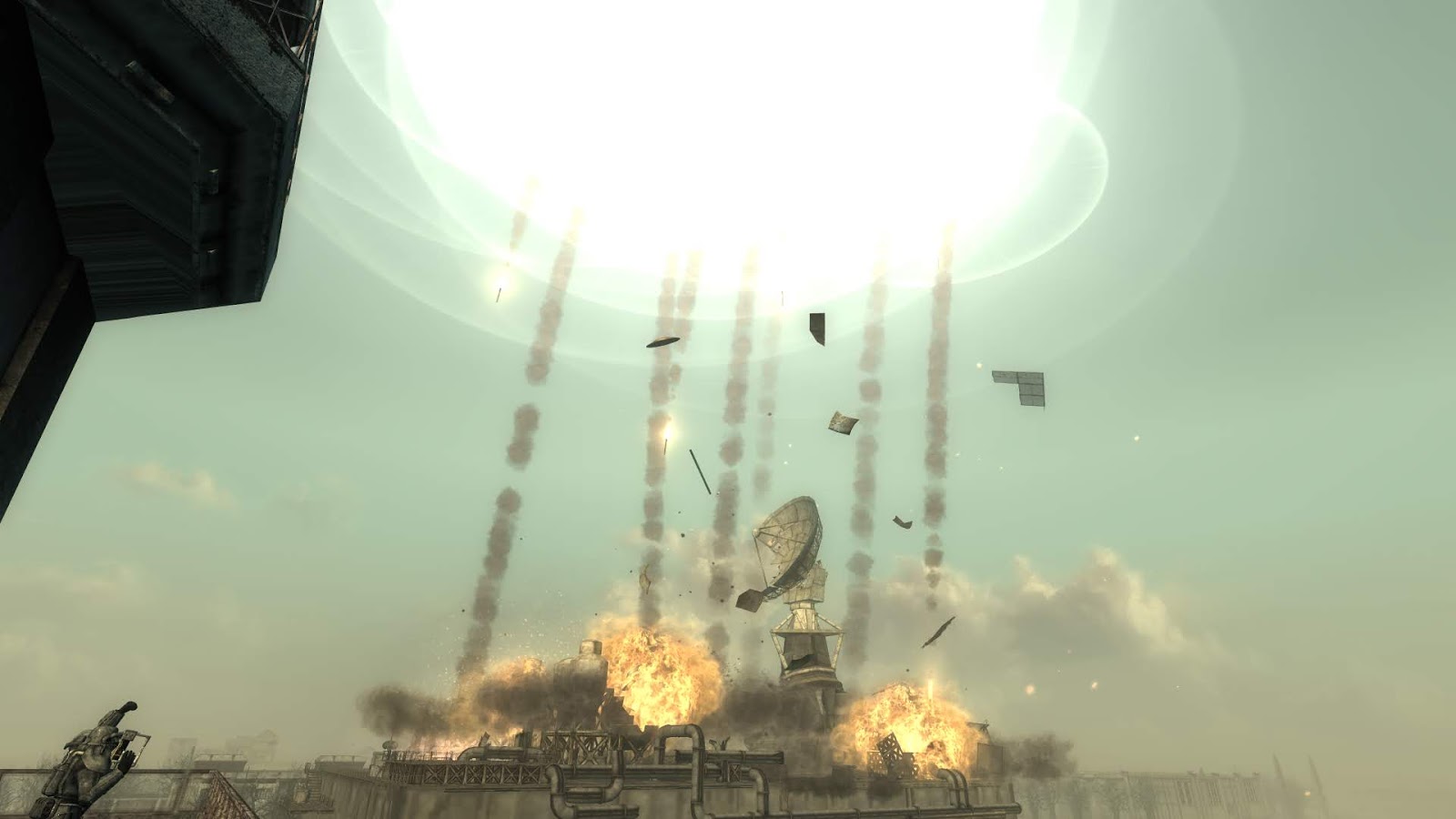
Mods have dramatically improved Fallout 3's appearance by replacing the game's original muddy textures with 4K versions, revamping the lighting engine and improving everything from draw distance to the models for bottles. They also increase the amount of video memory that can be used, hugely improving performance.

This sparseness is down to a surprising paucity of quests: Fallout 3 has only 59 quests, approximately half the number of New Vegas and one-third that of Fallout 4. That's actually not a major criticism, as in Fallout 3 you're spending less time checking off boxes and more time exploring for your own enjoyment, ransacking buildings for supplies and roaming off the beaten path to check out what appears to be an abandoned power station or hospital. Arguably not since STALKER: Shadows of Chernobyl had been released almost two years earlier had a game put you in such a desolate, haunted landscape and allowed you to explore it as you will (and STALKER, despite being a far more hardcore and tougher game, was considerably smaller in scope).

The game also enjoyed a terrific musical score by Inon Zur, which took in everything from an epic, stirring orchestral motif to bleaker, more haunting moments mixed in with hits from the 1930s and 1940s.

Holy foreshadowing!

Fallout 3's writing was not great, but it's easy to forget that it did have some splendidly inventive quests, some of them liberally borrowed from pop culture. The slaves with exploding neck collars are taken from the movie Battle Royale (2000), the quest with the giant fire ants is based on classic pulp SF movie Them! (1954) and a VR-gone-badly-wrong black-and-white sequence is inspired by the movie Pleasantville (1998). Liberty Prime, a gigantic "anti-communism" battle droid, is a clear nod at Transformers with a design homaging The Day the Earth Stood Still (1951). The society made up completely of kids at Little Lamplight seems to be an inverse version of The Lord of the Flies (as it appears to be the most stable town in the game, even though it's best not to ask where the fresh kids come from).

Other elements of the game have aged better than expected - the VATS-driven combat, which emulates the turn-based approach of the first two games, remains splendidly punchy and gory, although trying to play Fallout 3 like a first person shooter rapidly turns into an exercise in frustration - but others have not, particularly graphically. Thankfully, the hard-working modding community has made a plethora of mods which dramatically improve the game's appearance, adding 4K textures, removing that weird green tint from everything and improving lighting and draw distance to more realistic levels (as well as easing the game's weirdly restrictive memory limit, that left the game still chugging for people with monster graphics cards). I'll address how to add those to the game in a future post.

I spent 35 hours replaying Fallout 3, completing the base game and the Operation Anchorage and Broken Steel DLCs (the latter of which is essential to get rid of the original's diabolically bad ending), although I still have most of the map left unexplored (including areas I never visited in my original 2008-09 playthrough). I think I'll keep a-wandering through the Wasteland a while longer. Fallout 3 is not the best Fallout game by any means or (these days) the most approachable, but it does have a unique, haunting atmosphere and an eerie beauty which the other games lack. It also took a niche gaming series that definitely did not deserve to remain obscure and turned it into one of the biggest names in video game history, and in that sense it remains inarguably the most important game in the franchise.


Thank you for reading The Wertzone. To help me provide better content, please consider contributing to my Patreon page and other funding methods, which will also get you exclusive content weeks before it goes live on my blogs. A History of the Wheel of Time, SF&F Questions and The Cities of Fantasy series are debuting on my Patreon feed and you can read them there one month before being published on the Wertzone.

The Tombs of Atuan by Ursula K. Le Guin

Tenar is the high priestess of the Nameless Ones. She serves at the Tombs of Atuan, deep within the Kargish Empire, a place of rote and ritual. Despite the importance of her role she feels lonely and listless...until the day a wizard comes to her island.


The Tombs of Atuan (originally published in 1971) is the second novel in Ursula K. Le Guin's classic Earthsea sequence of novels, set in an enormous archipelago. It is not a direct sequel to A Wizard of Earthsea, the preceding novel, and in fact feels like a companion book more than a successor. The book focuses almost exclusively on the new character of Tenar, with the book's connection to A Wizard of Earthsea not becoming clearer until later on.

Tenar is an interesting character and it's a surprise to learn that she is Le Guin's first major female protagonist. Tenar is painted in Le Guin's traditional depth, as we get to know this young woman who combines curiosity, ruthlessness, loneliness and leadership skills. The book also inverts its presentation of Ged from the earlier novel. A Wizard of Earthsea was, for all of its travelling and epic journeys and mighty set-pieces, a deeply internal story of a boy finding out who he really is and making peace with himself. The Tombs of Atuan, being told entirely from Tenar's POV, instead allows us to meet and see Ged as strangers see him, wholly externally with only hints at what's going on under the surface. Thus our understanding of the main character of the series is expanded.

Le Guin's prose is powerful and evocative, and it's interesting in this novel that she flips the setting and feel of the earlier book on its head. A Wizard of Earthsea took place on land and sea under the sky, with the wind blowing in the characters' faces and freedom all around them, even as they were forced into a confrontation with a dark force they didn't understand. The Tombs of Atuan takes place almost entirely underground, our characters sometimes literally stifled and near-entombed under the earth, in claustrophobic surroundings. Le Guin nails this oppressive, stifled atmosphere and the elation the characters experience when they finally escape (not a spoiler, hopefully, since this is Book 2 of a six-book series).

There are some weaknesses to the novel. This is a short book, but even so, it does feel like an extended single episode rather than a novel-length narrative. Indeed, the book started as a short story for a magazine and had to be expanded to a longer word count for commercial reasons. It feels like maybe this should have been the opening section of a longer novel exploring more of Tenar's character (and it feels like her development is cut off just as it was starting to get interesting, and won't be revisited until the fourth book of the series) or remained as a short story. As it stands, the story feels a bit too slight and claustrophobic to sustain a full novel, despite the strengths of the writing and characterisation.


The Tombs of Atuan (****) is a slight story and perhaps a tad underwhelming compared to A Wizard of Earthsea, but it remains an ambitious and fascinating novel. Le Guin's writing power and her mastery of character is on full display. It is available now in the UK and USA as part of The Books of Earthsea omnibus edition.

Wednesday, 5 December 2018

Far Cry 6, Dragon Age 4 and Obsidian's "Project X" all to be unveiled this month

It's a busy week for some of gaming's biggest franchises and most interesting developers.


First up, and most interestingly, is that Obsidian will finally unveil their mysterious "Project X" that they've been working on in the background for the past three or four years whilst releasing smaller games like Tyranny and Pillars of Eternity. This game is the brainchild and a labour of love for Tim Cain and Leonard Boyarsky, the co-creators of the Fallout franchise and numerous other classic RPGs, including Vampire: The Masquerade - Bloodlines and Arcanum: Of Steamworks and Magick Obscure. Boyarsky was also a creative lead on Diablo III and its expansion Reaper of Souls for Blizzard, whilst Cain worked on games for Obsidian including Fallout: New Vegas.

The images revealed so far don't give much away, but hint at an SF RPG set in a retro-futuristic setting, possibly influenced by the likes of Buck Rogers and Flash Gordon. We'll find out for sure tomorrow when the game is fully unveiled.


Following that, on Friday, Ubisoft will unveil the future of the Far Cry franchise. The previous five games in the series have been - more or less - contemporary open world games with a very light dusting of science fiction and fantasy ideas, along with a couple of spin-offs (Blood Dragon and Primal) that had the licence to go much weirder. Far Cry 6 - assuming that's what the game will be called - sounds like it will be a full-on post-apocalyptic story, following on from the "good" ending to Far Cry 5 where the United States is (extremely randomly, as it had nothing to do with the plot of the game) devastated by a nuclear surprise attack launched by, er, North Korea. On the one hand, this may freshen up an increasingly bored franchise (Far Cry 5 was one of the weakest games in the series to date), or it may just be a case of the exact same game with a different paintjob. We will find out more on Friday.


Coming later this month, Electronic Arts and BioWare are poised to reveal some more information about the next Dragon Age game. BioWare's fantasy roleplaying series began back in 2009 with the solid Dragon Age: Origins and continued through the interesting-but-flawed Dragon Age II (2011) and the awful Dragon Age: Inquisition (2014). BioWare, once the great market leader for Western-style RPGs, has seen its thunder thoroughly stolen first by Bethesda and more recently by CD Projekt Red. Its last few games (Inquisition and last year's Mass Effect: Andromeda) have been underwhelming in the extreme, and there is little excitement for its next game, a generic multiplayer-focused, story-lite action-SF game called Anthem, due for release in March 2019. Dragon Age IV, or whatever is finally announced, has got its work cut out for it if it is to regain the stronger critical and commercial performance of earlier games in the series.