Sunday, 18 May 2014

New ELITE: DANGEROUS video shows galactic map and hyperspace

The fourth alpha build of Elite: Dangerous has launched, giving backers a chance to experience the game's navigation and starflight capabilities for themselves. The new version includes the galactic map, which players will use to jump from system to system, and an early version of the hyperspace animation that will accompany these jumps.


Apparently, the fourth alpha of Elite: Dangerous will be the final one. A beta test, which will likely try to combine the different game systems (combat, trading, navigation) together, will begin in a few weeks. The full game should be out towards the end of the year.

Gollancz published three Elite: Dangerous e-book novels last week. They will be released in hardcover on 16 October this year.

Thursday, 15 May 2014

Lily Allen turned down role on GAME OF THRONES

British pop star Lily Allen claims that she was offered a role on Game of Thrones that she turned down. Lily is the older sister of actor Alfie Allen, who has played the role of Theon Greyjoy on the show since it started.


In an Ask Me Anything on Reddit, Lily says the producers approached her with a view to her playing the role of Yara Greyjoy (Asha in the books), Theon's sister. Lily felt the role would be a little too incestuous - in their first scene together, Theon tries to feel up his sister, unaware of her identity - and turned it down. She goes on to say she'd quite like to be involved in the series in a musical capacity, similar to the appearances by Sigur Ros, the Hold Steady, The National, Gary Lightbody (of Snow Patrol) and Will Champion (of Coldplay) in the series.

This would have been an interesting choice, but I think Gemma Whelan has made the part her own. In addition, it's interesting that Allen describes the role as a cameo. Whilst Yara has had relatively little screen time - appearing in relatively brief scenes in six episodes out of twenty-five since she debuted - it is still a fairly important role with a lot of dramatic weight. Allen does not have any acting experience (outside of a few guest appearances as herself on various shows). It is possible that the producers envisaged the role of Yara as being much smaller and chose to later expand it.


During the casting for the second season, Lily was suggested several times, half-joking, by fans for the role. More popular was the suggestion of Lily and Alfie's father, the well-known British actor and comedian Keith Allen, for the role of Balon Greyjoy. The role eventually went to Patrick Malahide, who has played the role very well (if infrequently) since the second season.

FAR CRY 4 confirmed

News of the existence of Far Cry 4 leaked a few weeks ago, but it's now been officially confirmed by Ubisoft.


Far Cry 4 will be released on 18 November on PC, X-Box 360, X-Box One, PS3 and PS4. Like its predecessors, the game will be an open-world, combat-focused first-person shooter. You will be able to follow a linear storyline, undertake side-missions, engage in optional tasks to improve your character or mix them up as you see fit. The game will be set in Kyrat, a fictional region of the Himalayas where some dude (presumably the blonde guy on the cover) has set himself up as a king. Your character, I will hazard wildly, has to defeat him through the application of lunatic, gun-based ultraviolence.

Intriguingly, there will be a narrative link from Far Cry 3 to Far Cry 4, with the character of Hurk reappearing (and being playable in several DLC missions). This marks the first time two games in the franchise have been linked together by a recurring element. The previous games did not share locations, characters, storylines or, in the case of Blood Dragon and maybe the original Far Cry, even universes.

I'm a fan of the Far Cry games (particularly the first one), so I'm looking forwards to this. Sadly, the snowy setting and open-world gameplay means that many, many Far Cryrim jokes have already been made, and doubtless many more are to come.

Wednesday, 7 May 2014

Alpha Protocol

Mike Thorton is the newest recruit to Alpha Protocol, a clandestine American security organisation operating with maximum deniability. When an operation goes wrong and Thorton is targeted for assassination by shadowy forces operating within Alpha Protocol, he is forced to go undercover, expose a devastating international conspiracy and clear his name.


Alpha Protocol is a combat-focused, third-person RPG from Obsidian Entertainment, the developers of Fallout: New Vegas, Neverwinter Nights 2 and the recent South Park: The Stick of Truth. The game is more than slightly reminiscent of BioWare's Mass Effect franchise, with its reliance on cover-based combat and dialogue choices having a huge impact on how the game proceeds. Unlike the team-based mechanics of the Mass Effect trilogy, however, Alpha Protocol's hero Mike Thorton is a lone operator who has a wide array of stealth options to enhance his combat repertoire.

The game is structured around a series of missions in certain cities, including Rome, Moscow and Taipei. In each city Thorton has a home base where he can catch up on email, watch news reports (periodically updated to comment on the chaos caused by his latest operation) and buy new weapons and equipment. From each base he can rally out to do missions, which are sometimes nothing more than short cut scenes as Thorton tries to wheedle information out of someone else but are sometimes long and elaborate infiltration and combat operations. For each mission Thorton can attempt to achieve his objective through sneaking into locations without being seen, going in all guns blazing or attempt diplomacy (or some combination of the three). He also has the ability to hack security systems, remotely unlock doors or set traps. A levelling-and-skill system also gives Thorton a wide array of abilities he can upgrade to improve his chances of success.

The game is also heavily focused on characterisation. Thorton has a reputation with every character in the game, even enemies, and he can improve that reputation by saying the right things to them in dialogue. You can generally engage in conversations aggressively (inspired by Jack Bauer), suavely (inspired by James Bond) or professionally (inspired by Jason Bourne), with occasional extra options available if you have researched the right info about the character. Intelligence dossiers (bought through the black market or found on missions) hold clues as to how people will respond in certain situations, allowing you to manipulate them into helping you out. It's a clever system, enhanced by some satisfying dialogue (written by the mighty Chris Avellone) and some terrific, unexpected outcomes which radically change the way the story develops.

The game's reactivity is probably its best feature, with characters living or dying (sometimes taking entire storylines and occasional missions with them) based on your actions, or how you go about doing things. Alpha Protocol rewards replaying more than most games for this reason, with real consequences to your decisions.


Unfortunately, whilst the plot is excellent and the characterisation is strong, the actual gameplay is occasionally wonky. Infamously, the game was released by Sega in a highly unpolished state, as they had refused to give the game a full QA or testing pass after taking the initial build off Obsidian's hands. Minor bugs - clipping, jumpy camera controls, the physics engine occasionally going berserk - occasionally blight the game but are easily ignorable. More severe are problems with the game not reacting properly to your actions. For example, my usual approach to a mission was to attempt stealth but by around 50% of the way through each mission I'd given up on that and was resorting to gunplay. Yet my version of Thorton soon gained a reputation as a ghost, with other characters reacting to my ability to slip in and out of places undetected with awe. Considering I'd left a trail of blood, fire, chaos and bodies across most of Eurasia behind me, this didn't really make sense. There's also the fact that - especially on PC - the hacking minigame suffers from such poor and unresponsive controls that it's almost unusable.

Combat is reasonable, although pouring points into stealth soon makes you almost invulnerable, able to attack targets at will and hide almost in broad daylight. The stealth part of the game is fun but also made too easy by unconscious enemy bodies vanishing after a few seconds, meaning you don't have to worry about them being discovered. Instant takedowns (lethal or not) are also possible if you take the target by surprise. Played the right way, combat can be trivially easy. There's also periodic bossfights which, depending on the game's whim are either brutally hard or ridiculously straightforward: many areas have blindspots where the bosses can't see you, allowing you to shoot them with impunity.

Alpha Protocol does have a reputation for being heavily bugged, although I did not find this to be the case. Minor bugs abound, but on only two occasions was I forced to reload. Out of a 15-hour game, that's not too bad at all. It's a game clearly in need of a few more months of polishing, but it's still perfectly playable to completion.

Alpha Protocol (****) is a fun, clever, well-written and smart game hampered by minor-but-constant gameplay flaws and a few broken systems. The game is highly replayable and has some great ideas, but in many ways it feels like an early prototype of a style of game that would be achieved with considerably greater skill by Deus Ex: Human Revolution. Alpha Protocol is flawed and underrated gem that is definitely worth a second look. The game is available now on PC, X-Box 360 (UK, USA) and PS3 (UK,USA).

Updated MALAZAN world map

Ian Cameron Esslemont's Assail is released in two months, concluding his six-volume Malazan Empire series and bringing the total number of Malazan novels (including Steven Erikson's works) up to seventeen. The book will hopefully include a map of the continent of Assail (and subcontinent of Bael) to help fans in their quest to produce a definitive world map. In the meantime, here's a working idea:

Click to embiggen.


The basis of this map was the one created by D'rek on the Malazanempire forum. I moved Assail over a little closer to the other continents (it's pretty well-known, just avoided like the plague) and added the canonical map of Jacuruku from Blood and Bone, as well as moving it to the correct position. Its size comparable to the other continents remains unclear, however.

The map needs a little work - the Geonstel Archipelago is missing, Lether is a fair bit bigger than it should be and Genabackis is a bit smaller - and even after Assail there will still be blank bits on the map (central Lether, Stratem/southern Korel and western Seven Cities all remain fairly speculative), but we're certainly getting closer to the final picture here.

Richard Morgan's BLACK MAN optioned for film

Richard Morgan's novel Black Man (known as Thirteen in the USA) has been optioned as a feature film by the team behind the recent Johnny Depp vehicle Transcendence.


Transcendence producers Kate Cohen and Marisa Polvino are helming the adaptation, which is being written by Kenny Golde, the writer of Walking with the Enemy and a long-gestating film based on Isaac Asimov's The End of Eternity.

The novel was released in 2007 and went on to win the Arthur C. Clarke Award the following year. The book is set in 2107 and features a United States that has been torn apart into three separate nations by religious and political strife: the ultra-rich Pacific Rim, the fundamentalist Republic (aka 'Jesusland') and the liberal North Atlantic Union. Carl Marsalis, a 'thirteen' or genetically-engineered soldier hung out to dry when the war he was designed to fight ended, is recruited to help track down a rival thirteen who has gone on a rogue killing spree after visiting Mars. Carl teams up with a Turkish-descended policewoman, Svegi Ertekin, to track down the rogue thirteen.

With its no-holds-barred commentary on the state of America and its graphic violence, the book will not be easy to adapt to film whilst maintaining both its integrity and the high budget and adult rating that will be required to do it justice. This is a dark, brooding story which is singularly unfit to be turned into a summer popcorn blockbuster, so I'm interested in seeing how the producers tackle it.

Tuesday, 6 May 2014

Gratuitous Lists: Top Ten SFF Finales

Welcome to a new feature on the blog, where I list things in a list format because everyone likes lists. However, no-one (well, me) likes the incessant arguing over the placement of things on lists rather than their actual merits, so I'm not doing that.

Here is a list of what I think are the best final episodes of SFF TV series over the years, listed in no particular order but with my favourite one at the end. So, let's do this.

Blake's 7: Blake
Season 4, Episode 13, aired 21 December 1981

"Well, this doesn't look good."


An ending so unexpected that people are still talking about it thirty-three years later. In the closing moments of the final episode of the series, our long-missing idealistic hero, Blake, is revealed to have become a mercenary fighting for money and has betrayed his former comrades to the tyrannical Federation. His morally ambiguous second-in-command-turned-leader Avon guns him down...only for it to be revealed that Blake was still fighting the good fight all along and had a larger plan in mind. Cue Federation soldiers appearing and executing the entire regular cast of the show. The series ends by fading to black as Avon - apparently - is shot dead as well.

Bleak and nihilistic doesn't even begin to cover it, although it was later revealed that the show was never meant to end this way. A planned fifth season would have revealed that most of the characters would be still alive, having been stunned rather than killed. The BBC's announcement that this was final episode took the cast and crew as much by surprise as anyone, but for many years they suggested this had been the plan all along. So, not quite as ballsy as it first appeared, but still a jaw-dropping way to end the series. The rest of the episode is pretty good as well, with its famously cash-strapped effects team doing a reasonable job of depicting the crash-landing of our heroes' ship, Scorpio, on the surface of Gauda Prime.


Chuck: Chuck versus the Goodbye
Season 5, Episode 13, aired 27 January 2012

When in doubt, finish on a beach with an amnesia storyline. Actually, don't, unless your show is as good as Chuck.


For five seasons Chuck trod a careful path between out-and-out comedy, spy hijinks and a romance centred in the gradual development of lead character Chuck Bartowski from a loser working in an electrical store to a convincing secret agent able to woo his team-mate Sarah Walker. That made the decision the showrunners took in its final few episodes, with the erasing of Sarah's memories meaning she had no idea about their relationship, all the braver. Still, trope-savvy fans were expecting her memory to be restored in the final episode and All To Be Well. That didn't happen, with the series ending with Chuck apparently realising he had to win over Sarah from scratch. A surprising ending that didn't take the cop-out route and also featured some fantastic other scenes, such as the main villain being defeated to Jeff and Lester's memorable cover version of "Take on Me" by A-Ha, Morgan finally winning Casey's respect and several callbacks to the very first episode of the series.


Firefly: Objects in Space
Season 1, Episode 14, aired 13 December 2002

"Well, here I am."


Firefly was never meant to end with this episode, of course, but it makes for a surprisingly fitting denouncement and arguably its finest hour. The crew are trapped in deep space as a bounty hunter stalks their ship, trying to capture River Tam and getting embroiled in a battle of wits with her. The episode is moody and intense, tremendously well-written and directed by Joss Whedon (who later said it was the one piece of work he'd use to represent everything he's ever done) and featuring lengthy allusions to the work of Jean-Paul Sartre (the DVD commentary is worth a listen on this score) as well as knockout performances from Summer Glau and Richard Brooks as Jubal Early. The episode also features the eventual acceptance of River Tam into the ranks of the crew, ending a thematic storyline begun back in the pilot. But, yeah, this was an ending that came too soon.


Star Trek: The Next Generation: All Good Things...
Season 7, Episode 25, aired 23 May 1994

For a show about exploring deep space in the far future, ending with a poker game and gratuitous cleavage shot is an interesting stylistic choice.


After seven seasons, Star Trek: The Next Generation bowed out with a relentlessly entertaining romp that served as a greatest hits of the show's past. Q returns, keen to finish the trial he began in the pilot episode (and inadvertently hinting that maybe the whole thing was a pointless test, with humanity itself poised to evolve into the Q at some point in the distant future) and Picard has to find a way of allowing humanity to survive. The episode is rammed so full of plot holes that it doesn't even begin to make sense, but it's worth it to kick back and enjoy seeing the likes of Tasha Yar and Romulan Commander Tomalak again, as well as the futuristic, three-nacelled Enterprise cutting through Klingon warships like they're butter. A comprehensively superior way for TNG to bow out than its series of indifferent spin-off movies.


Buffy the Vampire Slayer: Chosen
Season 7, Episode 22, aired 20 May 2003

For the show that once blew up a high school as a form of cathartic release and commentary on growing up, going the whole hog and nuking the entire town was really the only way to top it.

When Buffy started, the title character was trying to avoid her role as the 'chosen one' whose destiny is to save the world. Seven seasons and several world-saving antics later (including at the cost of her own life, twice) the series, ironically, ends by doing exactly what Buffy wanted back in the beginning: by taking her status as the chosen one away by gifting the powers of the Slayer on hundreds of other girls all over the world. It's a surprisingly effective and clever ending given they couldn't kill her again or have her lose this final battle, this time against the very nature of evil itself.

As a finale the episode works on all sorts of other levels as well, with Willow finally moving on from her PTSD at the death of Tara and her resulting brush with evil in the previous season and Spike embracing his role as a hero. Only the death of Anya, which goes almost completely unnoticed by anyone apart from Xander, strikes a duff note. But the mistakes can be forgiven for those final shots of Sunnydale - the suburban American dream hiding the nightmare of the Hellmouth - being destroyed and the gang standing around wondering what to do next, the world their oyster. It's an ending ripe with possibilities, which the 'canon' Season 8 and 9 comics have really failed to live up to. Still, as endings go which wrap things up but leave room for more adventures, this is a very strong one.


Star Trek: Deep Space Nine: What You Leave Behind
Season 7, Episode 25, aired 2 June 1999

It's important for a finale to give emotional closure to the character arcs we have followed over the course of many years. But if you have 500 starships blowing the living crap out of one another, that helps too.


If TNG ended with a fun romp, its darker, superior spin-off DS9 ended with an epic tragedy. Hundreds of millions are killed as the Federation, Romulan Empire and Klingons join forces to destroy the Dominion forces in the Alpha Quadrant once and for all and the Dominion chooses to go down in a Götterdämmerung of fire and slaughter rather than surrender. Unlike the Picard-heavy TNG finale, the DS9 closer gives every character a moment to shine. Bashir and Dax finally (after seven years and numerous twists and turns, including one of them dying) get it together, O'Brien tires of the insanity of life on the frontier and gets to take his long-suffering family home and both Kira and Rom get promotions. But it's the way the show comes full circle to the events of the pilot episode, with Sisko fulfilling the role the Prophets laid out for him way back then, that satisfies the most. There's also the fact that the show doesn't sugar-coat its ending, with 'poor, simple' Garak getting the pardon he's been craving for so long, only to find his home is a blasted wasteland that will take decades to rebuild. And in the middle of everything, the producers even find time for a much-needed moment when the Klingon revelry in death and chaos repulses their Federation allies, an antidote for a franchise that has too-often depicted these sociopathic thugs as cuddly good guys.

All the more impressive is that Deep Space Nine, unlike it's near-rival Babylon 5, was not planned out ahead of time, yet the finale does a fantastic job of tying up all of the loose ends, making sure every character's fate is at least addressed and ending on the simple note of Jake looking out into space for his missing father. Its elegance makes the absolute ham-fisted butchering of the finales to Voyager and Enterprise years later look all the worse.


Babylon 5: Sleeping in Light
Season 5, Episode 22, aired 25 November 1998

Babylon 5: our last, best hope for pizza. I may have misread that.

Five years in the planning, Babylon 5's final episode is a quiet coda to everything that came before. Set twenty years after the rest of the series, it touches base with most of the characters and shows how their lives were changed by their experiences fighting the Shadows and Psi Corps, and what impact that had on them as people. Whilst the focus is on Sheridan's dying days as he knows the end foretold by Lorien has come, there's also time to touch base with the rest of the cast (including actors tragically no longer with us, such as Richard Biggs and Jeff Conaway) and see if it was indeed "all worth it". It's a brave and atypical choice to end the series this way, with showrunner and head (and, for most of its run, only) writer J. Michael Straczynski being the guy to turn the lights off ahead of the station's final demolition.


Avatar: The Last Airbender: Sozin's Comet Part 4: Avatar Aang
Season 3, Episode 21, aired 19 July 2008

Okay, he's 13 and she's 15 (there's a Weird Al Yankovic song in there somewhere), but he's just defeated Mark Hamill in epic single combat, so arguably justified.

Over the course of its three seasons, the anime-influenced animated series Avatar: The Last Airbender dedicated itself to telling just one story, one with a definitive beginning, middle and end. This final episode delivers what the previous sixty episodes had been building towards: the showdown between Aang and Fire Lord Ozai. The episode delivers on that score, with a magical battle that outclasses all the others in the show to date. Simultaneously Katara has to take down Azula in her own epic battle, and Sokka and his friends have to somehow destroy an entire Fire Nation sky armada before it can wipe out the Earth Kingdom. Cue enormous explosions and lots of destruction. But in the end it's the characters fates which are more important and the decision to end the series in Iroh's tea shop is an inspired one. It's a rich and satisfying ending that no amount of M. Night Syamalaning or inconsistent spin-offs can weaken.


Life on Mars/Ashes to Ashes
Season 3, Episode 8, aired 21 May 2010

"Pub?" "The interdimensionally weird one down the road that acts as the crossroads between life and death? Okay."

From the moment Sam Tyler was hit by a car in 2006 and somehow woke up in 1973, viewers were on the edge of their seat wondering what the hell was going on. Life on Mars itself had a strange and surreal ending which was a bit too open-ended, explained when a year later we got the spin-off/sequel series Ashes to Ashes, in which Alex Drake finds herself joining Team Gene Hunt in the 1980s. Over the course of three seasons Ashes to Ashes stepped out from its predecessor's shadow to deliver a different spin on the same premise. The final season, in which the team are hounded by the devil-like Jim Keats, perhaps steps a little bit too far into the territory of the weird and surreal, but the final episode offers a logical explanation for everything that's happened. It's also a depressing, heartbreaking end for many of these characters...but it is lightened in those final moments as Gene Hunt delivers his spiel to his latest time-slipped recruit and David Bowie's "Heroes" blasts into life over the end credits.

And to my favourite:

Angel: Not Fade Away
Season 5, Episode 22, aired 19 May 2004

"Let's go to Caprica, Agents of SHIELD, Bones and Person of Interest. Sorry, work. I meant to say work."
 
There are several reasons why I find Buffy's spin-off to be better than its parent show: the presence of a story arc spanning the whole series (as opposed to just one season), the theme of redemption and consequence that is much more devastatingly explored and its more adult view of the world, being a show about taking responsibility for your own decisions rather than moving through adolescence and finding yourself. It's also a show with more weight, with a gradually building sense of doom really from the moment Doyle buys the farm halfway through Season 1. By the end of Season 5 our characters have been, in some cases literally, to hell and back. Some of the heroes have fallen along the way - Cordelia is dead and Fred, her body possessed by the demon Illyria, is gone and almost certainly not coming back - but the threat remains as it has done from the first episode: the demonic law firm Wolfram and Hart. In the final episode of the series Angel and his comrades take down the Circle of the Black Thorn, thereby declaring war against the Senior Partners. No longer willing to tolerate Angel's defiance, the Senior Partners unleash the armies of hell on Los Angeles. The series ends with Angel pondering that he's always wanted to kill a dragon. "Let's go to work."

It's an ending that's amusing for being simply way beyond the show's budget to deliver properly, so cutting away before the fight begins is the only way it can be done. It also thematically makes sense: Angel was always about the fight and the struggle for what is right, no matter the odds. It's a battle with casualties. Wesley falls along the way and Lorne, though still alive, has his soul irreparably damaged when he coldly executes Lindsey on Angel's orders. There is also hope. Whilst the odds may be against our heroes (several thousand versus four), it helps that two of them are undead vampires with centuries of experience in combat and one is, er, a dark goddess from beyond the dawn of time. The After the Fall comic indeed suggests they are victorious...at the cost of Gunn being turned into a vampire and Los Angeles descending into the pits of hell (but who'd notice?).

But as a way of ending a series without either being too saccharine or taking the mickey out of the audience's intelligence, Angel finds just the right balance, and is thus my favourite TV show finale of all time. This week.


Bubbling Under

The BBC's Merlin (2008-12) is never going to be winning prizes for greatest genre show of all time, but it was a moderately entertaining show throughout its run that kept up the tension over whether Merlin's magical abilities would be discovered quite well. The final episode focuses on the revelation of Merlin's abilities to the mortally wounded Arthur and the resulting fall-out from that discovery. Perhaps they should have revealed it earlier, but basing the finale around the revelation and the impact on the characters was a good choice. The final scene showing the ancient Merlin hiking around modern-day Glastonbury, not so much.

Meanwhile, the short-lived Space: Above and Beyond (1996) may have been pretty terrible for most of its run before a late-season improvement in quality, but its final episode is striking enough that it's still talked about today. Several characters are apparently killed off, others are trapped on a planet and only two of the heroes survive to get back to their bunks. It's a surprisingly bleak ending. Even if the show had returned, it would be hard to see how they'd have pulled everyone out of the fire without it being seriously unconvincing.

On a lighter note, the final episode of Spaced (1999-2001) got the gang back together after splitting them up and ended on a high. The combination of Take That's "Back For Good" and a main battle tank is particularly memorable. A scene retroactively added later on confirming that Tim and Daisy do get it on and have a family is a little too on-the-nose, but the original episode ended in a way that was just perfect.

The short-lived Ultraviolet (1998) - aka The Show That Gave Unto The World Idris Elba - was brilliance incarnate, but the fact that writing, producing and directing it almost killed the creator meant that the planned second season was never made. This was almost certainly for the best, as the show's final episode is now a note-perfect battle of wills between the leader of the Code Vs (vampires) and the main characters which gradually intensifies as the vampires' true plans to trigger nuclear armageddon to darken the skies for centuries to come - obviously to their benefit - is revealed. Amazing stuff, especially when Stephen Moyer's vampire character is resurrected and promptly flees to the set of True Blood.

Finally, and a close contender for this list, was the final episode of Quantum Leap. For a show so resolutely optimistic and hopeful to end on such a downer - Sam Beckett never returns home and never sees his friend Al again - was an unexpected, brave choice. This was controversial at the time, with the feeling that showrunner Donald Bellisario was being too cruel to the characters after five years of putting them through the wringer. But seen from twenty years down the line, this was an appropriate choice, allowing Sam to go on and help thousands more people.


The Wertzone Special Award For The Episode That Should Have Been The Last One Of Its Series

Four years of fleeing across the galaxy only to get irradiated to death in what briefly appears to be Brooklyn? Best. Ending. Ever.


Battlestar Galactica: Revelations

If the rebooted Battlestar Galactica had ended with its mid-Season 4 finale, it would probably still rank as one of the greatest SFF shows of all time (despite a seriously below-par third and fourth season). Revelations was not only the best episode of the series in more than a year, it delivered the single most gut-punching SF cliffhanger since the ending of Blake's 7. The 30,000+ survivors of humanity, chased halfway across the galaxy by marauding robotic murderers, finally reach their long-dreamt-of safe haven, the thirteenth colony of Earth, only to find it a burned-out radioactive ruin. The final tracking shot takes in our speechless characters' reactions as they gaze across the river at the obliterated remnants of their hopes and dreams and abruptly cuts to black.

Sadly, BSG came back with another half-season of increasingly bizarre and bemusing plot turns until it turns out that it was all a fake-out and there was another planet called Earth our characters finally stumble across thanks to mystical magic music pumped out across the galaxy by some disembodied super-intelligence via the resurrected ghost-thing of a regular character, resulting in the colonisation of 'our' Earth 150,000 years in the past. Except they then had to explain why the fossil record shows that humankind evolved here on Earth, resulting in some quite ridiculous hoop-jumping that feels like the writers are simply taking the piss out of the audience's intelligence. Going out on the note that Japanese robots may one day destroy us sent exactly the wrong message, whilst going to the "All Along the Watchtower" well for the fifteen hundredth time that season was just an indulgence too far.

That just goes to show that you can have too much of a good thing. But the other shows on this list show you can have an ending that is satisfying, wraps things up and remains true to the spirit of the series. Let's hope that some of our present-day big hitters, like Game of Thrones and Orphan Black, get resolutions that are as satisfying.

The Ocean at the End of the Lane by Neil Gaiman

A middle-aged man returns to his home for a funeral, only to be drawn back into the long-forgotten events of his childhood, when he travelled through an ocean, visited another world and brought back something that did not want to leave.


The Ocean at the End of the Lane is Neil Gaiman's first novel for adults for eight years. It started off as a novella and grew larger than he first intended, though at 250 pages it's still on the short side for a novel. This is a book that touches on a number of themes, such as nostalgia, memory (and how it is mutable) and how a child's perception differs from that of an adult's. The book also ties in with some of Gaiman's other work, bringing in the Hempstock family from Stardust and The Graveyard Book. This is a novel that operates primarily as a mood piece, evoking the feeling of a childhood idyll and then darkening it with a nightmarish intrusion from another place. It's a classic trope, taking the idea of childhood as a sacrosanct time of warmth, fun and protection and then violating it with a force of darkness and evil.

That said, it's a story that Gaiman seems to shy away from exploring fully. Our unnamed protagonist has a rather capable of group of allies in the form of the Hempstock family, who know everything that's going on and have a solution for every problem that arises. It's difficult to build tension when your main character has a group of powerful magic-users on speed dial (effectively) to call upon at every turn. The book's structure is also odd: the novel is short, but it's quite a long time before the evil force arrives and it departs some time before the end of the book. It's almost like Gaiman wanted to write a moody piece about childhood but then decided he needed some sort of existential threat to be introduced and defeated because, well, it's a fantasy novel.

It's all well-written, as you'd expect, and there's some very nice moments of humour, characterisation and even genre-bending (the Hempstock occasionally evoking atomic physics and dark matter to explain magical events). But it's also a slight novel, with an odd structure and some fairly straightforward plotting. Gaiman seems to have always struggled a little with plotting in his novels, oddly as it's something he does very well in his comic and TV work, and Ocean doesn't address that issue.

The Ocean at the End of the Lane (***½) is a readable, enjoyable and, ultimately, disposable book. It passes the time but does not lodge in the mind the way Sandman or Neverwhere did. So, the wait for the undisputed Gaiman masterpiece novel continues. Ocean at the End of the Lane is available now in the UK and USA.

Sunday, 4 May 2014

ELITE: DANGEROUS reaches important milestone

Elite: Dangerous, the ambitious space trading game from Frontier Developments, hits an important milestone on 15 May. The game's fourth and final alpha build will be released, which will add the entire Milky Way galaxy to the game.

Part of the starmap in the original Elite, from 1984. Only go to Riedquat if you fancy dying, a lot.

At the moment the game, which is playable by those who backed the title's Kickstarter campaign, consists of a series of linked missions spanning around a single light-year, allowing fighting and docking but not much more. The new alpha release will add 400 billion star systems and the simulated space will increase to 100,000 light-years, effectively containing our entire galaxy. The game will accurately simulate the position of the stars relative to one another, including some nebulae and dust clouds. The game will remain limited in what can be done within this space - at the moment you can't visit Earth, for example, and the actual flyable space will be limited to a 200 light-year-wide stretch of the Bootes constellation - but it goes some way to showing the full potential of the game.

The starmap from Elite: Dangerous (concept art pictured) is a bit more impressive.

Several weeks after the release the fourth alpha build, the game will enter beta status as the last game systems (likely to involve missions, the economy and more varied AI enemies) are slotted into place. The game appears to be on track for a final release before the end of the year. Releasing the game in September would be appropriate, as that would mark the 30th anniversary of the release of the original Elite.

Meanwhile, on 15 May Gollancz will release three tie-in novels for the game in the UK.

Thursday, 1 May 2014

The American Trip

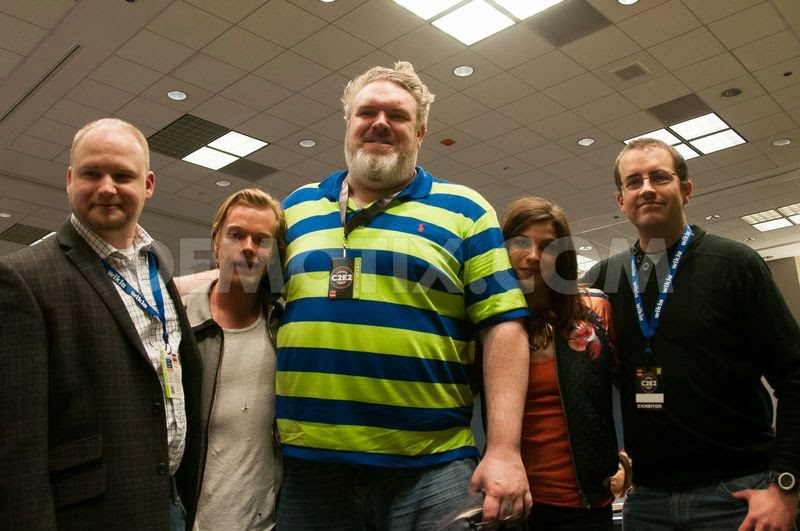
On Friday I ventured across the pond for the first time. Thanks to Wikia, I travelled to Chicago (via Toronto) to take part in a Game of Thrones fan panel at the C2E2 convention.


Eleven hours after leaving home (including the stop in Toronto) I finally arrived at Chicago's O'Hare Airport and was whisked by taxi the 20-odd miles to McCormick Place, where the convention was being held. For those unfamiliar with, C2E2 is a mass media SFF convention, essentially a Comic-Con, focused heavily on comics, movies and TV shows. There is a small book track as well, and I was briefly able to stop and say hi to John Scalzi and Patrick Rothfuss before pressing on with the Game of Thrones stuff.


One of the several other hats I wear is the founder and admin of the Game of Thrones Wiki, which has reached a high of 12 million hits per week during this season. Wikia, which runs the whole network, wanted me to join in a panel on the show. Initially it was just going to be myself, Jamie Hari of the Marvel and DC Database Wikis and Alfie 'Theon' Allen, but we were eventually also joined by Kristian Nairn (Hodor) and Natalia Tena (Osha). The actors were fashionably late, which left myself and Jamie to hold down the fort with several hundred fans for the opening minutes.


The panel seemed to be successful. Alfie talked about the process of playing such a damaged character as Theon and Kristian the various ways the directors have got him to act with such restricted dialogue. Natalia talked about the importance of the TV show as a separate entity to the books and the urgent need for male/female nudity parity in the show. I mused on the fan theory that Littlefinger is turning into Batman (the voice) and we threw it out there that Joffrey had faked his own death.


After the panel I had a chance to look around the rest of the convention. I got to see the original Ghostbusters ambulance and meet SFF legends Ernie Hudson (Ghostbusters, The Crow) and Tony Todd (Candyman and Worf's brother Kurn from ST:TNG and DS9). There was a lot of spectacular costumes around as well. The money and craftsmanship people put into their costumes was nothing short of jaw-dropping.


On the last day I got to meet Wheel of Time superfan Terez, who had a special surprise: a look at Robert Jordan's notes and papers that he had donated to the university of Charleston. There'll be a specific blog on this later on, but it was fascinating to see how the story evolved from the earliest outlines that Jordan wrote in the mid-1980s to the story that we got.


One major regret is that, after numerous restaurant and sightseeing recommendations, I didn't get out of the convention and hotel centre for the weekend, so I didn't see much of Chicago itself.


Then it was time for home (direct, this time and thankfully). Which would have been more fun if the plane hadn't suffered a partial electrical failure on the runway and then been delayed by 15 minutes by a brief groundstop for the whole airport, which left a lot of the passengers on-edge for the eight-hour flight home.

Still, a terrific experience. I enjoyed my first trip to the USA, brief though it was, and looking forwards to going back, hopefully for more than forty-eight hours next time.