The First Order has conquered much of the galaxy, but the Resistance is continuing to be a thorn in its side. As Supreme Leader Kylo Ren continues his search for Rey, he is contacted by a most unexpected source: Emperor Palpatine, mysteriously returned from the dead in the Unknown Regions of the galaxy with a powerful new weapon he will gift to the Order, in return for their help. The stage is set for a final showdown between the Light and the Dark Side, the Sith and the Jedi. Until the next one.
The Rise of Skywalker concludes the Star Wars sequel trilogy, an exercise in film-making where one writer-director gets to write the opening movie a trilogy, another one gets to trash it and do something completely different, and then the original writer-director comes back and trashes what the second one did but can't do his original plan (because it's been trashed) so says screw it and just turns in a greatest hits compilation. The Rise of Skywalker is fanservice turned into nothing less than avant-garde performance art, an unrelenting assault on the senses where it feels like the director spends two and a half hours playing you sound effects and video clips of the previous ten Star Wars movies and yelling "Remember that this was cool when you were twelve?"
We'll skip over the main storyline, which is a mostly forgettable travelogue of unoriginal new planets, including the 476th desert planet to appear in the franchise, in search of increasingly forgettable maguffins (a magic dagger, a droid memory decoder and a magic pyramid thing) and meeting almost completely pointless new characters. Richard E. Grant, Naomi Ackie and Keri Windsor are all great but have maybe 15 minutes of screen time combined. Palpatine - a screen-chewing Ian McDiarmid on fine form - has maybe less.
Instead the focus is firmly on our new friends: John Boyega, Oscar Isaac, Daisy Ridley and Adam Driver, with an even tighter focus on Ridley and Driver. The Rey-Kylo Ren relationship drives this entire trilogy and is the best thing about it, and it's especially the best thing about The Rise of Skywalker. The ambiguity of their relationship, Rey's pull towards the Dark Side and Kylo Ren's pull towards the Light Side makes this all quite tense and interesting in a way that Lucas never quite managed with either previous trilogy (since we already knew how Anakin was going to go and we never really thought that Luke was going to go bad). This thread gives the movie a spine to hang onto even when the overload of plot coupons, laser fights, fake-out deaths and lucky escapes get out of hand elsewhere. Expect a "Reylo Cut" of their relationship to emerge after the final film comes out on physical media which strips away a lot of the distracting frippery.
That distracting frippery gets very distracting as the movie builds towards its bombastic but - as with so much of this trilogy - strangely weightless climax. There's no real worldbuilding depth to this trilogy, with ships continue to be able to jump in and out of hyperspace directly from planetary atmospheres, and almost from planetary surfaces (ignoring the first six films which established you couldn't do that). The movie does bizarrely retcon the hyperspace ram from The Last Jedi, revealing it's not actually possible and they're not sure how it was done. This is probably the most overt of several decidedly juvenile, snide digs Abrams gets in at his predecessor film which feels both infantile and also hubristic; The Last Jedi had a lot of issues of its own, but it is also a more coherent, original film than The Rise of Skywalker.
The final thirty minutes of the film play like The Return of the King's five endings but on crack, with so much fanservice hurled at the audience that it is physically exhausting. Almost every single spaceship that's ever been in a Star Wars film or TV show turns up. Tons of characters from all three trilogies get cameos (some so short that you wonder why they bothered), and they even live-action canonise (albeit only through audio clips) several characters from the Clone Wars and Rebels TV shows. Fan-favourite musical cues from across the series are weaponised with merciless efficiency by John Williams on autopilot, who in lieu of new material seems to have merely hit "shuffle" on his Star Wars Greatest Hits playlist and handed it over to Abrams. The very end of the film goes full overload in burying the audience with cheese. It's not totally ineffective - it turns out that a sunset shot and John Williams' stirring theme still can't get old after forty-two years - but it feels a bit obvious and a bit safe.
The Rise of Skywalker (***) puts all of its dramatic heavy lifting on the shoulders of Adam Driver and Daisey Ridley's shoulders and they pull it off with aplomb, giving the film and the trilogy a dramatic spine which is really fascinating and well-played, when the movie remembers to focus on it. The rest of the time the move is an unrelenting popcorn rollercoaster ride which never stops moving and never stops hurling references to the previous movies at the viewer. On a base level that's fun, but those hoping for some new twists on the classic formula will leave disappointed.
The Rise of Skywalker is on general release worldwide.
Showing posts with label film reviews. Show all posts
Thursday, 19 December 2019
Friday, 14 December 2012
The Hobbit: An Unexpected Journey
Many years ago, the dwarves of Erebor, the Lonely Mountain, were driven from their home by Smaug, last of the great dragons. Thorin Oakenshield, the grandson of the last King of Erebor, has vowed to reclaim his home and called upon the dwarven clans of Middle-earth to aid him. Rebuffed, he instead plans a daring raid of a few chosen dwarves to slay Smaug whilst he sleeps. To aid them, Gandalf the Grey has promised to recruit a skilled burglar: Bilbo Baggins, a hobbit of the Shire. Their journey will take them through forests and caverns, all the while being tracked by an old enemy of Thorin's...
An Unexpected Journey is the first movie in a trilogy based on J.R.R. Tolkien's 1937 novel, The Hobbit. That's Tolkien's short novel which, by word-count, is just under a fifth of the length of The Lord of the Rings. There's been enormous controversy about director Peter Jackson's decision to split The Hobbit into three three-hour films, with a fear that there simply isn't enough story to warrant it and this will result in padding. That is the threat that constantly hangs over the film and to be fair, it mostly avoids it by making a major change: Jackson has decided to show in full Gandalf and the White Council's side-story to confront and destroy the 'Necromancer' of Dol Guldur (a storyline that takes place off-page in the novel). Whilst also controversial amongst fans, it does give Jackson a rich vein of story to mine to add to proceedings, but how successful this will be remains to be seen (this subplot is only really started in the film).
The movie opens with the older Bilbo (still played by Ian Holm) writing an account of his adventure for Frodo and narrating the destruction of the human town of Dale and the neighbouring dwarven mountain-city of Erebor by Smaug. We then have the traditional opening from the novel, with thirteen dwarves and the wizard Gandalf turning up on Bilbo Baggins's doorstep to recruit him for an adventure. By the time the young Bilbo (Martin Freeman) agrees to join the quest, a rather surprising forty minutes has passed. This sequence risks interminability, but Jackson takes advantage of the time to introduce the thirteen dwarves and give them some character traits missing from the source material. James Nesbitt's Bifur in the somewhat cynical joker of the pack, whilst Fili and Kili are the over-eager young guns out to impress their older peers. Dwalin is the bruiser and Balin the wise old - and somewhat pedantic - sage of the group (Ken Stott is excellent in the role). Bombur is fat and little more than that. The real impact is made at this stage by Richard Armitage as Thorin Oakenshield. Armitage is charismatic and has steely resolve and presence in his role, and is the standout performance of the movie (and, dare I say it, impresses more than even Viggo Mortensen as Aragorn in the original trilogy).
As well as showing the Necromancer stuff on-screen, Jackson has made some other changes to the story to increase the dramatic weight of events. Thorin now has his own nemesis, a mighty orcish warrior whose arm he cut off in battle. This warrior, long-thought dead, has returned and is now chasing down Thorin and his band (a bit like Lurtz in the movie version of Fellowship of the Ring, but a lot smarter and more continuously present). It's another change that I think some won't like, but as a dramatic device it worked fairly well at introducing some tension to the film. However, what was really distracting is that this orc has the exact same skin tone and texture as the Engineers in Prometheus and is likewise gigantic. His story arc is left unfinished at the end of the film, so we can assume he will return in the sequel (rather cleverly, as it provides a potentially better way of explaining a subplot in that film than Tolkien was able to do in the book).
Elsewhere the film feels a lack of cohesion: the Necromancer plot has little to do immediately with Thorin's quest, so every time we cut away to Radagast the Brown (a great performance by the ex-Doctor Who Sylvester McCoy) trying to resuscitate hedgehogs (!) or Gandalf discussing backplot with Saruman and Galadriel for what feel like nineteen hours, the movie flags. In fact, the dwarves get so bored of Rivendell (missed opportunity: someone saying, "On second thoughts, let's not go to Rivendell. 'Tis a silly place,") they just up and randomly leave. Once the dwarves are back on the road together and causing mayhem, the film perks up and more fun is had, even if sometimes accompanied by some unconvincing CGI.
The scenes in the goblin caves in the Misty Mountains are entertaining, but also daft. Barrie Humphries as the Goblin King works rather better than most were likely expecting (and there's a humourous nod to Gandalf's "You shall not pass!" moment from the original trilogy), but the extended battle-and-escape sequence is too slapstick to really present much tension. This contrasts to the successful scene where Bilbo meets Gollum (Andy Serkis, on fire as always) and acquires the Ring, which is brilliantly acted by both parties and features some nice tonal variations from comedy to menace and back again.
Overall, The Hobbit: An Unexpected Journey (***½) can be called a qualified success. It has some big problems that Jackson has not been able to overcome: the storyline is too slight to sustain three hours and even with the addition of extra storylines and characters, there are some scenes which feel like wheel-spinning for the sake of it (most notably at Rivendell). There is also a near-omnipresent use of CGI in almost every scene of the movie. The original trilogy worked best when the camera was allowed to film natural landscapes or when miniatures were used to depict locations and give them a sense of reality and weight. Here, CGI is much more freely employed, often with less regard for hiding the fact it is CGI. In particular, there is a dearth of truly awesome shots of the countryside of New Zealand in all its glory compared to the original trilogy: here, even many of the landscape shots have been bathed in CGI until they glow with lens-flare. Even in 2D and at 24fps, the film has a 'faker' sheen across it than the original films, which sometimes distracts.
Fortunately, Peter Jackson has learned from the mistakes of George Lucas and has remembered to include plenty of character moments to keep things more real. Armitage is awesome, as previously mentioned, but it's Martin Freeman's performance as Bilbo which anchors the movie. His character arc (and Thorin's, which develops in tandem) is well-handled and Freeman nails this icon in a way he didn't manage with Arthur Dent (in the disappointing Hitch-Hiker's Guide to the Galaxy movie). These character and thematic moments are less-successfully handled than in the original trilogy, but still give the film some dramatic weight and tension that keeps things interesting.
The film is on general release now and will be released on DVD and Blu-Ray - twice over - in 2013.
An Unexpected Journey is the first movie in a trilogy based on J.R.R. Tolkien's 1937 novel, The Hobbit. That's Tolkien's short novel which, by word-count, is just under a fifth of the length of The Lord of the Rings. There's been enormous controversy about director Peter Jackson's decision to split The Hobbit into three three-hour films, with a fear that there simply isn't enough story to warrant it and this will result in padding. That is the threat that constantly hangs over the film and to be fair, it mostly avoids it by making a major change: Jackson has decided to show in full Gandalf and the White Council's side-story to confront and destroy the 'Necromancer' of Dol Guldur (a storyline that takes place off-page in the novel). Whilst also controversial amongst fans, it does give Jackson a rich vein of story to mine to add to proceedings, but how successful this will be remains to be seen (this subplot is only really started in the film).
The movie opens with the older Bilbo (still played by Ian Holm) writing an account of his adventure for Frodo and narrating the destruction of the human town of Dale and the neighbouring dwarven mountain-city of Erebor by Smaug. We then have the traditional opening from the novel, with thirteen dwarves and the wizard Gandalf turning up on Bilbo Baggins's doorstep to recruit him for an adventure. By the time the young Bilbo (Martin Freeman) agrees to join the quest, a rather surprising forty minutes has passed. This sequence risks interminability, but Jackson takes advantage of the time to introduce the thirteen dwarves and give them some character traits missing from the source material. James Nesbitt's Bifur in the somewhat cynical joker of the pack, whilst Fili and Kili are the over-eager young guns out to impress their older peers. Dwalin is the bruiser and Balin the wise old - and somewhat pedantic - sage of the group (Ken Stott is excellent in the role). Bombur is fat and little more than that. The real impact is made at this stage by Richard Armitage as Thorin Oakenshield. Armitage is charismatic and has steely resolve and presence in his role, and is the standout performance of the movie (and, dare I say it, impresses more than even Viggo Mortensen as Aragorn in the original trilogy).
As well as showing the Necromancer stuff on-screen, Jackson has made some other changes to the story to increase the dramatic weight of events. Thorin now has his own nemesis, a mighty orcish warrior whose arm he cut off in battle. This warrior, long-thought dead, has returned and is now chasing down Thorin and his band (a bit like Lurtz in the movie version of Fellowship of the Ring, but a lot smarter and more continuously present). It's another change that I think some won't like, but as a dramatic device it worked fairly well at introducing some tension to the film. However, what was really distracting is that this orc has the exact same skin tone and texture as the Engineers in Prometheus and is likewise gigantic. His story arc is left unfinished at the end of the film, so we can assume he will return in the sequel (rather cleverly, as it provides a potentially better way of explaining a subplot in that film than Tolkien was able to do in the book).
Elsewhere the film feels a lack of cohesion: the Necromancer plot has little to do immediately with Thorin's quest, so every time we cut away to Radagast the Brown (a great performance by the ex-Doctor Who Sylvester McCoy) trying to resuscitate hedgehogs (!) or Gandalf discussing backplot with Saruman and Galadriel for what feel like nineteen hours, the movie flags. In fact, the dwarves get so bored of Rivendell (missed opportunity: someone saying, "On second thoughts, let's not go to Rivendell. 'Tis a silly place,") they just up and randomly leave. Once the dwarves are back on the road together and causing mayhem, the film perks up and more fun is had, even if sometimes accompanied by some unconvincing CGI.
The scenes in the goblin caves in the Misty Mountains are entertaining, but also daft. Barrie Humphries as the Goblin King works rather better than most were likely expecting (and there's a humourous nod to Gandalf's "You shall not pass!" moment from the original trilogy), but the extended battle-and-escape sequence is too slapstick to really present much tension. This contrasts to the successful scene where Bilbo meets Gollum (Andy Serkis, on fire as always) and acquires the Ring, which is brilliantly acted by both parties and features some nice tonal variations from comedy to menace and back again.
Overall, The Hobbit: An Unexpected Journey (***½) can be called a qualified success. It has some big problems that Jackson has not been able to overcome: the storyline is too slight to sustain three hours and even with the addition of extra storylines and characters, there are some scenes which feel like wheel-spinning for the sake of it (most notably at Rivendell). There is also a near-omnipresent use of CGI in almost every scene of the movie. The original trilogy worked best when the camera was allowed to film natural landscapes or when miniatures were used to depict locations and give them a sense of reality and weight. Here, CGI is much more freely employed, often with less regard for hiding the fact it is CGI. In particular, there is a dearth of truly awesome shots of the countryside of New Zealand in all its glory compared to the original trilogy: here, even many of the landscape shots have been bathed in CGI until they glow with lens-flare. Even in 2D and at 24fps, the film has a 'faker' sheen across it than the original films, which sometimes distracts.
Fortunately, Peter Jackson has learned from the mistakes of George Lucas and has remembered to include plenty of character moments to keep things more real. Armitage is awesome, as previously mentioned, but it's Martin Freeman's performance as Bilbo which anchors the movie. His character arc (and Thorin's, which develops in tandem) is well-handled and Freeman nails this icon in a way he didn't manage with Arthur Dent (in the disappointing Hitch-Hiker's Guide to the Galaxy movie). These character and thematic moments are less-successfully handled than in the original trilogy, but still give the film some dramatic weight and tension that keeps things interesting.
The film is on general release now and will be released on DVD and Blu-Ray - twice over - in 2013.
Monday, 7 November 2011
X-Men: First Class
Here's a knotty problem for a studio to face. What happens when you decide to make a fourth film in one of your biggest franchises, but without any of the three major actors who made the first three films so watchable (particularly when your third movie was a bit of a dog and only saved by their performances)? The decision to make X-Men: First Class as a prequel to the existing movies that was fully open to newcomers was a canny one, allowing 20th Century Fox to effectively reboot the series without throwing away the continuity of the previous films, but the side-effect of losing Hugh Jackman, Patrick Stewart and Ian McKellen must have caused some consternation in the office. However, by bringing in director Matthew Vaughn, hot off the acclaimed Kick-Ass, and casting James McAvoy and Michael Fassbender as the younger Stewart and McKellen, the studio showed some good judgement (which they could have done with on the third movie).

First Class is set in 1962, roughly forty years before the events of the existing movie trilogy. Fassbender's Lehnsherr, a survivor of the concentration camps (the memorable first scene of X-Men is cleverly recreated and expanded on in the opening of First Class), is scouring the world for Nazi criminals and in particular Klaus Schmidt, the Nazi scientist who experimented on him to find a use for his mutation. Schmidt turns out to be a mutant himself, now going by the name Sebastian Shaw (a strong performance by Kevin Bacon), who has attracted the enmity of the CIA and their new mutant consultant Charles Xavier (McAvoy) by orchestrating the rising tensions between the USA and USSR. Lehnsherr agrees to join Xavier's team of 'X-Men' to help stop Shaw's plans, but in the process finds himself questioning whether mutants and humans can ever live together peacefully. Caught in the middle is Xavier's adopted shapeshifting sister, Raven (Jennifer Lawrence) who is conflicted over whether she wants to be 'normal' or be true to her mutant nature.
The inner conflict within the primary characters gives the movie an unusual depth of character for a superhero flick and is true to the themes of tolerance and identity Bryan Singer raised in the first two movies in the series (and handled somewhat more ham-fistedly by Brett Ratner in the third). It also gives us the strongest scene in the movie, as the vengeance-obsessed Lehnsherr confronts two former Nazis in a bar in Argentina in a scene that Tarantino at his best would have been proud of (and the presence of Fassbender speaking German to Nazis in this scene gives viewers of Inglorious Basterds a sense of deja vu). Fassbender's performance throughout is excellent, and he has a great rapport with McAvoy which sells you completely these are the same people as Stewart and McKellen, just younger. That said, the later movies indicated that they were friends and allies for much longer than the few weeks this movie suggests was the case.
Elsewhere McAvoy plays the young Charles Xavier to perfection, respecting Stewart's performance but bringing youthful, idealism and a spark of mischief to the character that makes him sympathetic, even when he is appearing to be naive. Scenes where Xavier has to overcome the wearying cynicism of his team-mates are given weight by McAvoy making it clear that Xavier knows that his attempts to forge peace may be doomed, but the attempt must be made anyway. Lawrence's performance is solid, but her conflicted journey is not as handled as well as it could be, with her decision on what side to join not being sold completely successfully (and there are some continuity issues based on her character's behaviour in the first three films, though nothing too bad).
The film is well-paced, with a solid use of the old standbys of montages, voice-overs and exposition used to effectively a complicated storyline involving a relatively large cast of characters. A slight failure is the depiction of the bad guys: whilst Bacon's Shaw and January Jone's Emma Frost get plenty of screen-time and dialogue, Riptide and Azazel have little to do and nothing to say, and come across as flat as a result.
Elsewhere, the film has effective and impressive action sequences, a rather clever use of real history (though somewhat altered from our own) to enhance the narrative and some nice uses of 1960s imagery and visuals (particularly in the credits sequence). The action sequences are earned by good performances, strong direction and an enjoyable script that is a bit more complex and interesting than many superhero films. There's also a rather cool easter egg for fans of the other movies to watch out for.
X-Men: First Class (****) could have been a potential mess, but it emerges as the second-best movie in the franchise to date (after the splendid X2) and one of the best reboots of a superhero franchise to date. The move is available now in the UK (DVD, Blu-Ray) and USA (DVD, Blu-Ray)

First Class is set in 1962, roughly forty years before the events of the existing movie trilogy. Fassbender's Lehnsherr, a survivor of the concentration camps (the memorable first scene of X-Men is cleverly recreated and expanded on in the opening of First Class), is scouring the world for Nazi criminals and in particular Klaus Schmidt, the Nazi scientist who experimented on him to find a use for his mutation. Schmidt turns out to be a mutant himself, now going by the name Sebastian Shaw (a strong performance by Kevin Bacon), who has attracted the enmity of the CIA and their new mutant consultant Charles Xavier (McAvoy) by orchestrating the rising tensions between the USA and USSR. Lehnsherr agrees to join Xavier's team of 'X-Men' to help stop Shaw's plans, but in the process finds himself questioning whether mutants and humans can ever live together peacefully. Caught in the middle is Xavier's adopted shapeshifting sister, Raven (Jennifer Lawrence) who is conflicted over whether she wants to be 'normal' or be true to her mutant nature.
The inner conflict within the primary characters gives the movie an unusual depth of character for a superhero flick and is true to the themes of tolerance and identity Bryan Singer raised in the first two movies in the series (and handled somewhat more ham-fistedly by Brett Ratner in the third). It also gives us the strongest scene in the movie, as the vengeance-obsessed Lehnsherr confronts two former Nazis in a bar in Argentina in a scene that Tarantino at his best would have been proud of (and the presence of Fassbender speaking German to Nazis in this scene gives viewers of Inglorious Basterds a sense of deja vu). Fassbender's performance throughout is excellent, and he has a great rapport with McAvoy which sells you completely these are the same people as Stewart and McKellen, just younger. That said, the later movies indicated that they were friends and allies for much longer than the few weeks this movie suggests was the case.
Elsewhere McAvoy plays the young Charles Xavier to perfection, respecting Stewart's performance but bringing youthful, idealism and a spark of mischief to the character that makes him sympathetic, even when he is appearing to be naive. Scenes where Xavier has to overcome the wearying cynicism of his team-mates are given weight by McAvoy making it clear that Xavier knows that his attempts to forge peace may be doomed, but the attempt must be made anyway. Lawrence's performance is solid, but her conflicted journey is not as handled as well as it could be, with her decision on what side to join not being sold completely successfully (and there are some continuity issues based on her character's behaviour in the first three films, though nothing too bad).
The film is well-paced, with a solid use of the old standbys of montages, voice-overs and exposition used to effectively a complicated storyline involving a relatively large cast of characters. A slight failure is the depiction of the bad guys: whilst Bacon's Shaw and January Jone's Emma Frost get plenty of screen-time and dialogue, Riptide and Azazel have little to do and nothing to say, and come across as flat as a result.
Elsewhere, the film has effective and impressive action sequences, a rather clever use of real history (though somewhat altered from our own) to enhance the narrative and some nice uses of 1960s imagery and visuals (particularly in the credits sequence). The action sequences are earned by good performances, strong direction and an enjoyable script that is a bit more complex and interesting than many superhero films. There's also a rather cool easter egg for fans of the other movies to watch out for.
X-Men: First Class (****) could have been a potential mess, but it emerges as the second-best movie in the franchise to date (after the splendid X2) and one of the best reboots of a superhero franchise to date. The move is available now in the UK (DVD, Blu-Ray) and USA (DVD, Blu-Ray)
Sunday, 23 October 2011
Transformers: Revenge of the Fallen
According to common wisdom, the plot of Transformers: Revenge of the Fallen is incomprehensible. Which is odd, as it actually seemed reasonably straightforward to me. Essentially it goes like this:
Thousands of years ago - and apparently without anyone noticing - the Decepticons placed a device inside the Great Pyramid of Giza that can blow up the Sun and harvest it for energon, which they can use to fuel themselves and possibly restore their dying homeworld of Cybertron. The Fallen - the Decepticons' supreme commander, senior even to Megatron - wants to activate the device, but he fears setting foot on Earth due to the threat posed by Optimus Prime (apparently only 'a Prime' can kill him). Also, the device's starting key, the 'Matrix of Leadership', has been missing for millennia. The Autobots and their human allies end up getting involved in the Decepticon plan to find the key and start the machine and the whole matter is resolved in a string of unlikely plot coincidences and stupendous explosions (spoiler: the good guys win).

What confuses the matter is Michael Bay's total inability to selectively self-edit. The problem with Revenge of the Fallen - aside from those inherent to the franchise established in the opening movie which it is far too late to do anything about - isn't that the ingredients are wrong or that you couldn't make an entertaining movie with them, but that Bay and the writers throw every single half-baked idea they have into the mix, regardless of whether it makes sense or if they have the screentime to do it justice. In isolation, ideas like Devastator (a massive robot made up of seven lesser ones), the Pretender (a Terminator-esque Decepticon assassin that can pass as human) or Jetfire (an elderly Decepticon who switched sides to join the Autobots, got bored with the war and has spent decades disguised as an exhibit in the Smithsonian) could have made for interesting scenes or story points. Thrown on top of one another, they decohere the story and make it increasingly hard work to follow what's going on amidst the ridiculous number of fireballs being hurled around.
Matters aren't helped by the human cast: Shia LeBouf was blandly inoffensive in the first movie, but doesn't have the acting chops to sell Sam Witwicky's plot-inspired descent into temporary insanity, which reduces the middle third of the movie into barely-bearable tedium, though things are briefly livened up by the arrival of the Pretender assassin, a cool idea which is underdeveloped. In fact, most of the human performances are uninspired and uninteresting. There's also a bizarre lack of emotional response to events in the film. At one point a US aircraft carrier is destroyed and sinks, taking with it thousands of lives and an appreciable fraction of the USA's military power, but this garners almost no response whatsoever from anyone. No-one seems to be particularly concerned about the partial destruction of the Great Pyramid of Giza, either.
The Transformers themselves also suffer from the problems of plot overload. Compared to the dozen or so in the first movie, there are about forty in the second, and very few have any development or interesting character traits. Those that do get more screentime tend to be lazily-written and based on human racial stereotypes and caricatures which are inappropriate and moronic. Still, from the carnage Jetfire emerges as a more interesting character that not enough is done with, whilst Optimus Prime and Bumblebee develop well over their roles in the first movie. Indeed, Peter Cullen's dignified voice performance does seem to have come in from a completely different and considerably better film altogether. The Decepticons are mostly lacking in any kind of development whatsoever with the Fallen being a colossal disappointment and Devastator being a let-down after an impressive first appearance. The film's lack of memorable villains is a key problem (though hardly the greatest in the picture).
What really damages the film beyond all possible repair, however, is its severe pacing problem. The climactic battle sequence in the Egyptian desert (written by someone who's never looked at a map of the Middle East, but let's not go there) goes on for far too long, eating away at screentime that could have been better-used earlier in the movie to flesh out more interesting concepts and ideas, or simply could have been removed: two and a half hours is probably way too long for a brainless popcorn action movie in the first place.
Transformers: Revenge of the Fallen (*) is a spectacular failure of a movie, being incoherent, badly-paced, badly-acted and ill-conceived. The special effects are genuinely impressive and there are glimpses of concepts that could have made for a great film, but these are left underdeveloped in favour of atrocious attempts at comedy or pathos. It's certainly not the worst movie of all time, as some have labelled it, and it's almost worth watching as a masterclass in how not to make a big-budget action film. A tremendous let-down considering some promising ideas and also the inoffensively entertaining first movie in the franchise.
Thousands of years ago - and apparently without anyone noticing - the Decepticons placed a device inside the Great Pyramid of Giza that can blow up the Sun and harvest it for energon, which they can use to fuel themselves and possibly restore their dying homeworld of Cybertron. The Fallen - the Decepticons' supreme commander, senior even to Megatron - wants to activate the device, but he fears setting foot on Earth due to the threat posed by Optimus Prime (apparently only 'a Prime' can kill him). Also, the device's starting key, the 'Matrix of Leadership', has been missing for millennia. The Autobots and their human allies end up getting involved in the Decepticon plan to find the key and start the machine and the whole matter is resolved in a string of unlikely plot coincidences and stupendous explosions (spoiler: the good guys win).

What confuses the matter is Michael Bay's total inability to selectively self-edit. The problem with Revenge of the Fallen - aside from those inherent to the franchise established in the opening movie which it is far too late to do anything about - isn't that the ingredients are wrong or that you couldn't make an entertaining movie with them, but that Bay and the writers throw every single half-baked idea they have into the mix, regardless of whether it makes sense or if they have the screentime to do it justice. In isolation, ideas like Devastator (a massive robot made up of seven lesser ones), the Pretender (a Terminator-esque Decepticon assassin that can pass as human) or Jetfire (an elderly Decepticon who switched sides to join the Autobots, got bored with the war and has spent decades disguised as an exhibit in the Smithsonian) could have made for interesting scenes or story points. Thrown on top of one another, they decohere the story and make it increasingly hard work to follow what's going on amidst the ridiculous number of fireballs being hurled around.
Matters aren't helped by the human cast: Shia LeBouf was blandly inoffensive in the first movie, but doesn't have the acting chops to sell Sam Witwicky's plot-inspired descent into temporary insanity, which reduces the middle third of the movie into barely-bearable tedium, though things are briefly livened up by the arrival of the Pretender assassin, a cool idea which is underdeveloped. In fact, most of the human performances are uninspired and uninteresting. There's also a bizarre lack of emotional response to events in the film. At one point a US aircraft carrier is destroyed and sinks, taking with it thousands of lives and an appreciable fraction of the USA's military power, but this garners almost no response whatsoever from anyone. No-one seems to be particularly concerned about the partial destruction of the Great Pyramid of Giza, either.
The Transformers themselves also suffer from the problems of plot overload. Compared to the dozen or so in the first movie, there are about forty in the second, and very few have any development or interesting character traits. Those that do get more screentime tend to be lazily-written and based on human racial stereotypes and caricatures which are inappropriate and moronic. Still, from the carnage Jetfire emerges as a more interesting character that not enough is done with, whilst Optimus Prime and Bumblebee develop well over their roles in the first movie. Indeed, Peter Cullen's dignified voice performance does seem to have come in from a completely different and considerably better film altogether. The Decepticons are mostly lacking in any kind of development whatsoever with the Fallen being a colossal disappointment and Devastator being a let-down after an impressive first appearance. The film's lack of memorable villains is a key problem (though hardly the greatest in the picture).
What really damages the film beyond all possible repair, however, is its severe pacing problem. The climactic battle sequence in the Egyptian desert (written by someone who's never looked at a map of the Middle East, but let's not go there) goes on for far too long, eating away at screentime that could have been better-used earlier in the movie to flesh out more interesting concepts and ideas, or simply could have been removed: two and a half hours is probably way too long for a brainless popcorn action movie in the first place.
Transformers: Revenge of the Fallen (*) is a spectacular failure of a movie, being incoherent, badly-paced, badly-acted and ill-conceived. The special effects are genuinely impressive and there are glimpses of concepts that could have made for a great film, but these are left underdeveloped in favour of atrocious attempts at comedy or pathos. It's certainly not the worst movie of all time, as some have labelled it, and it's almost worth watching as a masterclass in how not to make a big-budget action film. A tremendous let-down considering some promising ideas and also the inoffensively entertaining first movie in the franchise.
Sunday, 6 March 2011
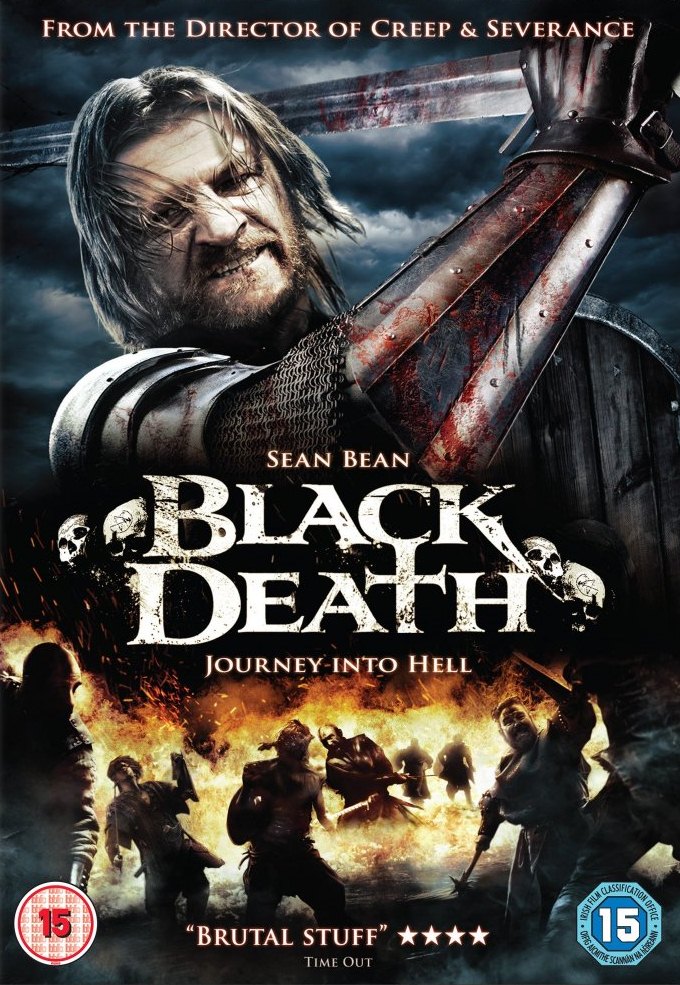
Black Death
It is 1348 and the Black Death is sweeping the English countryside, killing tens of thousands. A young monk, Osmund, has fallen in love with a young girl who has taken refuge in his monastery. His actions lead him to joining a band of the King's men, led by the knight Ulric, on a mission to find a marshland village reputed to be in the grip of witchcraft. Along the way, he hopes to break off and run away with his love. But in the woodlands he finds himself drawn onto a far darker and crueler path.

Black Death is a relatively low-budget movie financed and made in Germany, although the film is in English and has a mostly British cast. It stars Sean Bean as Ulric and Eddie Redmayne - the main character in the recent adaptation of Pillars of the Earth - as Osmund, with veteran actors David Warner (too many roles to list) and Tim McInnery (Blackadder) in support, along with rising star Carice van Houten (noted for recent roles in Black Book, Valkyrie and Repo Men). A bunch of solid supporting actors such as Emun Elliott (soon to be seen in Game of Thrones, along with Bean) and John Lynch (Merlin's father in the BBC series of the same name) line out the relatively small cast.
Given this is a small-budget movie with Sean Bean wearing armour and swinging a sword, the first impression is of a cheesy action flick. Nothing could be further from the truth. Black Death is a surprisingly bleak and dark movie about faith, power and fundamentalism. Sean Bean's Ulric is a far, far cry from his other heroic roles or his out-and-out villains. Instead he's a God-fearing knight who believes absolutely that the Black Death is God's punishment of humanity for its sins. He's a brave and capable warrior, but also utterly unrelenting and ruthless in his quest, capable of killing anyone who gets in his way. Redmayne's Osmund is idealistic and hopeful, shocked by the viciousness of the world and the perchance for violence demonstrated by his new associates.
The film unexpectedly moves into Wicker Man territory when our protagonists reach the supposedly witch-infested town and become engaged in a struggle of faith, reason and power. McInnery is cast against type as the the town headman, with Van Houten as the woman who has brought hope to it. Van Houten is a little too obviously villainous from the off, but her contempt of those who slavishly believe whatever they are told is well-played.
The director, Christopher Smith (best-known for Severance), seems to be aware of the potential for sniggering comparisons to Monty Python and the Holy Grail and with Blackadder, so tackles them head-on. McInnery's casting is possibly one allusion to this, whilst the scene with the monks flagellating themselves as they walk along seems to be a very overt reference to the Grail. Beyond these nods, there is little humour in the film, especially once it moves into its final, dark act.
The film's biggest weakness is that the supposedly wordly wise knights fall a little to easily into a certain and very obvious trap, and whilst the film's focus is commendable in an age of bloated 3D monsters, some side-elements and secondary characters could have done with a bit more fleshing out.
The film's ending is a startling, expectation-destroying sequence. Initially it appears to render the entire film pointless, but on further reflection it raises further questions over corruption and fundamentalism that are surprisingly effective.
Black Death (****) is a dark, bleak and occasionally powerful movie which poses hard questions of its audience. A sometimes uncomfortable watch, this is a far more intelligent and interesting movie than it looks like on first glance. It is available now in the UK (DVD, Blu-Ray) and, on Region 2 import only, USA (DVD, Blu-Ray).

Black Death is a relatively low-budget movie financed and made in Germany, although the film is in English and has a mostly British cast. It stars Sean Bean as Ulric and Eddie Redmayne - the main character in the recent adaptation of Pillars of the Earth - as Osmund, with veteran actors David Warner (too many roles to list) and Tim McInnery (Blackadder) in support, along with rising star Carice van Houten (noted for recent roles in Black Book, Valkyrie and Repo Men). A bunch of solid supporting actors such as Emun Elliott (soon to be seen in Game of Thrones, along with Bean) and John Lynch (Merlin's father in the BBC series of the same name) line out the relatively small cast.
Given this is a small-budget movie with Sean Bean wearing armour and swinging a sword, the first impression is of a cheesy action flick. Nothing could be further from the truth. Black Death is a surprisingly bleak and dark movie about faith, power and fundamentalism. Sean Bean's Ulric is a far, far cry from his other heroic roles or his out-and-out villains. Instead he's a God-fearing knight who believes absolutely that the Black Death is God's punishment of humanity for its sins. He's a brave and capable warrior, but also utterly unrelenting and ruthless in his quest, capable of killing anyone who gets in his way. Redmayne's Osmund is idealistic and hopeful, shocked by the viciousness of the world and the perchance for violence demonstrated by his new associates.
The film unexpectedly moves into Wicker Man territory when our protagonists reach the supposedly witch-infested town and become engaged in a struggle of faith, reason and power. McInnery is cast against type as the the town headman, with Van Houten as the woman who has brought hope to it. Van Houten is a little too obviously villainous from the off, but her contempt of those who slavishly believe whatever they are told is well-played.
The director, Christopher Smith (best-known for Severance), seems to be aware of the potential for sniggering comparisons to Monty Python and the Holy Grail and with Blackadder, so tackles them head-on. McInnery's casting is possibly one allusion to this, whilst the scene with the monks flagellating themselves as they walk along seems to be a very overt reference to the Grail. Beyond these nods, there is little humour in the film, especially once it moves into its final, dark act.
The film's biggest weakness is that the supposedly wordly wise knights fall a little to easily into a certain and very obvious trap, and whilst the film's focus is commendable in an age of bloated 3D monsters, some side-elements and secondary characters could have done with a bit more fleshing out.
The film's ending is a startling, expectation-destroying sequence. Initially it appears to render the entire film pointless, but on further reflection it raises further questions over corruption and fundamentalism that are surprisingly effective.
Black Death (****) is a dark, bleak and occasionally powerful movie which poses hard questions of its audience. A sometimes uncomfortable watch, this is a far more intelligent and interesting movie than it looks like on first glance. It is available now in the UK (DVD, Blu-Ray) and, on Region 2 import only, USA (DVD, Blu-Ray).
Sunday, 30 January 2011
Inception
Dom Cobb (Leonardo DiCaprio) is an agent working in the field of data acquisition and extraction. However, rather than follow the traditional routes of industrial espionage, he uses cutting-edge technology to extract this information from his targets' dreams. This can be a dangerous task, with the infiltrators at risk from the target's subconscious, but Cobb is the best in his field.

Exiled from the USA for undisclosed reasons, Cobb is desperate to return home and see his children. His latest employer claims that he can make this happen, but only if Cobb can perform the impossible: inception, placing an idea so deeply in the target's subconscious that they believe they came up with it themselves. Cobb has never managed to succeed at this before, but relishes the challenge and the reward. He assembles a team of the very best in their field to mount a reverse-heist into the unconscious of a top businessman, but can he leave his own past behind?
Inception was one of the more heavily-acclaimed movies of 2010, a complex SF thriller helmed by director-of-the-moment Christopher Nolan (The Prestige, The Dark Knight). Its cerebral and complex premise was feared to be off-putting to casual audiences, but the film took an impressive $820 million at the box office and demonstrated that a clever film could still be a break-out hit. At least that's the narrative that's been spread around by various critics. Actually Inception's complexity is more about asking the audience to retain information and maintain a keen eye for detail. The film isn't really ambiguous (aside from a slightly cheesy final shot that screams "The End...OR IS IT?!?") and the rules of the dream-hacking and details of the heist are pretty well-laid-out by clearly-related expositionary sequences.
Like The Matrix, the film isn't as original as it first appears but melds its ideas with compelling action sequences (a fistfight in a hallway with the exterior gravity switching around is an impressive highlight) and use of CGI (Paris wrapping itself into a giant ball is a staggering visual idea, executed flawlessly). It lacks the confused cod-philosophy of The Matrix's weaker sequels though, instead focusing on the characters of Cobb (a damaged, somewhat arrogant man) and his team-members, particularly Arthur (Joseph Gordon-Levitt), Eames (Tom Hardy), Ariadne (Ellen Page), Saito (Ken Watanabe) and their mark, Robert Fisher (Cillian Murphy), well-written characters who stand out alongside the film's impressive visuals and more complex ideas.
The film's SF influences are intriguing. Previously Nolan had worked with Christopher Priest on The Prestige and Inception feels very much like a Priest novel reworked to include more explosions and machine guns. The big difference between them is that Priest loves ambiguity whilst Nolan is less interested in leaving open questions, with only the very final shot leaving the story open to further interpretations. The DNA of Philip K. Dick can also be seen in the "What is reality?" question that pops up throughout the film, not to mention the vast and imposing SF city that we encounter in the final act.
The film falters occasionally. Like The Dark Knight the film occasionally feels weighed down by maybe one or two too many subplots (though vastly less of a problem than on The Dark Knight, which sometimes loses focus as a result of this). Whilst the film has a strong emotional core with regards to Cobb's relationship with his deceased wife and his desire to be reunited with his children, in other areas the film is less emotionally engaging. In particular, the key relationship between Fisher and his father (the late Pete Postlethwaite) never really grabs hold of the imagination.
These are somewhat minor issues, however. Inception (****½) features strong performances, a clever premise and mixes entertainment with thought-provoking ideas. The film is available now in the UK (DVD, Blu-Ray) and in the USA (DVD, Blu-Ray).

Exiled from the USA for undisclosed reasons, Cobb is desperate to return home and see his children. His latest employer claims that he can make this happen, but only if Cobb can perform the impossible: inception, placing an idea so deeply in the target's subconscious that they believe they came up with it themselves. Cobb has never managed to succeed at this before, but relishes the challenge and the reward. He assembles a team of the very best in their field to mount a reverse-heist into the unconscious of a top businessman, but can he leave his own past behind?
Inception was one of the more heavily-acclaimed movies of 2010, a complex SF thriller helmed by director-of-the-moment Christopher Nolan (The Prestige, The Dark Knight). Its cerebral and complex premise was feared to be off-putting to casual audiences, but the film took an impressive $820 million at the box office and demonstrated that a clever film could still be a break-out hit. At least that's the narrative that's been spread around by various critics. Actually Inception's complexity is more about asking the audience to retain information and maintain a keen eye for detail. The film isn't really ambiguous (aside from a slightly cheesy final shot that screams "The End...OR IS IT?!?") and the rules of the dream-hacking and details of the heist are pretty well-laid-out by clearly-related expositionary sequences.
Like The Matrix, the film isn't as original as it first appears but melds its ideas with compelling action sequences (a fistfight in a hallway with the exterior gravity switching around is an impressive highlight) and use of CGI (Paris wrapping itself into a giant ball is a staggering visual idea, executed flawlessly). It lacks the confused cod-philosophy of The Matrix's weaker sequels though, instead focusing on the characters of Cobb (a damaged, somewhat arrogant man) and his team-members, particularly Arthur (Joseph Gordon-Levitt), Eames (Tom Hardy), Ariadne (Ellen Page), Saito (Ken Watanabe) and their mark, Robert Fisher (Cillian Murphy), well-written characters who stand out alongside the film's impressive visuals and more complex ideas.
The film's SF influences are intriguing. Previously Nolan had worked with Christopher Priest on The Prestige and Inception feels very much like a Priest novel reworked to include more explosions and machine guns. The big difference between them is that Priest loves ambiguity whilst Nolan is less interested in leaving open questions, with only the very final shot leaving the story open to further interpretations. The DNA of Philip K. Dick can also be seen in the "What is reality?" question that pops up throughout the film, not to mention the vast and imposing SF city that we encounter in the final act.
The film falters occasionally. Like The Dark Knight the film occasionally feels weighed down by maybe one or two too many subplots (though vastly less of a problem than on The Dark Knight, which sometimes loses focus as a result of this). Whilst the film has a strong emotional core with regards to Cobb's relationship with his deceased wife and his desire to be reunited with his children, in other areas the film is less emotionally engaging. In particular, the key relationship between Fisher and his father (the late Pete Postlethwaite) never really grabs hold of the imagination.
These are somewhat minor issues, however. Inception (****½) features strong performances, a clever premise and mixes entertainment with thought-provoking ideas. The film is available now in the UK (DVD, Blu-Ray) and in the USA (DVD, Blu-Ray).
Saturday, 2 October 2010
Four Lions
Omar, Waj, Faisal and Barry are four Muslims living in Sheffield. Radicalised by the war on terror, they decide to martyr themselves for the cause by damaging the British state as much as possible (although Faisal favours training crows to carry explosives into buildings instead). Barry, a new convert to the religion, is furious when Omar ascends to lead the group and, along with the mentally-challenged Waj, is invited to Pakistan for training in an al-Qaeda camp. As Barry and Omar vie for leadership of the would-be terror cell, Omar faces another conflict with his pacifist brother. After the accidental detonation of some of their explosives (and a passing sheep) attracts the attention of the authorities, the cell rushes to London to carry out their plan...

Chris Morris is well-known, even notorious, in the UK for his extremely confrontational and controversial brand of comedy. He first rose to attention fronting spoof news show The Day Today in 1994 (which also gave the world Steve Coogan's character of Alan Partridge) before moving onto the considerably harder-edged Brass Eye. He's been less prominent recently, focusing on co-writing the so-so Nathan Barley (with Charlie Brooker) and having a recurring guest spot on the first two seasons of The IT Crowd. Four Lions, which he co-wrote and directed, is his first full-length feature film.
The question the film poses is, is it possible to make suicide bombers funny? Predictably, the film attracted controversy in the UK before release, but afterwards seemed to win over most of the critics by knowing when to veer between comedy and tragedy, not to mention the complex characterisation of lead character Omar (an excellent performance by Riz Ahmed), a man who is prepared to die for Islam but angers his pacifist-but-old-school brother by treating his wife as a full equal and partner. The film characterises the would-be suicide bombers as a mix of fundamental radicals and crowd-followers who earnestly believe in their faith and their cause, but also benefit from their comparatively easy lives in the West (leading to the hardcore jihadists in Pakistan labelling the British visitors as 'Mr. Beans').
The culture clash is well-handled, particularly with Barry (Nigel Lindsay) who has something of an inferiority complex due to not being born a Muslim and urgently wants to stamp his authority on the group, but constantly failing due to his moronic ideas, lack of stealth (he was in the papers for sending a cake in the shape of the Twin Towers to a local synagogue on the anniversary of 9/11) and ludicrous sense of destiny ("If we don't do this, Islam is finished!"). 'Special' Waj (Kayvan Novak) and the easily-led Faisal (Adeel Akhtar) are more played for laughs, but the writers and actors are careful to give them more depth and turn them from figures of fun into gradually more tragic figures as the film continues (the culminating conclusion between Waj and Omar is brilliantly-played).
There are some genuine, jet-black, laughs in the course of the film (look out for the police snipers arguing over whether wookies and the Honey Monster are related to bears) as it builds to an inevitably bleak ending. This gradual shift in tone, which could have sunk the film if mishandled, is masterfully executed.
On the negative front, the film fails to address exactly why the four British Muslims are radicalised in the first place (aside from Barry's issues), a question that has been often asked here in the wake of the 7/7 London bombings in 2005. Perhaps Morris felt there was no easy answer to the question and so dodged around it, but it does leave Omar in particular bereft of a convincing motivation for his actions, especially given his liberal tendencies in other areas.
Four Lions (****) is a sometimes hilarious, sometimes tragic but always absorbing film that makes the viewer laugh and raises some challenging questions without offering pat answers. The movie is available now in the UK on DVD and Blu-Ray, with no US release listed as yet.

Chris Morris is well-known, even notorious, in the UK for his extremely confrontational and controversial brand of comedy. He first rose to attention fronting spoof news show The Day Today in 1994 (which also gave the world Steve Coogan's character of Alan Partridge) before moving onto the considerably harder-edged Brass Eye. He's been less prominent recently, focusing on co-writing the so-so Nathan Barley (with Charlie Brooker) and having a recurring guest spot on the first two seasons of The IT Crowd. Four Lions, which he co-wrote and directed, is his first full-length feature film.
The question the film poses is, is it possible to make suicide bombers funny? Predictably, the film attracted controversy in the UK before release, but afterwards seemed to win over most of the critics by knowing when to veer between comedy and tragedy, not to mention the complex characterisation of lead character Omar (an excellent performance by Riz Ahmed), a man who is prepared to die for Islam but angers his pacifist-but-old-school brother by treating his wife as a full equal and partner. The film characterises the would-be suicide bombers as a mix of fundamental radicals and crowd-followers who earnestly believe in their faith and their cause, but also benefit from their comparatively easy lives in the West (leading to the hardcore jihadists in Pakistan labelling the British visitors as 'Mr. Beans').
The culture clash is well-handled, particularly with Barry (Nigel Lindsay) who has something of an inferiority complex due to not being born a Muslim and urgently wants to stamp his authority on the group, but constantly failing due to his moronic ideas, lack of stealth (he was in the papers for sending a cake in the shape of the Twin Towers to a local synagogue on the anniversary of 9/11) and ludicrous sense of destiny ("If we don't do this, Islam is finished!"). 'Special' Waj (Kayvan Novak) and the easily-led Faisal (Adeel Akhtar) are more played for laughs, but the writers and actors are careful to give them more depth and turn them from figures of fun into gradually more tragic figures as the film continues (the culminating conclusion between Waj and Omar is brilliantly-played).
There are some genuine, jet-black, laughs in the course of the film (look out for the police snipers arguing over whether wookies and the Honey Monster are related to bears) as it builds to an inevitably bleak ending. This gradual shift in tone, which could have sunk the film if mishandled, is masterfully executed.
On the negative front, the film fails to address exactly why the four British Muslims are radicalised in the first place (aside from Barry's issues), a question that has been often asked here in the wake of the 7/7 London bombings in 2005. Perhaps Morris felt there was no easy answer to the question and so dodged around it, but it does leave Omar in particular bereft of a convincing motivation for his actions, especially given his liberal tendencies in other areas.
Four Lions (****) is a sometimes hilarious, sometimes tragic but always absorbing film that makes the viewer laugh and raises some challenging questions without offering pat answers. The movie is available now in the UK on DVD and Blu-Ray, with no US release listed as yet.
Friday, 25 June 2010
Moon
The Lunar Industries corporation has given the world cheap energy thanks to a helium-3 mining operation on the far side of the Moon. Helium-3 is mined by massive automated harvesters and freighted back to Earth. The operation is controlled by a single moonbase, Sarang. To keep costs down, the base is manned by only one man at a time, helped by the base's artificial intelligence, GERTY.

Sam Bell is nearing the end of his three-year stint on the Moon and is looking forward to returning home to his wife and daughter when he starts experiencing odd hallucinations and mood swings. Whilst driving out to repair a harvester, he is involved in an accident. Recovering back at the base, Bell is confused by the way GERTY is treating him, and the lengths the AI is taking to ensure he doesn't leave the base...
Moon is the directorial debut by Duncan Jones, an old-school SF film very much in the vein of late 1970s/early 1980s movies such as Silent Running, Alien and Outland, including a very small cast, a strong visual look and some superb model work, with very little CGI present in the film at all. An absolutely brilliant Sam Rockwell is the only actor with significant screen time, although the Kevin Spacey-voided GERTY has a reasonable amount to do as well.
Moon has a strong theme of isolation. Bell is alone on the dark side of the Moon, without even Earth on the horizon to look up to. The communications satellite is broken, meaning that communications with Earth are long, pain-staking and tedious. The fact that Bell is starting to hallucinate and see things is understandable given his sense of loneliness, but, as with all good SF movies, we are asked if there is something more to his visions than just good old insanity. Moon rewards at least two viewings, as the director expertly sets up some clues as to what is going on before the big revelation (which interestingly isn't a last-minute twist, but happens fairly early on with the rest of the story dedicated to exploring it in greater depth).
The movie poses some interesting questions on duality, our sense of self, and what defines a person. In this regard it is the best SF novel that Christopher Priest never wrote. The atmosphere is taut and claustrophobic, with occasional moments of black humour that work well. Jones uses the viewers' likely experience of previous SF films against them: is GERTY a positive and helpful AI, or is he cracking up like HAL? Jones also knows when to play a trope straight, when to invert it and when to send it up quite nicely.
The only negative that comes immediately to mind is that the end of the film is a little bit too neat (although still very satisfying) and there are one or two elements left under-developed (such as Bell's family back home). But otherwise, this is a fine, intelligent, atmospheric and at times unsettling SF movie.
Moon (****½) is available now in the UK (DVD, Blu-Ray) and USA (DVD, Blu-Ray).

Sam Bell is nearing the end of his three-year stint on the Moon and is looking forward to returning home to his wife and daughter when he starts experiencing odd hallucinations and mood swings. Whilst driving out to repair a harvester, he is involved in an accident. Recovering back at the base, Bell is confused by the way GERTY is treating him, and the lengths the AI is taking to ensure he doesn't leave the base...
Moon is the directorial debut by Duncan Jones, an old-school SF film very much in the vein of late 1970s/early 1980s movies such as Silent Running, Alien and Outland, including a very small cast, a strong visual look and some superb model work, with very little CGI present in the film at all. An absolutely brilliant Sam Rockwell is the only actor with significant screen time, although the Kevin Spacey-voided GERTY has a reasonable amount to do as well.
Moon has a strong theme of isolation. Bell is alone on the dark side of the Moon, without even Earth on the horizon to look up to. The communications satellite is broken, meaning that communications with Earth are long, pain-staking and tedious. The fact that Bell is starting to hallucinate and see things is understandable given his sense of loneliness, but, as with all good SF movies, we are asked if there is something more to his visions than just good old insanity. Moon rewards at least two viewings, as the director expertly sets up some clues as to what is going on before the big revelation (which interestingly isn't a last-minute twist, but happens fairly early on with the rest of the story dedicated to exploring it in greater depth).
The movie poses some interesting questions on duality, our sense of self, and what defines a person. In this regard it is the best SF novel that Christopher Priest never wrote. The atmosphere is taut and claustrophobic, with occasional moments of black humour that work well. Jones uses the viewers' likely experience of previous SF films against them: is GERTY a positive and helpful AI, or is he cracking up like HAL? Jones also knows when to play a trope straight, when to invert it and when to send it up quite nicely.
The only negative that comes immediately to mind is that the end of the film is a little bit too neat (although still very satisfying) and there are one or two elements left under-developed (such as Bell's family back home). But otherwise, this is a fine, intelligent, atmospheric and at times unsettling SF movie.
Moon (****½) is available now in the UK (DVD, Blu-Ray) and USA (DVD, Blu-Ray).
Thursday, 10 June 2010
The Road
Civilisation has been destroyed, the human race reduced to a few survivors struggling to eke out a living amidst the ruins of what once was. A man and his son make their way south to the coast, hoping to find warmer weather and more plentiful supplies of food, before the world dies.

Based on the Pulitzer-winning 2006 novel by Cormac McCarthy, The Road is a post-apocalyptic movie starring Viggo Mortensen as the father and Kodi Smith-McPhee as his son. A number of other established actors have extended cameos, with Charlize Theron playing Mortensen's wife in flashback, Robert Duvall as an old man met on the road and The Wire's Michael K. Williams as a thief, whilst Guy Pearce also appears briefly. However, the film focuses on Mortensen and Smith-McPhee almost exclusively for long stretches of its running time.
The book is notable for its pared-back, stark prose style, which is unflinching in its depiction of the brutalised, battered world and the often savage people that are encountered along the way. The film is similarly cold and stripped-back, with a heavily desaturated colour palette and a certain remoteness to the directing style which only lightens in some of the more emotional scenes between the father and his son. It's a film in which morality without the context of civilisation is questioned, with the son constantly asking, "Are we the good guys?" and the survivors finding their faith (either in God or in human nature), constantly challenged by circumstances. That it addresses this issues with a scarcity of dialogue for a modern film is all the more impressive, and is reflective of the book.
There have been some changes to accommodate the medium of film. There are a few more incidents along the road, maybe a few more characters who appear and interact with our protagonists (though still a bare handful), and there's a couple of moments where cliche rears its ugly head (notably the boy's complete inability to shut up when possible hostile people are around, which I don't recall being so pronounced in the book), though these are mercifully brief. For a post-apocalyptic movie, there's also a near-total lack of modern special effects, with only one incongruous CGI establishing shot in the whole film (although no doubt much more subtle CGI manipulation of images occurs throughout). This adds to the sense of realism. The film is also well-paced and fairly short for a modern picture at about 100 minutes in length. On the minus side, Charlize Theron's character has more screentime than in the book, which you'd expect to mean her character receives more development, but this isn't really the case, and an early scene involving a truck full of nefarious folk up to no good briefly makes you think you're watching Mad Max (for all of about five seconds though, so not a huge issue), which isn't really the tone the creators were going for.
The Road (****½) is fascinating, well-acted, impressively-directed and unflinching, whilst occasionally sounding a note of hope. The film is available now in the UK (DVD, Blu-Ray) and USA (DVD, Blu-Ray).

Based on the Pulitzer-winning 2006 novel by Cormac McCarthy, The Road is a post-apocalyptic movie starring Viggo Mortensen as the father and Kodi Smith-McPhee as his son. A number of other established actors have extended cameos, with Charlize Theron playing Mortensen's wife in flashback, Robert Duvall as an old man met on the road and The Wire's Michael K. Williams as a thief, whilst Guy Pearce also appears briefly. However, the film focuses on Mortensen and Smith-McPhee almost exclusively for long stretches of its running time.
The book is notable for its pared-back, stark prose style, which is unflinching in its depiction of the brutalised, battered world and the often savage people that are encountered along the way. The film is similarly cold and stripped-back, with a heavily desaturated colour palette and a certain remoteness to the directing style which only lightens in some of the more emotional scenes between the father and his son. It's a film in which morality without the context of civilisation is questioned, with the son constantly asking, "Are we the good guys?" and the survivors finding their faith (either in God or in human nature), constantly challenged by circumstances. That it addresses this issues with a scarcity of dialogue for a modern film is all the more impressive, and is reflective of the book.
There have been some changes to accommodate the medium of film. There are a few more incidents along the road, maybe a few more characters who appear and interact with our protagonists (though still a bare handful), and there's a couple of moments where cliche rears its ugly head (notably the boy's complete inability to shut up when possible hostile people are around, which I don't recall being so pronounced in the book), though these are mercifully brief. For a post-apocalyptic movie, there's also a near-total lack of modern special effects, with only one incongruous CGI establishing shot in the whole film (although no doubt much more subtle CGI manipulation of images occurs throughout). This adds to the sense of realism. The film is also well-paced and fairly short for a modern picture at about 100 minutes in length. On the minus side, Charlize Theron's character has more screentime than in the book, which you'd expect to mean her character receives more development, but this isn't really the case, and an early scene involving a truck full of nefarious folk up to no good briefly makes you think you're watching Mad Max (for all of about five seconds though, so not a huge issue), which isn't really the tone the creators were going for.
The Road (****½) is fascinating, well-acted, impressively-directed and unflinching, whilst occasionally sounding a note of hope. The film is available now in the UK (DVD, Blu-Ray) and USA (DVD, Blu-Ray).
Subscribe to:
Posts (Atom)