Showing posts with label lucasarts. Show all posts

Wednesday, 28 September 2022

Return to Monkey Island

Guybrush Threepwood, pirate adventurer, would-be nemesis of the ghost pirate LeChuck and implausibly successful wooer of the beautiful Elaine Marley, has finally worked out that, despite all of his adventures, he has never actually worked out what the Secret of Monkey Island actually is. Returning to his original stomping ground of Melee Island, he sets out on his new quest, only to learn with horror that LeChuck is already three steps ahead of him.
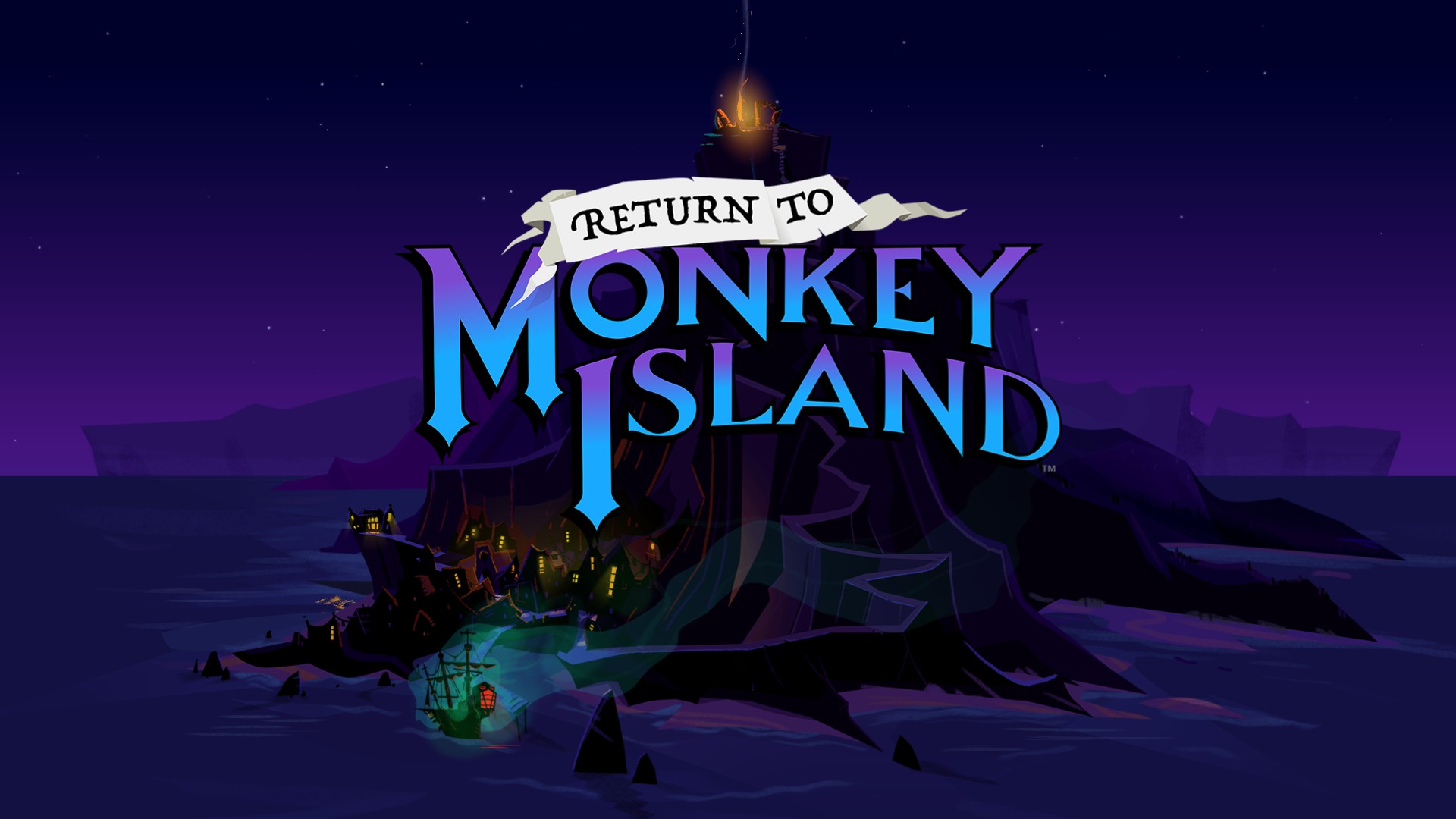

Released back in 1990, The Secret of Monkey Island almost immediately became acclaimed as one of the greatest video games of all time. Fiendish puzzles, funny writing, awful puns and the daftest protagonist name in gaming history combined to make a memorably brilliant, if rather short, game. Monkey Island 2: LeChuck's Revenge followed a year later with a better story, more interesting puzzles, a much greater variety of locations and fantastic music. It also, infamously, had a very strange ending that left a lot of people scratching their heads.

That ending was never really resolved. The creative team behind the first two games, most notably lead designer and writer Ron Gilbert, left LucasArts and moved on. A separate team eventually made a third game in 1997, but wisely skipped past the ending to the second title and picked up some years later with only minimalist references to what happened in the meantime. The Curse of Monkey Island was a great game in its own right, despite the change in ownership. Escape from Monkey Island (2000) and Tales from Monkey Island (2009) followed, to a middling reception. Better-received were HD remakes of The Secret of Monkey Island and Monkey Island 2 in 2009 and 2010, which introduced them to a new generation and got people thinking about that crazy ending again.
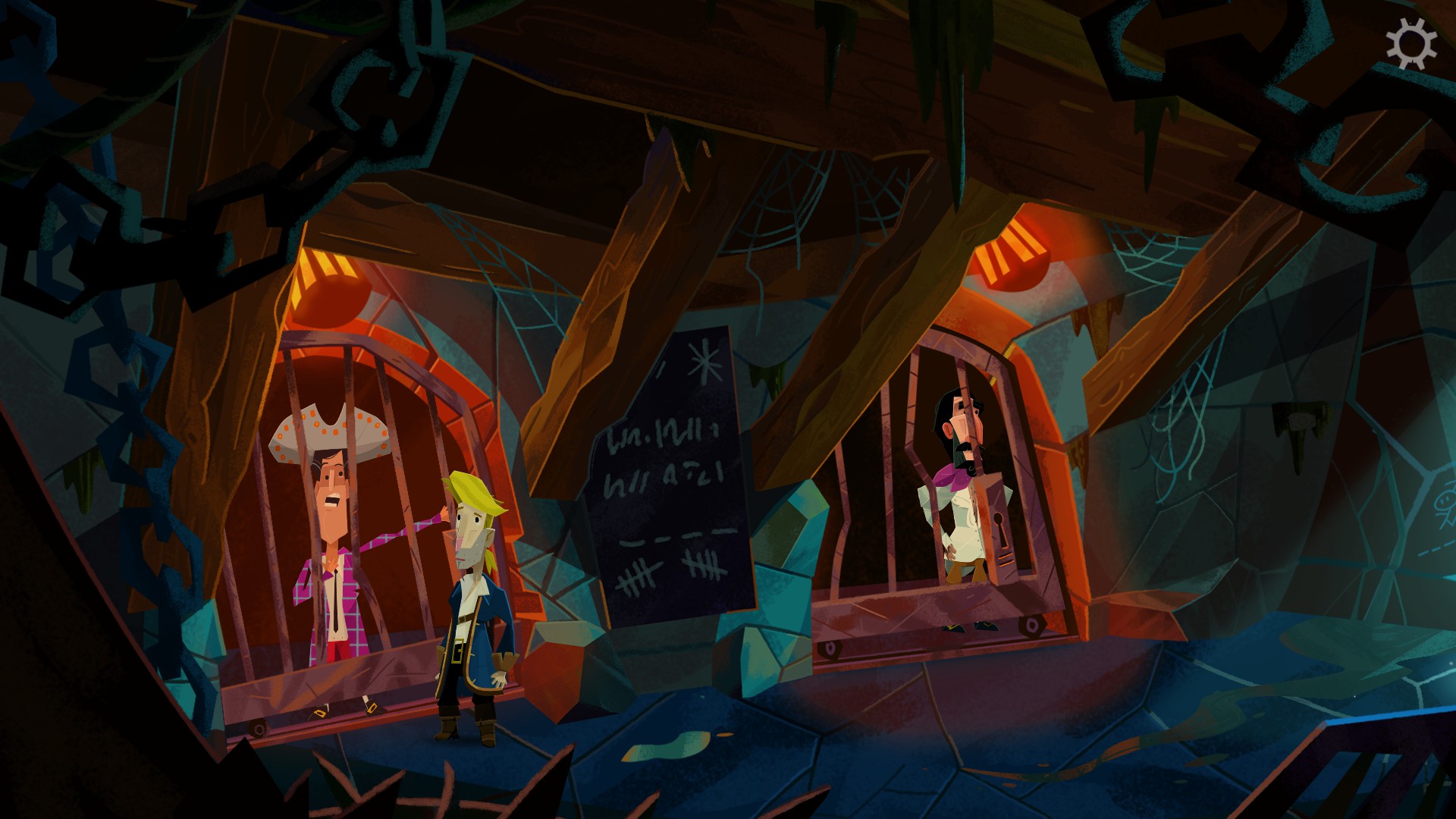
Now the unlikely has happened: Ron Gilbert and Dave Grossman have reunited to make Return to Monkey Island, a game that finally picks up after the ending of Monkey Island 2 and forges on. The new game also doesn't eject the others from continuity: having kinda explained the ending to Monkey Island 2, we fast-forwards a few years past all of Guybrush's other adventures to pick up on him returning to Melee for his new expedition. He and Elaine are now happily married and Elaine is running a campaign to eliminate scurvy from the Caribbean, leaving Guybrush free to take up his quest.

The first two-thirds or so of Return to Monkey Island is a journey which will trigger the nostalgia feels in players. This part of the game almost exclusively uses locations from the original title in the series, so once again you'll visit the SCUMM Bar, hang out at the Governor's Mansion and visit the Voodoo Lady for enigmatic advice, before visiting Monkey Island, falling off the overlook again and sneaking onto LeChuck's ship. But this is a melancholic form of nostalgia: Melee Island has had an economic crisis, a lot of the old businesses are shut down, and there's newcomers who don't recognise Guybrush or particularly care about him being a regular from years or decades before. There's still plenty of laughs here, but Return also examines its own status as a legacy sequel made years after the originals (not always the best of ideas) in a way that that is smart without vanishing up its own posterior.
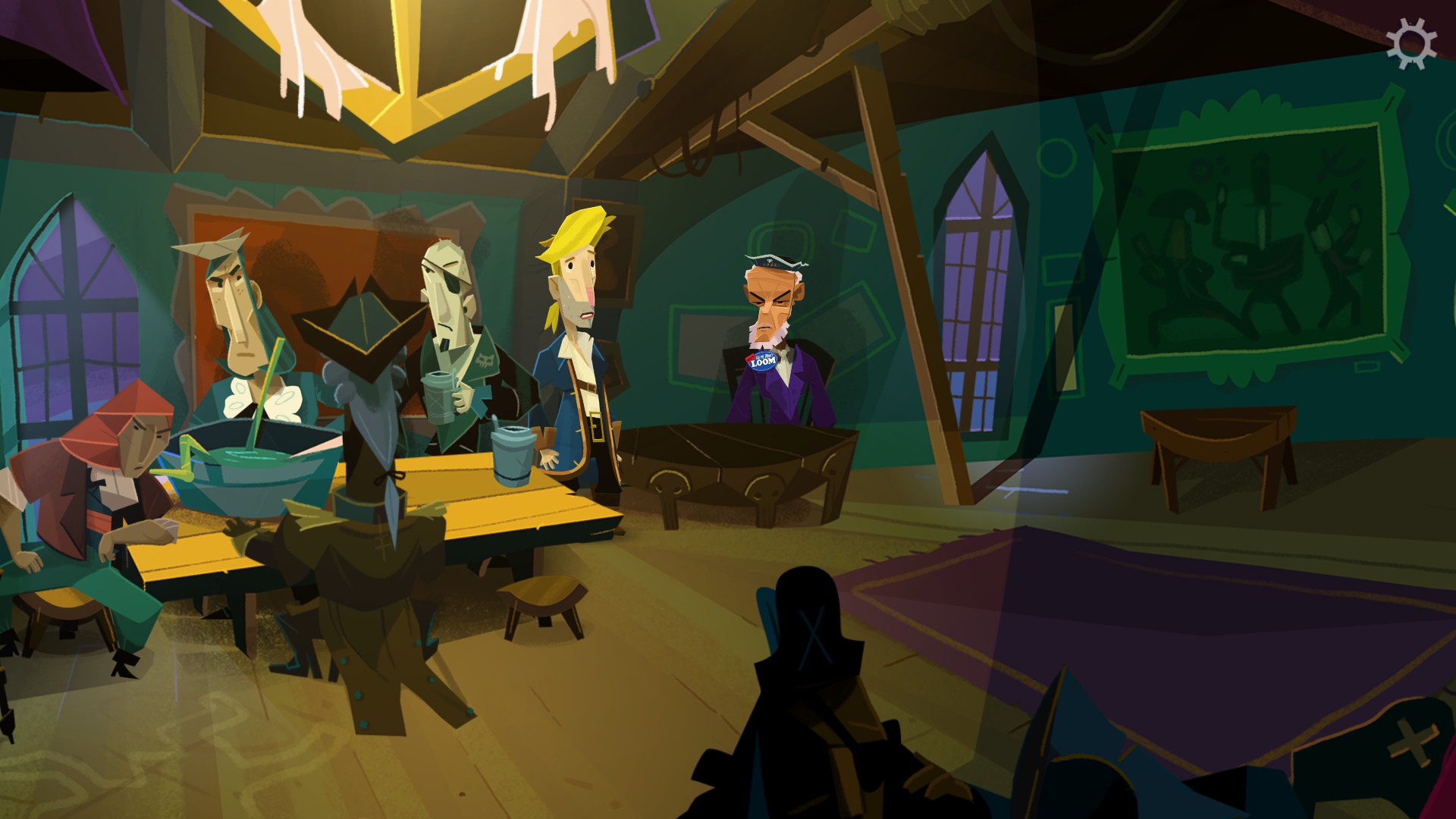
The latter third of the game opens up and Guybrush gets to explore a series of new islands and locations never before seen in the series. This sequence feels somewhat briefer than it should be, possibly a budget issue or the decision they had almost too much material for one adventure game but not enough for two, so trimmed some things to keep it in the confines of one title. This has the unfortunate effect of meaning that the game is dominated by locations you've seen before, whilst the new and fresher material is crammed into a relatively brief part of the game towards the end, before we once again return to a familiar location for the grand finale.

But ultimately it works. The puzzles are fine, not too obtuse apart from a couple of eye-rollers (a built-in hintbook pretty much means you never need to look up online solutions, although the game encourages you to use it as little as possible), and the story is entertainingly told, with that undercurrent of melancholic nostalgia running through it to make it more interesting. 
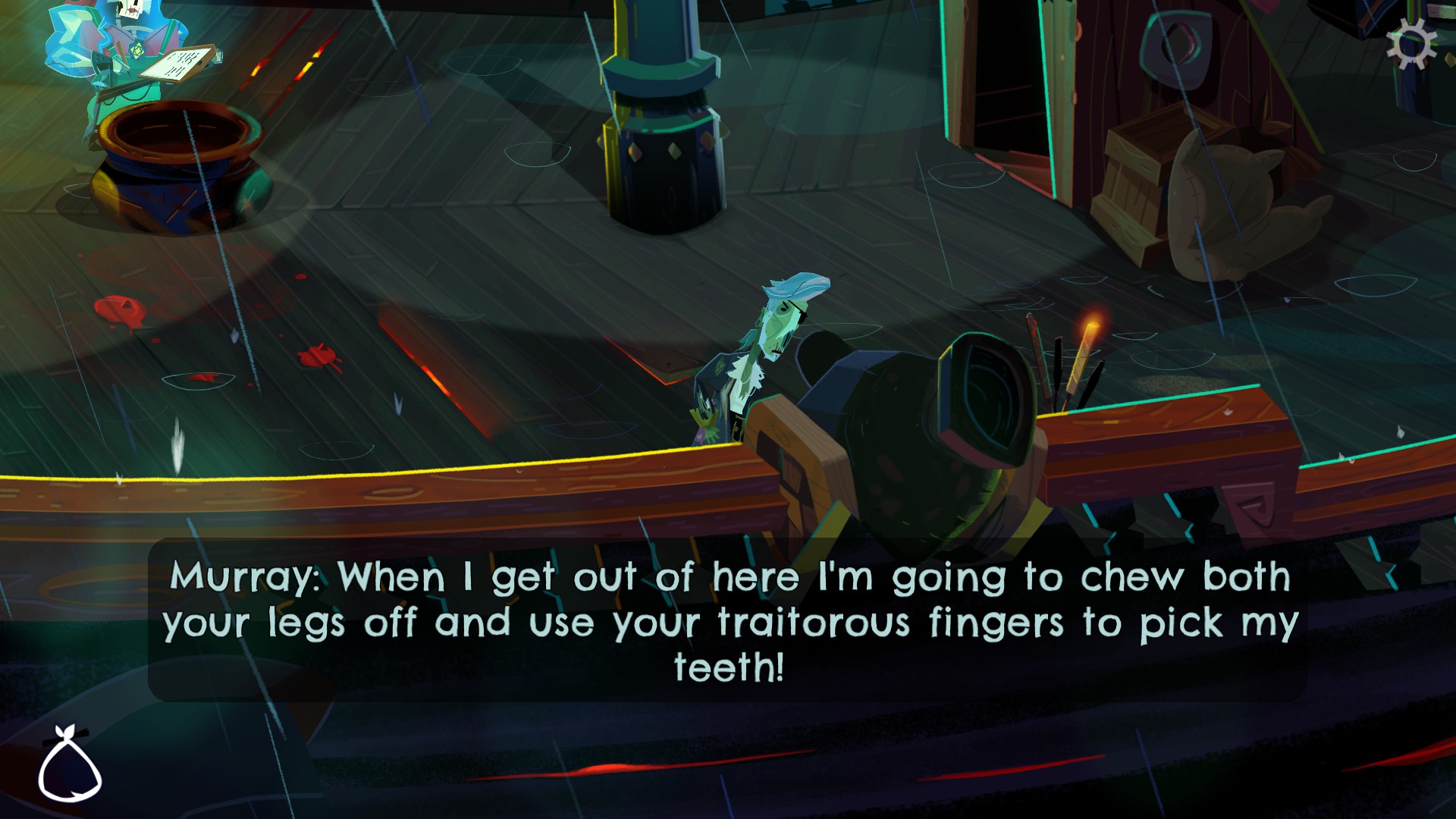
Return to Monkey Island (****½) is, improbably, excellent. Once you get over the stylised new art direction, it works really well and the music is fantastic. Creatives in their fifties revisiting the scene of their greatest hit from their twenties could have gone badly wrong, but Return to Monkey Island emerges as far smarter, funnier, emotional and engaging than it really should. Even if its own ending does definitely skim around the edges of taking the mickey, but it does earn it. The game is available now on PC, Mac and Nintendo Switch.

Thank you for reading The Wertzone. To help me provide better content, please consider contributing to my Patreon page and other funding methods.

Thursday, 9 September 2021

STAR WARS: KNIGHTS OF THE OLD REPUBLIC REMAKE officially announced

Aspyr Media are working on a full remake of Star Wars: Knights of the Old Republic, arguably the greatest and best-regarded Star Wars video game of all time*.

Knights of the Old Republic, developed by BioWare in association with LucasArts, was released in 2003. Set roughly 4,000 years before the events of The Phantom Menace, the game tells the story of a war being fought between the Galactic Republic and its Jedi defenders against a Sith army and fleet led by Darth Malak. The player takes on the role of a character of their own creation who is roped into helping rescue a Jedi Knight named Bastila Shan from the city-planet Taris. As the game continues, the player acquires a large array of allies, such as the murderous and meme-generating assassin droid HK-47, and learns a shocking secret about themselves. Events culminate in a final battle between the Republic and the Sith Empire.

The game was immensely successful on release, generating both critical acclaim and high sales. It was followed by two sequels: the more ambitious but more divisive sequel, Knights of the Old Republic II: The Sith Lords (2004) from Obsidian Entertainment; and MMORPG The Old Republic (2011) by BioWare themselves. Although set in an original universe, the later Mass Effect trilogy (2007-12) draws on some structural ideas from Knights of the Old Republic.

It is unclear how thorough a remake this will be, since no gameplay footage has been shown. The "remake" title and the age of the game and engine suggest that it'd have to be a much more thorough reworking of the game from scratch, possibly in a new engine, rather than the "retexture-and-polish" style of remakes like the Mass Effect Legendary Edition.

Knights of the Old Republic Remake is "early" in development and no release date has yet been set. So far, it has only been announced for PlayStation 5.

* Arguments for TIE Fighter, Republic Commando and Jedi Outcast can be heard at a later date.

Tuesday, 6 July 2021

TIE FIGHTER gets a stunning fan-made remake

The iconic 1994 video game TIE Fighter has gotten a comprehensive remake from fans.

TIE Fighter: Total Conversion is a mod for X-Wing Alliance, the 1999 semi-sequel to TIE Fighter featuring a much better engine. The mod is a spinoff of the X-Wing Alliance Upgrade mod, which replaces all of the game's models and textures with much more modern equivalents whilst retaining the classic gameplay.

The game revamps all 13 campaigns from the original game and its two expansions, for a total of 104 missions. The game also features 41 "reimagined" missions, with many more ships (including the Super Star Destroyer Executor in some cases) added to the original missions to dramatically increase the size and scope of the battles. The mod also, impressively, supports VR.

To play the game, you'll need a copy of X-Wing: Alliance from GoG, a download and install of the X-Wing Alliance Upgrade mod, and a download and install of the TIE Fighter: Total Conversion mod, all of which are fairly self-explanatory.

Tuesday, 12 January 2021

Lucasfilm Games returns from the dead

In surprising news, Lucasfilm have resurrected their defunct gaming division, Lucasfilm Games (known from 1990 as LucasArts). The division was shuttered in 2013 when Lucasfilm and Electronic Arts negotiated a ten-year agreement for EA to develop and publish video games based on Lucasfilm properties, particularly Star Wars titles. But now it's back.


Lucasfilm/LucasArts Games developed dozens of titles between 1983 and 2013, including: Maniac Mansion, Zak McKraken and the Alien Mindbenders, Loom, The Secret of Monkey Island, Monkey Island II: LeChuck's Revenge, The Curse of Monkey Island, Escape from Monkey Island, Indiana Jones and the Last Crusade, Indiana Jones and the Fate of Atlantis, Sam and Max Hit the Road, Day of the Tentacle, Grim Fandango, Secret Weapons of the Luftwaffe, Their Finest Hour, Night Shift, The Dig, Full Throttle and Outlaws. Their Star Wars games included beloved classics such as X-Wing, TIE Fighter, X-Wing vs. TIE Fighter, X-Wing: Alliance, Dark Forces, Jedi Knight: Dark Forces II, Shadows of the Empire, Rebellion, Rogue Squadron, Republic Commando, The Force Unleashed and The Force Unleashed II.

At the time of LucasArts' dissolution, they were developing an ambitious game called Star Wars: 1313, set in the underbelly of Coruscant and featuring ambitious gameplay and narrative ideas.

The Lucasfilm Games "sizzle" video above heavily leans on the recent EA-published games Battlefront (2015), Battlefront II (2017), Jedi: Fallen Order (2019) and Squadrons (2020). This suggests that, for now, Lucasfilm Games is a brand that will be applied to further Star Wars titles as they are developed. However, it may also indicate more ambitious future gaming plans, including setting up new development teams in-house.

EA's handling of the Star Wars licence has been mixed. Battlefront and Battlefront II were heavily-criticised for nickel-and-diming players through shady reward schemes (although the two games have sold more than 30 million copies, a very healthy figure in the current market). However, Fallen Order and Squadrons have had a much warmer critical reception. It has been rumoured that EA are currently developing Battlefront III and Fallen Order II, with an option to fast-track Squadrons II should the game's sales be satisfactory.

Many more games have been cancelled in development. An attempt at BioWare to get Knights of the Old Republic III underway was apparently also shot down by EA management, to the irritation of fans.

EA's licence to publish Star Wars games reportedly expires in 2023, so it'll be interesting to see if they re-sign with Disney or Disney are putting plans in place to develop games internally once again.

More tantalising is the idea that Lucasfilm might also be considering reopening their vaults and developing new games from their immense stash of long on-hiatus IPs, such as the Monkey Island and Maniac Mansion series.

It'll be interesting to see where this goes.

Tuesday, 12 December 2017

Get some free games! For free!

Two of the online video game stores are giving away free games this week to entice people to look at their December sales.


Ubiplay has put up Assassin's Creed IV: Black Flag for free for this week. This nautical take on the Assassin's Creed franchise is often cited as the best game in the series and an easy one to start off with.


GoG also has Grim Fandango Remastered up for free for this week. Originally released in 1998 by LucasArts, Grim Fandango is comfortably one of the best video games and certainly one of the best adventure games of all time. The remastered edition adds a revamped and much-improved mouse control system and enhanced graphics.

Tuesday, 29 December 2015

60 Unforgivable Plot Holes in STAR WARS: THE FORCE AWAKENS...or not

That bastion of glorious journalism, the Huffington Post, has published two articles, one entitled "40 Unforgivable Plot Holes in Star Wars: The Force Awakens" and the other "20 More Plot Holes in Star Wars: The Force Awakens". Some of the points raised are valid, and indeed rather annoying. Rather a lot are totally invalid, and are either explained in the film itself or in the six movies that precede it. So let's take a look at each point and see how fair each one is.

NOTE: SPOILERS FOR STAR WARS: THE FORCE AWAKENS THROUGHOUT


Saturday, 28 November 2015

Star Wars: Episode I - The Phantom Menace

1999. The new millennium was approaching, the Cold War had ended, it was a time of unparalleled optimism and glorious hope for the future. Ruined, some (with perhaps a loss of perspective) say, by The Phantom Menace.


The first film in the prequel series to George Lucas's classic original Star Wars trilogy has had much opprobrium poured over it through the years. It's been appraised, reappraised and analysed far more than a film of its quality really deserved, to the point where it's difficult to sit down and watch it without it buckling under the weight of a decade and a half of scorn.

It's certainly not a great film. It suffers from an extremely clunky and unappealing opening sequence in which the Trade Federation (which we neither know nor care about) invades Naboo (a planet we neither know nor care about) because of tax and trade disputes (which no-one cares about) and a pair of Jedi (one of whom we kind of know) rescue the planet's queen (whom we only know or care about - back then anyway - because she was awesome in Leon) and spirit her away to Tatooine, where suddenly The Plot actually kicks in and we meet Darth Vader, except he's a ten-year-old kid who drives flying Formula One cars. They then go to Coruscant (which we only care about from a decade's worth of mostly great tie-in novels), get General Zod fired from his job ruling the universe, discover that Yoda in his heyday was actually quite annoying and then fly back to Naboo and beat up the Trade Federation with the help of a bunch of frogs led by Brian Blessed.

As plots go, it's weird, bitty and full of episodic chunks which completely fail to connect to one another with any real coherence. The events on Tatooine, based around our heroes trying to repair their ship, gambling on a highly improbable race outcome, trying to scientifically quantify the Force and finding out that Darth Vader built C-3PO (what?), feel completely isolated from the rest of the movie in particular. The resolution is also pat, convenient and implausible in the extreme.

The movie also fails quite spectacularly in its primary goals of either 1) providing interesting or relevant backstory for the films we've already seen or 2) providing a compelling alternate starting point for newcomers to the franchise. In particular 2) is a problem because The Phantom Menace is weak enough that it has put people off from proceeding any further with the series.


BUT.

It's not a total disaster. As a live-action cartoon for kids, it's actually fairly inoffensive. The actors give their best with some disastrous material, but Liam Neeson in particular does sterling work by adopting an authoritarian but stubborn rebel streak for Qui-Gon Jinn. It's a difficult acting choice to pull off, but he does it reasonably well and even succeeds in providing a few of the film's more amusing moments through subtle scenes such as where he is stymied by Watto, the film's most successful CG alien creation (the fact he's presented as a humourous, somewhat sympathetic character with a genuine emotional care for Anakain whilst also being an unrepentant trafficker in human slaves hints at a moral complexity that is never fully explored). Most of the other actors are considerably less able to meld their formidable acting skills (in the case of Ewan McGregor and Natalie Portman) to Lucas's often terrible lines. Ian McDiarmid takes the valid - if increasingly irritating over the course of the trilogy - alternate path of simply hamming things up in every scene he's in.

The film is also surprisingly well-paced. It moves fairly fast, packing in quite a lot of plot (if partially nonsensical) and characters (if mostly underdeveloped) into two hours. Even if a scene doesn't work, it usually doesn't go on long enough for it to be a major problem. This is every much not the case with the two films that followed them, particularly the interminable "romance" and "action" scenes in Attack of the Clones which are so numerous and lengthy that they become genuinely emotionally traumatising. There's also the phenomenal visual design of the film, from sets to spacecraft (mostly still models at this stage) to sets to creatures. The designers achieve the near-impossible task of creating a new, more pristine aesthetic within the Star Wars universe established by three older films, two animated series and numerous books, and making it work.

Then there's the music. John Williams creates a whole new soundtrack which is genuinely epic and stirring, particularly his "Duel of the Fates" during the movie's climax. This melds well with the lightsabre duel between Darth Maul and the Jedi, one of the better action sequences in the entire series (the pod race, for all its implausibility, is another). The minimalist approach to Darth Maul as a villain, in stark contrast to the overblown, overlong pomp elsewhere (see the frankly unnecessary number of "Darth Sidious talking smack over a holoprojector" scenes), actually works very well and is an approach Lucas should have used elsewhere.

None of this can save The Phantom Menace from its weaknesses, but in many ways it's a better movie than either of its immediate successors. Indeed, if you can mentally switch off Jar-Jar Binks (who is actually in a lot less of the film than you may recall) or find The Phantom Edit version of the movie, it arguably emerges as the best of the three prequels thanks to Neeson's excellent, grounded performance, the musical score and some of the more well-judged action sequences in the series.

The Phantom Menace (**½) is available now as part of the complete (but soon not to be) Star Wars Saga box set (UK, USA).

Friday, 4 September 2015

MONKEY ISLAND and COMMAND & CONQUER celebrate their birthdays

Two of the most influential names in gaming celebrated anniversaries this week.

It's been ten o'clock on Melee Island for twenty-five years now...

The Secret of Monkey Island went gold on 2 September 1990 and hit shops a couple of weeks later. It was the latest in a series of graphical adventure games released by LucasArts using the SCUMM Engine. The previous games using the engine - Maniac Mansion, Zak McKraken and the Alien Mindbenders, Indiana Jones and the Last Crusade and Loom - had all been successful, but The Secret of Monkey Island was bigger still. It may still be the funniest video game ever made, as well as one of the cleverest, with some exceptionally fiendish puzzle design and the excellent idea of insult sword fighting still resonating today.

The same team made the superior sequel, Monkey Island II: LeChuck's Revenge, but then began leaving the company. The Curse of Monkey Island (1997) and Escape from Monkey Island (2002) were made by different teams and are not counted as wholly canon (although Curse has numerous fans). Ron Gilbert, the main creative force on the first game, talks about the original game's release here and how he would handle a third canon Monkey Island game here. Gilbert is currently working on a SCUMM-esque retro adventure game called Thimbleweed Park, which he hopes to release next year.

You can play The Secret of Monkey Island and Monkey Island II today, using special editions which allow you to either play in "classic" mode or with revamped, modern graphics.


Westwood couldn't afford a lot of actors for C&C's cut scenes, so drafted in their staff to help. Joe Kucan, the director of the cut scenes, became the game's bad guy, Kane, inadvertently creating (arguably) the most iconic non-pixellated bad guy in video games.

Meanwhile, it is also the twentieth anniversary of the release of Command and Conquer. Developed by Westwood games and released on 31 August 1995, Command and Conquer had a huge impact in the way it popularised the real-time strategy genre. The same developers, Westwood, had effectively created the genre with Dune II: The Battle for Arrakis in 1992, but that game had problems with the player only being able to select one unit at a time. C&C allowed for entire armies of mixed units to be assembled and used to attack the enemy en masse. The game was also influential with its elaborate cut scenes and the focus on a narrative, the battle between the Global Defence Initiative (GDI) and the terrorist Brotherhood of Nod for control of tiberium, a potent energy source brought to Earth by meteorites.

The game was followed by three direct sequels: Tiberian Sun (1999), Tiberium Wars (2007) and Tiberian Twilight (2010). However, the game also spawned two spin-off universes. The more famous of these was the Red Alert series, which used time travel to create a series of conflicts between the Western Allies and Soviet Union (and later the Japanese Empire). The Red Alert series is considerably sillier and camper than the core series, but is also arguably superior, with better units. This sub-series consists of Red Alert (1996), Red Alert 2 (2000) and Red Alert 3 (2008). The second spin-off was Command and Conquer: Generals (2002); a sequel/reboot was in development before being canned a couple of years ago.

The influence of the C&C games can be seen and felt in all the RTS games that followed, from StarCraft to Homeworld to this week's Act of Aggression (a self-aware homage to the original series), even if EA has seemingly abandoned the franchise.

You can get most of the C&C games on Origin.

Wednesday, 22 July 2015

Wertzone Classics: Star Wars: X-Wing Alliance

The Rebel Alliance has been dealt a severe blow with the destruction of its base on Hoth. In the aftermath of the disaster, numerous factions sympathetic to the Alliance have been exposed and the Empire has taken vengeance. Caught up in the chaos are the Azzameens, a trading family supplying the Rebels. With the Empire closing in, the youngest pilot in the family elects to the join the Rebels and help in the fight. However, his loyalties to his familes remain strong...


X-Wing Alliance was originally released in 1999 and is the fourth and final game in the X-Wing series, following on from X-Wing (1993), TIE Fighter (1994) and the multiplayer-focused X-Wing vs. TIE Fighter (1997). The game opens during the events of The Empire Strikes Back and concludes with the epic Battle of Endor from Return of the Jedi, with the player helping flesh out events in the background of both movies.

X-Wing Alliance is, technically, the most accomplished game in the series. The graphics are far superior to the earlier games and the fighter cockpits are now all fully-modelled 3D environments which you can look around in. The game has the widest variety of ships and stations in the series and bumps things up a notch by allowing you play small freighters, such as the YT-1300 and 2000-series Corellien freighters and, in the final mission, the Millennium Falcon itself. The game also unfolds over a larger scale, with many missions requiring multiples jumps through hyperspace to other star systems. The engine can handle far vaster battles than the previous game, with the concluding Battle of Endor involving over a dozen capital ships and hundreds of fighters. The game also makes excellent use of the movie soundtracks and sound effects to form the perfect backdrop to the game.


It remains controversial over if this is the best game in the series, however. For my money it is. It has the best pacing, the best difficulty curve (one or two insanely hard spikes aside) and a growing sense of menace and scale as the assault on the second Death Star approaches. There are 50 missions, which is a lot for this kind of game (the others only reached this size with their expansions included), especially since many of these missions are longer than the very longest missions in the previous titles. It's certainly a big, satisfying game which takes the previous mixture of spectacular space combat, in-battle tactics and larger strategy (through the ability to give wingmen orders, which they handle better than ever before thanks to much stronger AI) and tightens everything up a notch.

The biggest weakness - and it is not a major one - is the storyline involving the Azzameen family. Ignoring their silly name (and you even sillier designation as "Ace"), this storyline does get you involved in the game a bit more than in its forebears, which gave your character no backstory at all. However, the game forces you to sit through several fairly tiresome family-oriented missions before you get to the join the Rebellion and hop in an X-wing. The addition of freighters to the game is a good one, but these end up being a bit overpowered due to their auto-tracking turrets. This is especially notable in the YT-2000 Otana, which has two gun batteries and requires you to merely be pointed in the enemy's vague direction to scythe through entire squadrons - even of TIE Avengers and Defenders - with impunity. These missions can be a bit more fun as they involve characters not associated with the Rebels, such as your crazy sister Amon and even crazier brother Emon (not the most exciting names), and your psychotic droid co-pilot MK-09 (a slightly less homicidal forerunner of HK-47). They bring a bit more personality to a game series that was, until this title, rather lacking in personality.


One slight problem with this story is that it's not entirely concluded at the end of the game. The Azzameen storyline ends on a cliffhanger with a traitor being exposed in the family and doing a runner. Clearly, his pursuit would have factored into any expansion to the game. However, X-Wing Alliance suffered badly in the Great Space Combat Crash of 1999, selling disappointingly, and no expansion or sequel was made. Fortunately the game's core storyline finishes fairly decisively with the Battle of Endor, which provides more than enough closure for the whole game.

X-Wing Alliance's other big problem was one of timing. The X-Wing series had comfortably usurped the Wing Commander franchise's crown as Best Space Combat Series and worn it well through the 1990s, but just a few months before X-Wing Alliance came out another game was released. Conflict Freespace: The Great War was, despite a dodgy name, an altogether hardier and better game, with superior, more visceral combat, better visuals and far weightier handling. It left the X-Wing series looking a bit tired. Even worse was to come when Freespace 2 was released about six months after X-Wing Alliance. Freespace 2 was space combat perfected and pretty much killed the entire genre stone dead by not giving it anywhere to develop.

Freed from contemporary issues, X-Wing Alliance (****½) emerges as a still impressive, top-notch game. It is available now from GoG. Unlike the earlier X-Wing games, which were made before the modding scene took off, X-Wing Alliance allowed modding and the results include the impressive X-Wing Upgrade project, which improves the visuals massively of the whole game. I strongly recommend it as it both upgrades the in-game models to something far palatable for modern gamers, and also adds widescreen support for current monitors.

Tuesday, 21 July 2015

KNIGHTS OF THE OLD REPUBLIC II gets a new update...ten years after release

Knights of the Old Republic II has, somewhat bizarrely, gotten a major Steam update today. Given that the game was originally released for Windows XP back in February 2005, this feels a bit late in the day. However, given the game's legendarily broken status on release, it is a bit of a special case.


The original Knights of the Old Republic, created by BioWare and released in 2003 for the original X-Box, is one of the greatest CRPGs ever made and one of the greatest instalments of Star Wars - in any medium - ever released. It's a character-focused adventure which channels the pulp sci-fi feel of the original Star Wars movie and nails it absolutely right. It's downright brilliant and you should certainly play it if you haven't already. It's also a bit of a prototype for BioWare's later Mass Effect games, although for my money Knights of the Old Republic is comfortably superior. It's been recently updated to run on modern PCs from GoG and is well worth a look.

Knights of the Old Republic II, developed by the then-newly-formed Obsidian Entertainment, is every bit the Empire Strikes Back to the original game. It's darker, more brooding, more morally dubious and has a bit of a massive downer ending (although not a cliffhanger). It presents a far more cynical view of the Star Wars universe, one of shades of grey where the very simplistic notion of a "Light" and "Dark" side of the Force seems laughable. It's far more conceptually original and interesting than the original game. It should have been even better, but for LucasArts rushing the game out before it was ready, in a buggy and not-entirely-complete state.

A couple of post-release patches did help correct the more general and grievous technical problems the game was suffering from, but the missing content could not be fixed without a massive update which LucasArts were curiously unwilling to let Obsidian undertake.

Fortunately, Obsidian were canny enough to include some of the assets and code for the missing content on the actual game CD, allowing modders to extract them and start looking at ways of filling in the gaps themselves. And after a decade they've done what is by all accounts a bang-up job, via the Restored Content Mod. This completes a couple of incomplete storylines in the original game, puts some more closure in the ending (previously a rushed voiceover explained the fate of many of the characters) and, most critically, adds an entire new location to the game: a droid production facility which comes complete with attendant quests and characters and much focus on the beloved, homicidal assassin droid HK-47.

The new update officially incorporates the Restored Content Mod and also adds native controller support as well as blasting the resolution up to 5K for absolutely no good reason other than they can. It's great to see this older, underrated game being updated and brought to a new audience as a result.

Friday, 10 July 2015

Wertzone Classics: Star Wars: TIE Fighter

The Galactic Empire is at the height of its power, its reach and control extending across most of the known galaxy. Even the destruction of the Death Star at the Battle of Yavin has not proven a fatal blow. But with the Rebel Alliance gaining new allies and followers, the need for the Imperial military to recruit new pilots for its TIE fighter squadrons has never been greater.


TIE Fighter was originally released in 1994 as the sequel to the previous year's X-Wing. X-Wing had been a big hit and a success, so a sequel was inevitable. However, the decision to have the player join the "bad guys" and fight against the heroes of the Rebel Alliance was somewhat unexpected. It was an idea that LucasArts took and ran with to great effect.

Technically, TIE Fighter is a big improvement over X-Wing. The flight model is a bit better, the wingman controls and AI are superior and the game's missions are more varied, with more in-mission events and unexpected events making things less predictable. There are far more ships and models (including proper space station models, thankfully) and you can now target sub-systems on big ships, allowing you to take out shield generators or turrets. Graphically the game looked a lot better on release, although for this re-release you are limited to the original graphics or the 1998 Collector's Edition, featuring the far more detailed and impressive X-Wing vs. TIE Fighter engine. The latter is certainly still reasonable enough to play today.

As you would hope, your CO (and most of the Imperials) has an English accent.

The game has a much more prominent and focused narrative. You play an Imperial fighter pilot who also has a secret agenda as an agent for Emperor. In some missions you have secret orders which go against your main mission but which will benefit the Emperor, standing you in his good graces and opening up further promotions. Part of the game revolves around an internal threat to the Empire, resulting in a mass defection of part of the Imperial Fleet to the Rebels, and you play a pivotal role in exposing the conspiracy. The narrative is pretty decent even today, featuring as it does bad people doing bad things to even worse people, making for a morally murky tale.

The game also does a great job of placing you as a cog in the Empire's military machine. X-Wing's wonky AI often required you to rush around doing everything yourself, but TIE Fighter's is much stronger and requires you to more often fulfil your mission objectives and stick to your role rather than being a stand-out hero. Without intending to, this allowed LucasArts to nail the difference between the Rebels and the Empire between the two games, and adds a lot to the atmosphere. TIE Fighter's early missions can also be tough, with you in a fragile, unshielded TIE fighter, interceptor or bomber going up against much tougher Rebel fighters.

If TIE Fighter has a problem, it's that it doesn't stick to its guns for very long. Within a few missions you are regularly flying the Assault Gunboat, a powerful ship with shields and heavy weapons that can easily go toe-to-toe with an X-wing (and with some judicious power management, can match A-wings). As the game continues you gain access to the TIE Advanced, which is more powerful than any ship in the Rebel arsenal. You then get the TIE Defender, which dials this up to eleven. At this point you may as well switch on a god mode cheat. Then, just to make sure it hasn't made you overpowered enough, you get access to a "Missile Boat" which has gatling gun missile launchers and allows you to lay waste to entire enemy squadrons before they can get anywhere near you.

"Get out of the frigging way!"

This is all enormous fun and does address the problem of why, in the films, the Empire seems to be technologically inferior to the Rebels despite having much vaster resources, but it's also a bit silly and undermines the tension of early missions where a single mistake can mean a horrible, flaming death. It could also be argued that by making you a "bad guy" and then making you fight even worse people for most of the time rather than having to do anything really awful (like shooting down civilians), the game pulls its punches when it could have opened up into a more interesting study of morality in warfare.

But for a large chunk of its length, TIE Fighter (****) is superb. Combat is fast and furious, there is a much greater sense of tactics and strategy at work, the story (complete with cameos by the likes of Vader and Admiral Thrawn) is solid and the game does a great job of making you feel like a pawn of the Empire. It is a huge amount of fun, hasn't aged too badly at all and is now available from GoG.

Monday, 8 December 2014

GRIM FANDANGO REMASTERED release date, DAY OF THE TENTACLE REMASTERED announced

Double Fine have confirmed that their remastered edition of classic 1998 adventure game Grim Fandango will be released on 27 January, along with a new trailer.


The new version of the game has been optimised for modern PCs and will also include versions for Mac, Linux, PS4 and PS Vita.

Double Fine have also confirmed that they are bringing back Day of the Tentacle, the sequel to the original LucasArts adventure game Maniac Mansion. Originally released in 1993, Day of the Tentacle was hugely critically acclaimed on release and is sometimes described as the best adventure game ever made (an honour it sometimes exchanges with Monkey Island II and Sam and Max Hit the Road). This new version will likely be more akin to the Monkey Island re-masters from a couple of years ago, allowing gamers to play both the original and a graphically updated version of the game. In fact, it sounds like this new version is based on the already-in-progress remastering work that LucasArts was undertaking when it was shut down by new owners Disney back in 2012.

Meanwhile, Ron Gilbert, the original creator of Maniac Mansion (and The Secret of Monkey Island), is crowdfunding a new, classic-style adventure game called Thimbleweed Park. With more than a week to go, the game has raised more than $100,000 over its originally-requested target amount.

Sunday, 16 November 2014

Star Wars: X-Wing

The Galactic Civil War is at its height. The Sullustans are negotiating to join the Rebel Alliance, but the Empire is rumoured to be constructing a weapon of incredible power. Into this chaos steps Keyan Farlander, a fresh recruit for the Alliance. He is assigned to the cruiser Independence as an X-wing fighter pilot.


Way back in 1993 - improbable as it seems now - Star Wars merchandise was thin on the ground. Timothy Zahn's Thrawn Trilogy of novels had just started a renaissance in the popularity of the franchise and West End Games had been producing a successful pen-and-paper roleplaying game for several years, but there was still a gap in the market for an iconic Star Wars video game.

X-Wing proved to be that game. Riffing off both the starfighter dogfights in the movies and the then-extremely popular Wing Commander series of games (which later upped the ante by recruiting Luke Skywalker himself, Mark Hamill, to appear in later titles in that series), X-Wing hit a sweet spot of game design. It didn't just put the player in the seat of a fighter and let them get on with it, it also gave them control over the various ships' weapons and power systems. This was a vital move as it moved the game from being an arcade shoot 'em up and instead more towards the realm of serious simulation, or at least as serious as it could be when it came to simulating fictional spaceships.

The game is played from the cockpit of one of the Rebel Alliance's iconic fighters: the X-wing superiority fighter, the A-wing fast interceptor and the Y-wing medium bomber. The B-Wing expansion (included in most editions of the game) adds the B-wing heavy bomber to the roster as well. Each ship has a different role. The A-wing is lightly-armed and armoured, is relatively fragile and has a small missile load-out but is also lightning fast and highly manoeuvrable. The Y-wing is slow and lumbering, but has hardier shields and armour, a large warhead magazine and has a secondary ion cannon which can disable enemy ships rather than destroying them. The X-wing falls between, being fairly fast and having a reasonable torpedo payload, but is also quite manoeuvrable and its four laser cannons make it an excellent dogfighter.

Each fighter has three energy systems that the player needs to manage: engines, weapons and shields. Keeping your weapons charged is necessary if you want to fire them, shields need to be kept up (or recharged after being hit) if you don't want to explode and the engines need to be charged to allow you to move fast. This sounds complicated but in practice all that is needed is two buttons which control how much power is diverted from the engines to the other systems (along with a third for rapidly dumping power from one system to another). This adds a more tactical element to the game, since you can retreat from nasty fights (by dumping all power to the engines and speeding clear), recharge your shields and weapons and then rejoin the fray. As the game continues and you gain additional ranks, you also gain the ability to give commands to wingmen in battle. Some later, complex engagements depend on your forces engaging several enemies at once. This is all handled through some pretty logical and instinctive keyboard commands.


The latest version of the game allows you to play in two flavours. The original 1993 version of the game has much more primitive graphics but better music which adapts to the changing fortunes of the battle. It also allows you to play with a mouse. The 1998 version has vastly superior graphics but a simple looping music track. It is also only playable with a joystick or gamepad. I prefer the latter for the stronger visuals, but some swear by the original.

Almost twenty-two years on from its original release, X-Wing holds up remarkably well. The gameplay is fast, enjoyable and surprisingly deep. The game's systems are relatively primitive - the energy balancing and wingman mechanics are handled through just a few button presses each - but in combination with one another provide a variety of different responses to dire situations. Dogfights are fast and furious, but the game does a good job of providing you the information you need to manage even complicated situation effectively. All in all, the game has withstood the test of time very well.

There are, however, several problems. One of these is that it's simply not as good as its sequels. X-Wing feels like a prototype for a style of game only perfected in the later TIE Fighter and X-Wing Alliance, particularly mission structure and in-mission story events. The storyline is fairly bare-bones (all of the character stuff is handled in the manual and strategy guide) and missions tend to become fairly predictable, especially towards the end of the game. Although there is a reasonable variety of craft on hand to both control and fight, X-Wing has the smallest roster of ships in any of the games and it won't be long before you have seen all the game has to offer on that front. The game also arguably fails to live up to its billing of allowing you to recreate the iconic X-wing vs TIE Fighter battles from the first film: all too often you are controlling a fragile A-wing or lumbering Y-wing and fighting Imperial Gunboats (which are more durable than TIEs due to their shields). Enemy AI is also not fantastic in this game, with the computer only having a small number of manoeuvres it can pull off which rapidly become predictable. Most irritatingly, whilst the game unleashes the main Star Wars fanfare when you've fulfilled your objectives, it doesn't provide any such notification for a mission failure. Concluding a half-hour mission only to find the ship you were escorting got blown up ten minutes ago and you need to start again is not fun.

That isn't to condemn the game fully. It's shorter and more focused than its sequels, and its opening tour of duty serves as a reasonable introduction to the series and its mechanics. It's also surprising how fully-formed the compelling gameplay of the series is in this first title

X-Wing (***½) is available now on PC from GoG. The GoG release includes both the 1993 and 1998 versions of the game, along with the game manual and strategy guide. Both expansions, Imperial Pursuit and B-Wing, are also included. Its immediate sequel, TIE Fighter, is also available now with the multiplayer-focused X-Wing vs. TIE Fighter and the much more epic conclusion to the series, X-Wing Alliance, due to follow soon.

Monday, 27 October 2014

X-WING and TIE FIGHTER re-released

GoG have teamed up with LucasArts to re-release the classic space combat sims X-Wing and TIE Fighter. The games will be available from GoG within the next day.


Released in 1993, X-Wing was a blatant attempt by LucasArts to cash in on the success of Chris Roberts's Wing Commander series by deploying the heavy firepower of the Star Wars universe. Employing then-cutting-edge 3D graphics and a finely-tuned power balancing mechanic, X-Wing managed to be better than its rival and was a superb - if extremely tough - game. Released a year later, TIE Fighter was even better, with a gripping storyline casting the player as an ordinary pilot unfortunately employed by the bad guys.

The series continued in 1997 with the multiplayer-focused X-Wing vs. TIE Fighter, although it did feature an excellent, story-based expansion called Balance of Power. In 1999 the series concluded with the epic X-Wing Alliance.

At this stage, only the original X-Wing and TIE Fighter are being re-released from the series. Both games have been updated to work with modern PCs and the GoG editions include both the original versions and their 1998 re-releases, which are the same but use the much more advanced graphics engine from X-Wing vs. TIE Fighter. X-Wing will include both its expansions (Imperial Pursuit and B-Wing) whilst TIE Fighter will include its Defender of the Empire expansion.

Both games are excellent and I can recommend getting them both. However, they require joysticks (or, at the very least, gamepads) to play properly.

In additional news, LucasArts classics Sam and Max Hit the Road, Indiana Jones and the Fate of Atlantis and Knights of the Old Republic are likewise being re-released tomorrow. Knights of the Old Republic is highly recommended, as the previous PC version required a little bit of tinkering to get working properly (its sequel generally works absolutely fine). This version should work with modern graphics cards and operating systems out of the box.

GoG have said that they will ultimately be releasing thirty LucasArts titles over the coming months, suggesting that the overwhelming bulk of the LucasArts archive will eventually be available.

Rumourville: PS3 turn-based classic Valkyria Chronicles is also, curiously, getting a PC release many years after the original release.

Sunday, 1 June 2014

BUFFY THE VAMPIRE SLAYER reimagined as a 1990s adventure game

Artist Andrew Scaife has reimagined scenes from Buffy the Vampire Slayer as a 1990s LucasArts adventure game, and it's awesome.


Scaife has done seven scenes, one for each season. He's put a lot of detail into each scene, not just the characters and environments but also on such things as inventory (what Buffy is carrying in each scene) and what the characters are doing to get out of their predicaments.


If an enterprising modder doesn't go off and make a Buffy adventure game now, I will be disappointed. Check out all of the scenes over at Scaife's website.

Wednesday, 3 April 2013

Disney shutting down LucasArts

LucasArts, the game-making division of Lucasfilm, is being shut down by the company's new supreme overlords at Disney.


Disney is instead switching video game development of Lucasfilm properties (i.e. Star Wars) to external companies under a licencing model. The fate of 1313, a new Star Wars game internally developed by LucasArts and set between Episode III and IV, is unclear, although rumours have stated that the game has been on hold since late last year as Disney wants all new Star Wars games to focus on the time period of the new movies.

LucasArts was founded in 1982 and worked on some very early home video games before the release of its first big hit, Maniac Mansion, in 1987. That game introduced the SCUMM Engine, which put impressive graphics and a mouse-driven interface into the adventure genre, previously dominated by text inputs. Further games refined this system, such as the brilliant Zak McKraken and the Alien Mindbenders (1988) and Indiana Jones and the Last Crusade (1989), the latter of which may still be one of the very best movie tie-in games ever made. LucasArts adjusted their formula in 1990 with the quirky and enjoyable LOOM, which replaced the typical command system with a music-driven one. In 1990 LucasArts released arguably their best-known, non-Star Wars game with The Secret of Monkey Island, following that up a year later with the epic and superior Monkey Island 2: LeChuck's Revenge. Indiana Jones and the Fate of Atlantis was released in 1992, followed by Maniac Mansion 2: Day of the Tentacle and Sam and Max Hit the Road in 1993.

Following this point, the widespread adoption of 3D technology for games left LucasArts feeling that their adventure games looked outdated. The Curse of Monkey Island (1997) was their last adventure game using 2D animation, with both Grim Fandango (1999) and Escape from Monkey Island (2000) featuring 3D graphics. Though critical acclaim was still forthcoming (rather less for Escape), LucasArts wound up its adventure-producing division in 2003. Many of the people working there went on to found Telltale Games, who eventually ended up producing episodic new Sam and Max and Monkey Island games. Their most recent hit was The Walking Dead episodic game series.

Meanwhile, LucasArts branched into other areas of gaming. In 1993 they published X-Wing, a Star Wars-themed competitor to Chris Roberts's Wing Commander series of space combat games. The critically-acclaimed series eventually ended up comprising four core titles: X-Wing (1993), TIE Fighter (1994), X-Wing vs. TIE Fighter (1997) and X-Wing Alliance (1999). Disappointing sales for X-Wing Alliance - accompanying the wholesale collapse of the space combat simulator genre after a decade of success - saw the series cancelled at that point. LucasArts moved into console gaming, working with BioWare to produce the RPG Knights of the Old Republic in 2003 and with Obsidian on the ill-fated Knights of the Old Republic II in 2004. They also produced the action game Star Wars: Republic Commando in 2005.

Increasingly, post-2000 LucasArts was working more and more with external companies to produce their games, with LucasArts often only providing oversight. The most recent example of this is the highly troubled MMORPG The Old Republic, co-produced with BioWare and apparently the most expensive computer game of all time (with rumours abounding about how close the game has come to breaking even). It is likely that these elements also factored into Disney's decision to shut down the company.

Sad news for the once-great games development company which kick-started the careers of, amongst many others, Ron Gilbert and Tim Schafer.