Showing posts with label red dwarf. Show all posts

Thursday, 26 February 2026

RIP Rob Grant

In tragically surprising news, as he was in the news just last week, Red Dwarf co-creator Rob Grant has passed away at the age of 70.

Born in Salford in 1955, Grant grew up in the north of England, studying at Liverpool University. He met Doug Naylor in the mid-1970s at university and they collaborated on a series of sketch shows for BBC Radio 4, including Cliche and Son of Cliche. For the latter they created a character called "Dave Hollins, Space Cadet," the last human being alive after being marooned in the distant future. Filing that for future reference, they started working on TV projects for comedian Jasper Carrott and then the satirical puppet show Spitting Image. In 1986, Grant and Naylor wrote "The Chicken Song," a satirical song for Spitting Image which unexpectedly hit #1 on the British music charts.

Both Grant and Naylor were science fiction fans and wanted to do something in that genre. In 1987 they developed the TV science fiction sitcom Red Dwarf for the BBC. After running into numerous problems with casting - original choice for Rimmer, Alan Rickman, bailed out to appear in some obscure American movie set in a skyscraper - and scheduling - the entire first season had to remounted after a studio strike - the show debuted in February 1988 and was immediately successful. Its stars, Craig Charles, Chris Barrie, Danny John-Jules and Norman Lovett (later joined by Hattie Hayridge and Robert Llewellyn), became well-known figures on British television almost overnight.

The show aired six seasons from 1988 to 1993, selling hundreds of thousands of copies on VHS and hundreds of thousands of copies of two novels penned by Grant and Naylor, Infinity Welcomes Careful Drivers and Better Than Life. The TV show also spawned a high-selling magazine and a fervent fan community. Despite being one of the the biggest comedy shows in Britain during its early lifetime, the show attracted relatively little attention from the critical community and was mostly ignored for TV awards. Ironically, the show achieved its highest critical success in the United States by winning an International Emmy Award for the Season 6 episode Gunmen of the Apocalypse. There were two attempts to film a pilot for the US market, both failing to go to series.

Grant and Naylor co-created a more conventional sitcom for ITV about theatrical agents called The 10%ers in 1993, but their creative relationship was cooling. They stopped working together after 1993 and dissolved their writing partnership in 1995, though both retained ownership stakes in the Grant Naylor production company. This dissolution, along with legal troubles for castmembers of the show, prevented a new series of Red Dwarf being made until 1997, with Naylor leading a new writing team. Naylor later wrote the eighth season in 1999 by himself. Rob Grant's last contribution to the Red Dwarf mythos was a novel, Backwards, published in 1996.

Grant created and wrote the period sitcom Dark Ages for ITV in1999 and the SF sitcom The Strangerers for Sky One in 2000. He pivoted to writing novels for Gollancz, namely Colony (2000), Incompetence (2003) and Fat (2006), along with a radio series for BBC Radio 4 called Quanderhorn, a pastiche of Quatermass, written by Andrew Marshall. He also penned a radio series called The Nether Regions, again with Marshall.

In 2022 Grant announced an intention to return to Red Dwarf to produce a spin-off prequel TV show called Red Dwarf: Titan. This created a legal tangle with Naylor that took a year or so to resolve. Since 2023, Grant had been working on this project with Marshall, with multiple streaming companies taking meetings but nobody willing to commit a budget. Just last week, they confirmed they had written a novel version of the project, which Gollancz had picked up for publication this summer. This will now be a posthumous release, and Grant's final project.

Rob Grant suddenly passed away on 25 February. Red Dwarf castmembers, friends and fans have posted tributes online.

On a personal note, I met Rob Grant on several occasions in the late 2000s at various publishing events in London with Gollancz. He was very personable, funny and a seemingly infinite reservoir of anecdotes. He will very much be missed.

Friday, 20 February 2026

RED DWARF co-creator returns to franchise after 30 years with new novel

Red Dwarf co-creator Rob Grant is returning to the franchise he created in 1988 with a new novel. This will mark his first contribution to the Red Dwarf mythos since his 1996 novel Backwards, published three years after his last contributions to the TV series.

Rob Grant created Red Dwarf alongside his writing partner Doug Naylor, expanding on ideas they originally created for the radio comedy sketch Dave Hollins: Space Cadet. Red Dwarf is set three million years in the future, aboard the mining ship Red Dwarf which had to flee out of the Solar system when an onboard radiation leak sterilised the ship. The sole survivor is chicken soup repair technician Dave Lister, sentenced to suspended animation for bringing an unregistered cat on board. The ship's powerful-but-deranged AI, Holly, releases Lister from suspended animation and charts a course back to Earth. To keep Lister sane, Holly resurrects his officious and pedantic superior officer Arnold J. Rimmer (the J stands for Judas) as a hologram. They later discover a humanoid creature who descended and evolved from Lister's cat, and then rescue a sanitation droid named Kryten to round out the crew.

Red Dwarf ran for six seasons on the BBC from 1988 to 1993, with Grant and Naylor also penning two spin-off novels, Infinity Welcomes Careful Drivers (1989) and Better Than Life (1990). The series became a massive smash hit success. The show went on hiatus after Season 6 due to creative differences between Grant and Naylor and legal troubles for some of the cast. Grant decided to pursue solo original novel projects, penning Colony (2000), Incompetence (2003), Fat (2006) and The Quanderhorn Xperimentations (2019), the latter based on a radio series for BBC Radio 4.

Meanwhile, Doug Naylor returned to helm six further seasons of Red Dwarf, airing intermittently in 1997, 1999, 2009, 2012, 2016 and 2017, followed by a TV movie in 2020. Grant occasionally contributed interviews to various re-releases on DVD and Blu-Ray, but did not seem interested in returning to write new material.

In 2022, a legal battle erupted between Grant and Naylor for control of the property. The events were disputed, with Grant confirming that Naylor was continuing to develop new TV projects with the existing cast whilst he was in talks to develop a new reboot TV series that would allow the franchise to continue indefinitely (with the existing castmembers now ranging from their late fifties to early seventies), whilst Naylor complained he'd been forced out of the loop. In 2023, the two sides confirmed all legal issues had been resolved, with both Grant and Naylor free to continue developing their respective projects.

Grant's project is Red Dwarf: Titan, originally planned as both a TV series and novel. Titan is a low-key reboot of the Red Dwarf premise, deliberately set in a parallel universe to avoid clashing with the established canon (though Red Dwarf's approach to canon and continuity has always been "relaxed," to say the least). This fresh take is set on Red Dwarf whilst it is still in the Solar system, and before the nuclear accident that wipes out the crew. The story starts with the crew of the ship accepting shore leave on Saturn's moon Titan, where Lister and Rimmer reluctantly have to work together after receiving an ominous message from the distant future.

Plans for a possible TV version of the project remain on the backburner, so Grant has proceeded with the novel, cowritten with his recent writing partner Andrew Marshall (best-known as the creator and writer of the hit 1990s sitcom 2point4 Children).

The novel will be published on 16 July 2026 by Gollancz in the UK.

Doug Naylor's plans for further Red Dwarf adventures with the original crew have apparently hit problems caused by the collapse in funding for a lot of UK shows in the post-pandemic era, with Dave (the UK channel that commissioned Seasons 9 through 12 and the 2020 special) no longer able to fund original programming as it used to.

Monday, 27 May 2024

RED DWARF to return (again)

It's been confirmed that Red Dwarf will be returning - yet again - with new episodes in 2025. The venerable British science fiction sitcom celebrated its thirty-sixth anniversary in February and a long-running rights dispute between co-creators Rob Grant and Doug Naylor was settled last year, allowing both writers to continue working with the franchise (they worked on the show together for its first six seasons before splitting in 1993).


The new episodes will be helmed by Doug Naylor again, who has also helmed all of the episodes produced since 1993, and will take the form of a 90-minute special split into three 30-minute episodes for broadcast. With the cast now getting on a bit, there had been doubt over whether the show would return, with the 68-year-old Robert Llewellyn particularly reluctant to don the heavy prosthetics needed to play the android Kryten. But he notes that he was talked back into the role once more, for a possible last (?) hurrah.

Rob Grant has also confirmed that he is working on a new project called Red Dwarf: Titan, a prequel set before the events of the original show with Lister stuck on Saturn's titular moon when he runs into the officious Arnold J. Rimmer. The prequel explores their relationship before they wound up on the mining ship Red Dwarf and its fateful radiation leak which killed the entire crew (bar Lister). This project is being developed as both a novel and a TV show, possibly for streaming. The project may involve the original cast introducing or framing the main story, which would obviously need to be recast with younger actors. This might be a crucial moment in determining if the franchise has a long-term future. The premise (four people stuck on a spaceship three million years in the future and thousands of light-years away) does not easily allow for spin-offs, and so far the producers have resisted recasting any of the lead roles (aside from Kryten, who was played by a different actor on his very first appearance, with Llewellyn taking over for the second).

Red Dwarf originally aired six seasons on BBC2 from 1988 to 1993. Two additional seasons were produced in 1997 and 1999 before a long hiatus, caused by problems in trying to get a feature film off the ground. The show returned on comedy channel Dave for a one-off special in 2009, followed by new, full seasons in 2012, 2016 and 2017. Another special aired in 2020.

The new Red Dwarf episodes will shoot in October for transmission in 2025.

Friday, 10 March 2023

RED DWARF rights split between its original creators

In an interesting move, it's been announced that the rights to venerable British SF sitcom Red Dwarf have been split between its two creators, Rob Grant and Doug Naylor, as part of a legal agreement. This clears the way for the return of Red Dwarf to television and possibly its debut in other areas.


Red Dwarf celebrated its 35th anniversary last month. The live-action sitcom started airing in 1988 and depicted the misfortune of Dave Lister, probably the last human being alive in the universe. Lister is put into stasis as punishment for smuggling a pregnant cat aboard his mining ship, the gigantic Red Dwarf. Unfortunately, during his confinement the ship's crew are killed by a lethal radiation leak and the vessel's sentient AI, Holly, orders the ship out of the Solar system to prevent further contamination. Unfortunately, it takes three million years for the radiation to disperse and for Lister to be released safely. As well as Holly, Lister is soon joined by a holographic recreation of his dead superior officer, the mind-numbingly tedious and arrogant Arnold "Judas" Rimmer, and the last survivor of a humanoid species which evolved from his cat. Later seasons add Kryten, a service mechanoid rescued from a derelict spacecraft, and occasionally Kristine Kochanski, Lister's ex-girlfriend whom, in a parallel universe, survived instead of him.

The show aired six seasons in rapid succession from 1988 to 1993, becoming one of the biggest shows on British television. Co-creators and co-writers Grant and Naylor split up their partnership after Season 6, and Naylor returned (first with other collaborators, then solo) to produce two additional seasons in 1997 and 1999. Naylor was then side-tracked into trying to make a movie which never came to fruition, so returned with a three-part special in 2009, followed by new, full seasons in 2012, 2016 and 2017. The latest bit of Dwarf to air was a TV movie, The Promised Land, in 2020.

In 2021 it was revealed that Naylor had either been fired or forced to resign from Grant Naylor Productions, the production company he had set up with Rob Grant to produce the show. Although Grant had left in 1993, the show had continued with his permission as a co-director of the company. The reasons for Naylor's departure were disputed, with Naylor claiming he'd been forced out and Grant claiming that work had been underway on two further TV specials with Naylor slated to write. Grant subsequently confirmed that he was planning to return to the franchise to write for the first time since a 1996 spin-off novel.

Today's agreement suggests that both Naylor and Grant will proceed with different Red Dwarf projects, potentially both involving the original castmembers. The cast themselves, now all in their late fifties and sixties, have expressed doubt on how long they can keep playing their roles, leading to speculation that the future of Red Dwarf may lie in a possible reboot, maybe on a streaming service. A previous attempt to adapt Red Dwarf to the American market in 1993 resulted in two pilots which never made it to series, but the show's longevity and the increased American demand for streaming product may tempt them to revisit the idea.

Whether this means that the two previously-planned TV movies involving the original cast can now go ahead is unclear.

Saturday, 15 February 2020

RED DWARF celebrates its 32nd anniversary

Red Dwarf, the greatest SF sitcom of all time, today celebrates its 32nd anniversary.


The series launched on BBC2 in the UK on 15 February 1988 and has run - somewhat intermittently - ever since. It has chalked up 12 seasons and 73 episodes in that time, a rather modest amount given its longevity, but fans have cited the show's slow rate of release as being helpful to its quality, with the writers and actors only reconvening when they feel they have some new stories to tell.

The premise of Red Dwarf is that the crew of the five-mile-long mining vessel Red Dwarf are wiped out by a lethal radiation leak. The sole survivors are Dave Lister, who had been sentenced to temporal stasis for smuggling an unquarantined cat onto the ship; the aforementioned cat, safely hiding in the cargo hold; and Holly, the ship's computer with an IQ of 6,000. Holly steers the ship out of the Solar system to avoid contamination and waits until the radiation clears...which takes three million years. Lister awakens to find himself probably the last human being alive. His companions are Holly, who has been driven slightly loopy through loneliness; a humanoid creature who is the last known survivor of a race which evolved from his cat; and a holographic recreation of Lister's pedantic and officious superior, Arnold Rimmer.

Over the course of the series, the premise remains constant but also evolves. Kryten, a service mechanoid, is rescued from a wrecked ship in Season 2 and joins the crew full-time in Season 3. In Season 7 the crew are joined by Kristine Kochanski, Lister's ex-girlfriend whom they rescue from a parallel universe (she disappears again by Season 9); whilst in Season 8 they temporarily resurrect the entire crew of the ship. The crew become more knowledgeable and skilled in space travel, but also make a number of powerful enemies, including genetically-engineered mutants and a race of killer androids.

The main reason for the show's longevity, aside from the charisma of the central cast, is that the show is a comedy which just happens to be set in an SF setting, rather than a comedy which takes the mickey out of science fiction (as all too many failed SF sitcoms do). In fact, the show has featured often cutting-edge SF ideas like nanobots, genetic engineering and black/white hole theory, sometimes taken fairly seriously (although often with amusing outcomes for the crew and the plot). The spin-off novels were particularly notable for being written just after the writers had absorbed A Brief History of Time, hence becoming the first SF novels to mix jokes about class warfare, curries and football alongside discussions of spaghettification and quantum singularities. The author of the latter, Stephen Hawking, was a huge fan of Red Dwarf.

Red Dwarf is due back on screens later this year with a 90-minute special which finally addresses arguably the show's biggest dangling plot thread, the fate of the rest of the humanoid cat species.

Here's to 32 years of adventures with the smegheads, and hopefully many more to come.

Tuesday, 22 October 2019

RED DWARF TV movie commissioned for 2020

A two-hour Red Dwarf TV movie has been commissioned for release in 2020.


Red Dwarf is probably the longest-running sitcom in the world, in terms of the time from its commissioning without ever being formally cancelled: it was commissioned in 1987, aired its first two seasons in 1988 and its most recent season - its twelfth - in 2017. The show has also spun off a best-selling series of novels and a huge amount of merchandise.

Co-creator Doug Naylor spent many years during the show's longest hiatus (between its eighth season in 1999 and its ninth in 2009) working on a feature-length movie version of the story, several times bringing it close to filming only for funding to disappear. It is unclear if the new film is based on the same script.

The cast's growing age and commitments to other projects (which has frequently stymied reunion plans) has led to some speculation that this movie may mark the end of the Red Dwarf saga. This remains to be seen. For now, there will be some new Red Dwarf on screen in 2020.

Monday, 20 May 2019

Gratuitous Lists: Top Ten SFF Pilots

Five years ago, I talked about the best SFF finales, the shows that stuck their landings with good, rousing endings. Even rarer than a good ending is a good pilot, a great first episode that hooks you into a show for the duration. Many shows take a good 3-4 episodes to bed in and start getting good, so shows which are on fire from the first episode are rarer, and more valuable to networks.

Here is a list of ten of the best show-openers (in no particular order). Note that I have used "pilot" to mean "the first episode of the series" rather than the technical definition (a premiere episode filmed separately to the rest of the series, not always for public consumption).


Battlestar Galactica: The Mini-Series
Aired 8-9 December 2003

Ronald D. Moore worked on the Star Trek franchise over a decade, starting on The Next Generation in 1989 and rounding off the final season of Deep Space Nine in 1999, co-writing two movies along the way. In 2000 he joined the writing team of Star Trek: Voyager in its sixth season, but quickly found his goals for the series being thwarted. He wanted to see Voyager, trapped far from home on the other side of the galaxy, taking damage and staying damaged from episode to episode. He wanted to see more consistent characterisation, the morals of Starfleet being tested in extreme circumstances. Instead the other writers and producers wanted to hit the reset button at the end of every week.

Three years later, Moore was approached by the Sci-Fi Network (now SyFy) with an intriguing offer. They'd picked up the rights to 1978 space opera Battlestar Galactica and were developing a remake project. A previous reboot attempt, with X-Men producers Bryan Singer and Tom DeSanto, had foundered in the wake of 9/11 and SyFy were now looking for a fresh take. Moore agreed to take on the project on the understanding that he wanted to make it a more gritty and adult show. Although he'd enjoyed the original show, he felt the premise had been under-valued. The destruction of twelve planets and the deaths of billions of people would have left a staggering mental scar on the survivors, not to mention raising extreme ethical concerns of how the military and civilian authorities worked together in such circumstances, not to mention the collective PTSD of having tens of thousands of people trapped in spacecraft with dwindling supplies for months or years on end.

The result was a mini-series, aired on SyFy and then NBC in 2003, which served as a backdoor pilot for a series proper. And it'd be fair to say that Moore and his team knocked it out of the park. The second the mini-series opens it feels different. Director Michael Rymer created a shaky, immediate style of shooting that put the viewer in the heart of the action. Composer Richard Gibbs used a drums-heavy sound to create a very different, military-feeling soundtrack. The actors, a mix of newcomers like Jamie Bamber and Katee Sackhoff and industry veterans like Edward James Olmos and Mary McDonnell, are uniformly excellent. The visual effects by CG studio Zoic are (still) amazing. Over the course of a generous three hours, the mini-series builds the world of the Twelve Colonies and then tears it down, leaving the bewildered survivors to try to escape and build a new life for themselves.

It's not the series at its best - the first episode of Season 1 and thus the next episode after this, 33, may hold that honour - but it does set up the show well and leave you wanting to watch more.


Blake's 7: The Way Back
Aired 2 January 1978

In the late 1970s, veteran TV writer Terry Nation was called in to a meeting at the BBC to discuss creating a new show. A respected writer with a huge amount of experience in the industry, he was still best-known for creating the Daleks for Doctor Who fifteen years earlier, and the BBC were hoping to tap that magic again. Nation had several ideas for crime dramas and other ideas, but the executives he was talking to seemed underwhelmed. Improvising on the spot, Nation suggested a dystopian space opera, with a band of malcontents and criminals reluctantly joining forces to escape a tyrannical government. He left with a commission to write a pilot.

Blake's 7 was developed as a conscious riposte to the relentless optimism of Star Trek; the symbol of the despotic Terran Federation is that of Star Trek's Federation but turned to the extreme right. Nation decided he didn't want to write a children's show, and instead wrote an adult, tough and at times brutal pilot script in which engineer Roj Blake is taken to a clandestine meeting of rebels against the government and learns that he was once a respected military leader, captured by the Federation and mind-wiped to be turned into a model citizen. Blake is horrified and suffers a mild mental breakdown as his real memories come flooding back. His new associates are killed in a massacre and Blake finds himself on trial on trumped-up charges of child molestation. His lawyers discover the truth and embark on a quest to clear Blake's name...with invariably fatal results. Only at the end of the episode does Blake meet some of his other soon-to-be fellow shipmates (Jenna and Vila; Avon doesn't appear until the second episode), as he is carried away from Earth on a transport, vowing to return to destroy the government.

The Way Back is uncompromising and quite astonishingly cynical, landing in tone somewhere between Nineteen Eighty-FourThe Prisoner and a waking nightmare, and light-years from the cowboy theatrics of the then recently-released movie Star Wars. It has money problems - Blake's 7 was commissioned as a replacement for contemporary crime drama Softly Softly: Task Force and given the exact same budget! - but these are mostly overcome by cunning use of industrial wastelands and locations as sets and some quite excellent model work. What remains overwhelmingly impressive is the bleak atmosphere and superb acting, particularly from Gareth Thomas as Blake. Not just a great pilot episode, this is one of the best episodes of the entire series.


Doctor Who: An Unearthly Child
Aired 23 November 1963

The day after the assassination of President John F. Kennedy, the BBC started broadcasting a very unusual drama series. Commissioned as a stopgap between the Saturday sports coverage and an evening pop music show, Doctor Who was a show that combined elements of historical drama, science fiction and educational show. Its long list of creators (Sydney Newman, Anthony Coburn, C.E. Webber, Donald Wilson, Verity Lambert and David Whittaker all played a role in development) shows it was a tough concept to translate to screen, but eventually they succeeded and filmed a pilot episode.

Unfortunately, the pilot episode was a failure. The direction was off, the actors fluffed their lines several times and bits of the set broke off during filming. Unusually (because of the considerable expense), the BBC took the step of mounting a full re-shoot of the pilot, along with a partial rewrite of the script to make the characters more relatable. This time, the team hit it out of the park, crafting a remarkable 25-minute science fiction mystery series that would ultimately launch a franchise that would run for fifty-six years (and counting).

An Unearthly Child sees Coal Hill School teachers Ian Chesterton and Barbara Wright becoming concerned about the welfare of one of their students, Susan Foreman, who is quite astonishingly bright and intelligent about somethings (like science and maths) but astoundingly ignorant about others. They are bewildered to discover that she lives with her grandfather in what appears to be a junkyard. Her grandfather, who answers only to the title "Doctor," tries to escape their attention by taking refuge in a police telephone box, but the teachers follow him inside only to discover it is in fact a camouflaged space/time machine, a TARDIS. Shenanigans ensure in which they also learn that both the Doctor and Susan are aliens, exiles from another world, before the TARDIS malfunctions and carries them away from Earth, beginning an adventure that will last a long, long time.

The first episode of Doctor Who has many of the ingredients of later episodes, including a mystery and dramatic revelations, but this time they're about the Doctor himself. This was the first time people had encountered the character, or the TARDIS, and in many cases the very idea of time travel. With some impressive sets (by 1963 BBC standards), good writing and an off-beat atmosphere, not to mention a superlative performance by William Hartnell (the Doctor), which is somewhere between stern and outright threatening, An Unearthly Child sets the scene for all that has followed since.


The Expanse: Dulcinea
Aired 23 November 2015

Bringing James S.A. Corey's series of space opera novels to the screen was always going to be a big challenge, but it's one that the team at Alcon Entertainment rose to with a relish. Dulcinea introduces the setting of the 23rd Century Solar system as vividly as Ron Moore introduced the world of the Twelve Colonies in Battlestar Galactica a dozen years earlier. The attention to detail is amazing, from the lighter gravity in the asteroid settlements to the way the crewmembers of ships not under thrust have to float in zero-g. More important are the actors, with Thomas Jane as a world-weary detective and Steven Strait as the idealistic would-be hero who puts his life (and those of others) on the line to do what he considers to be right.

The result is a vivid and immediately-impactful vision of the future, and a show that starts already in fifth gear and only accelerates from there. Stunning visuals (the effects team on the show deserve all the plaudits for their clear, detailed style, and to be frank the guys creating the murky, often barely-discernible CG on Star Trek: Discovery could learn a lot from them), some excellent music and some terrific directing (the opening imagery of Julie Mao on her terror-stricken ship is now iconic) help propel the story onwards.

The Expanse is the best space opera show since - and possibly including - Battlestar Galactica and this first episode is an important part of the reason why. Remember the Cant!


Firefly: Serenity
Aired 20 December 2002

Serenity was the first episode of Firefly to be written and shot, but it was not the first to be broadcast: Fox felt the episode was low on action and pace, so they ordered Joss Whedon to create a punchier opening (resulting in The Train Job) and moved this premiere to later in the run. Of course, as this episode was the one that established what the hell was going on and introduced the characters and premise, this didn't do much but leave viewers extremely confused and switching off in their droves, leading a few weeks later to the show's cancellation.

This was a huge shame (understatement) as Serenity - not to be confused with the movie of the same name - is a splendid pilot, the best Joss Whedon has ever written. It sets up both the world and the worldview of its characters, introduces a relatively large cast and establishes a significant mystery that will run across the season. It also has to tell rollicking good story in its own right, which it does with enviable skill.

Whilst it's hard to pinpoint one reason why Firefly failed, taking it's excellent opening two hours and burying them at the end of the first season probably had a key role to play.


Lost: Pilot
Aired 22 September 2004

Costing almost $15 million, the pilot episode to Lost is still the most expensive TV pilot ever filmed. To sell the crash-landing of Oceanic Flight 815 on a remote island in the South Pacific, ABC shipped a broken-up Lockheed L-1011 to Hawaii, scattered bits of it along a beach and then, after several weeks of shooting, had to carefully remove it again. It was absurdly indulgent, but every second of the expense ends up on screen, resulting in a scene of chaos, explosions and people trying to save one another that grabbed the audience and didn't let up.

J.J. Abrams and Damon Lindelof's script is intriguing, setting up no less than fourteen regular characters (and several more recurring) and establishing almost all of them with some interesting character work before later episodes would do the heavy lifting of fleshing them all out via flashbacks. Excellent acting and fantastic location shooting in Hawaii added up to that rarest of things, a network TV show that looked as expensive as premium cable.

Lost's pilot shows the value of starting your show with a bang, grabbing the audience's attention, and then not letting it go.


Mr. Robot: eps1.0_hellofriend.mov
Aired 24 June 2015

Mr. Robot began life as a movie script by Sam Ismail which he developed for some time before realising that the story was too big and the characters bursting past the page count, demanding more material. Ismail reframed the two-hour movie as a ten-hour season of television, with the pilot expanding from the first thirty pages of the script.

Mr. Robot's pilot is remarkable, an intense drama blending psychology, hacking, cyberthriller and drama. Rami Malek is perfectly cast as Eliot Alderson, a man suffering from depression and loneliness who relates to people by hacking them online, even his therapist. In doing so he finds out secrets about them that they don't even know, and is able to influence their lives without them ever knowing.

Mr. Robot's pilot also has unusual rewatch value. You can watch it on the surface as the technothriller it comes across as, but after watching Season 1 you can go back with fresh information and see all the events again in a different light. A remarkable opening episode to a very unique-feeling series.


Red Dwarf: The End
Aired 15 February 1988

"Everybody's dead, Dave." The very first episode of Red Dwarf sets up a very strong premise, with Dave Lister, the lowest-ranking crewmember on the five-mile-long mining ship Red Dwarf (because the service robots have a better union than the human maintenance crew), being sentenced to spend the rest of the mission in temporal stasis after smuggling an unquarantined cat on board. This proves unexpectedly helpful when the crew is wiped out by a lethal radiation leak. Holly, the ship's AI (IQ 6,000, "the same as 12,000 traffic wardens"), steers the ship into deep space and waits for the radiation to die down to a safe background level...which takes 3 million years.

Emerging from stasis, Lister discovers his only company is the now-senile Holly, a humanoid lifeform who descended from his pregnant cat and a holographic recreation of Lister's commanding office, the painfully officious and unpleasant Arnold J. Rimmer.

It's a great premise which gets the show off to a good start (arguably the second episode, Future Echoes, is also required viewing as it sets up how the show can move beyond its limited premise), showcases the amazing cast and features some good gags. A 31-year (and counting) journey started here.


Star Trek: Deep Space Nine: Emissary
Aired 3 January 1993

Deep Space Nine is almost certainly the finest Star Trek television series for myriad reasons, from its greater levels of serialisation to its intricate character arcs to its refusal to push the reset button at the end of each episode, but one that is oft-overlooked is the fact that it has the best opening episode in the entire franchise.

The Cage was so esoteric and weird that it put the broadcasters off and nearly killed the original Star Trek, before it came back with the (somewhat) stronger and mostly-recast second pilot Where No Man Has Gone Before; the broadcasters were still unconvinced and ended up dropping in a random early Season 1 episode to kick things off instead. Star Trek: The Next Generation's Encounter at Farpoint was intriguing but clumsily-written, with the characters pale shadows of their later, more fleshed-out incarnations. Voyager's Caretaker was only okay, and Enterprise's Broken Bow started off well by promising a more low-tech approach to Star Trek that it had pretty much broken by the end of the pilot. Discovery took arguably three whole episodes to even finish off setting up its basic premise.

Emissary, though, is a much more successful episode. It opens with a literal bang, with producer Michael Piller finally apologising to fans for having to wimp out on showing the Battle of Wolf 359 from The Next Generation's Borg epic The Best of Both Worlds three years earlier (due to cost). An epic flashback depicts the desperate struggle as the Borg cut through a Starfleet armada of forty starships with contemptuous ease, Commander Ben Sisko losing his wife in the process.

The rest of the episode is fascinating. The Cardassians have withdraw their occupation force from the planet Bajor after forty years of brutal conquest, leaving massive religious and social upheavals in their wake. The Federation has stepped in to help the transition and run an orbiting Cardassian space station, but to the surprise of the Starfleet personnel, they find a hostile reception among those Bajorans who fear they've swapped one oppressor for another. It's all rather messy and a big departure from The Next Generation, where everyone is so civilised and reasonable and solves problems over cups of (Earl Grey, hot) tea and sessions with the ship's counsellor. The fact that the main cast includes a significant number of both Starfleet and non-Starfleet personnel (a first and, to date, last for the franchise) allows for more character and cultural conflict than we'd previously seen on Trek, and fuelled seven full (and mostly excellent) seasons of stories.


The Walking Dead: Days Gone Bye
Aired 31 October 2010

The Walking Dead has become such a divisive and polarising show, that it's easy to forget how well-received the first episode (and most of the first season) was. Directed by Frank Darabont (that's Mr. Shawshank Redemption to you and me), the opening episode is a masterclass in slowly building tension and character interplay, particularly the exchanges between Rick and Morgan (so effective that Morgan would return to the series years later by popular fan demand).

The visuals are striking throughout, particularly the closing images of Rick riding a horse into an eerily deserted Atlanta, only to be attacked by a vast horde of walkers and forced to take refuge in a tank. It's rare to see a pilot given this level of production value, scripting and direction, and a genuine pleasure to watch.

Of course, Darabont would be forced off The Walking Dead in -contentious circumstances a year later (with litigation still continuing today), and The Walking Dead would go through so many showrunners, writing staffs and contortions of premise that the show today barely resembles how it started, but this opener remains excellent and compelling viewing.


Thank you for reading The Wertzone. To help me provide better content, please consider contributing to my Patreon page and other funding methods, which will also get you exclusive content weeks before it goes live on my blogs. SF&F Questions are debuting on my Patreon feed and you can read them there before being published on the Wertzone.

Friday, 27 April 2018

BBC to release RED DWARF and DOCTOR WHO in HD

In an interesting move, the BBC has confirmed they are releasing Doctor Who and Red Dwarf on Blu-Ray in high definition...despite the original shows being shot natively on video, which should make such a process impossible.


Backing up and as previously discussed at length in our HD remastering discussions for Buffy the Vampire Slayer, The WireThe X-Files and the proposed (and unlikely-to-happen) Babylon 5 remastering, it has been possible for various TV shows to be natively remastered in HD or even 4K because they were shot on film. Film retains a huge amount of information (as it's also what was used for movies, projected onto massive cinema screens) so getting a very high quality image from the original film source is a relatively straightforward process.

The complicating factor in most American TV shows is that, although shot on film, they were mastered (that is, having music, sound effects and visual effects added) on much lower-quality videotape, which is where the broadcast version of the episode exists. Videotape is impossible to remaster, because the extra visual information simply doesn't exist in the image. If you tried, the image would just come up very blurry with large and visible pixels. So, for shows like Star Trek: The Next Generation, the remastering team had to go back and re-edit every single episode together from scratch, re-add the music and sound effects and redo all of the visual effects from scratch in HD. This was both time-consuming and very expensive.

In case of British television shows which were shot on video - i.e. they never existed on film at all - it was assumed that they would simply never be remastered and would have to remain in standard definition forever. There has been some talk of advanced extrapolation - scanning the original material, blowing it up to HD and then filling in the pixels dynamically with an advanced algorithm - but this appears to be many years away still.

These new Blu-Ray editions appear instead to be "upscales", an attempt to make the episodes appear to be HD through a more primitive process of adding more pixels to the screen. It can be a very variable process, sometimes surprisingly effective and other times disastrous. I'd wait for reviews before seeing how well the upscale has been done.

In the case of Doctor Who, it appears that so far only a "test run" is being done with Season 12, the first season to star Tom Baker as the Fourth Doctor. Originally broadcast from 1974 to 1975, this season was chosen as it features the most popular Doctor and features arguably two of the greatest Doctor Who stories of all time, The Ark in Space and Genesis of the Daleks. The Blu-Ray will also have lots of new special features, including a brand-new retrospective by Tom Baker on his time as the Doctor. It will be released on 11 June 2018.

Red Dwarf's release is much more confident, with Seasons 1-8 being released in a single box set in one go. This will be released on 1 October 2018.

Thursday, 15 February 2018

Gratuitous Lists: The Ten Best RED DWARF Episodes

In honour of Red Dwarf's thirtieth anniversary today, it's time to take a look at the ten best episodes of the show's run.

The stories are not presented in quality order because at this level, there's not much between these episodes. This is the show firing at its very best and frankly all of these episodes are worth watching.


The End
Season 1, Episode 1

"Everybody's dead, Dave." The very first episode of Red Dwarf sets up a very strong premise, with Dave Lister, the lowest-ranking crewmember on the five-mile-long mining ship Red Dwarf (because the service robots have a better union than the human maintenance crew), being sentenced to spend the rest of the mission in temporal stasis after smuggling an unquarantined cat on board. This proves unexpectedly helpful when the crew is wiped out by a lethal radiation leak. Holly, the ship's AI (IQ 6,000, "the same as 12,000 traffic wardens"), steers the ship into deep space and waits for the radiation to die down to a safe background level...which takes 3 million years.

Emerging from stasis, Lister discovers his only company is the now-senile Holly, a humanoid lifeform who descended from his pregnant cat and a holographic recreation of Lister's commanding office, the painfully officious and unpleasant Arnold J. Rimmer.

It's a great premise which gets the show off to a good start (arguably the second episode, Future Echoes, is also required viewing as it sets up how the show can move beyond its limited premise), showcases the amazing cast and features some good gags. It all started here, and it's startling to think how far it would come.


Better Than Life
Season 2, Episode 2
Red Dwarf started off being quite claustrophobic, but in Season 2 the writers started finding ways of getting the crew off their miserably grey spaceship. In Better Than Life the crew get hooked into a video game designed to give them their fantasies. Unfortunately, the game is not prepared for the invasion of Rimmer's self-loathing, disturbingly twisted psyche which sets about sabotaging the game for everyone else with wild abandon. The result is an escalating series of catastrophes in the game as Rimmer's subconscious sets about destroying anything that threatens to make him or his friends happy. It's both extremely funny and also desperately sad and twisted as we realise for the first time that Rimmer has deep-seated reasons for being such an unpleasant man, which the series soon starts mining for great material.


Meltdown
Season 4, Episode 6

Red Dwarf is at its best when mixing pathos and comedy, mining the characters to produce funny material. But sometimes the show just likes to kick back and be absolutely daft with a high concept, in this case ripping the mickey out of the movie Westworld. This episode is definitely in that category. The crew arrive on "Waxworld", a theme park planet inhabited by wax-droids who are supposed to act out historical scenes for the edification of visitors. Unfortunately the droids have gone a bit insane over the last million years or so, and are now trapped into fighting a horrendous war based on their characters' programming.

Or, to put it another way, the episode features the crew teaming up with the unlikeliest band of heroes in history, consisting of Pythagoras ("Alas our numbers do not reach twenty-one; at least then we could form an equilateral triangle,"), Santa, Stan Laurel, Marilyn Monroe, Sergeant Elvis Presley, Gandhi ("DON'T EYEBALL ME GANDHI! Drop to your knees and give me fifty, now!"), Mother Theresa and Queen Victoria. Their enemies are the ultimate team-up of evil and depravity: Adolf Hitler, Rasputin, Emperor Caligula ("Bring hither the swimsuit with the bottom cut out and unleash the rampant wildebeest!"), Al Capone, Richard III and James Last. Inspired by the martyrdom of Winnie the Pooh, the good guys have to fight one last battle to gain victory. Which would be more hopeful if some idiot hadn't put Rimmer in charge of military strategy.

Kryten
Season 2, Episode 1 
The second season of Red Dwarf immediately opens up the world of the series, introducing the character of Kryten, a service mechanoid suffering from neuroses and an obsession with cleaning. For this first appearance, the character is played by David Ross rather than Robert Llewellyn (who took over when the character was made a regular in Season 3), but Ross nails the character's tics very well. The episode works so well because it gets up our heroes hopes - Kryten reports that the all-female crew of his starship, the Nova 5, are still alive which turns out to be a slight exaggeration - and then shatters them before delving into both Kryten's character and also the worst excesses of Rimmer at his most obnoxious. The "Kryten's rebellion" scene, where Kryten suddenly starts channelling Marlon Brando, remains excellent.


Back to Reality
Season 5, Episode 6

When Season 5 of Red Dwarf aired back in 1992, the production team let it slip that negotiations for a sixth season had become complicated and the show might end forever. This made the final episode's conceit - that the last four years have been part of a VR game played by four people desperately trying to escape a dystopian cyberpunk future of total law enforcement - a little more disturbing as it could possibly have been true. The episode leans into genuine dramatic moments surprisingly well before bringing things around for an uproariously hilarious finale in which the crew engage in an epic car chase whilst being pursued by rocket launcher-wielding motorcyclists and helicopter gunships...all of which happens conveniently (for the sake of the budget) offscreen. This episode also introduces us to the crew's alternate-reality alter-egos, most memorably Duane Dibley (the Cat's thermos-wielding, sandal-wearing alter-ego) and "Jake Bullet, Cybernautics! (traffic control)".


Quarantine
Season 5, Episode 4
Given that, for most of its run, Red Dwarf has an all-male cast, it's interesting when the show spotlights this fact. Quarantine forces the Cat, Kryten and Lister into living in the same room for a week. At first this seems fine as they hang out all the time anyway, but the inability to leave the room for a break soon pushes them past breaking point. The examination of not-always-healthy male friendships is interesting but not allowed to interfere with the comedy, which kicks in a notch when we are introduced to Mr. Flibble, the universe's most psychotic laser-wielding penguin.


Gunmen of the Apocalypse
Season 6, Episode 3
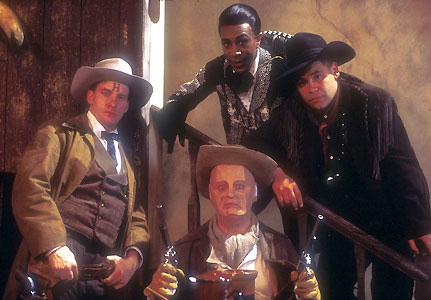
Did you know that Red Dwarf won an Emmy Award? It did, an International Emmy in 1994, for this episode. Gunmen of the Apocalypse was filmed on location in a replica Wild West town erected in, er, Kent and it's clear that both the writers and actors fell in love with the concept. The episode sees the Wild West town stand in as the personification of Kryten's mind as it is invaded by a computer virus. The crew take on new personas thanks to a VR game and enter his mind to fight the virus, which takes the form of the Four Horsemen of the Apocalypse, here re-conceptualised as Wild West gunfighters.

The whole thing is massively high concept but works well, with some fantastic lines, comic timing and possibly the best musical score ever written for the series.


Thanks for the Memory
Season 2, Episode 3
Thanks for the Memory may be the most melancholy episode of Red Dwarf ever made. Feeling sorry for Rimmer on the anniversary of his death, after Rimmer drunkenly confesses he's never been in love, Lister decides to gift him the memory of the love of his life. It's an act of kindness which, of course, backfires.

The episode works because it has a central, genuinely SF idea that is explored in an interesting manner (namely memory transferal and the question of whether memories are what defines us, recently the focus of Altered Carbon) and the story explores the characters of both Lister and Rimmer in intelligence and depth. A criticism of the series is that the writers found Rimmer such a rich source of humour and story that they sometimes left the other characters out in the cold, including our ostensible hero Lister, but this episode works well in telling us more about Lister and the mistakes he's made in his own life. The result is one of Red Dwarf's finest hours, being emotionally affecting as well as very funny.


Marooned
Season 3, Episode 2

With the third season of Red Dwarf running rather expensive, Doug Naylor and Rob Grant decided to write a tight bottle-episode focusing on Lister and Rimmer after their ship, Starbug, crash-lands on an ice moon. With supplies running low (Lister being forced to choose between a Pot Noodle and a tin of dog food and is genuinely wracked by the decision), the two are forced to resort to desperate measures to survive. We learn more about the two characters than ever before and the episode is unusual in making Lister a bit more at fault than Rimmer. Rimmer is also shown for the first time to have a laudable sense of honour (even if it takes a lot to kick it into action).

Marooned is hilarious and Barrie and Charles have often mooted taking it on the road as a two-man play. Possibly Red Dwarf's best-written half-hour and an unmissable episode.


Polymorph
Season 3, Episode 3
One of Red Dwarf's strictest rules is that there are no aliens. Everything that appears in the show has to be human or made by humans. That means no ravaging monsters. Or at least it didn't, until the writers hit on the idea of GELFs (Genetically-Engineered Life Forms), human-created creatures which, invariably, had broken free of human control and turned in to raging maniacs. The shapeshifting polymorph, which also drains subjects of their negative emotions (turning Lister into a homicidal maniac, Cat into a bum and Rimmer into a vegan hipster) is the finest of these creatures. The crew set out to take on the creature in a mickey-take of Aliens that works fantastically well, resulting in some of the show's finest sight gags. This isn't Red Dwarf at its cleverest or deepest, but it may at it's just laugh-out-loud funniest.

Thank you for reading The Wertzone. To help me provide better content, please consider contributing to my Patreon page and other funding methods, which will also get you exclusive content weeks before it goes live on my blogs. SF&F Questions and The Cities of Fantasy series are debuting on my Patreon feed and you can read them there one month before being published on the Wertzone.

Happy 30th Birthday, RED DWARF!

Today marks the 30th anniversary of the airing of the very first episode of Red Dwarf, the world's longest-running science fiction comedy show. Set 3 million years in the future, Red Dwarf is the story of the last known human being alive, Dave Lister, a slovenly bum, and his friends and allies (and the officious, arrogant and borderline insane Arnold Rimmer, Lister's nemesis) as they explore deep space and occasionally try to get home.


Red Dwarf was created by writers Rob Grant and Doug Naylor in the mid-1980s. Grant and Naylor had been writing together for years, working as writers on satirical puppet show Spitting Image and on radio shows such as Son of Cliche. On Son of Cliche they created a character named "Dave Hollins, Space Cadet", an Earthman who gets stuck millions of years in the future with only a senile computer for company. They developed and expanded the concept, re-titling it Red Dwarf, and trying to sell it to the BBC or Channel 4.

They initially had a cool reception: the BBC was trying to shut down Doctor Who, feeling the show had run its course (they succeeded, if only temporarily, in 1989), and was fiercely resisting making another SF show. There wasn't much interest from other quarters. The show was only finally greenlit after influential producer Paul Jackson - who had produced the massive hit shows The Two Ronnies, Three of a Kind and The Young Ones - took on the project and championed it.

Despite this success, the show was assigned a tiny budget that badly affected Grant and Naylor's casting choices. They'd originally wanted Alfred Molina to play Lister and Alan Rickman Rimmer, but with less money to hand they settled on "punk poet" Craig Charles and one of their voiceover funnymen from Spitting Image, Chris Barrie. Dancer Danny John-Jules and stand-up comedian Norman Lovett completed the cast, place a humanoid descended from Lister's pet cat and the ship's super-advanced AI Holly, respectively. Given their original casting choices had all been white, Naylor and Grant had ended up with a cast that was 50% black, which came in for some bizarre criticism in the British press at the time. The show also had no regular female characters, although this was the point: later episodes established that the absence of any women on board would contribute to the crew's growing list of neuroses and bizarre tics. The show wouldn't gain a recurring female character until Season 3, when Hattie Hayridge took over from Norman Lovett as Holly (who could change his/her appearance at will), and then the addition of Chloe Annett as Kochanski in Seasons 7 and 8.

Red Dwarf debuted on 15 February 1988 to largely indifferent ratings, but a surprisingly strong critical response. In fact, the first episode of Red Dwarf - the ironically titled The End - attracted the highest Audience Appreciation Index response since the Queen's Coronation in 1952! The rest of the first season was patchy, with the terrible budget and awful sets letting the show down even when the gags were pretty funny.

The cast of Red Dwarf in the first episode, which aired thirty years ago today: Danny John-Jules as Cat, Chris Barrie as Rimmer and Craig Charles as Lister.

Season 2 followed later the same year, and saw a slight budget increase that allowed for location filming and some pretty good model work. Grant and Naylor also adjusted their writing style. Having been influenced by Alien and Silent Running, they liked the idea of nailing the isolation of the characters. They built episodes around the idea of loneliness and also around Rimmer's tragic backstory (which they were careful to ensure made the character more understandable, not magically more likeable). The second season was vastly superior to the first and ensured that a third season was commissioned. Naylor and Grant took more direct control as producers and were able to assign the budget more carefully, making it look like the series had been given a much bigger budget increase between seasons than was really the case. Season 3 had a faster pace, more location shooting, more elaborate visual effects, all-new sets and the addition of a new character, service mechanoid Kryten, played with scene-stealing relish by Robert Llewellyn.

It was at this point that Red Dwarf became a breakout, smash-hit success. Seasons 3-6 (airing from 1990 to 1993) saw a very high, consistent run of quality, with some remarkable effects and character work. The show benefited from Naylor's decision to include more actual science in the show, with it riffing on quantum science, nanotechnology, artificial intelligence, virtual reality, parallel universes, alternate timelines and other cutting-edge ideas. Ratings were huge, breaking records for a show airing on BBC-2, and the critical acclaim was immense. Grant and Naylor co-wrote two bestselling novels based on the series, Infinity Welcomes Careful Drivers and Better Than Life, and discussions over a feature film began. The show's future appeared bright.

Then the show was rocked by two major problems. First off, Craig Charles was arrested on serious criminal charges. Although these charges were later dropped and he was fully exonerated, they took over three years to fully resolve. During this time Rob Grant also quit the show. He felt that the potential of the premise had been exhausted and he wanted to try other projects, including writing novels. Doug Naylor was left to take the reigns himself. With Charles's problems resolved, Seasons 7 and 8 were finally shot and aired in 1997 and 1999. Season 8 won the show's highest ratings of all time, smashing BBC-2's highest ratings recorded up to that time. However, Seasons 7 and 8 only got a lacklustre critical reception, with many viewers feeling that the show had run out of ideas and was badly missing Grant's input, who was much better at character whilst Naylor was more the ideas man.

Then the show disappeared for eleven years.

Chris Barrie as Rimmer, Craig Charles as Lister, Robert Llewellyn as Kryten and Danny John-Jules as Cat in Red Dwarf XII, which aired in 2017.

Doug Naylor had made a decision that Red Dwarf belonged on the big screen and dedicated the next decade of his life trying to get the show into cinemas. Scripts were written and rewritten, investors were lined up (only to pull out). Several times the film got within weeks of entering production only to fall apart at the last minute. Frustrated and annoyed, Naylor finally got the show back on the air in 2009, writing and producing a three-part mini-series for the BBC-owned cable channel Dave called Back to Earth (since retconned as Season 9). It was not well-received, but did get enormous ratings. These paved the way for a return of the series in full, resulting in Seasons 10 (2012), 11 (2016) and 12 (2017), all of which had a positive critical reception, as well as setting records for the Dave cable channel. A thirteenth season is now in the planning stages.

Red Dwarf's appeal has largely been down to the everyman factor, putting blue-collar workers in space who don't know anything about quantum entanglement or slipstream drives, they're just there to keep things ticking over. The show also mixes quite advanced gags about science with very basic gags about bodily secretions, as well punching a hole through the po-faced nature of science fiction. Kryten's quest to become human and learning about human concepts is treated dubiously by the rest of the crew (resulting in the memorable line, "Knock off the Star Trek crap, it's too early in the morning") and then given a very amusing resolution, when he actually becomes human for an episode and is so horrified by having to manage a penis ("Is that the best design someone could come up? The 'last chicken in the shop' look?") that he elects to become a mechanoid again ASAP.

The early appeal also came down to the mixture of laughs and tragedy, pathos and comedy, particularly in the character of Rimmer and in Lister's loneliness which he only manages to surmount by devoting every waking hour to winding Rimmer up. Red Dwarf is a sitcom but one with tremendous and maybe unparalleled characterisation.

There's also something admirable about the show in how it refuses to die. Seasons 2-6 were inarguably the show's golden period and it's been variable ever since Rob Grant left (reaching a nadir in Season 9 but then recovering strongly since then), but it constantly explores new SF ideas and finds new angles with which to approach the universe and the characters. It also helps that the actors were mosty in their twenties when the show started; the transition of these young twenty-something men into middle-aged and slightly world-weary fifty-somethings has felt very natural, helped by the fact they have pretty good genes. I can see these guys still exploring deep space and finding fun ways of doing so in another ten years. The show's long hiatuses, resulting in only 12 seasons in 30 years, have also helped in building up anticipating for the show's return and in giving the writers more time to come up with new ideas.

Red Dwarf is one of science fiction TV's great survivors, being funny, dramatic and human as required. Here's to many more years of exploring the final, smeggiest frontier.

Friday, 17 November 2017

Red Dwarf XII

The mining ship Red Dwarf continues on its long quest to return home, its dysfunctional crew consisting of the last human being alive, a hologram of his superior officer, a neurotic cleaning droid and a lifeform descended from the ship's cat.


In 2018 Red Dwarf will celebrate its thirtieth anniversary, making it comfortably the longest-running SF comedy show of all time (and one of the longest-running SF shows full stop, with only Doctor Who and Star Trek now outliving it). There are several reasons for its longevity: a core cast of four charismatic performers, a strong sense of humour that riffs on both human nature and cutting-edge scientific ideas and multi-year breaks between seasons that allow both the cast and writers to refresh themselves and come back with renewed energy. So whilst the show started thirty years ago, it's only now concluding its twelfth season.

The twelfth season is of a pair with last year's eleventh, written and filmed alongside it and recorded at the same time. This raised the spectre that writer Doug Naylor (alas, co-creator and co-writer of the show's golden age Rob Grant remains absent) might be burned out or tired, but this is not the case. Season 12 is, if anything, slightly better than Season 11, with fewer weaker moments and some much funnier moments rooted in both character (always Naylor's weak spot compared to Grant) and SF.

The season starts off well with Cured, which asks the question if people can be "cured" of evil and results in a classic Red Dwarf story beat where Lister jams on electric guitar with a "good" clone of Adolf Hitler. Siliconia, where Kryten is "rescued" from slavery by fellow mechanoids, is a bit throwaway but does have some great sight gags and does lean into the SF trope of the "happy slave" who is programmed to enjoy their treatment (something it'd be interested to see Star Wars address at some point).

The season's weakest episode is Timewave, set on a ship where criticism has been outlawed, which isn't as funny as it wants to be and has some very lazy gags. Mechocracy, in which the machines on Red Dwarf go on strike and Rimmer and Kryten stage an election to win back their loyalty, is solid if forgettable.

The season saves the best for last: M-Corp is a satirical take on Apple which could have felt lazy but actually steps up to being amusing and also makes some nice, intelligent points about (literally) blind brand loyalty and giving corporations ownership of everything. Skipper, the best episode of the season and possibly the last six seasons, taps into the well of Rimmer's self-loathing and disappointment in a way that hasn't been done since Grant was still on board. Although the episode suffers from some continuity issues (the show apparently forgetting that the events of Seasons 7 and 8 happened, and the existence of Ace Rimmer), it is extremely funny and brings back some fan-favourite characters without overusing them to boot.

The cast are a well-oiled machine at this point, the guest stars do a good job (although Johnny Vegas's guest appearance feels a bit incongruous) and the show does a lot with what is clearly a limited budget, a "problem" which I suspect has resulted in the show's improved quality since the relatively high-budget days of Seasons 7-9, since it forces a reliance on better dialogue and ideas rather than flashy visual effects.

For a TV show about to enter its fourth decade, Red Dwarf (****) is in surprisingly rude health. Superior to the previous two seasons (which were okay, if not outstanding) and certainly far better than the three weak seasons before that, the twelfth season of the show sees it getting back to, if not its best, certainly not far off. The season will be available from 21 November 2017 on Blu-Ray (UK, USA) and DVD (UK, USA).

Saturday, 29 October 2016

Red Dwarf XI

The mining ship Red Dwarf, lost in deep space for three million years, is continuing its long voyage home. The four-man (well, one-man, one-hologram, one-android and one-bipedal-cat) crew continue to get into unusual scrapes as they seek to survive.


Red Dwarf began way back in 1988, making it easily the longest-running science fiction sitcom in history. Part of the show's success is its mixing of real SF ideas with funny gags and character development rooted in tragedy and pathos: Red Dwarf at its best is not afraid to make its audience feel sorry or even upset as it even makes them laugh.

Unfortunately, the more detailed characterisation and tragedy mostly left the show along with co-creator and writer Rob Grant after the sixth season. Since that time Red Dwarf has, under its other co-writer Doug Naylor, become a much more conventional sitcom with running gags, recurring characters and ideas and topical humour that may be outdated in a few years' time but raises a smile now.

This eleventh season airs four years after the tenth, itself a low-budget attempt to get the show back on the air via the UK cable channel Dave. That was very successful, hence a noticeable budget increase for this season with more visual effects, location filming and more elaborate sets. It's still a long way from the show at the height of its biggest success on the BBC at the end of the nineties (during the seventh and eighth seasons, when the humour risked taking a back seat to the spectacle), but it definitely frees the show up to open up the scale and employ some more highbrow and expensive ideas.

For the most part, it works. Without Grant or another more character-focused writer, the show is never going to be as good as it was back in its brilliant second through fifth seasons (and the only-marginally-weaker sixth), but we're also a long way from the more tedious episodes of the seventh through ninth seasons as well. Naylor seems to be writing within his limitations, knowing that what he's good at is channelling SF ideas for laughs. Some of these misfire - season opener Twentica hits a series of dud gags - but things rapidly improve from there. A vending droid is mistaken for a genius medical bot and is given the task of carrying out vital surgery, Kryten has a mid-life crisis and finds a way of communing with the universe, and - in easily the best episode of the entire series since Season 6 - Rimmer is promoted by a 3D-printed Space Corps officer and finally gets his dream job only for it to all go spectacularly wrong. There's also a couple of Cat-centric episodes which work pretty well.

Continuity is, as usual, treated as something optional, so there's no mention of the missing Kochanski or Holly, which will likely annoy some long-term fans, and the show is a little bit too eager to use simulants and GELFs again rather than creating some new concepts. But the cast is on fine form, even if their age is starting to tell, and even in its weaker moments the season remains firmly entertaining.

No, it's not the show at its best and some of its worst post-Grant indulgences do occasionally resurface, but the eleventh season of Red Dwarf (***½) is overall fun and watchable. It will be released on Blu-Ray (UK, USA) and DVD (UK, USA) in November. Season 12 has already been filmed, is currently in post-production and will air on Dave in mid-to-late 2017.