Tuesday, 14 July 2020

Wertzone Classics: Conflict Freespace: The Great War & The Silent Threat

AD 2335. The Galactic Terran Alliance (GTA) has been fighting a war against the Vasudan Empire for fourteen years. The war has taken its toll on both sides, but peace initiatives have not gained ground and both sides seem to be locked in a stalemate. Without warning, both sides are attacked by alien vessels belonging to a hitherto unknown species, quickly dubbed the "Shivans." The Shivans employ superior technology and seem to have no interest in gaining strategic or tactical advantages or seizing control of systems, only destroying everything in their path. With the Shivan fleet pressing in on the Vasudan homeworld and Earth, the humans and Vasudans reluctantly join forces to face the mutual threat.

Descent: FreeSpace – The Great War | Know Your Meme

The space combat video game genre enjoyed its heyday in the 1990s. Inspired by the original space simulator game, Elite (1984) and spearheaded by Wing Commander (1990), numerous games in the genre were released over the next decade. Arguably the best-received in terms of acclaim and sales was Star Wars: TIE Fighter (1994). A late challenger was Conflict Freespace: The Great War (Descent Freespace in the United States for various copyright reasons), released in 1998 by Volition, who, as Parallax, had created the Descent series of combat games.

Freespace chose an inauspicious moment to enter the genre, as its popularity had arguably just peaked and the developers had no experience in the field, but it proved a good move. At the time the game came out, many of its rivals (such as the X-wing series) had seemingly abandoned single-player narratives in favour of chasing a multiplayer audience, whilst the Wing Commander series has grown obsessed with elaborate cut scenes and full motion video starring Hollywood stars over actual gameplay. Freespace struck a chord with its visceral action, impressive game engine, fine sense of pacing and stripped-back presentation. Freespace has no lengthy animated sequences or cheesy videos packed with military cliches, instead presenting its story simply and matter-of-factly, and insisting on getting players into the action as soon as possible.

The game consists of 29 missions, each of which starts with a briefing. After the briefing your ship and weapons loadout are auto-selected, allowing you to join the action immediately. Veteran players can choose their craft and weapons to better suit their play style. During the game you can command fast, versatile (but fragile) scouts, hardier bombers and jack-of-all-trades fighters. The game is notable both for its unusually finely-tuned difficulty setting (with five rather than three settings, including a "very easy" mode that effectively allows you to sit back and just watch things unfold as your wingmen do everything for you) and for its unusually strong AI, particularly that of your wingmen whom you can give very specific orders to (such as automatically fending off enemies targeting your fighter or targeting specific subsystems on an enemy capital ship). Part of the game's enduring appeal is this more strategic element, sometimes allowing you to stand off and observe a battle from afar and order your fighters on how to proceed.
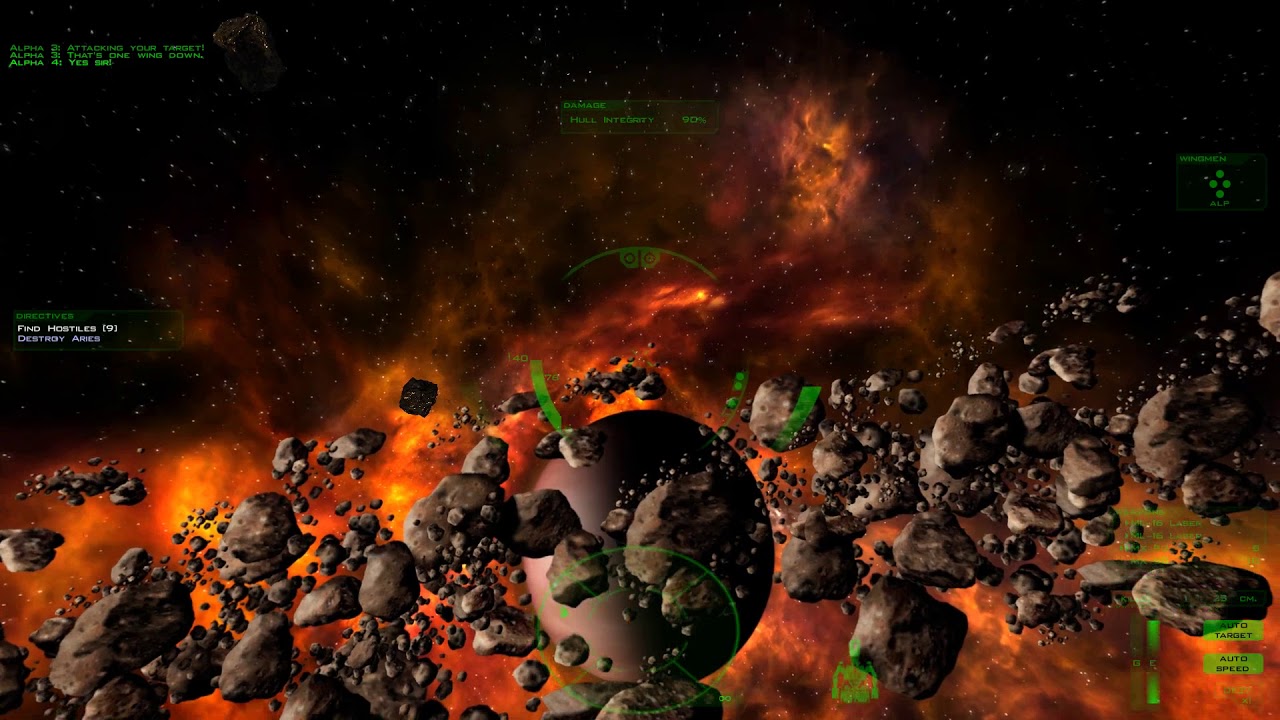
Freespace 1 The Great War - Freespace 2018 - YouTube

Much more fun, of course, is the up-close and personal dogfighting. Freespace has a robust flight model and, with modern versions of the game, excellently updated graphics which makes close-in space combat often joyous to behold. Matching speeds with enemies, executing an afterburner burn to break a missile lock and dropping velocity to keep an enemy in your sights is all well-handled and instinctive. It was great in 1998 and remains great in 2020.

The story unfolds over a lengthy campaign. The story isn't the most dynamic ever in the genre, but does a good job of keeping you engaged throughout. There's a nice XCOM-ish feel to early missions as the Terrans and Vasudans have to scavenge Shivan technology to match their superior shields and sensors, and later on the battles becoming increasingly large and desperate. It's not the most compelling SF narrative ever written, but does it job very well. Particularly interesting is the lack of exposition with regard to the Shivans, who remain a terrifying enigma right up to the end.

The original game is great, although it does have some technical drawbacks, particularly the lack of fully-voiced dialogue; more than once important plot information unfolds through on-screen text dialogue, which is easy to completely miss mid-battle.

After completing the main campaign, you can proceed on with the game's expansion, The Silent Threat. The modern version of the expansion includes 18 missions (all voiced this time), generally somewhat harder than in the original game, and with a much murkier and more original storyline. I must admit to enjoying this more than the original game, as it moves away from standard SF cliches a bit more.

Conflict: Freespace (****) and The Silent Threat (****½) are both joys to play in 2020, having, thanks to the dedicated and active modding community, aged and matured like a fine wine (see below). Even more importantly, they set the scene for Freespace 2, one of the best video games ever made.

Playing the Game: Playing games that are 22 years old can be a bit of an uphill experience, especially for a franchise that's never had an official remaster. Fortunately, that's not much of a problem; back in 2002 Volition released the source code for all three games in the series and that's allowed a very passionate modding community to continuously update them with new graphics, sound effects and voiceovers. The easiest way to play them is to get a copy of Freespace 2 from GoG, download and install the Knossos launcher, and, once that's done and found your copy of the installed game, you can then select which mods to use. The ones you really want to install are Freespace Port (which adds the original campaign), Freespace Port MedivaVPs (which updates all the graphics and sounds), Silent Threat: Reborn (which adds the latest version of the expansion campaign) and MediaVPs (which updates the Freespace 2 campaign with all the latest material). Then you're good to go.

As a bonus, there are also dozens of fan-made mods for the game, including ones for well-known franchises like Babylon 5 and Battlestar Galactica, as well as a fan-made new game in the Wing Commander franchise. There are also numerous mods which expand on the Freespace and Freespace 2 storyline.

Desperados III

The Old West, 1870. Bounty hunter John Cooper is hunting down Frank, a notorious outlaw who killed his father. Frank is in bed with the DeVitt Railroad Corporation, and thus is protected by wealth and power. Cooper joins forces with a group of disparate allies who each have their own reasons for taking on these formidable enemies. They have to work together and make the most use of their skills to win the day.


Back in 2016, Mimimi Games came out nowhere to deliver Shadow Tactics: Blades of the Shogun. A stealth tactics game built around achieving at times impossible-seeming objectives with a limited team of characters. It was unexpectedly genius and emerged as my favourite game of the year. It was a game that wore its influences pretty openly: the Commandos series from the late 1990s but, possibly even more overtly, the Desperados series from the early 2000s. Focus Interactive, who had the Desperados IP, hit on the idea of hiring Mimimi to make a prequel to those games (to not put off newcomers to the series) using the Shogun engine. It was a match made in heaven.

Fortunately, this partnership delivers in spades. Desperados III wears two hats, as an actual continuation of the Desperados series and also as a semi-sequel to Blades of the Shogun. It fulfils both objectives admirably.

The game consists of sixteen missions, each taking place on a massive (and I do mean massive) map filled with enemies. You have between 1 and 5 characters, each with their own distinctive personality and set of skills, equipment and objectives. The aim of the game is stealth: you have to reach an objective by avoiding guards. You can try to sneak past them or pick them off one-by-one. Whilst your characters are capable fighters, they are very easily overwhelmed, so the aim of the game is to keep as low a profile as possible. You can also knock guards (or well-meaning civilians who'll raise the alarm if they spot you somewhere you shouldn't be) out if the idea of mass slaughter is unpalatable, but doing so is time-consuming and you risk detection.


There is some cleverness to the game. One of your characters can whistle to lure unsuspecting guards into ambushes, or one of your female gunfighters can put on a disguise and lure enemies to their doom, but more disciplined enemies will ignore such distractions, forcing you to be more creative in how you handle the situation. An optional mode allows you to pause the game to set up actions for your characters to execute simultaneously, a good way of taking out two guards who are permanently in each other's field of view.

Desperados III adds guns to the Blades of the Shogun mix and encourages a somewhat more aggressive style of play throughout. Each gun as a noise area which will alert guards in that zone, so you can be surprisingly aggressive in taking on enemies as long as you are also careful of what the consequences might be. Your sniper character - Dr. McCoy - is decidedly powerful in taking out enemies on watchtowers (whose disappearances tend to be easily missed by their comrades), but he is limited by ammo.

The decidedly semi-realistic tone of the game takes a turn for the weird just before the halfway mark when you recruit a character who can use actual voodoo magic, including seizing control of an enemy's mind or "linking" two characters together so whatever happens to one, happens to both. This feels a bit weird (and even overpowered) when it first appears, but it later gives rise to some of the game's most inventive puzzles and challenges, so it's fair enough. Some of the moves you can pull off with Isabella (and her pet cat) will have the player giggling like a buffoon.


Desperados III succeeds through its magnificent level design, which is often jaw-dropping. It's not uncommon, especially in the back half of the game, to be confronted by a mission that appears flat-out impossible, until you find that one guard who goes out of everyone else's eyeline for a few seconds, which then causes the map to start unravelling lot a knot. Each mission is systemic rather than prescriptive, though; it's completely up to you which tactics and abilities you use to achieve each objective. There's some excellent videos of the game developers being taken by surprise by some of the solutions that players have come up with to puzzles. There's also a splendid mission post-mortem screen which takes you (fairly quickly) step-by-step through the mission you just completed, showing how it unfolded without the several dozen quicksaves and quickloads you likely went through in the process.

The story is a fairly serviceable revenge narrative, but there's some nice character beats dropped on top of that (such as grumpy McCoy's gradual, reluctant acceptance into the team). At sixteen missions taking about 35 hours to complete, the game also hits a sweet spot of not being too long whilst not outstaying its welcome. In a welcome move, the game adds a bunch of optional missions at the end of the game which take place on the existing maps, but adds new enemies and puzzles, or allows you to use characters who weren't available earlier on in the game. More of these missions will be dynamically added in free updates over the coming months.

I'm not sure if there's any flaws of note in the game. It does share Shogun's occasional confusion on what you're trying to get a character to do, such as thinking you're trying to get a character to climb a wall rather than hide in the shadows next to it, but these occasions were much reduced from the first games. Hardcore Desperados fans may also grumble about the lack of utility for horses. In the original games you can ride horses (sometimes using them to reach inaccessible ledges), release them from the stables to cause a distraction or come up with other creative ideas; in this came the only thing you can do with them is spook them to kicking someone standing next to them.

Overall, Desperados III (*****) is compelling, incredibly smart, fiendishly clever and ridiculously addictive as it forces you to overcome its challenges on each mission. It is available now on PC, PlayStation 4 and X-Box One.

Friday, 10 July 2020

Valve tease next-generation HALF-LIFE game

Valve recently released Half-Life: Alyx, an interquel in their popular Half-Life video game series, set between Half-Life and Half-Life 2. The VR-only title was very successful (considering the small potential audience) and its cliffhanger ending, which revisited that of Half-Life 2: Episode Two, suggested that a proper Half-Life 3 was finally in the offing.


A new documentary about the making of the game, The Final Hours of Half-Life: Alyx, expands on Valve's activities since the release of their last big single-player game Portal 2 in 2011, and popular online arena game Dota 2 in 2013. The documentary confirms at least six different iterations of Half-Life 3 were prototyped and abandoned, as well as a Left 4 Dead 3 and an open-world Left 4 Dead game that would revamp the entire series. An action-RPG to compete with the likes of Skyrim was at one point considered, as well as a number of VR games.

The documentary chronicles Valve's infamously open and relaxed approach to project development. Since Valve own Steam, the most popular and successful PC digital storefront in the world with annual revenue in the billions, they don't actually have to release games to remain solvent. After Dota 2's release, the company also become more interested in hardware, leading to some interesting ideas which ended up not being hugely successful (like Steam PCs and Steam controllers) and some other areas which did work out better (particularly VR tech). Most interesting is the acknowledgement by Valve that their "open development" environment may have been fun, but it was also extremely frustrating. Eventually the company decided to focus back onto the Half-Life franchise, leading to Alyx.

A key point in the documentary is Valve confirming that they are no longer "afraid" of the legacy of Half-Life and now want to make a full-scale Half-Life sequel for next-generation consoles (and PC, presumably). Slightly surprising is that Valve may have to scale up to do this; their recent projects have been generally smaller in scope, so they don't actually have the battery of artists, programmers and coders that making an actual Half-Life 3 would require. Even Alyx was made somewhat on the low-down, re-purposing assets from other games and featuring significantly less action and enemies than a "proper" game would require. But obviously Valve have the resources to do this pretty much at will.

This isn't confirmation that Half-Life 3 has been greenlit, but it is a statement of intent by a company that seems to finally be waking up. And it'd be nice to get a new Half-Life game that non-VRheads can play before Half-Life 2's twentieth anniversary in November 2024.

Thursday, 9 July 2020

Watchmen: The Limited Series

Tulsa, Oklahoma, 2019. A white supremacist group, the Seventh Kavalry, is fighting a long-running battle with the Tulsa Police Department. To protect their identities after several of their number were assassinated, the police have been given special dispensation to hide their identities under masks; the Kavalry likewise hide themselves under masks based on that of the vigilante Rorschach. Police officer Angela Abar, who goes by the nickname Sister Night, is tasked with helping flush out the Kavalry and receives assistance from Jean Smart, formerly known as Silk Spectre, now an FBI agent. Meanwhile, Adrian Veidt, formerly Ozymandias, "the smartest man in the world" who may be also its greatest mass-murderer, finds himself trapped in the strangest puzzle box ever devised.


When it was announced that HBO was proceeding with a TV series based on the classic Alan Moore/Dave Gibbons graphic novel Watchmen, there was widespread scepticism. The previous film version of the novel (only released in 2009) was not particularly accomplished but was adequate, raising the question of if a further adaptation was necessary. The TV show, however, quickly hewed in a different direction, becoming more of a thematic sequel to the comic book and being set more than thirty years after its events.

The TV mini-series (which started as a regular series but was converted into a mini-series when the production team expressed doubt about returning) has ended up being, somewhat surprisingly, a qualified success. Damon Lindelof and his writers have crafted a new story which at first glance feels only tangentially connected to the original, but as the episodes pass it becomes more and more deeply entwined with the events of the original graphic novel and ends up being a strong continuation.

In the original graphic novel, Alan Moore (who was, as is his custom, not involved in this new project) created Rorschach as an exploration of what a vigilante without any oversight would end up being like in the "real world." Rorschach ended up giving his life for his belief that the people deserve to know the truth about what really happened in New York City and his message did get out in his journal...which was promptly dismissed as the tinfoil ramblings of a lunatic. Conspiracy theorists have gotten hold of his journal and used it to further their own insane agendas, further discrediting Rorschach's story, although we (as viewers) know it was completely true.

The tie-ins with the original series take a back seat for the first three episodes or so, which focus more on Sister Night and the Tulsa Police Department fighting the Seventh Kavalry. This is a pretty good story on its own merits, propelled by excellent performances from Regina King, Don Johnson, Tim Blake Nelson, Yahya Abdul-Mateen II and Louis Gossett Jr., and examines themes of racial inequality, bigotry driven by externalisation and police authoritarianism. As the story unfolds we also spend time with a mysterious character played by Jeremy Irons relaxing at a country house with some servants, which feels like a huge non-sequitur until the stories begin converging.

In the second half of the series the Kavalry storyline dovetails back into elements of the original Watchmen narrative, as we learn more about the backstory of the Minutemen and also what happened to Dr. Manhattan after the events of the original series, culminating in the episode A God Walks into Abar, easily the season's strongest episode and a callback to the original comic sequence where we see Dr. Manhattan's creation. Events culminate in a grand finale which feels distinctly true to the story's comic book roots, even down to the somewhat ambiguous ending.

Watchmen (the TV show) is a reasonably strong and effective work. It is clearly the work of the more restrained and thoughtful Lindelof who worked on The Leftovers rather than the self-indulgent and trite one who worked on Prometheus and J.J. Abrams' Star Trek films. The tone of the series walks a careful line - not dissimilar to the original comic book - of developing weightier themes and ideas whilst also remembering that it is a comic book story, with a more colourful ending. In this sense it is both a deconstruction and a celebration of comic books, rather than a cynical deconstruction alone (as Amazon's recent series The Boys is). Threading this particularly needle is not easy and it's impressive the show ends up as accomplished and well-judged as it is.

There are a few problems, particularly with character set up. It feels like the Lady Trieu storyline was not set up well enough in earlier episodes, meaning it feels a bit odd when this story assumes prominence towards the endgame. The Veidt story is entertaining on its own merits, but its psychotic comedy of English manners feels tonally disjointed compared to the rest of the series, but overall it adds variety to the story.

The Watchmen TV series (****½) (which feels like now it should really have been given a distinct title) is accomplished television. It's superbly well-acted, mostly well-written and manages the difficult balancing act of introducing new elements to this world whilst also picking up on story elements left behind from the original and addressing them. Combined with a haunting score by Trent Reznor and Atticus Ross, it makes for impressive viewing. The series is available now in the UK and USA, as well on HBO's streaming services in the United States.

Wednesday, 8 July 2020

THE LAST KINGDOM renewed for a fifth season

The Last Kingdom has been renewed by Netflix for a fifth season.


Lead actor Alexander Dreymon broke the news to his fellow castmembers via several video chats. Understandably, they were very excited by the news. It's also a great sign from Netflix in the success of the series; Netflix has a habit of cancelling shows after two seasons, so for Netflix to pick up the series for a third season with them (they took over production from the BBC in Season 3) is a confidence booster that the show - expected to last for six or seven seasons in total - will go all the way.

The fifth season is expected to adapt the ninth and tenth books in Bernard Cornwell's novel series, Warriors of the Storm and The Flame Bearer, although the TV series has become an increasingly loose adaptation of the books as it has continued.

The thirteenth and final novel in the series, War Lord, will also be published on 15 October this year.


Thursday, 2 July 2020

FALLOUT TV series in development at Amazon with WESTWORLD creative team

Amazon Prime Television has added another show to its increasingly-crowded roster of science fiction and fantasy projects. Jonathan Nolan and Lisa Joy, the creators and showrunners of Westworld for HBO, are developing a Fallout TV series, based on the best-selling video game series.


Nolan and Joy's Kilter Films is developing the project Amazon Studios with a go-clause in the contract, meaning that there will be no pilot phase and a full first season would be commissioned automatically based on the strength of the scripts.

Based on Nolan and Joy's statement, they claim to be fans of the Fallout video game series and are working with the current licence holders at Bethesda Game Studios on script and story ideas. The project has been in the planning stages for several years already.

Nolan and Joy are also in pre-production - pandemic permitting - on both a fourth season of Westworld at HBO and a mini-series based on William Gibson's novel The Peripheral for Amazon.

The Fallout video game series is set in a parallel universe where the transistor was not invented until the 21st Century, leading to a futuristic society that much more closely resembled the classic SF aesthetics of the 1950s. This society then destroyed itself in a nuclear war between the United States and China in 2077. The video games, set between 25 and 210 years later, depict the rebuilding of this world and the emergence of new factions, ideologies and nations who struggle to come out on top.

The series launched with Fallout (1997) and Fallout 2 (1998), both developed by Black Isle Studios, the internal RPG division at Interplay. The series was conceived as a spiritual successor to an earlier game, Wasteland (1988), when they could not secure the IP rights to that game. Two spin-off games, Fallout Tactics (2001) and Fallout: Brotherhood of Steel (2004), followed from Interplay. Facing bankruptcy, Interplay sold the Fallout IP to Bethesda, who developed and published Fallout 3 (2008). Much of the original Black Isle team had reconstituted as Obsidian Entertainment, who were then contracted by Bethesda to produce Fallout: New Vegas (2010). Bethesda themselves then developed Fallout 4 (2015) and Fallout 76 (2018), a multiplayer spin-off the series which launched to highly negative reviews but recently had something of a rehabilitation thanks to the Wastelanders expansion and relaunch (2020).

To date, the Fallout video game series is estimated to have sold over 60 million copies worldwide, almost half of which are attributable to the success of Fallout 4  by itself.

Wednesday, 1 July 2020

Sales of THE WITCHER books pass 15 million

Based on publicity information released by Gollancz, the Witcher books by Andrzej Sapkowski have now passed 15 million worldwide sales.


The previous available figure indicated that the series had sold around 6 million copies by the middle of last decade. The massive jump in sales in just a few years is down to two factors: the immense success of the Witcher video game trilogy by CD Projekt Red (the last of which has now sold around 30 million copies by itself) and the success of the Netflix television series based on the books, which debuted last December. As we saw with Game of Thrones on HBO, a successful and well-received TV adaptation can massively drive sales of the books; the Song of Ice and Fire novels sold 9 million copies in 2012 alone and have sold around 80 million extra copies since the TV show debuted in 2011. Whether The Witcher can match those kind of sales remains to be seen.

The first Witcher book - also called The Witcher - was published in 1990 and was a collection of short stories. It was later revised and reissued in 1993 as The Last Wish. A second story collection, Sword of Destiny, was released in 1992. The five-volume "proper" novel series followed: Blood of Elves (1994), Time of Contempt (1995), Baptism of Fire (1996), The Tower of the Swallow (1997) and The Lady of the Lake (1999). A stand-alone prequel, Season of Storms, followed in 2013.

STAR TREK: LOWER DECKS gets airdate

The latest Star Trek series has gotten an airdate. Star Trek: Lower Decks launches on CBS All Access on 6 August 2020.


Lower Decks, which takes its name and premise from the Season 7 episode of Star Trek: The Next Generation of the same name, is the second animated series in the Star Trek franchise, following on from Star Trek: The Animated Series, which aired for two seasons in 1973-74. The series follows the crew of the California-class USS Cerritos in the year 2380, just after the events of the film Star Trek: Nemesis. The series will focus more on the junior crew of the starship, the crewmen in at the deep end in dealing with crises whilst the bridge crew make the important decisions.

The USS Cerritos is a "second contact" ship, whose job is following up on civilisations who have already had their more glamorous first contact with the Federation and working out trade deals, whether the newly-contacted civilisation wants to join the Federation and so on.

The show is expected to have a lighter and more humorous tone than the other Star Trek series. It will air on CBS All Access in the United States and CTV Sci-Fi Channel in Canada, but no European broadcaster has yet been announced.

Season 3 of Star Trek: Discovery is expected to arrive in the autumn. Production of the next batch of Star Trek shows - Season 2 of Star Trek: Picard, Season 1 of Section 13 and Season 1 of Strange New Worlds - are currently on hold due to the coronavirus pandemic. A further animated show aimed at a younger audience is also in co-development at Nickelodeon; it is unclear what stage of development this show is at.

Scott Lynch and Elizabeth Bear named in SFF misconduct allegations

Author Alexandra Rowland has accused fellow writers Scott Lynch and Elizabeth Bear (who are married) of abusing them, claims which they have vigorously denied. This story follows several other accusations of harassment in both the SFF lit field and in video gaming over the past two weeks.

This is a developing story and one facts are in some dispute. However, there has been enough discussion of it in the public sphere that at least a bald recounting of the events and claims is possible.


On Friday 26 June, author Alexandra Rowland wrote a blog post in which they accused fantasy author Scott Lynch and Elizabeth Bear, of abusing and grooming them for several years. Their full post can be read here. To summarise, Rowland contends that, in 2015 and at the age of 25 (twelve years younger than Lynch), they were propositioned by Lynch into having a relationship with him on the basis that he was talking his wife into having an open relationship. Rowland agreed but this subsequently triggered a series of hostile confrontations with Bear, who (in Rowland's contention) put the blame for the event on Rowland and not Lynch, and they subsequently walked away from the situation and cut all contact. Rowland also contends that this kind of problem has happened before with several other young writers (there have been several anonymous allegations of this type supporting Rowland's claim, but no other writer has come forward publicly).

Scott Lynch's initial response was angry and threatened legal action. A subsequent and more measured response rejected the claims in greater detail, although agreeing that he had a consensual relationship with Rowland with his wife's knowledge. Lynch rejected any notion of this being a pattern of behaviour on his part and he has had no contact with Rowland in three years.

Elizabeth Bear also gave a lengthy response (after Lynch's initial response but before his second) in which she categorised Rowland's behaviour as part of a pattern of inserting themselves, unwanted, into other people's spaces and not respecting boundaries. Writers CD Covington, Arkady Martine and Devin Singer provided some support for this assertion.

Writer Kurt Panakau also claimed that Rowland is acting in bad faith, and posted screenshots confirming a similar event happened with another married author three years before the Lynch relationship took place. It should be noted, of course, that bad things can happen to the same person twice. The other married author has not yet been identified.

An anonymous Twitter account provided support for Rowland's account of events, alleging that Lynch behaved towards the account-holder inappropriately at a convention.

Elizabeth Bear has further posted a claim that this issue has reignited long-standing Twitter feuds dating back a decade to previous clashes between SFF writers over other issues (particularly the RaceFail controversy of 2009-10), and anonymous accounts may be posting false information to further their own agenda and even scores. Other commentators have accused this of being deflection.

Many of the previous stories of abusive behaviour and taking advantage of power dynamics in the SFF field have had multiple witnesses and the alleged perpetrators have owned up to their own bad behaviour. This story is much more contentious and contended, and involves multiple allegations and denials on both sides, which is why I was more reluctant to cover it versus other allegations since the facts are in much more dispute. However, the story has become dominant in the SFF field in the last few days.

For my part, I have met Scott Lynch three times and Elizabeth Bear once (briefly on all occasions), and have had positive but brief online interactions with both. I have reviewed some of their books positively in the past. I had not heard of Alexandra Rowland prior to this story breaking.

Further developments are expected.

The Breadwinner

Kabul, Afghanistan. Parvana is an 11-year-old girl living in a city under the control of the Taliban. She helps her father sell his wares at the market every day, but when he is arrested and taken away Parvana is left as the family's sole breadwinner. Unable to go out on the streets alone and unescorted, she cuts off her hair and poses as a boy. As times become leaner, she is forced to work harder and take more risks to ensure her family's survival. To keep them entertained, she tells them stories of the distant past, when Afghanistan was part of Parthia and heroes fought elephant kings in order to protect their people.


The Breadwinner is a 2017 animated film from Irish studio Cartoon Saloon, based on the 2000 novel by Deborah Ellis. The film is set in the capital city of Afghanistan was it was still under Taliban control. This resulted in an oppressive atmosphere with informers on every street corner, limited food supplies and women forced to cover themselves from head to foot and not allowed out on the streets without a male relative accompanying them. The story asks a simple question: what happens when the sole male breadwinner for a family is arrested and taken away, leaving the women behind, effectively trapped in their house?

The result is a story that's both relevant to the time it was written in, but also timeless: the family's young daughter has to disguise herself as a boy, Aatish, in order to work to afford food and get water for her family. This results in both tension - Parvana is at constant risk of discovery - but also liberation. Parvana has spent much of her young life under Taliban rule, so the sudden freedom to go where she wants and do what she likes (within reason) is liberating, to the point of risking overconfidence.

As the film's main narrative unfolds, where Parvana tries to help her family and discover her father's ultimate fate, so too does a secondary story which Parvana is telling to her baby brother every night, the story of a young hero who seeks to confront the Elephant King who has stolen his village's crop seeds. Parvana finds herself drawing on the story for comfort and solace, as it teaches her resilience and fortitude even in the face of insurmountable odds.

The film uses two styles of animation, one for each narrative strand and both are impressive. The Elephant King story takes on a storybook tone, with the animation suggesting paper figures animated in a more fairy-tale quality, whilst the "real world" material is still stylised, but more realistic. The voice actors, most of them Afghan, are also excellent, selling a story which can be both grimly bleak but also optimistic for the future.

The film is also successful in depicting life under the Taliban with nuance: many people, even ostensible Taliban soldiers, are clearly doing what they are doing under coercion and fear and take no real joy in oppressing others, whilst others are bullies taking delight in being given the freedom to exert their brutal authority. Some fight against the system, a few openly and a few through some acts of kindness for others. The film does not extend into the post-2001 civil war period, so we never find out how Parvana's life changes after the Taliban in Kabul are driven out, but the film does sound several notes of hope that things will improve, at least in part for these characters.

Instead, The Breadwinner (*****) remains anchored firmly with the characters, showing them adapting to life under difficult circumstances and finding ways of surviving and finding hope. There are no easy answers, but there is optimism to be found here in the depiction of human courage. The film is available now in the UK and USA.