Thursday, 9 June 2022

Scott Lynch provides update on his GENTLEMAN BASTARD series

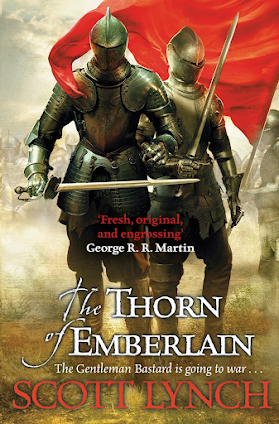
Scott Lynch has provided another update on his long-percolating Gentleman Bastard series, confirming progress on both the fourth novel and a number of long-promised novellas.


Lynch's series began with The Lies of Locke Lamora in 2006, a hugely successful debut fantasy novel that was marketed the first of seven books. It was immediately followed by Red Seas Under Red Skies in 2007. However, it was five years before the third book, The Republic of Thieves, finally hit shelves. Lynch confirmed in candid blog posts that he had been facing mental health issues which had delayed work on the series.

Lynch completed a draft of the fourth novel in the series, The Thorn of Emberlain, in 2019 (and shared a sneak peek at the map in 2016). However, additional health issues (presumably not helped by the pandemic) meant that progress on revisions proceeded very slowly. Lynch confirmed a year ago that he had switched to a new medication regime which seemed to be paying off, and was trying to speak more openly about his projects.

In today's update, Lynch confirmed that work on revising The Thorn of Emberlain continues and he hopes to have news on that front next month. In the meantime he has also completed the third of three Gentleman Bastard novellas which will serve as a nonessential bridge between The Republic of Thieves and The Thorn of Emberlain, the first exploring Locke and Jean's flight from the city of Karthain. The first novellas is as-yet untitled, but will be published by Subterranean Press before possibly seeing a wider release later on. The later novellas' titles have been known for a while, being The Mad Baron's Mechanical Attic and The Choir of Knives.

The Thorn of Emberlain is one of the most eagerly-awaited, long-gestating fantasy novels in the field, alongside George R.R. Martin's The Winds of Winter and Patrick Rothfuss's The Doors of Stone (both some eleven years in progress) and JV Jones's Endlords (twelve years). Both Martin and Jones have provided significant recent updates on making good progress, although the status of Rothfuss's novel remains unclear.

Tuesday, 7 June 2022

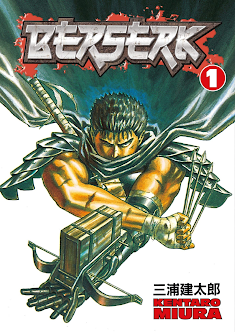
BERSERK to be completed by Kentaro Miura's lifelong friend and collaborator

It has been confirmed that the late Kentaro Miura's incomplete manga magnum opus, Berserk, is to be completed by his longtime friend and occasional collaborator Kouji Mori, working with his existing publishers and artists.


Miura wrote and largely drew 363 chapters of Berserk from 1989 until he passed away in 2021 at the far-too-young age of 54. These chapters had been assembled into 41 volumes (essentially, graphic novels). Miura had become infamous for his slow work rate and exacting perfectionism, sometimes going several years at a time without producing new material. This perfectionism had paid off, with more than 50 million sales making Berserk one of the biggest-selling manga series of all time.

Kouji Mori has known Miura since the age of 15 and the two had frequently discussed plans for their respective manga series. Mori is known for his own work in the field, with Holyland being particularly highly-praised and critically respected. Miura had divulged the full storyline of Berserk, including its ending, to Mori some years before his passing and told him he was the only other person to know how it ends.

Miura had also spent some years working with a team of artists at Studio Gaga in replicating his art style to help speed up his production rate. These artists will be working with Mori on the new chapters of the story.

Both Studio Gaga and Kouji Mori note they cannot hope to replicate Miura's writing and art style in full, but they hope to provide the next best thing and deliver an ending to the saga for the fans and dedicated to Miura's memory.

Monday, 6 June 2022

SANDMAN gets full trailer and release date

Netflix's adaptation of Neil Gaiman's The Sandman will hit screens on 5 August this year.

The trailer opens with Sandman/Morpheus/Dream (Tom Sturridge) intoning, "I am the King of Dreams, ruler of the Nightmare Realm." We then meet Johanna Constantine (Jenna Coleman), occult detective, as meets Mad Hettie and is told that the Sandman is coming. Johanna says he's a fairy story, but Hettie disagrees. Two police officers are then shown shooting open the Sandman's prison releasing him back into the world after more than a century of imprisonment.

Morpheus then returns to his realm, the Dreaming, where he meets his librarian Lucienne (Vivienne Acheampong), who warns him that the realm has gone to rot in his absence. We then briefly see a brace of characters: Death (Kirby  Howell-Baptiste), Desire (Mason Alexander Park), John Dee (David Thewlis) and The Corinthian (Boy Holbrook), who notes that "he's free, he's out of his cage." The trailer ends with Morpheus greeting a raven, who may or may not be Matthew (voiced by Patton Oswalt).

The show also stars Gwendoline Christie as Lucifer, Charles Dance as Roderick Burgess, Asim Chaudhry as Abel, Sanjeev Bhaskar as Cain, Donna Preston as Despair, Joely Richardson as Ethel Cripps, Kyo Ra as Rose Walker, Stephen Fry as Gilbert, Razane Jammal as Lyta Hall and Sandra James-Young as Unity Kincaid, with Mark Hamill as the voice of Merv Pumpkinhead.

Gaiman is co-writing the new adaptation and has also served as showrunner.

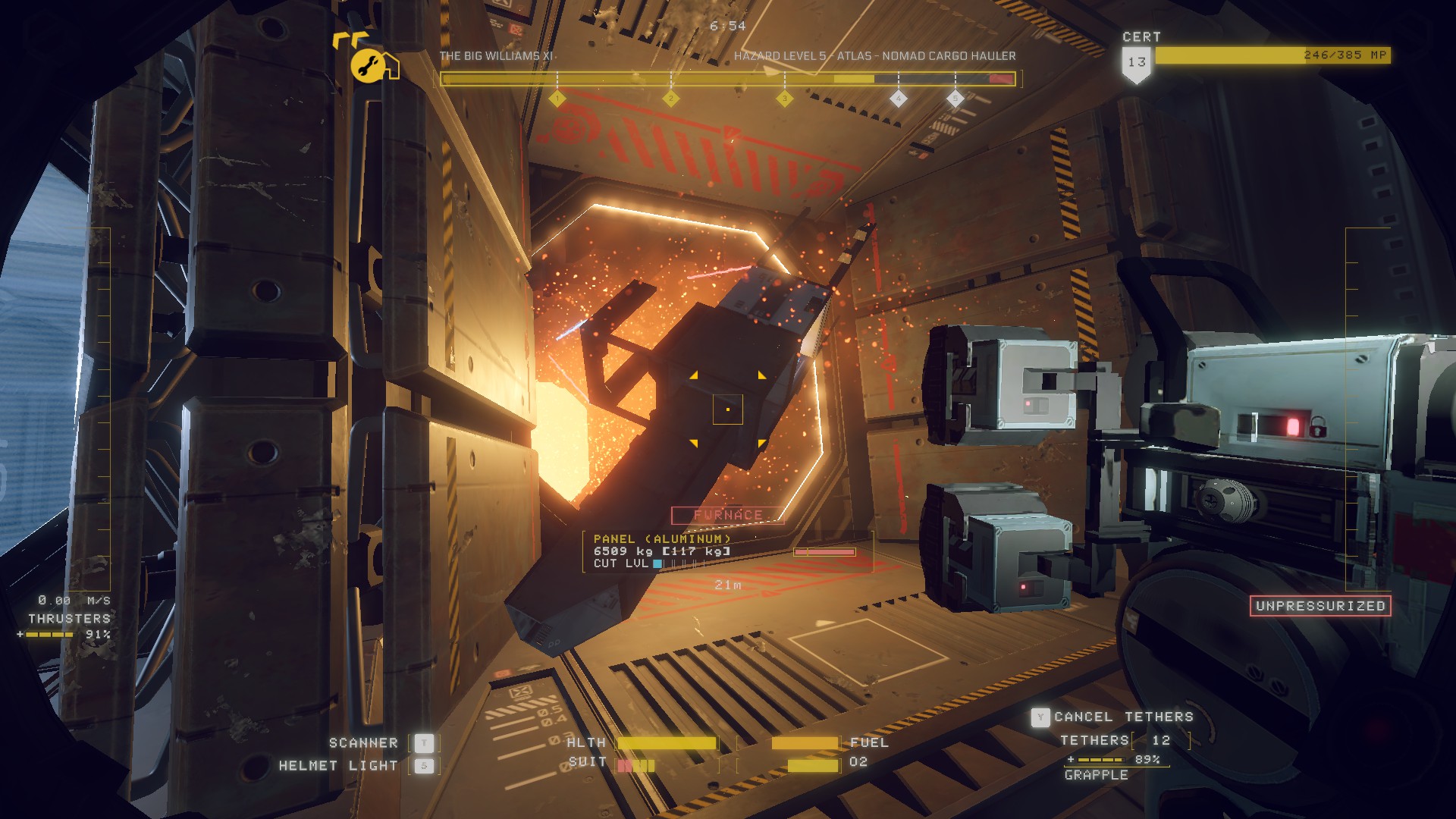
Hardspace: Shipbreaker

The 24th Century. Powerful mega-corporations send under-resourced workers into orbit to break up old starships and recycle them. It's gruelling, dangerous work but Lynx Corporation is happy to provide workers with equipment and even clone bodies to download into if they die on the job...for a fee, of course. New workers start more than a billion dollars in debt and have to drive down the debt through hard, risky labour. However, there may be another way of dealing with Lynx's ruthless profiteering.


Hardspace: Shipbreaker is the latest game in the growing "disassembly" genre. For the last decade or so, there's been a boom in games that allow you to build things, like Minecraft and Fallout 4's settlement building mode. But we've also had games that give you the ability to dismantle things. Teardown is a good example of that and, on a different scale, so is Unpacking. This is the first game where you get to dismantle spaceships, which is inherently cool.

It also helps that the game is made by Blackbird Interactive, the same team (as Blackbird and earlier at Relic) who made the Homeworld series of video games, which have some of the most incredibly-designed spacecraft ever seen in gaming. That skill carries over into Hardspace, with the spacecraft looking like they've come straight from the covers of 1970s and 1980s SF novels with artwork by the likes of Chris Foss and Peter Elson.
To start with, the ships you have to take apart are simple. They are unpowered and depressurised, so you can just pop the cockpit canopy or an airlock and start slicing them up quickly. Ship components and contents are divided into three categories: disposable items that get burned in the furnace, recyclable items that get sent into the processor and contents that can be used again as-is, which go in the collection barge. You have access to a gravity gun-like manipulation device which you can yeet things around with, and a laser cutter which you can use to cut connecting points or just slice things apart.

As the game continues you rapidly acquire more tools: tethers allow you to move large ship components that are too big for your manipulator, whilst demolition charges shatter ship hardpoints that your laser can't touch. However, ships get bigger and more complicated. A pressurised ship means you have to find a way of venting the atmosphere safely without destroying the contents (or yourself). A powered ship means safely removing the reactor without it going critical, and a ship with active fuel tanks means shutting down the flow of fuel through pipes (unless you want to blow the ship to smithereens with an ill-placed laser cut). Later ships may have still-active and dangerously-demented AI systems who do not appreciate being cut to pieces, or coolant systems that can freeze you solid if you are too cavalier with health and safety.
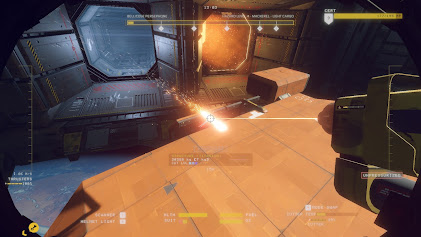
There are four ship classes, each with a huge number of modified variants, usually between cargo, passenger and research variants. Some ships are easy to start breaking apart from the outside in, like peeling a large metal banana that can travel at thousands of kilometres per second. Other ships are fiendish puzzle boxes that might explode if you set a foot wrong, requiring you to get into their depths and start carefully working your way outwards. 100%ing a ship with no losses is an amazing feeling, but the game is somewhat forgiving; blowing a ship apart accidentally is frustrating, but you can usually salvage enough debris to turn a profit.

On top of the simple act of demolishing ships, there's a strong storyline that permeates through the game in the form of video calls, emails and stern warnings from head office. The work you are doing is very dangerous and the company has complete call on your services. Fellow workers upset with this position have called for unionisation, alarming the company enough to send union-busters and new bosses to try to intimated people into staying in line. You have control over this storyline, since you can choose to join the union or keep your head down and keep working (you can even join the union and then sabotage it by refusing to join in strike action or keeping working properly instead of upsetting the union's plans).
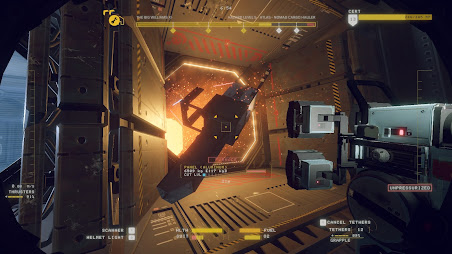
The narrative is not a huge amount of the game, turning up in odd voiceovers here and there, but it does feel timely with both the video game industry and many industries globally seeing a resurgence in labour rights debates and questions, with unions becoming a stronger force then they have been for some decades. It's unusual to see a game being so topical and raising questions worthy of debate.

But ultimately the game is about dismantling spaceships and it does that brilliantly. 3D movement in the vacuum of space, sending chunks of hull hurtling into the correct receptacle and correctly detonating a dozen charges in a way that breaks a ship apart just right are all satisfying. The UI is excellent, controls are responsive and solving a tricky puzzle in how to get a ship to break apart without exploding is immensely gratifying.
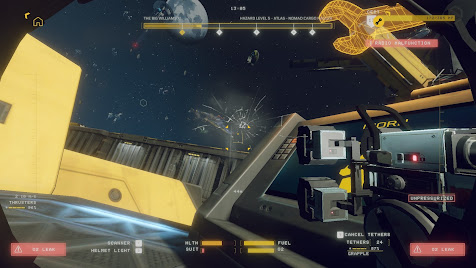
Problems do exist. Some controls feel like they could be spread out more: yeeting objects away from you with the gravity gun should be its own control rather than shared with breaking an object to ransack it for spare parts, as it's too easy to destroy an item you want to dispose of and too easy to dispose of an item you want to salvage. Tool modes can also change when you're not using them, meaning it's very easy to use the laser cutter's "wide beam" mode rather than its scalpel mode, sometimes with catastrophic results. Removing every last couch, computer terminal and light fitting from the larger ships can also start to feel like real work rather than fun, although clever cutters can come up with ingenious ways of dismantling ships around their furniture so it can be disposed of quickly and easily. The 15-minute shifts also feel a little restrictive after a while and some sort of overtime mode or upgrade extending them to 30 minutes could be a really good idea.

The problems are mostly minor and are overcome with experience. Hardspace: Shipbreaker (****½) is a superb game which has a great new idea and executes it extremely well. It is available now on PC and is coming to Xbox and PlayStation in the near future.
Sunday, 5 June 2022

Agents of SHIELD: Season 4

Having defeated the threat posed by the ancient Inhuman Hive, SHIELD is about to go public again. However, political and public discontent over the existence of the Inhumans continues to grow. The SHIELD team led by Agent Coulson have a new problem when they meet the mysterious entity known as Ghost Rider, and have to confront an enemy of their own making.


Season 4 of Agents of SHIELD acts as something of a reset of the show's premise. Although the Inhuman background story from Seasons 2 and 3 does continue into Season 4, most of the storylines that dominated the show's opening years have now been laid to rest and the season's focus is on new threats.

To accommodate the show's original airing schedule, the season is broken into three distinct arcs, each of which has its own subtitle and title card. The Ghost Rider arc takes up the first eight episodes and sees the SHIELD team first hunting down and then allying with Ghost Rider, in this case the Robbie Reyes incarnation of the character, to confront the threat of the Darkhold (which recently showed up in WandaVision and Doctor Strange and the Multiverse of Madness). SHIELD was, at least nominally, originally pitched as a slightly more grounded story that just happened to take place in the MCU, but the transition to having a guy walking around whose head is a flaming skull is surprisingly well-handled (helped by Gabriel Luna's splendid performance). By keeping this story down to a modest eight episodes rather than sprawling across all twenty-two episodes of the season, the showrunners keep things pacy and fresh, although the main villain is forgettable.

The transition to the "LMD" or "Robots" arc is also well-handled, although this seven-part arc is not as well-paced. There's a bit more wheel-spinning and the storyline, where the SHIELD team have to deal with an errant android they helped create, is so reminiscent of Avengers: Age of Ultron that it's even brought up a few times. It's fun, but a little wearying.

The final arc, also spanning seven episodes, is known as "Agents of Hydra" and sees the SHIELD team trapped in a VR simulation called the Framework, where Hydra won the war against SHIELD and now acts the enforcement arm of a totalitarian world government. They journey into a dystopian otherworld is surprisingly fun, helped by the show bringing back characters killed off years ago to create a new team of heroes. What I really wasn't expecting was how this storyline elevated Iain De Caestecker to the role of the show's MVP. He's always been a good actor and each season has given him more and more acting challenges that he's always risen to, but his role here as the outright villain is brilliantly played. The rest of the cast are on top form as well, but De Caestecker goes to the next level. Henry Simmons as Mack gets close in the season finale as well.

Season 4 of Agents of SHIELD (****) is easily the strongest to date. Splitting the season into three arcs improves pacing and the cast deliver excellent performances, especially Iain De Caestecker and the brilliant John Hannah, promoted to regular for this season. It's not a flawless season, with a few saggy episodes in the mid-running and the usually-reliable Zach McGowan not getting a lot to do beyond growl menacingly, but it finally delivers the promise that this show is a worthy part of the Marvel Cinematic Universe, even if it doesn't get the respect it deserves. The season is available now worldwide on Disney+.

Thank you for reading The Wertzone. To help me provide better content, please consider contributing to my Patreon page and other funding methods.

Friday, 3 June 2022

Sony's SPIDER-MAN games coming to PC

Sony's much-praised Spider-Man video games are making the transition to PC this year. Spider-Man launches on 12 August and will be followed by Miles Morales a couple of months later. Both will be the remastered editions designed to take advantage of superior modern hardware.

Spider-Man was released in 2018 on the PlayStation 4. Developed by Insomniac Games (best-known for the Spyro the Dragon, Ratchet & Clank and Resistance franchises), the game was a huge success. It was praised for its open-world depiction of New York City and freedom in allowing the player to go where they wanted whilst fulfilling typical Spider-Man goals like rescuing civilians and defeating villains. The game contains a main storyline revolving around the villainous Mr. Negative and various side-missions. The game was particularly praised for its web-slinging sense of movement.

Spider-Man was enormously successful, selling more than 33 million copies to become one of the biggest-selling individual games of its generation. A stand-alone expansion, Spider-Man: Miles Morales, was released in 2020. A sequel, Spider-Man 2, is in development for a planned 2023 release.

Spider-Man is the latest in a series of well-received ports of formerly PlayStation-exclusive titles to the PC, following on from Horizon: Zero Dawn, Days Gone, God of War and the forthcoming Uncharted: Legacy of Thieves collection. Sony have confirmed that income from these ports will exceed $300 million next year, making future ports to the PC platform a priority for the company. Fans are hoping that the Last of Us and earlier Uncharted games, Bloodborne, Demon's Souls and Ghost of Tsushima will follow.

Thursday, 2 June 2022

DRAGON AGE: DREADWOLF announced by BioWare

BioWare have confirmed that the next game in their Dragon Age series of fantasy CRPGs will be called Dreadwolf, but the game has no release date as yet.


Dreadwolf will be the fourth game in the series. It began with Dragon Age: Origins in 2009 and then continued with Dragon Age II (2011) and Dragon Age: Inquisition (2014). Set on the continent of Thedas, the games initially chronicled the invasion of the civilised lands by a monstrous race called the Darkspawn. Subsequent games have focused on political intrigue and the conflict between wizards and the world's religious orders. The games have spun off a number of novels and comics.

According to BioWare, Dreadwolf will focus on the character of Solas, a character from Inquisition, who will serve as the titular Dreadwolf and the game's main antagonist.

BioWare have been working on the game since Inquisition's release, but development was complicated by several ideas and builds for the game being scrapped and then started over. Staff were also seconded to help on Mass Effect: Andromeda (2017) and Anthem (2019). The direction and format of Dreadwolf has changed several times during development, with a strong multiplayer focus being scrapped in favour of being a single-player-only game.

BioWare have not set a release date for the game, but it is not expected before 2023 at the earliest. BioWare are also working on a new Mass Effect game.

Piranesi by Susanna Clarke

Piranesi - although that is not his name - dwells in the House, a vast labyrinth of halls, vestibules and statues. The upper level of the House is filled with clouds and the lower with an ocean, with tides that occasionally flood the middle floors where Piranesi lives. The only other dweller of the House is the Other, a friendly but curt man who sometimes brings Piranesi supplies from unknown reaches of the structure. The Other warns Piranesi that a newcomer has entered the House, threatening destruction and chaos. Piranesi tries to avoid this newcomer, but his orderly trackings of the House's tides reveal that a great flood is coming, and he struggles on whether to warn the interloper or let them be swept away.


Piranesi is the long, long-awaited second novel by Susanna Clarke. In 2004 she released her first book, Jonathan Strange and Mr. Norrell, which was one of those once-in-a generation books which was released to uproarious critical acclaim and immense commercial success (I had mixed feelings on it, with a brilliant opening half let down by a rambling second). A television adaptation was screened in 2015. However, Clarke's only other publication since then is a short story collection, The Ladies of Grace Adieu and Other Stories. Despite occasional hints at a Jonathan Strange sequel, nothing further materialised until Piranesi arrived in 2020. Clarke confirmed that ill health had made completing the Jonathan Strange sequel impossible, so she had chosen Piranesi as a smaller, more manageable project to complete instead.

Piranesi is something of a fable, with the protagonist an unreliable narrator not because of deception, but because his memory is faulty. His origins are unclear, and he knows what certain items are despite apparently never having set foot outside of the House (if that is even possible; the House seems to consist of the entirety of its world). Piranesi maintains a strict regime of updating his diary (and its gargantuan index), fishing so he won't starve and building up supplies of combustible for the winter. He also liaises with the Other on his various projects, and is a master of the House's geography and wildlife (birds nest on the top floor and various sea life can be found in the lower). The oddness of the situation is not apparent to Piranesi, who has no memory of things being any different. He is trusting beyond a fault and guileless.

Clarke lets the novel unfold like a mixture between a dream and a puzzle, slowly giving the reader more clues as to the nature of what is going on. Some may lament the lack of ambiguity in the conclusion of the novel - you get a pretty full picture of what's happened - but it fits Clarke's style from Jonathan Strange where exposition is made part of the literary effect, not shied away from.

Despite some similarities in how it imparts information, Piranesi is in some respects the antithesis of Jonathan Strange. It is short and pacy whilst the earlier novel was expansive and floundered. Piranesi has a very small cast of characters and a very narrow setting, whilst the earlier book had a huge cast, spanned most of Europe and explored numerous subplots. Clarke's style here is much tighter than in the earlier book, with not a word or phrase wasted. The similarities of Piranesi's isolation to the COVID lockdowns, although accidental (the novel was finished before the pandemic), also feels oddly timely.

Piranesi (*****) is a joyfully-written puzzle box of a novel, stronger than Clarke's earlier work and featuring a memorable world and fascinating characters. It is available now in the UK and USA.

Thank you for reading The Wertzone. To help me provide better content, please consider contributing to my Patreon page and other funding methods.

First WARHAMMER 40,000 video roleplaying game announced

Owlcat Games have confirmed they are working on the first-ever Warhammer 40,000 CRPG. The developer is best-known for their video games in the Pathfinder fantasy roleplaying setting.


The CRPG is called Warhammer 40,000: Rogue Trader, sharing a name with both the original 1986 incarnation of the miniature wargame and the 2009 tabletop roleplaying game from Fantasy Flight. This version of the WH40K franchise sees the player take command of a semi-independent starship as it trades between the various worlds of the Imperium and, sometimes and controversially, various alien species. Although Rogue Traders serve the Imperium and the Emperor, they also have leeway to act on their own initiative, despite the risk of being infected with heresy.

Rogue Trader will allow you to build a party from various classes and - heresy! - several races, including Terran and Eldar. The game is set in the Koronus Expanse, a dangerous frontier region, where the player will have to overcome obstacles through roleplaying and turn-based combat.

Owlcat previously developed the Pathfinder adaptations Kingmaker and Wrath of the Righteous. Both games were highly praised for their storylines and variable outcomes, although also criticised (and praised!) for some old-school, hardcore design decisions.


Games Workshop also confirmed a number of other video games based on Warhammer properties are in development, including a retro-FPS called Boltgun that looks like Doom with a 40K makeover.

Wednesday, 1 June 2022

Blogging Roundup: 1 April to 31 May 2022


The Wertzone

News


Reviews


Articles


Dragonmount

Thank you for reading The Wertzone. To help me provide better content, please consider contributing to my Patreon page and other funding methods.